
Research article · 2021 · Full text
International Journal of Geography Geology and EnvironmentA study of agriculture transformation and development in India
Volume 3(1) · Pages 29–30
Research areasAgricultural Economics and PracticesAgricultural risk and resilience
Abstract
Author-writtenIndia is an Agricultural country and Agriculture is the main occupation of the Indian since ancient times. But now the use of traditional methods of farming has been reduced and replaced by modern technology based farming for the first time in post in depend emcee India, emphasis was laid on Agricultural development for this central Government and made special provision in Indian economic planning. But today Agriculture has changed and India has become self- sufficient various modern technologies, fertilizers, implements, seeds have played an important role in this.
Summary
Source-checkedPlain-language reading of the full paper, prepared with AI and checked against the text. Each point links to the authors' own words.
Why it matters
- Agriculture has been the primary occupation in India since ancient times, making it a fundamentally agricultural nation. View evidence ↗
- Agricultural development is critical for any national economy as it is the primary sector providing the basic necessities for human existence. View evidence ↗
- In India, agriculture and its allied activities serve as a main source of occupation and have contributed approximately 50% to the national income. View evidence ↗
The question
- The study examines the economic framework through which traditionally low-productivity agriculture is transformed into high-productivity modern agriculture to aid policy formulation and growth planning. View evidence ↗
What they did
- The analysis considers a population of approximately 1.21 billion people, with 68% residing in rural areas where agriculture is the primary occupation. View evidence ↗
- The study references data showing an average farm size of 1.57 hectares, with 93% of farmers holding less than four hectares and cultivating nearly 55% of arable land. View evidence ↗
What they found
- The Green Revolution, starting in the mid-20th century, significantly increased the production of food grains, particularly rice and wheat, through the introduction of high-yielding varieties. View evidence ↗
- India became the world's second largest agrarian economy, reaching record productions of nearly 290 million tons of food grains, over 310 million tons of fruits and vegetables, over 176 million tons of milk, and 12 million tons of fish. View evidence ↗
- By 2016-17, India had become an exporter of various agricultural commodities with a value of 33.87 billion USD. View evidence ↗
- Agricultural demand has shifted from basic cereals toward high-value products, including dairy, fruits, vegetables, meat, and processed products. View evidence ↗
- Because Indian agriculture is dominated by small and marginal farmers who cannot afford high-cost conventional farming, there is an urgent need for low-cost alternative farming systems. View evidence ↗
- The sector faces increasing pressures from biodiversity loss, soil erosion, climate change, and changing consumer preferences regarding food production. View evidence ↗
What it means
- The author concludes that if policymakers provide proper incentives, farmers will meet future demands, as they have done previously under supportive government policies. View evidence ↗
- The author notes that Indian agriculture is hindered by several natural and man-made challenges, including water scarcity, fragmented land holdings, and issues with seeds and marketing. View evidence ↗
Visual summary
1 visualsIllustrations explain the paper; they do not show study data.
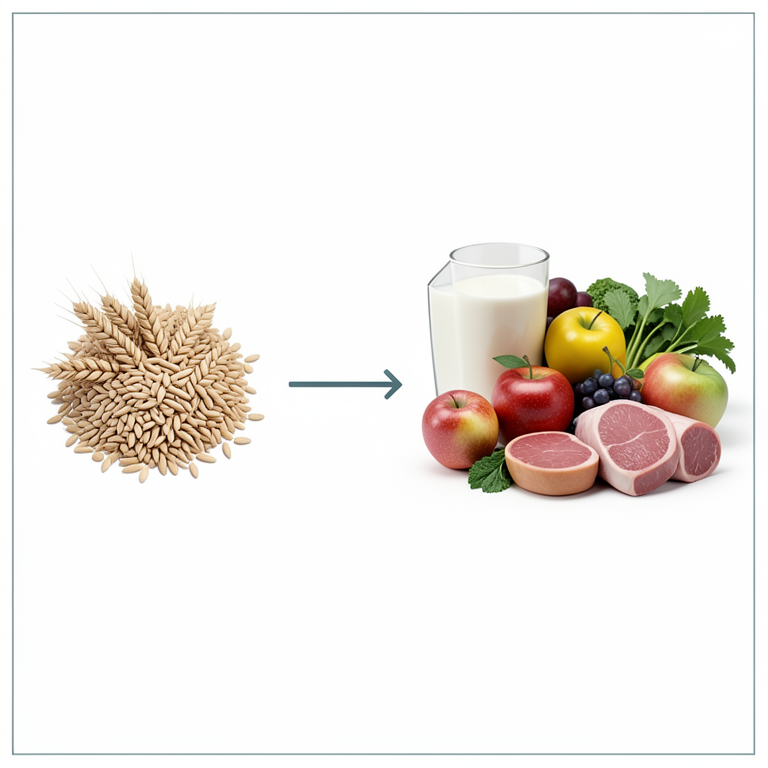
Shift in Agricultural Demand
AI-generated conceptual illustration (Indian agricultural crops and livestock). It explains the idea and does not show study data.
View source evidence ↗Introduction
India is a country about 1.21 billion people. About 68% of India's population lives in rural where the main occupation is agriculture. Indian agriculture is characterized by small farm holding. The average farm size is only 1.57 hectares (U.S. Library congess-2007). Around 93% of farmers have land holding smaller than four vector and they cultivate nearly 55% of the arable land. Development of agriculture is important for economy of any country because it is a primary sector of the economy which provides basic ingredients necessary for the existence of mankind. Agricultural transformation and its development are multidimensional in nature. It includes a variety of a states like agricultural land utilization, intensity of cropping crop productivity, crop concentration, crop diversification, crop combination, commercialization of agriculture nature of relationship and maintenance of ecological balance and so on (Singh Jasbir & Dhillon.S.S-2004) [2] .
Role of Agriculture
Agriculture plays an essential role in the process of economic development of less developed countries like India. Agricultural development is an integral part of overall economic development. In India agriculture is the main source of national income and occupation agriculture and allied activities have contributed nearly 50% to the India's national income. Around 60% of the total working population was engaged in agriculture and related activities (Agarwal.S.N-1973) [3] . Agricultural sector in India has moved from a traditional agriculture in the 1950 to the modern technological dynamic high capital intensive agriculture in which along with food and non food crops horticulture and other allied activities have also expanded. A study of the economic from were within which traditionally low productivity agriculture is transform into high productivity modern agriculture policy-formulation and planning for growth.
Role of Green Revolution for Transformation
The role of the green revolution in 1965-66 is very important in the transformation of Indian agriculture for this, the pioneer of green revolution Shri. Swaminathan's work on this is very remarkable. Green revolution, great increase in production of food grains especially wheat and rice that resulted in the large part from the introduction into developing countries of new, high yielding varieties beginning in the mid 20 th century (Hussian, Majid-2004) [4] . The green revolution in India was first introduced in Punjab in the late 1960 as part of a development program issued by international donor agencies and government of India.
Transformation in agriculture
India though the green Revolution process in the 1960 and followed by white yellow and blue Revolutions had witnessed Unprecedented grains in agricultural and food production registering record production, of nearly 290 million tons of food grains over 310 million tons of fruits and vegetables over 176 million tons of milk and 12 million tons of fish rendering India the second largest agrarian economy of the world (Hussian, Majid-2011) [5] . Importantly the rainbow Revolution had more than half the incidences of poverty and hunger in the country and transform the nation from the state of ship-to-mouth to the state of Right to food based on home grown food and the country became in exporter of several agricultural commodities valued at 33.87 billion USS during 2016 -17.
Other Supporting Components
India traditional strain in agriculture has increased manifold on account of the efforts of our farmers and improvements in technology. We need continue to improve and move from your food security to a focus on a mix of mixture of agricultural production as well as actual return that farmers get from their produce. The experience of the evolution of the agricultural sector over centuries tells us that which sector has evolved from being a basic food gathering activity to an intensive production system due to population growth increase in income organisation technological revolution and liberalization of international trade Change that occurs along with this transformation is that the demand of agricultural products both food and non-food also changes the food demand sheets from basic serial to high value products such as dairy products fruits and vegetables and meat and meat products and process products due to income growth urbanization and trade liberalization NABARD is mandated to faster the development of both agriculture and rural India his second main objective of the n c e r t paper for Weber NABARD is to examine whether the transformation of Indian agriculture in recent years also fundamentally changed the relationship between rural India and agriculture challenges before agriculture the Indian agriculture is controlled by the small and marginal farmers most of them do not have capacity to adopt high cost conventional farming so there is an urgent need alternative low cost farming system that increases productivity and other another view we can see there are increasingly pressure from climate change soil erosion and biodiversity loss and from consumers changing fast food and concerns about how it is produced increasing population and related food demand always remain the most important challenges for the developing world Indian agriculture is black by several problem and challenges some of them are natural and some others are manmade water scarcity soil erosion agricultural marketing seeds small and fragmented land holdings Conclusion for all the future prospect of Indian agriculture maybe we'll various factors contributed to the transformation of agriculture in India many changes have taken place in the field of agriculture in the last 70 years due to the research of new technologies so if the policy maker able to provide the proper incentive to farmers will meet the further demand as they had responded with in the past when government policies were supportive the sustainable agriculture practices are derived from the amalgamation of traditionally adopted health practices with modern development of agricultural 16
References
8 in the original paper- The green revolution in India US library of Congress is country studies retrieved 2007.
- Singh Jasbeer, Dhillon SS. Agriculture geography Tata McGraw hill publication New Delhi 2004.
- Agrawal SN. India's population problem Tata McGrawHill publishing New Delhi 1973.
- Hussain Majid. Systematic agriculture geography Rawat publication Jaipur and New Delhi 2004.
- Hussain Majid. India and world geography Tata McGraw hill publication New Delhi 2011.
- Hussain Majid. Human Geography Rawat publication New Delhi 1994.
- Sanyal Sanjeev. The In Credible history of India's geography penguin Publication New Delhi 2015.
- Singh Savindra. Physical geography pravalika publication Allahabad 1998.
Cited by 5
From OpenAlex, OpenCitations and reference lists read by Scinovex
- Organic farming in India: A brief review
Koyel Mukherjee, Abhishek Konar, Pranabesh Ghosh · International Journal of Research in Agronomy · 2022
Various food crops are produced in India, including cereals, pulses, and oilseeds. The biggest challenge in India since Independence has been supplying enough food for the growing population. Therefore, high-yielding varieties are cultivated with irrigation water, fertilizers, or pesticides. Government policy continues to encourage the growth of the agribusiness sector through substantial investment in infrastructure and food processing. Technological advancements and agri-infrastructure upgrading is still a concerning matter to achieve excellent status. With the time high use of chemical fert
- The revival of ancient grains: Millets ↗
Rahul Verma · International Journal of Political Science and Governance · 2023
UN has declared year 2023 as the international year of millet, India being the largest producer of millets has lots to gain by promoting millet as a main course of diet. Millets have proved their usefulness in dealing with malnutrition, management of diabetics, heart conditions and anemia; at the same time conserving water, sequestering carbon from atmosphere. Although millets were
- An analysis of DNA extraction and genetic improvement in plant
Gopika Mk, Sunil Chauhan · International Journal of Agriculture and Nutrition · 2024
Several wild species of Limonium are indigenous to the southern parts of Italy, demonstrating the genus's adaptability to the Mediterranean climate and habitat. As a result of its beauty and versatility, Limonium is cultivated all over the globe for use in floral arrangements, both wet and dry. The decorative market is driven in large part by the novelty and aesthetic value of new designs. The research used Limonium sinense var. Golden Diamond plants that had been regrown from tissue culture. The vegetation was once gathered from K.F. Bio-plants Pvt. Ltd. in Pune-411036, India. Seedlings were
- Crop diversification in Haryana ↗
Preety, Rakesh Sihmar · International Journal of Financial Management and Economics · 2023
Because most rural residents depend on agriculture directly or indirectly for their living, agriculture is essential for the growth of an economy. Following the green revolution in 1966-1967, crop specialization in India was increased, with a focus on rice and wheat in particular while horticulture has been practiced. Analysis of the trend, pattern, and extent of agricultural diversification is attempted
- Sustainable agricultural development in India: An overview
Anuj Kumar, Sonal Meena, Sunil Kumar, Riya Rana · International Journal of Agriculture Extension and Social Development · 2022
In the middle of the twentieth century, there was unprecedented growth in the agricultural sector around the world. Green Revolution technology-driven development has achieved the important goal of the total supply of agricultural food grains. This has ensured food security for the growing population. However, the next stage of agricultural development is facing a serious challenge in terms of sustainability. While the main problem faced by the developing countries in the south is related to the sustainability of resource use, the main challenge facing the developed economies in the north is t