
Research article · 2021 · Full text
International Journal of Agriculture Extension and Social DevelopmentImpact of climate change on agriculture
Volume 4(1) · Pages 118–119 · DOI: 10.33545/26180723.2021.v4.i1b.90 ↗
Research areasClimate Change and Environmental ImpactClimate change impacts on agriculture
Abstract
Author-writtenClimate change is a global problem that is having a huge impact on human society and other factors climate change and Agriculture are interrelated processes, both of which take place on a global scale, with the adverse effects of climate change affecting Agriculture both directly and indirectly. This is due to erratic rainfall, rising sea level, bad weather, adverse effects on Agricultural crops etc. DVE to climate change.
Summary
Source-checkedPlain-language reading of the full paper, prepared with AI and checked against the text. Each point links to the authors' own words.
Why it matters
- Climate change is a global issue that directly and indirectly impacts human society and agriculture, as the two processes are interrelated on a global scale. View evidence ↗
- Agriculture is highly dependent on climate because crop selection and farming methods are tailored to the specific regional characteristics of an ecosystem. View evidence ↗
- Climate change disrupts agricultural ecosystems by altering temperature, sunlight, and precipitation, which in turn affects hydrology, livestock, and arable land. View evidence ↗
The question
- The study aims to assess the impacts of climate change on the land productivity of major food and non-food grain crops in India. View evidence ↗
What they did
- The research focused on evaluating land productivity changes for primary grain crops (both food and non-food) within India. View evidence ↗
What they found
- In most cases, land productivity decreases as the annual average temperature increases. View evidence ↗
- Climatic fluctuations pose a threat to food security, particularly for households of small and marginal farmers. View evidence ↗
- Agriculture in Central and Southern India is considered more risky; while some reports suggested a non-significant positive impact until 2015, it is predicted that Indian agriculture will suffer most by 2018 if temperatures increase significantly. View evidence ↗
- Agriculture is not only affected by climate change but contributes to it through greenhouse gas emissions from livestock and rice production. View evidence ↗
- Agricultural processes are responsible for approximately 54% of methane emissions, 80% of nitrous oxide emissions, and nearly all carbon dioxide emissions related to land-use deforestation. View evidence ↗
- Livestock production utilizes up to 70% of all land used for agriculture or the earth's land surface. View evidence ↗
- Large-scale farming can lead to significant soil erosion, with 25% to 40% of soil reaching water sources and carrying pesticides and fertilizers. View evidence ↗
What it means
- The author concludes that climate change is a global crisis that requires a collective effort to stop human encroachment on nature. View evidence ↗
- The author states that climate change is already impacting agriculture, though these effects are unevenly distributed globally. View evidence ↗
Visual summary
1 visualsIllustrations explain the paper; they do not show study data.
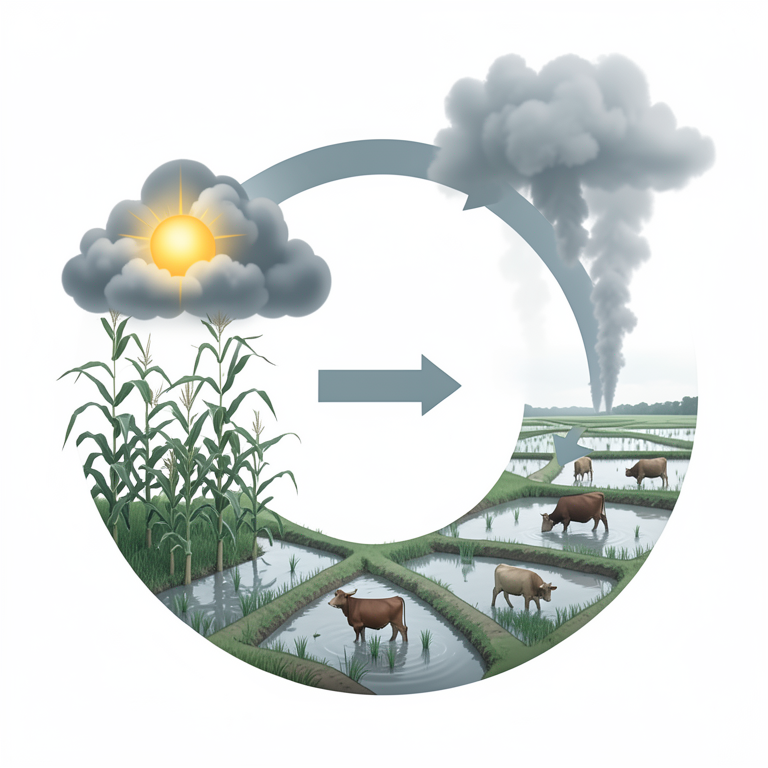
The Feedback Loop of Climate and Agriculture
AI-generated conceptual illustration (maize plants, cattle, and rice paddies). It explains the idea and does not show study data.
View source evidence ↗Introduction
Climate change refers to changes beyond the average atmospheric condition that are cause both by natural factors such as the orbit of Earth revolution volcanic activities and crystal moment and by artificial factors such as the increase in the concentration of greenhouse gases and aerosol climate change by global warming which refers to the average increase in global temperature has become a mega train that will lead to significant Global changes in the future Concerning its impacts the United Nation intergovernmental panel on climate change presented considerable scientific evidences in its fourth report on climate change any they have become clearly recognized worldwide agriculture production is carried out through the selection of crops suitable for the climate of a specific region and application of proper farming methods there for agriculture is a climate dependent biodiversity with notable regional characteristics regional characteristics refers to the ecosystem Characteristics determined by the climate of a region climate change disturb the agricultural ecosystem resulting in the changes in agricultural climate elements such as temperature precipitation and sunlight while further influencing are arable livestock and hydrology sectors
Scope of Climate Change
Climate change affect the agricultural ecosystem giving rise to lights and taste and causing population moment and change in Biodiversity in the livestock sector climate change brings about biological changes in the areas such as fertilization and breathing and also appeared the growing pattern pastures climate change affect the hydrology including underground water level water temperature river flow and water quality of place and marshes by impacting precipitation evaporation and soil moisture content as illustrated above climate change has a wide range of impacts on the rural economy including agricultural productivity reserve values of the farmhouse old and asset values and it also affect is IIT agricultural infrastructure through the change in water sources available for agriculture Impact on Indian agriculture major Impacts of Climate Change on Indian agriculture this study assessed the change impacts on land productivity for Major food and non food grain crops in India the major impacts is related to land productivity decreases with an increase in annual average temperature in most of the cross the adverse impact of Climate Change on agricultural production indicates food security threat to small and marginal farmers households and adversely affected due to climatic fluctuations results show that our eyes is temperature would reduce agricultural productivity and horses sensitivity of Indian agriculture to climate change According to reports from various organization it is understood that the agricultural impacts of Climate Change in India or uncertain the total average impact may be positive or negative depending on the climate impacts also very both quantitative and qualitative the by crop level of agronomic management region and season as to the seasonal impacts the rugby agricultural in Central and southern India will be more risky but more senior your show that climate change will have an overall positive impact on not significantly on India's agriculture until 2015 by the year 2018 main temperature increased very large the Indian agriculture will suffer the most Other causal effect other causal factors the agricultural sector is a driving force in the gas emissions and land use effects thought to cause climate change in addition to be a significant user of land and consumer of fossil fuel agriculture contributes directly to Greenhouse gas emission through practices such as Rice production and raising of livestock according to the intergovernmental panel on climate change the three main causes of the increase in greenhouse gases observed over the post past 250 years have been fossil fuels land use and Agriculture land use agriculture contributes to Greenhouse gas increases through land use in four main hue number 102 releases linked to deforestation second Methane religious from enteric fermentation in cattle 3rd Methane releases from rice www.extensionjournal.com cultivation 4 nitrous oxide releases from multilizer application together these agricultural processes comprise 54% of Methane emission roughly 80% of nitrous oxide emission and Virtually all carbon dioxide emission tied to land use deforestation also 88 regional carbon reuptake which can result in increased concentration of Co2 the dominant Greenhouse gas Fertilizer production the greenhouse gases carbon dioxide Methane and nitrous oxide are produced during the manufacture of Nitrogen fertilizers can be combined into an equivalent amount of carbon dioxide that figure for the United Kingdom is over to kilograms of carbon dioxide equivalent for each kilogram of Ammonium Nitrate livestock live stock and leaves stock related activities such as deforestation and increasingly feel in intensive farming practices are responsible for 18% of human made greenhouse gas initial worldwide livestock production up to 70% of all and used for agriculture or soil of the land surface of the earth the way life stock is great also decide the entirety of the land in the future not cultivating racing can lead to on healthy soil and its function of livestock farm appeared the habitats of local animals and had led to a drop in population of many local spaces from being displaced Soil erosion large scale farming can cause large amount of soil erosion causing between 25 and 40% of soil to reach water sources with carrying the pesticides and fertilizers used by farmers effect of soil erosion on the loss of your style that it has led to increased pollution and sedimentation in streams and rivers clogging the waterways and causing declines in fish and other species and degraded lands are also often less able to hold onto water which can worsen flood in soil erosion is a natural as any other type of erosion but human activities have greatly accelerated
Conclusion
Climate change is a major crisis facing the entire world this must be faced by altogether there is no alternative but to stop human encroachment on nature climate change is already affecting agriculture with effects unevenly e distributed across the world
References
0 in the original paperCited by 22
From OpenAlex, OpenCitations and reference lists read by Scinovex
- AI-Enabled decision support systems for agrometeorological forecasting and climate change mitigation
S. S. Chinchorkar · International Journal of Statistics and Applied Mathematics · 2025
Agriculture is challenged by climate change and can only be mitigated through in advanced forecasting and strategy. This research investigates AI enables decision support systems for agrometeorological forecasting and climate change mitigation. Four machine learning algorithms were then implemented to predict temperature, precipitation, and drought susceptibility: Random Forest, Long Short-Term Memory (LSTM), Support Vector Machines (SVM), Convolutional Neural Networks (CNN). With high predictive accuracy achieved, the models were trained using historical climate and agricultural data. The res
- Climate change and food security
Anjali Negi, Jasbir Kaur, Shikha Sharma, Kanwaljit Kaur · International Journal of Agriculture Extension and Social Development · 2024
Climate change is a serious threat to our planet. Rising temperatures, erratic rainfall and extreme weather conditions have created havoc for many nations. The rate of global warming is higher than it has ever been. Variations in temperature are altering weather patterns and upsetting the natural balance of the ecosystem. Such climatic changes have adverse effect on the food security as well. Thus the current study explores the effects of climate change on food security. The results are based on the perspectives of different researchers. The effects were studied under food availability, food a
- Geographic information systems (GIS) in veterinary science and sustainable resource management: A comprehensive review ↗
KR Chaudhary, YA Desai, GD Desai, SJ Jadav · South Asian Journal of Agricultural Sciences · 2026
❝ 0Found by Scinovex - The carbon footprint challenge: A holistic review of causes, impacts and global solutions
Mitali Mehta, Mohd. Hussnain, Ankush Moran, Suraj R. Hosur · International Journal of Research in Agronomy · 2026
This study provides a comprehensive review of the concept, causes, effects, and solutions to the carbon footprint, with a focus on its significance in the global climate change narrative. Originating from the concept of the ecological footprint, the carbon footprint quantifies the total greenhouse gas emissions, primarily CO2, attributed to human activities. The study highlights that major contributors to global emissions include energy production, agriculture, industry, and transportation, with the United States, China, the European Union, and India being the top emitters. The escalating carb
- Climate change and horticultural crop productivity: Impacts, adaptation, and mitigation strategies
Vicky Yadav, Kuchhadiya Deep S, Ashish Kumar, NK Meena, Chiranjit Mazumder, Arun Kumar · International Journal of Research in Agronomy · 2026
Climate change is emerging as one of the most pressing challenges of the 21st century, with significant implications for horticultural systems worldwide. Fruits, vegetables, ornamentals, spices, and plantation crops are particularly vulnerable to shifting climatic patterns, which can lead to altered phenology, reduced productivity, compromised quality, and heightened susceptibility to pests and diseases. Temperature extremes, erratic rainfall, elevated CO₂ levels, and increased frequency of extreme weather events disrupt normal growth cycles and physiological processes, threatening both yield
- Application of AI and machine learning in modern agronomy: A comprehensive review
Surekha Nistala, L Subha, Chanchal Bhargav, Nitish Kumar, Subhajit Pal, Pradeep Yadav · International Journal of Research in Agronomy · 2026
The integration of artificial intelligence (AI) and machine learning (ML) into agronomy is revolutionizing modern agriculture by enabling data-driven decision-making and automation. This in-depth study looks at how modern AI and machine learning technologies are used in farming. It covers everything from old expert systems to new deep learning models, drones and self-driving cars. We discuss about how AI has transformed farming throughout the years, including major studies and renowned people who have helped it expand. We also discuss about the primary technologies and data sources that have m
- Advancing urban horticulture through vertical farming: A global review of technologies and sustainability
Khushal Balram Muradi, V Siva Teja, Harshavardhan Mohan Totawar, Laxmi PS, Choudhari Balaji Keshavrao, Yogesh V Wayal · International Journal of Advanced Biochemistry Research · 2026
Rapid urbanization, climate variability, and declining arable land are placing increasing pressure on conventional horticulture, prompting the development of resource-efficient production systems. Through optimized space, water, and fertilizer utilization in controlled conditions, vertical agriculture has evolved as a game-changing strategy that permits high-density, year-round crop production. Recent developments in vertical farming, such as system architecture, soilless growing methods (hydroponics, aeroponics, and aquaponics), environmental control, artificial lighting, automation, and data
- Climate change and sericulture sustainability: Impacts on mulberry production, silkworm biology, disease dynamics and silk productivity
G Savitha, R Moulidharshan, R Nandha Kumar, S Susikaran, M Akash · International Journal of Agriculture and Food Science · 2026
Climate change has become a significant challenge to agricultural sustainability, especially in climate-sensitive industries like sericulture, where environmental stability is crucial for both silkworm (Bombyx mori L.) rearing and mulberry cultivation. Mulberry growth, silkworm physiology, disease incidence, cocoon productivity, and silk quality are all greatly impacted by variations in temperature, humidity, rainfall patterns, photoperiod and air quality. The current understanding of how climatic variability affects various parts of the sericulture value chain is summarised in this article. I
- From dormancy to germination: Establishing epigenetic memory and stress tolerance via innovative seed priming technologies
Pradeep Krishnamurthy, Sreehari V Santhosh, Neethu RS · International Journal of Advanced Biochemistry Research · 2026
Climate change and its associated anomalies, such as heat and water stress, pose significant risks to seed quality and agricultural productivity. Seed germination and dormancy are critical biological transitions regulated by a complex interplay of genetic, hormonal, and environmental factors to ensure survival in fluctuating environments. This paper explores how the hormonal balance between abscisic acid (ABA) and gibberellic acid (GA) influences the chromatin remodeling and histone modifications, thereby harnessing the key dormancy-related genes like DOG1. Moreover, the sensitivity of seed ge
- Assessment of the drought in the semi-arid marathwada region applying satellite data indices and google earth engine algorithms
Mahesh Huchhe, Narsingrao Bandela · International Journal of Research in Agronomy · 2026
Drought is regarded as a natural disaster in the semi-arid Marathwada region, arising from high temperatures and inadequate, irregular rainfall. The economy, society, environment, and people's means of subsistence are all directly impacted by these circumstances. The launch of the cloud-based geospatial analysis platform GEE has simplified the process of obtaining high-performance computing resources for the online processing of multi-temporal MODIS satellite data. An analysis of drought conditions, including their severity, can be done on this platform, along with their spatial and temporal d
- Integrated weed and biofertilizer management strategies for sustainable barley production
SK Moinuddin, Arafat Mondal, Argha Mandal, Hasim Kamal Mallick, Nilotpal Das · International Journal of Research in Agronomy · 2026
Barley is one of the most important cereals grown globally for food, feed, and industrial uses. Weed control and overuse of chemical fertilizers, however, have limited its productivity, impacting soil health, environmental quality, and the sustainability of the agricultural system. The practice of Integrated Weed and Biofertilizer Management has become a green and sustainable solution to boost the productivity of barley while reducing environmental hazards. This review emphasises the importance of implementing integrated weed management strategies, such as cultural, mechanical, biological, and
- Effect of biochar application on soil properties and maize productivity in tropical Santa Cruz ↗
Maria Elena Vargas, Carlos Quispe Mamani, Roberto Torrez · South Asian Journal of Agricultural Sciences · 2026
Biochar the solid carbonaceous product of biomass pyrolysis has attracted global research interest as a soil amendment with the potential to simultaneously improve soil physical and chemical properties, increase crop productivity, and sequester carbon for centuries. In Bolivia's Santa Cruz department, the combination of rapidly expanding soybean-maize cropping systems and the prevalence of highly weathered Oxisol-type soils with low pH,
- Projecting the economic impact of data-driven labor market intelligence on united states workforce competitiveness, economic resilience, and strategic decision-making ↗
Olivia Oluchi Ebepu · International Journal of Financial Management and Economics · 2026
This paper proposes a technical framework for estimating the economic benefits of a shift from descriptive to predictive Labor Market Intelligence (LMI). Existing workforce data systems, characterized by slow lag times and occupational classifications, are increasingly inadequate for understanding the fast-moving disruptions occurring as a result of Generative Artificial Intelligence (GenAI) and changes in the global economy. A multi-layered framework
- Technology as a tool for empowering women farmers in a climate-change scenario
G. Anand, P. Kalaiselvi, S. Paul Sebastian, M Senthil Kumar, G. Amuthaselvi, G Porkodi · International Journal of Research in Agronomy · 2025
The impact of climate change is reshaping agricultural practices worldwide, disproportionately affecting vulnerable communities, particularly women farmers in developing countries. Women, who constitute a substantial portion of the agricultural workforce, often face barriers such as limited access to resources, education, land ownership and decision-making power. However, technological innovations have the potential to empower women farmers, improving their resilience to climate change, enhancing productivity and promoting sustainability. This review paper explores the role of technology in ad
- Women on the frontlines: The impact of climate change on millet farming and gendered vulnerabilities ↗
Ritu Pradhan, Anupreet Kaur Sobti · International Journal of Home Science · 2025
Introduction and Aim: Millet farming, vital for sustainable agriculture and nutrition security, is particularly susceptible to the adverse impacts of climate change. In many agricultural communities, women play a crucial role in millet cultivation and household food provisioning, yet they often face unique vulnerabilities and challenges exacerbated by climate variability. This review aims to explore the intricate relationship between climate
- Combining ability for maize inbreds lines for yield and yield traits
PD Waghmare, D. V. Dahat, VL Amolic, GC Shinde, MR Patil, SD Shinde · International Journal of Advanced Biochemistry Research · 2025
Analysis of variance showed that mean squares were highly significant for traits such as number of kernel rows per ear, number of kernels per row, number of kernels per ear, 100 kernel weight (g), kernel weight per ear (g), kernel yield per plant (g). etc. High heritability coupled with high genetic advance was recorded for the traits plant height and ear height that depicts the existence of additive gene effects. The analysis of variance for combining ability revealed that mean squares were significant for almost all the characters. Variance due to sca was greater than gca variance for the tr
- Impact of climatic factors on Crop Production Index in India ↗
Gnyana Ranjan Bal, Aruna Sharma, S. C. Sharma · Asian Journal of Management and Commerce · 2025
Climate change is increasingly understood as a global challenge, and agriculture is one of the sectors most vulnerable to its impacts. Changes in temperature, degree of moisture and greenhouse gas emissions can affect soil fertility, moisture availability and yield. Many studies have referred to the urgency of addressing climate, as agriculture concerns issues of food security and farmers' livelihoods. Taking
- Climate change impacts on livelihood security in Rural India ↗
Priya Pradhan · International Journal of Political Science and Governance · 2025
Climate change poses a growing threat to livelihood security in rural India, where livelihoods are predominantly dependent on climate-sensitive sectors, including agriculture, livestock, and natural resources. Rising temperatures, erratic rainfall patterns, and the increasing frequency of extreme weather events have intensified economic uncertainty and social vulnerability among rural households. This study aims to examine the impacts of climate change on
- Examining the carbon emissions from dairy supply chains: An in-depth review
Rishabh Sahu, AK Tripathi, Namita Shukla, CK Paikra · International Journal of Advanced Biochemistry Research · 2024
The dairy sector stands as a noteworthy contributor to global greenhouse gas emissions. However, the intricacies of comprehending the carbon footprint within dairy product supply chains render the task complex and multifaceted. This review of research delves into the most recent findings derived from both national and international studies. It meticulously examines the role played by crucial stakeholders in the endeavour to mitigate carbon emissions across the entirety of the dairy supply chain. Through the narrative lens of ten principal characters, each embodying diverse perspectives and spe
- Heterosis for yield traits in maize (Zea mays L.)
PD Waghmare, D. V. Dahat, VL Amolic, GC Shinde, SR Dhonde, MR Patil · International Journal of Advanced Biochemistry Research · 2024
In this study, a set of eight parents, fifty-six F1s (direct and reciprocals), and two standard checks were evaluated during the rabi season of 2019 with two replications in a randomized block design at the research farm of All India Coordinated Research Project on maize, Rahuri center, Mahatma Phule Krishi Vidyapeeth, Rahuri, Dist. Ahmednagar. The cross combination DS-NP/R-8-42 x 52099 exhibited high per se performance and highly significant standard heterosis for almost all the studied characters. Similarly, the combinations 52099 x IC-331144, DS-NP/R-8-42 x IC-331144, and 52099 x DML-1112 s