
Research article · 2020 · Full text
International Journal of Agriculture and Food ScienceExtent of remittances to households in villages around onigambari forest reserve of Oyo state, Nigeria
Volume 2(2) · Pages 08–10 · DOI: 10.33545/2664844x.2020.v2.i2a.35 ↗
Research areasUrban and Rural Development ChallengesMigration and Labor Dynamics
Abstract
Author-writtenThe study examined the extent of remittances to households in villages around Onigambari Forest Reserve of Oyo State. Multi-stage sampling techniques were used to select 96 respondents and data were collected with the aids of interview schedule. The data were analysis through descriptive analysis. The distribution shows that majority of the respondents were male (75.5%), above 50 years of age (55.3%), married (66%) and 79.8% engaged in farming activities. It was revealed that most (67.0%) of the respondents often received remittances once in a year. The level of receiving revealed at the end of the study that extent of remittance was low. The study concluded that remittances in this study area is not a well-recognized phenomenon in spite of the recognized advantages of a well-articulated remittance management in Nigeria. It is therefore recommended that the rural household dwellers should develop a vast communication strategy with their immigrant’s children, friends and relatives to ensure adequacy and frequency allocation of remittances.
Summary
Source-checkedPlain-language reading of the full paper, prepared with AI and checked against the text. Each point links to the authors' own words.
Why it matters
- In developing countries such as Nigeria, remittances serve as a critical source of capital that contributes to the economic development of rural households. View evidence ↗
- Remittances are used to improve food security, general well-being, and the sustainability of natural resources within rural communities. View evidence ↗
- Despite the growth of internal and international remittances, there is a lack of appropriate data to determine their actual impact on rural livelihoods. View evidence ↗
The question
- The study aims to investigate the extent of remittances received by households in villages surrounding the Onigambari Forest Reserve in Oyo State, Nigeria. View evidence ↗
What they did
- The research was conducted in villages located around the Onigambari Forest Reserve in the Oluyole Local Government Area of Oyo State. View evidence ↗
- A total of 96 respondents were selected using multi-stage sampling techniques, and data were gathered via interview schedules. View evidence ↗
- The collected data were analyzed using descriptive analysis methods. View evidence ↗
What they found
- The majority of the study respondents were male (75.5%), while 24.5% were female. View evidence ↗
- Over half of the respondents (55.3%) were above 50 years of age, with 39.4% aged 41-50 and 5.3% aged 31-40. View evidence ↗
- Farming was the primary occupation for the majority of the respondents (79.8%). View evidence ↗
- Most respondents (67.0%) receive remittances once per year, while 33.0% receive them occasionally once a year. View evidence ↗
- No respondents reported receiving remittances on a daily, weekly, or multi-monthly basis. View evidence ↗
- The overall extent of remittances to the study area was found to be low for 75.5% of the respondents. View evidence ↗
What it means
- The authors conclude that remittances are not a well-recognized phenomenon in the study area, despite the known benefits of structured remittance management for rural growth. View evidence ↗
Visual summary
2 visualsIllustrations explain the paper; charts are replotted from the paper's own table values.
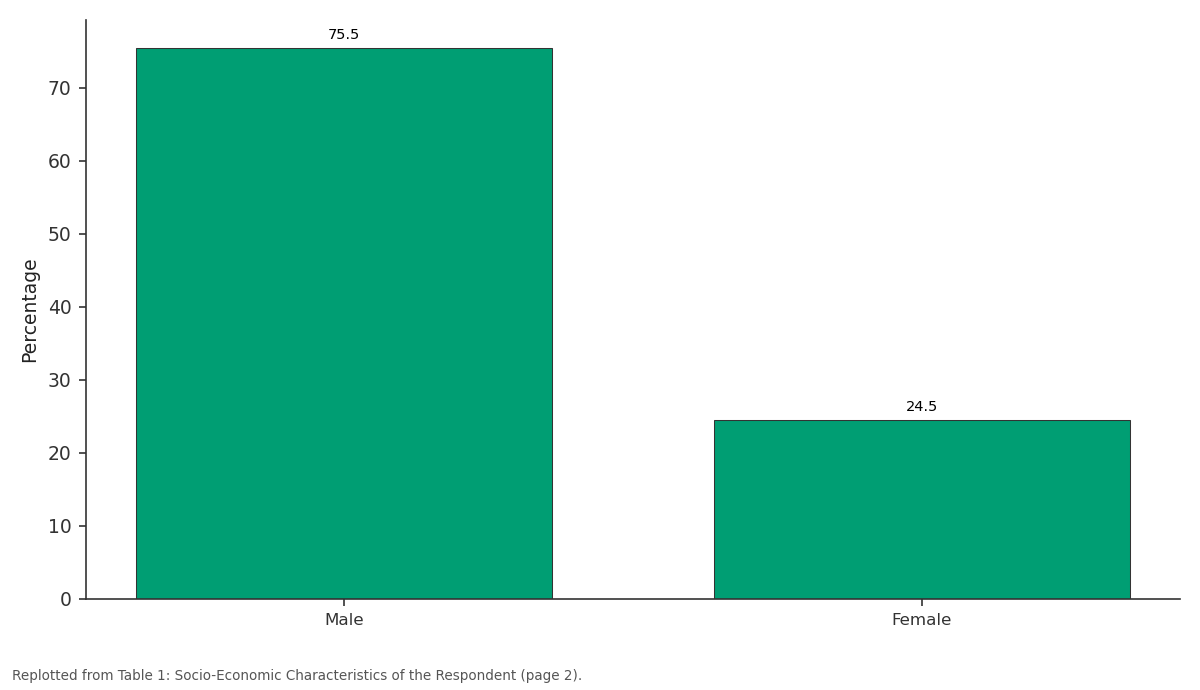
Percentage: Male vs Female
Replotted from Table 1 (page 2) of the original paper. Every bar is the paper's own table value.
View source evidence ↗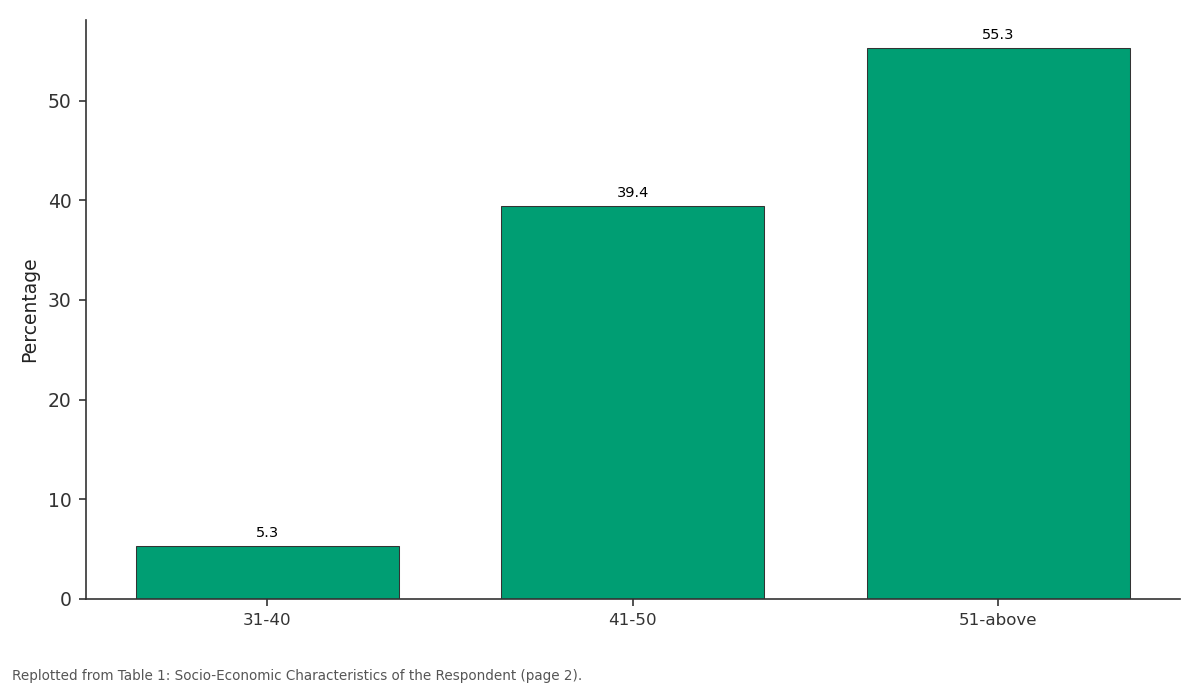
Percentage: 31-40 vs 41-50 vs 51-above
Replotted from Table 1 (page 2) of the original paper. Every bar is the paper's own table value.
View source evidence ↗Figures & tables
From the original paper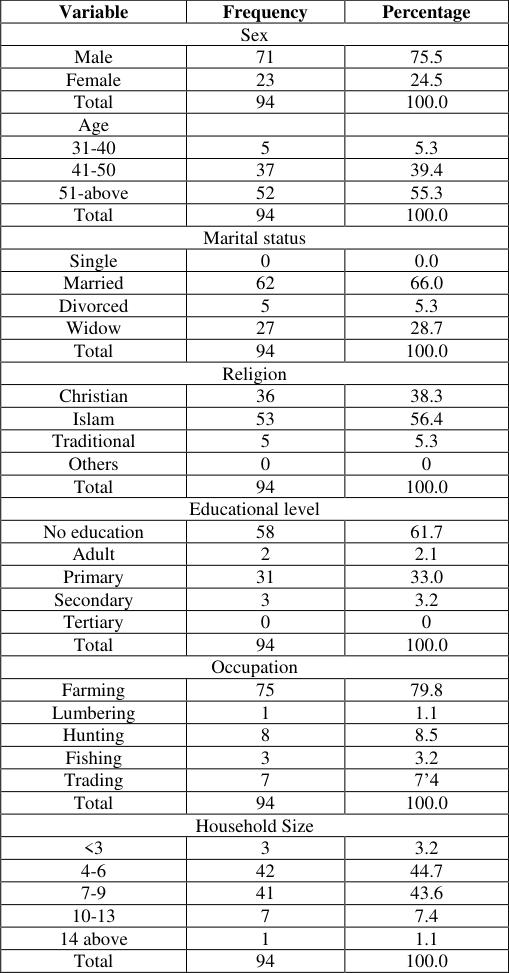 Table 1
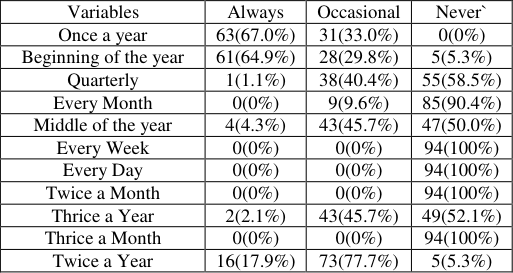 Table 2
 Table 3
Introduction
Remittances have been identified as an important source of capital for people in developing countries like Nigeria due to its contribution to economic development of rural households dwellers. According to Poprzenovic (2007) [6] , remittances are defined as income in terms of money and goods that are sent by migrants or relatives, families and friends to their respective home towns. It is the current transfers in cash or kindsent or brought from non-residents to residential households. Therefore Peoples livelihood outcome depend on this magnificent source to improve their food security, general wellbeing and sustainability of natural resources in their community. Remittances received increases consumption or investment in capital of household resulting into higher return of household economy (Adger et al, 2002) [1] . Remittances flow has a direct effect on the distribution of income and assets accumulation with an indirect effect on resource users and therefore reducing poverty in the rural areas. Poverty is a state at which people realize themselves as a non-human being due to lack of well-being (Kamaga et al, 2009). The level of consumption, expenditure, income and assessing of assets can be a measure of poverty. A majority of poor people in the world live in the rural areas and an important source of income accessible for poor people are remittances. It would therefore be great to determine how remittances have affected household livelihood outcome. Remittances flow has a direct effect on the distribution of income and assets accumulation with an indirect effect on resource users. There is immense consensus that remittances can help poverty alleviation among rural households. However, the wealthier households May have no income sources from remittances. There is no doubt that larger percentage of poor people in the world especially developing countries lives in the rural areas. People in this environment migrate to the urban areas to secure better future for themselves and their households. The effect of their movement to areas where they could generate more resources sometimes contributes to livelihood of their family back home in form of remittances. The rural-urban migrants send remittances to their relatives in the rural areas and these remittance-receiving households use the remittances for various purposes. However, despite the ever increasing size of remittance, both internal and international, the extent of remittances still remain unclear as a result of inappropriate data to determine the outcomes on their livelihood. Therefore the study attempt to provide insight to the extent of remittances to households in villages around Onigambari Forest Reserve of Oyo State
Methodology
The study was conducted in villages around Onigambari Forest Reserve located in Oluyole Local Government Area (LGA) of Oyo state. Onigambari is one of the early forest reserves in the state and it is divided into 5 series namely Onigambari, Busogboro, Onipe, Olonde and Mamu. Onigambari forest reserve is a lowland forest. The reserve is located between latitude 70⁰ 25 1 N and longtitude 30⁰ 50 1 E. It is situated at the southern part of Ibadan bounded on the west by River Ona and on the east by the main road of Ibadan to Ijebu-ode. Multi stage sampling method was used and total of 96 respondents were selected for the study. The socio-economic characteristic of the respondents examined includes sex, age, marital status, religion, education level, occupation, household size. The distribution shows that majority of the respondents (75.5%) were male while 24.5% were female. This implies that there are more male household heads in the study area. This is in line with work of Ayad et al (1997) [2] who reported that most household heads are usually male as males are known to be the head of the family except on cases where the male is dead leaving the household head position for the wife. Also, the table shows that 5.3% of the respondents were between the age range of 31-40, 39.4% were between 41-50 years while 55.3% were above 50 years of age. This indicates that larger percentage of the respondents were above 50years. This implies that the respondents which are household heads are old enough to state their experience on whether they receive remittances or not. Furthermore, it was observed from the result that none of the respondent is single, 66.0% were married, 5.3% were divorced and 28.7% were widow. This result implies that no household heads is expected to remain single except if he/she is divorced or has lost his wife or lost her husband. This could attribute to African culture which regarded marital status as a social symbol which attracts prestige. Furthermore it is suggested that higher percentage of married people is an indication of more responsible adults in the society. Table 1 above also revealed that 56.4% of the respondents practice Islam while 38.3% of the respondents practice Christianity. It was observed that only 5.3% practice the traditional religion. Although Islam is greater in percentage, there is no prejudice or discrimination towards the choice of religion among respondents in the study area. In term of education, it was revealed from the table that 61.7% of the respondent in the study area have no formal education, 2.1% had adult education, and 33.0% had primary education while 3.2% were able to acquire secondary education. This can be attributed to the fact that the study area is a rural settlement and minimal range of educational level is expected in the study area. In addition, it was pointed out from the table that majority of the respondents (79.8%) engaged in farming as major occupation, 1.1% engaged in lumbering, 8.5% were into hunting while 3.2% engaged in fishing and 7.4% engaged in trading. This result implies that most of the household heads engage in farming as their major source of livelihood. Majority of the respondents being farmers is in consonance with the assertion of Yusuf and Falusi (2000) [7] who reported agriculture has the main occupation of 75% of people in most developing nations. Similarly, Neven et al (2009) [4] noted that agriculture as a sector is dominated by small holdings farming families, with most of them residing in rural areas. It was emerged from the table above that 3.2% of the respondent had <3 persons in their house while 44.7% of the respondents had between 4-6 household members, 43.6% between 7-9 persons while 7.4% and 1.1% had household members ranges from 10-13 and > 13 respectively. This implies that the families of people in the study area tend to migrate out for greener pastures which in turn resulted into more remittances for the community. 2 above shows that majority of the respondents 67.0% receives remittances once in a year, 33.0% receives it occasionally once in a year. Also, 64.9% receives remittances always at the beginning of the year while 29.8% receives it occasionally at the beginning of the year while 5.3% does not receive it at all during the beginning of the year. Only 1.1% of the respondents frequently receive remittances quarterly while 40.4% receives it occasionally at every quarter of the year and 58.5% does not receive remittances quarterly at all. None of the respondents frequently receives remittances every month but 9.6 occasionally receive remittances every month and 90.4% does not receive remittances every month. Furthermore, at every middle of the year, 4.3% of the respondent receives remittances frequently while 45.7% occasionally receives remittances at the middle of the year and 50.7% does not receive any remittances at the middle of the year. The result further shows that none of the respondents receive remittances every day, every week, twice in a month or three times in a month. Thrice in a year, 2.1% receives remittances frequently while 45.7% occasionally receives remittances three times in a year and 52.1% does not receive remittances three times a year. Lastly, 17.9% of the respondents frequently receive remittances twice in a year while 77.7% occasionally receives remittances two times in a year and 5.3% does not receive remittances two times in a year The result therefore shows that larger percentage of the respondents only receives remittances once in year or only at the beginning of the year at 67.0% and 64.9% respectively. Meanwhile, larger percentage of the respondents rarely or does not receive remittances at other periods or amount of times of the year. This indicates that despite the ever increasing size of remittance, both internal and international, remittances have not been appropriately discharged to the rural dwellers and this is in support of Nightingale (2003) [5] who observed that in spite of the recognized advantages of a well-articulated remittance management regime to aid growth and development of rural settlements, Nigeria does not see remittance allocation as a major priority. The effects of remittances on livelihood outcome of households in rural areas still remain uncertain. Conclusively, Table 3 shows that there has been little or minimal extent of remittance back to the study area. This implies that there is no adequate fund coming back to the study area as at when due.
| Level | Frequency | Percentages |
|---|---|---|
| low | 71 | 75.5 |
| high | 23 | 24.5 |
Table text extracted from the original PDF; superscript letters are shown inline. The original table image is below.
View original table image
| Variable | Frequency | Percentage |
|---|---|---|
| Sex | ||
| Male | 71 | 75.5 |
| Female | 23 | 24.5 |
| Total | 94 | 100.0 |
| Age | ||
| 31-40 | 5 | 5.3 |
| 41-50 | 37 | 39.4 |
| 51-above | 52 | 55.3 |
| Total | 94 | 100.0 |
| Marital status | ||
| Single | 0 | 0.0 |
| Married | 62 | 66.0 |
| Divorced | 5 | 5.3 |
| Widow | 27 | 28.7 |
| Total | 94 | 100.0 |
| Religion | ||
| Christian | 36 | 38.3 |
| Islam | 53 | 56.4 |
| Traditional | 5 | 5.3 |
| Others | 0 | 0 |
| Total | 94 | 100.0 |
| Educational level | ||
| No education | 58 | 61.7 |
| Adult | 2 | 2.1 |
| Primary | 31 | 33.0 |
| Secondary | 3 | 3.2 |
| Tertiary | 0 | 0 |
| Total | 94 | 100.0 |
| Occupation | ||
| Farming | 75 | 79.8 |
| Lumbering | 1 | 1.1 |
| Hunting | 8 | 8.5 |
| Fishing | 3 | 3.2 |
| Trading | 7 | 7’4 |
| Total | 94 | 100.0 |
| Household Size | ||
| <3 | 3 | 3.2 |
| 4-6 | 42 | 44.7 |
| 7-9 | 41 | 43.6 |
| 10-13 | 7 | 7.4 |
| 14 above | 1 | 1.1 |
| Total | 94 | 100.0 |
Table text extracted from the original PDF; superscript letters are shown inline. The original table image is below.
View original table image
Result and Discussion
Result and Discussion
Recommendation and Conclusion
From the result gotten from this research work, it shows that majority of the respondents were male and are slightly above middle age bracket, few had formal education while many does not and the major occupation of the respondent is farming. Its therefore concluded that larger percentage of the respondents only receives remittances once in a year mostly at the beginning of the year as shown by the result which affirms to the fact that remittances in the study area. Remittances in this study area is not a well-recognized phenomenon in spite of the recognized advantages of a well-articulated remittance management regime to aid growth and development, Nigeria does not put remittance of migrants into their best use and migrant individuals has also failed in adequately sending home their remittances.
The following are the recommendations made base on the findings of this study. The rural household dwellers should develop a vast communication strategy with their immigrant's children, friends and relatives to ensure adequacy and frequency allocation of remittances.
The community should derive a strategy to attract remittances to the community for community developmental projects which will result into improvement in their livelihood outcomes.
Figures and tables from the paper
| Variables | Always | Occasional | Never` |
|---|---|---|---|
| Once a year | 63(67.0%) | 31(33.0%) | 0(0%) |
| Beginning of the year | 61(64.9%) | 28(29.8%) | 5(5.3%) |
| Quarterly | 1(1.1%) | 38(40.4%) | 55(58.5%) |
| Every Month | 0(0%) | 9(9.6%) | 85(90.4%) |
| Middle of the year | 4(4.3%) | 43(45.7%) | 47(50.0%) |
| Every Week | 0(0%) | 0(0%) | 94(100%) |
| Every Day | 0(0%) | 0(0%) | 94(100%) |
| Twice a Month | 0(0%) | 0(0%) | 94(100%) |
| Thrice a Year | 2(2.1%) | 43(45.7%) | 49(52.1%) |
| Thrice a Month | 0(0%) | 0(0%) | 94(100%) |
| Twice a Year | 16(17.9%) | 73(77.7%) | 5(5.3%) |
Table text extracted from the original PDF; superscript letters are shown inline. The original table image is below.
View original table image
References
7 in the original paper- Adger WN, Kelly PM, Winkels A, Huy LQ, Locke C. Migration, remittances, livelihood trajectories, and social resilience.AMBIO: A Journal of the Human Environment. 2002; 31(4):358-366.
- Ayad Mohamed, Bernard Barrere, James Otto. "Demographic and socioeconomic characteristics of households". DHS Comparative Studies. Calverton, Maryland: Macro International Inc, 1997, (26).
- Kamanga P, Vedeld P, Sjaastad E.Forest incomes and rurallivelihoods in Chiradzulu District, Malawi.Ecological Economics. 2009, 68(3):613-624.
- Neven D, Odera MM, Reardon T, Wang H. Kenyan supermarkets, emerging middle-class horticultural farmers, and employment impacts on the rural poor. World Development. 2009; 37(11):1802-1811.
- Nightingale F. "Nigeria: an assessment of the International labor Migration Situation, the case of Female Labor Migrants". Gender Promotion Programme Working Paper. International Labour Office, Geneva, 2003, (7).
- Poprzenovic, A. Remittances and Income Inequality in Croatia. Department of Economics, School of Economics and Management. Lund University, 2007
- Yusuf SA, Falusi AO. Trend Analysis of the Performance of Agriculture in Nigeria (1970-1998). Nig Agric. Dev. Stud, 2000, 1-2.
Cited by 7
From OpenAlex, OpenCitations and reference lists read by Scinovex
- Household domestic water consumption patterns in a rural semi-arid village: A case study of Kumbha village in Hisar district, Haryana
Krishna Devi, Mehtab Singh, Parveen Kumar, Yogender Kumar · International Journal of Geography Geology and Environment · 2022
The need for water in India is increasing as a result of development, both in urban and rural areas. This could exacerbate tensions and conflicts over the distribution of water sources. Understanding the specifics of actual water use on a household level is critical for water demand management. As a result, based on questionnaires and interview surveys of 105 households consisting 10 per cent of total households, this paper investigates the pattern of domestic water consumption in semi-arid Kumbha village of Hisar district in Haryana state of India, in order to better understand how local comm
- A mini-review of pharmacological and economical values of Funtumia africana ↗
Precious Ezougha Oyaseiye, Bamidele Martin Amos Tautua, Sandile P. Songca · Journal of Pharmacognosy and Phytochemistry · 2022
Funtumia africana belongs to the family Apocynaceae. It is a fast growing tree found in green forests and forest reserves in West Africa. The plant has a long history of use in traditional medicine to treat and manage various diseases such as diabetes, cancer, burns, amoebic dysentery, urinary incontinence, bacterial infections and malaria. It is used economically for the production
- Market development for non-timber forest products ↗
Rina Malazogu, Maria Bottari · International Journal of Research in Marketing Management and Sales · 2022
This study explores the market development for non-timber forest products (NTFPs), emphasizing the economic viability, environmental sustainability, and socio-cultural significance of NTFPs. By examining various case studies and employing a mixed-methods approach, this research identifies key challenges and opportunities in the NTFP market, offering strategic recommendations for stakeholders.
❝ 1PDF - Vulnerability and morphometric characteristics of hunting game species in the Lama Forest Reserve (Southern Benin republic) ↗
Sedjro Gilles Armel Nago, Daniel Sika Chabi-Boni, Johannes Alikpanou, Rodéric Roland Singbénou Sagbo, Sabirou Moussa Touré, Armand K. Natta et al. · Journal of Entomology and Zoology Studies · 2021
Protected areas play an important role in the sustainable conservation of biodiversity. In southern Benin Republic, the Lama Forest Reserve is a refuge for wildlife. It also generates significant incomes for the local population. However, anthropogenic activities together with uncontrolled hunting are increasingly threatening the sustainability of these resources. The study aims at investigating the hunting activities characteristics and the
- Population movement, financial transfers, and alterations in forested coverage within rural regions ↗
Eden Animut, Agegnehu Dejene · International Journal of Advanced Academic Studies · 2024
This paper examines the multifaceted relationship between population dynamics, financial transfers (including remittances), and changes in forest cover in rural areas. By integrating demographic theories, economic models, and environmental data, we aim to shed light on how human migration and economic activities contribute to environmental changes, specifically deforestation or reforestation, in rural landscapes.
❝ 0PDF - Forest restoration and reforestation initiatives ↗
Roberto Prati, Andrea Pomero · International Journal of Humanities and Education Research · 2022
Forest restoration and reforestation initiatives have gained significant attention worldwide as essential strategies for combating deforestation, biodiversity loss, and climate change. This paper provides a comprehensive review of various restoration and reforestation approaches, their ecological and socio-economic impacts, and the challenges and opportunities associated with their implementation. Drawing on a wide range of scholarly sources and case studies, we examine
- Community development, remittances, and social networking in forested regions ↗
Dina Ronald, James Stewart · International Journal of Sociology and Humanities · 2022
This paper explores the interplay between community development, remittances, and social networking in forested regions. Drawing upon case studies and empirical evidence, it examines how remittance flows from migrants working in urban areas contribute to local development initiatives, social capital formation, and resilience in forest-dependent communities. By analysing the dynamics of social networks within these communities, the paper aims to