
Research article · 2021 · Full text
International Journal of Veterinary Sciences and Animal HusbandrySuccessful clinical management of contagious ecthyma (Orf) in goat: A case report
Volume 6(1) · Pages 40–42 · DOI: 10.22271/veterinary.2021.v6.i1a.324 ↗
Research areasPoxvirus research and outbreaksHerpesvirus Infections and TreatmentsVirus-based gene therapy research
Abstract
Author-writtenClinical management of orf in animals is a challenging task due to as there is no specific treatment for this viral infection. Orf disease caused by a double-standard (ds) DNA virus belongs to poxviridae family. A female black goat of 1.5 years presented with the history of lameness and proliferative skin lesions around oral cavity. On clinical examination characteristics lesions and physical examination findings pointed towards contagious ecthyma. Animal was treated with Ceftriaxone (15mg/kg, IM, BID, Intacef®) for five days, meloxicam (0.5mg/kg IM, Melonex®) for 3 days. The owner was guided to a regular application of boric acid mixed with desi curd on skin lesions and honey for oral mucosal wounds, twice a day. Good personal hygiene (both veterinarian and owner) was maintained in order to avoid zoonotic transmission. Animal shown drastic improvement in the clinical condition with complete recovery from oral lesions after 30 days of treatment.
Summary
Source-checkedPlain-language reading of the full paper, prepared with AI and checked against the text. Each point links to the authors' own words.
Why it matters
- Orf is a disease caused by a double-stranded DNA virus from the Poxviridae family. View evidence ↗
- This global non-systemic eruptive skin disease affects wild and domestic artiodactyls, with goats being more frequently affected than sheep. View evidence ↗
- The disease represents a serious health threat to the small ruminant industry and carries significant economic consequences. View evidence ↗
The question
- The study addresses the challenge of managing Orf in animals because there is no specific treatment available for the viral infection. View evidence ↗
What they did
- The case involved a 1.5-year-old female black goat presenting with lameness and proliferative skin lesions around the oral cavity. View evidence ↗
- Medical treatment consisted of Ceftriaxone (15mg/kg, IM, BID) for five days and meloxicam (0.5mg/kg IM) for three days. View evidence ↗
- Topical care included applying a mixture of boric acid and Desi curd to skin lesions and honey to oral mucosal wounds twice daily. View evidence ↗
- Strict personal hygiene was maintained by the veterinarian and owner to prevent the virus from transmitting to humans. View evidence ↗
What they found
- The goat showed significant clinical improvement and achieved complete recovery from oral lesions 30 days after treatment began. View evidence ↗
- Initial clinical examination revealed a fever of 104.3°F, although pulse and respiratory rates remained within normal ranges. View evidence ↗
- The animal was found to be dehydrated with dry skin lesions that emitted an offensive odor. View evidence ↗
What it means
- The authors conclude that while Orf is self-limiting, symptomatic treatment and the use of systemic and local antibiotics are essential to manage common secondary bacterial infections. View evidence ↗
- The authors state that vaccination is an effective method for controlling Orf disease. View evidence ↗
Visual summary
1 visualsIllustrations explain the paper; they do not show study data.
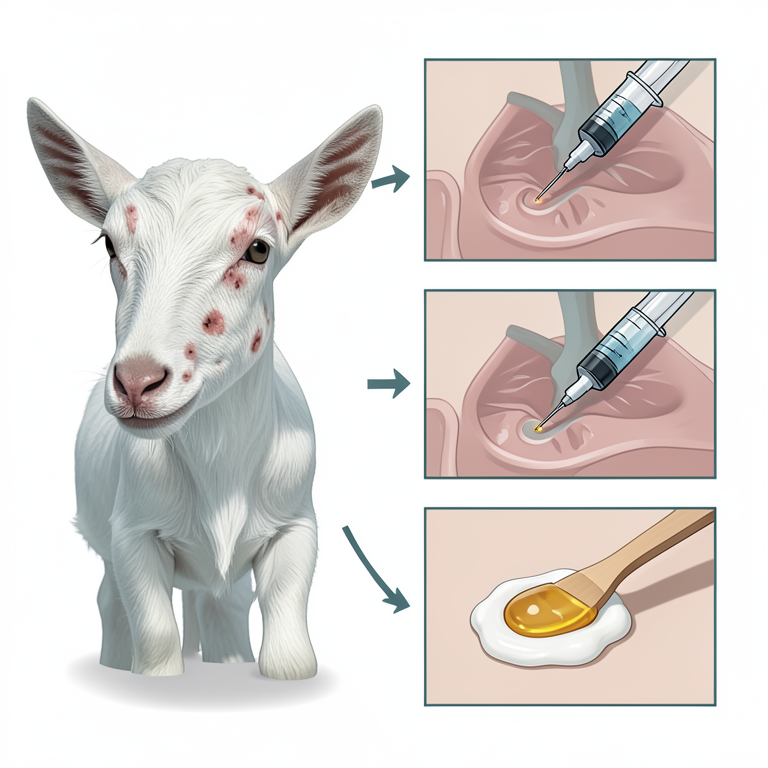
Multimodal Treatment Approach
AI-generated conceptual illustration (goat kids). It explains the idea and does not show study data.
View source evidence ↗Figures & tables
From the original paper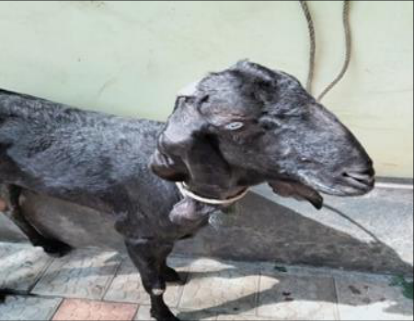 Figure 2
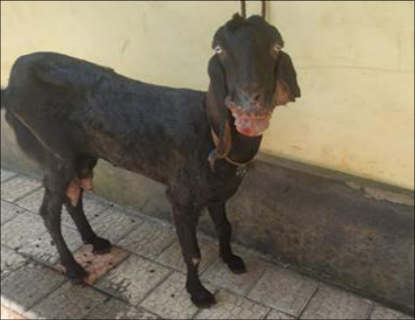 Figure 1
Introduction
Contagious ecthyma, also called contagious pustular dermatitis, orf, ecthyma contagiosum, and scabby mouth or sore mouth (CDC 2015) [3] . A disease caused by a double-standard (ds) DNA virus belongs to Poxviridae family. It is a non-systemic eruptive skin disease and distributed globally, affects wild and domesticated artiodactyls, frequently causes disease in small ruminants like sheep and goats (Haig et al. 2006) [4] . Goats are more affected than sheep. Contagious ecthyma can be transmitted to humans through direct/indirect contact with infected animals (Groves et al. 1991) [6] . Dog can contact infection from consumption of orfcontaminated meat. Typical clinical signs include proliferative skin and mucous membrane of the oral cavity, tongue, lips and ears are developed sequentially in the form of papules, vesicles, pustules, scabs which are important for the diagnostic point of view (Jaiswal et al. 2019) [9] . The disease also results in genital, udder and foot lesions in the lambs. During outbreak morbidity can be as high as 100%, whereas mortality is less than 1%. More common in late summer, fall and winter on pasture and in feedlots (Nandi et al. 2011) [11] due to resistance of the virus and it can live in a dry environment for a longer period (Radostits et al. 2007) [12] . Orf has become a potentially serious health threat for the small ruminants industry with an important economic impact.
Case history and clinical observations
A female black goat of 1.5 years presented to the veterinary hospital with the history of in appetence, dull, nasal exudates, lameness and proliferative skin lesions around the oral cavity (lips, oral commissure), nostril and muzzle region (Figure . 1). On clinical examination, it observed that the animal was dehydrated, skin lesions were dry and had an offensive odour. The pulse rate and respiratory rate are within the normal physiological range, whereas fever off 104.3 0 F was noticed. The owner stated that he and neighbor lost 1 animal (Goat) each 45 days back respectively. Characteristic lesions and physical examination findings pointed towards contagious ecthyma.
Treatment
As there is no specific treatment for this viral infection, in this case, the goat was treated with Ceftriaxone (15mg/kg, IM, BID, Intacef ® ) for five days, meloxicam (0.5mg/kg IM, Melonex®) for 3 days. The owner was guided to a regular application of boric acid mixed with Desi curd on skin lesions and honey for oral mucosal wounds, twice a day. Good personal hygiene (both veterinarian and owner) was maintained throughout the treatment period in order to avoid zoonotic transmission of the disease. This intervention had shown drastic improvement in the clinical condition with complete recovery from oral lesions after 30 days of treatment (Figure . 2). [8] . Risk factors for orf virus infection include age, congestion due to increased stocking density, orphaned lambs and stress (Abdullah et al. 2015) [1] . The disease is usually transmitted through contact from infected to susceptible animals. The incubation period varies from 4 to 8 days with an initial rise in temperature. Even though infection is confined to the skin (epidermal cell layer) of the oral cavity, eyelids, teats and coronary band of affected animals with a combination of secondary bacterial infections (Gelberg et al. 2012) [5] , however, lesions may extend to the squamous epithelium of the digestive tract, causing ulcerative gastroenteritis (Zachary et al. 2012) [5,7,13] . And these symptoms mimic the vesicular diseases (foot and mouth diseases and bluetongue) of clovenfooted animals. Nandi et al. (2011) [11] also reported that in combination with skin lesions goats showed pneumonia, arthritis and lymphadenopathy in ORFV infection. The ecthyma contagious can be diagnosed on the basis of characteristic lesions on the predilection site (skin). It should be differentiated from the foot and mouth disease (FMD), staphylococcal dermatitis, dermophilosis and ulcerative dermatosis sheep pox and goat pox (Watson, 2004: Nandi et al. 2011) [11,14] . The commonly employed laboratory test for diagnosis is the serological test like enzyme-linked immunosorbent assays (ELISAs), complement fixation test (CFT), histopathology of affected tissues, cell culture isolation and polymerase chain reaction (PCR).
Zoonosis most commonly occurs during lambing, shearing, drenching, handling during treatment, or slaughtering of the affected animal. Infection in humans is self-limiting, heal spontaneously. Personal hygiene should be followed during handling of affected animals in order to avoid transmission zoonotically and to the healthy flock. Contagious ecthyma can cause massive economic losses in the flock. Although orf is a self-limited disease, symptomatic treatment with dressings and local antiseptics are very helpful.
The secondary bacterial infection is common in orf infection, so systemic and local antibiotics must be included in the treatment protocol. The aim of treatment was reducing the severity of the lesions and speed recovery as removal of the scab may delay healing (Radostits et al. 2007) [12] . Both synthetic and traditional herbal therapies help in treating the infection (Nandi et al. 2011) [11] . Orf disease can be effectively controlled by vaccination. An autologous vaccine can be used by triturating the scab material in saline followed by the addition of antibiotics (Bath et al. 2005) [2] . Although various types of vaccines are available against the orf disease. Particularly live attenuated vaccines are used because of its efficacy. Although, vaccination is the efficient and cost-effective method of preventing the infection. Sanitary measures and disinfection practices like isolation of infected animals, quarantine of new animals, regular disinfection of fomites should be done along with the vaccination. It is difficult to eradicate once the orf outbreak occurred in flock or herd.
Figures and tables from the paper
References
14 in the original paper- Abdullah AA, Ismail MFB, Balakrishnan KN, Bala JA, Hani H, Abba Y et al. Isolation and phylogenetic analysis of caprine Orf virus in Malaysia. Virus Disease 2015;26(4):255-259.
- Bath GF, Van Wyk JA, Pettey KP. Control measures for some important and unusual goat diseases in southern Africa. Small Ruminant Research 2005;60(1-2):127-140.
- CDC. Orf virus (sore mouth infection). Centres for disease control and prevention (CDC), centres for disease control and prevention (CDC), 1600 Clifton Rd. Atlanta Gorgia, GA 30333 USA 2015.
- Haig DM. Orf virus infection and host immunity. Current opinion in infectious diseases 2006;19(2):127-131.
- Gelberg HB, Zachary JF, McGavin MD. Alimentary system and the peritoneum, omentum, mesentery, and peritoneal cavity. In: Pathologic Basis of Veterinary Disease, Eds., Elsevier, St. Louis, Mo, USA, 5 th edition 2012, P326-327.
- Groves RW, Wilson-Jones E, MacDonald DM. Human orf and milkers' nodule: a clinicopathologic study. J Am Acad Dermatol 1991;25(4):706-11.
- Disease. Elsevier Health Sciences 2012.
- Hosamani M, Scagliarini A, Bhanuprakash V, McInnes CJ, Singh RK. Orf: an update on current research and future perspectives. Expert Rev. Anti Infect. Ther 2009;7:879-893.
- Manu Jaiswal, Mohammad Nazeer, Rajat Varshney, Kuldeep Saini, Girjesh Upmanyu, Rupam Sinha. Clinical Management of Contagious Ecthyma in Goats -A Case Report. Int. J Curr. Microbiol. App. Sci 2019;8(02):879883.
- Nadeem M, Curran P, Cooke R, Ryan C, Connolly K. Orf: Contagious pustular dermatitis. Irish Medical Journal 2010;103(5):152-3.
- Nandi S, De UK, Chowdhury S. Current status of contagious ecthyma or orf disease in goat and sheep-a global perspective. Small ruminant research 2011;96(23):73-82.
- Radostits OM, Gay C, Hinchcliff KW, Constable PD. A textbook of the diseases of cattle, horses, sheep, pigs and goats, Saunders Elsevier, Edinburgh London 2007.
- Zachary JF, McGavin MD. Mechanisms of microbial infections. In pathologic basis of veterinary disease, Eds., Elsevier, St. Louis, Mo, USA, 5th edition 2012, P210.
- Watson P. Differential diagnosis of oral lesions and FMD in sheep. In Practice 2004;26(4):182-191.
Cited by 3
From OpenAlex, OpenCitations and reference lists read by Scinovex
- Construction and characterization of a contagious ecthyma virus double-gene deletion strain and evaluation of its potential as a live-attenuated vaccine in goat ↗
Zhen Zhu, Guanggang Qu, Jige Du, Changjiang Wang, Yong Chen, Zhanning Shen et al. · Frontiers in Immunology · 2022
Contagious ecthyma is a highly contagious viral disease with zoonotic significance caused by orf virus (ORFV) that affects domestic, ruminants and humans. Live attenuated virus and attenuated tissue culture vaccines are widely used in the fight against ORFV, however, the conventional attenuated vaccine strains have many drawbacks. The aim of this project was to construct a promising contagious ecthyma vaccine…
❝ 14PDF - Penggunaan Kunyit (Curcuma domestica Val.) dan Kandistatin® untuk Penanganan Penyakit ORF pada Kambing Saanen: Studi Kasus di BBPTU-HPT Baturraden ↗
Sarwo Edy Wibowo, Surya Alfandi, Fahmida Manin, Pudji Rahayu, Anie Insulistyowati, Darlis Darlis et al. · Jurnal Ilmiah Ilmu-Ilmu Peternakan · 2024
Latar Belakang: Penyakit ORF disebut juga dengan Contagious Ecthyma (CE), Contagious Pustular Dermatitis (CPD), Sore Mouth disebabkan oleh virus dari genus Parapoxvirus menyerang kambing dan domba. Penyakit orf bersifat sangat mudah menular pada kambing dan domba, dan bersifat zoonosis. Tujuan: Penelitian ini bertujuan untuk mengetahui efektivitas penggunaan kunyit dan Kandistatin® untuk pengobatan penyakit ORF di BBPTU-HPT Baturaden. Metode: Metode yang…
❝ 0PDF - Successful clinical management of contagious ecthyma in Kanni goats of Virudhunagar district of Tamil Nadu
MS Murugan, V. Palanichamy, M. Madhanmohan, TV Meenambigai · International Journal of Veterinary Sciences and Animal Husbandry · 2024
An outbreak of contagious ecthyma was noticed at organised Kanni breeding goat farm, Virudhunagar District during September 2024. The morbidity was 68% but there was no mortality. Both sex of goats and kids were affected. The goats developed pyrexia with restricted feed intake, appeared dull, depressed with lesions on muzzle, nostrils and lips. The Characteristic lesions and physical examination findings strongly suggested contagious ecthyma and further confirmed by PCR assay. The affected goats were segregated from browsing and provided with stall feeding. They were treated with Ceftriaxone (