
Research article · 2024 · Full text
International Journal of Veterinary Sciences and Animal HusbandrySuccessful clinical management of contagious ecthyma in Kanni goats of Virudhunagar district of Tamil Nadu
Volume 9(6S) · Pages 143–146 · DOI: 10.22271/veterinary.2024.v9.i6sc.1894 ↗
Research areasMicrobial infections and disease researchAnimal Disease Management and Epidemiology
Abstract
Author-writtenAn outbreak of contagious ecthyma was noticed at organised Kanni breeding goat farm, Virudhunagar District during September 2024. The morbidity was 68% but there was no mortality. Both sex of goats and kids were affected. The goats developed pyrexia with restricted feed intake, appeared dull, depressed with lesions on muzzle, nostrils and lips. The Characteristic lesions and physical examination findings strongly suggested contagious ecthyma and further confirmed by PCR assay. The affected goats were segregated from browsing and provided with stall feeding. They were treated with Ceftriaxone (15mg/kg, IM, BID) for five days, Meloxicam (0.5mg/kg IM) for 3 days and Viro care 10mL/day for five days. The lesions were washed with potassium permanganate solution and an ethno veterinary medicine paste of tender neem leaves and turmeric was applied over the lesions thrice daily. There was complete recovery within 3-4 weeks.
Summary
Source-checkedPlain-language reading of the full paper, prepared with AI and checked against the text. Each point links to the authors' own words.
Why it matters
- Contagious ecthyma, also known as Orf or sore mouth, is a skin disease caused by the parapoxvirus that creates scabby lesions around the nostrils and mouth. View evidence ↗
- The virus is spread through direct or indirect contact, specifically entering the body through damaged or broken skin. View evidence ↗
- Young animals face higher mortality rates because oral lesions can cause anorexia and an inability to feed, which may lead to secondary infections. View evidence ↗
- The disease causes significant economic losses in small ruminants by reducing meat market value and hindering overall productivity. View evidence ↗
The question
- The study aimed to implement and evaluate the clinical management of a contagious ecthyma outbreak in Kanni goats in the Virudhunagar district of Tamil Nadu. View evidence ↗
What they did
- The study was conducted at a private Kanni goat breeding farm in Rajapalayam, Tamil Nadu, which consisted of 5 bucks, 84 does, and 52 kids. View evidence ↗
- Diagnosis was confirmed using PCR with CEV-specific primers targeting a 408 bp sequence. View evidence ↗
- Medical treatment included Ceftriaxone (15mg/kg, IM, BID) for five days, Meloxicam (0.5mg/kg IM) for three days, and Viro care (10mL/day) for five days. View evidence ↗
- External lesions were treated twice daily with a fresh 1:1 herbal paste of turmeric powder and aloe vera gel, after being cleaned with potassium permanganate solution. View evidence ↗
What they found
- The outbreak resulted in a morbidity rate of 68%, although no deaths occurred. View evidence ↗
- Affected goats across all ages and sexes typically exhibited depression, anorexia, scab lesions around the mouth and nostrils, and a fever of 40 °C. View evidence ↗
- Goats that were segregated in a sick animal shed and received the combined treatment showed complete recovery within three weeks. View evidence ↗
- Overall, the affected animals achieved complete recovery within a period of 3 to 4 weeks. View evidence ↗
What it means
- The authors conclude that the combination of early disease identification and the timely use of both synthetic and herbal therapies is effective in controlling contagious ecthyma in Kanni goats. View evidence ↗
Visual summary
1 visualsIllustrations explain the paper; they do not show study data.
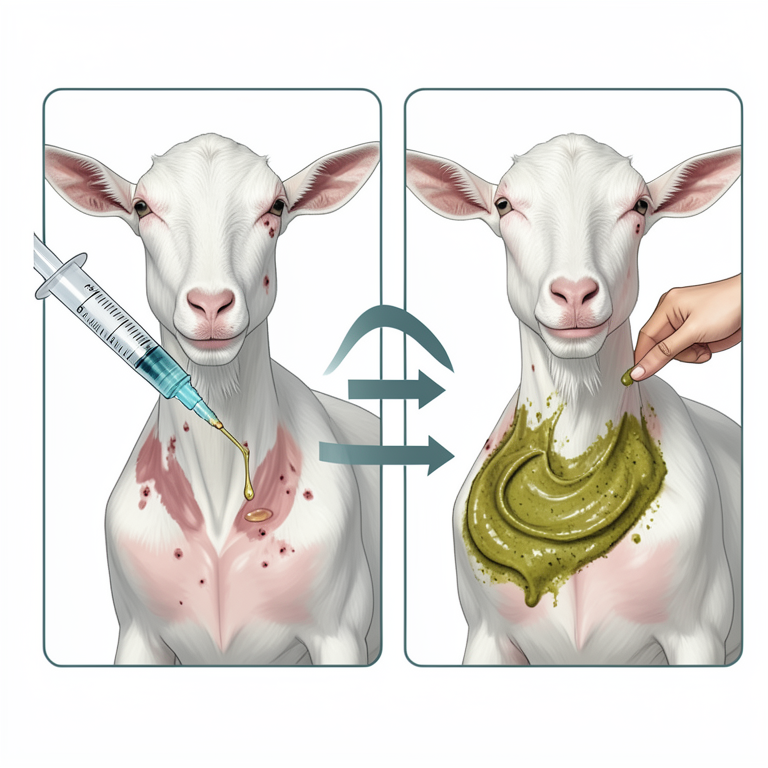
Integrated Treatment Protocol
AI-generated conceptual illustration (Kanni goats). It explains the idea and does not show study data.
View source evidence ↗Introduction
ORF, commonly known as sore mouth or contagious pustular dermatitis, is caused by the parapoxvirus and leads to scabby lesions around the mouth and nostrils. Contagious ecthyma is an eruptive skin disease with a global presence (Mondal et al., 2006) [4] . This virus is primarily responsible for producing acute pustular lesions (Abdullah et al., 2015) [1] . The virus can be transmitted through direct or indirect contact via broken, scarified, or damaged skin (Frandsen et al., 2011) [3] . Morbidity associated with the disease can reach as high as 100%, but the mortality rate in uncomplicated cases rarely exceeds 1% (Abu Elzein et al., 2011) [2] . The increased mortality in young animals is primarily due to their inability to feed, resulting from oral lesions that may lead to secondary infections and anorexia. This condition tends to be more severe in goats than in sheep (Nandi et al., 2011) [10] . Contagious ecthyma can be passed to humans through direct or indirect contact with infected animals (Groves et al., 1991) [6] . The economic impact of this disease is considerable, especially in its effects on young lambs and kids. ORF results in significant economic setbacks in small ruminants, as the lesions often hinder optimal productivity and lower the market value of meat (Nandi et al., 2011) [10] . Although there is no specific treatment as it is self-limiting, the use of topical antibacterial agents can facilitate a faster recovery, help the animals resume normal feeding (Wilson et al., 2002) [16] .
Materials and Methods
The Kanni goat breeding private farm was located at Rajapalayam, Virudhunagar District, Tamil Nadu, India. The farm had a size of 5 bucks, 84 does with 52 kids. The affected goats appeared dull, depressed, and anorexic. Few adult goats of irrespective of sex and kids were exhibited characteristic skin lesions on oral commissure, lips, muzzle and extended to all over the face. Their external skin lesions were dry, ulcerative, and scabby, initially occurring at the corners of the lips and gradually spreading to the areas around the mouth (Figure : 1a-1d). There was increased rectal temperature and presence of nasal exudates. The pooled scab material was collected and Viral DNA was extracted from 10% suspension of scab materials by phenol-chloroform method as described by Sambrook et al. (1989) [13] . Polymerase chain reaction (PCR) was performed following method of Ramesh et al. (2008) [12] .
The extracted DNA was subjected to PCR using CEV specific primers which flanks a 408 bp sequence (forward primer: 5' CGC AGA CGT GGC TGA CGT 3' and reverse primer: 5' TGA GCT GGT TGG CGC TGT CCT 3'). The PCR cycling condition was one cycle of 94°C for 12 minutes followed by 40 cycles of 94°C for 30 seconds and 68°C for 45 seconds and final soaking at 4°C in a thermal cycler (Eppendorf Master cycler). The PCR amplified products were examined 2% agarose gel containing ethidium bromide. The affected goats were treated with Ceftriaxone (15mg/kg, IM, BID, Intacef) for five days, Meloxicam (0.5mg/kg IM, Melonex) for 3 days and Viro care 10mL/day for five days. The lesion was cleaned using cotton swabbed in potassium permanganate solution. Lesion was treated externally by application of herbal paste prepared from turmeric powder and aloe vera gel in 1:1 ratio. After each application fresh paste was prepared and applied twice daily.
Results and Discussion
Contagious ecthyma is a disease that affects sheep and goats found in tropical areas with hot and humid climates. Parapoxvirus causes proliferative skin lesions, starting as papules, progressing to pustules, and eventually forming thick scabs or crusts on the mucous membranes of the lips, muzzle, and nostrils. The symptom observed during present outbreak was suggestive of contagious ecthyma. The disease was further confirmed by PCR(Fig. 1-g). ORF virus can resist dry environment and can continue to live for considerable length of time ranging from months to years in dry environments (Radostits et al., 2007) [11] . Diseased goats kept in sick animal shed and treated as above showed complete recovery within three week of starting the treatment (Fig. 1 e-f). Aloe vera contains anthraquinones with antiviral properties that inactivate enveloped viruses. It also has six antiseptic agents-lupeol, salicylic acid, urea nitrogen, cinnamic acid, phenols, and sulfur-that inhibit fungi, bacteria, and viruses. The polysaccharide glucomannan and growth hormone gibberellin stimulate fibroblast activity, boosting collagen synthesis with both topical and oral use (Chitra et al., 1998) [5] . Aloe vera gel enhances collagen composition, increases cross-linking, and improves wound contraction and scar tissue strength. Turmeric contains curcumin, supports wound healing through its anti-inflammatory (Chitra et al., 1998) [5] , anti-infectious (Heggers et al., 1996; Ling et al., 2009) [7,8] , and antioxidant effects (Mega et al., 2013) [9] . Topical curcumin application enhances re-epithelialization and promotes neovascularization. Both synthetic and traditional herbal therapies help in treating the infection (Nandi et al., 2011) [10]
Conclusion
Most of the affected goats of all ages and sexes showed pyrexia (40 °C), anorexia, depression, and scab lesions around the mouth and nostrils, with 68% morbidity. Early identification of disease and timely intervention of both synthetic and herbal therapies curbs the contagious ecthyma infection in Kanni goats.
Acknowledgement
AcknowledgementAuthors are grateful to the Director of Extension Education, Chennai and the Director of CAHS, Chennai Tamil Nadu for providing facilities for carried out this work.
References
16 in the original paper- Abdullah AA, Ismail MF, Bin Balakrishnan KN, Bala JA, Hani H, Abba Y, et al. Isolation and phylogenetic analysis of caprine ORF virus in Malaysia. Virus Dis. 2015;26(4):255-259.
- Abu Elzein EME, Housawi FMT. Severe long-lasting contagious ecthyma infection in a goat's kid. Zentbl Veterinarmed B. 2007;44:561-564.
- Frandsen J, Enslow M, Bowen AR. Orf parapoxvirus infection from a cat scratch. Dermatol Online J. 2011;17.
- Mondal B, Bera A, Hosamani M, Tembhurne P, Bandyopadhyay S. Detection of Orf virus from an outbreak in goats and its genetic relation with other parapoxviruses. Vet Res Commun. 2006;30:531-539.
- Chitra R, Sajithlal GB, Chandrakasan G. Influence of Aloe vera on collagen characteristics in healing dermal wounds in rats. Mol Cell Biochem. 1998;181:71-76.
- Groves RW, Wilson-Jones E, MacDonald DM. Human Orf and milkers' nodule: a clinicopathologic study. J Am Acad Dermatol. 1991;25(4):706-711.
- Heggers JP, Kuchukcelebi A, Listengarten D, Stabenau J, Ko F, Broemeling LD, et al. Beneficial effect of aloe on wound healing in an excisional wound model. J Altern Complement Med. 1996;2:271-277.
- Ling G, Yang S, Zhou H, Shao L. Synthesis, crystal structure, and anti-inflammatory properties of curcumin analogues. Eur J Med Chem. 2009;44(2):915-919.
- Mega B, Li J, Cao H. Antioxidant and anti-inflammatory activities of curcumin on diabetes mellitus and its complications. Curr Pharm Des. 2013;19(11):2101-2113.
- Nandi S, De UK, Choudhury S. Current status of contagious ecthyma or Orf disease in goats and sheep-A global perspective. Small Rumin Res. 2011;96(2-3):7382.
- Radostits OM, Gay C, Hinchcliff KW, Constable PD. A Textbook of the Diseases of Cattle, Horses, Sheep, Pigs and Goats. 10 th ed. Edinburgh: Saunders Elsevier; 2007.
- Ramesh A, Vadivoo VS, Suresh Babu S, Saravanabava K. Confirmatory diagnosis of contagious ecthyma by amplification of the GIF/IL-2 gene by PCR. Tamil Nadu J Vet Anim Sci. 2008;4(6):208-210.
- Sambrook J, Fritsch EF, Maniatis T, editors. Molecular Cloning: A Laboratory Manual. 2 nd ed. Cold Spring Harbor (NY): Cold Spring Harbor Laboratory Press; 1989.
- Shivaraju S, Mohan D, Kalaiselvan E, Maiti SK, Prakash GV. Successful clinical management of contagious ecthyma (Orf) in goat: A case report. Int J Vet Sci Anim Husbandry. 2021;6(1):40-42.
- Singh RK, Rai D, Yadav D, Bhargava A, Balzarini J, De Clercq E. Synthesis, antibacterial and antiviral properties of curcumin bioconjugates bearing dipeptide, fatty acids and folic acid. Eur J Med Chem. 2010;45(3):1078-1086.
- Wilson DJ, Scott PR, Sargison ND, Bell G, Rhind SM. Effective treatment of severe facial dermatitis in lambs. Vet Rec. 2002;150:45-46.