
Research article · 2020 · Full text
International Journal of Veterinary Sciences and Animal HusbandryCorrelation between viable count and protection rates provided by live bacterial vaccines in chickens
Volume 5(1) · Pages 22–27
Research areasSalmonella and Campylobacter epidemiologyBacteriophages and microbial interactionsIdentification and Quantification in Food
Abstract
Author-writtenBackground: Colibacillosis is one of the most important diseases of the poultry industry around the world. It causes considerable economic damage every year. Salmonella Enteritidis and Salmonella Typhimurium are important cause of food-borne illness. Vaccination plays an important role in the overall bio-security system. This study aimed to the use of enumeration of viable bacterial count as an alternative method to challenge test to quantify the colony-forming units (CFU) of specified live bacterial poultry vaccines. Material and methods: Two different live vaccinal mutant (aroA gene deleted E. coli O78 and aroA gene deleted S. Typhimurium STM-1 vaccines) were used in this study. The bacterial count was applied in each vaccine and different doses for each vaccine above and below the vaccinal dose were calculated and adjusted then inoculated in different groups of one day old SPF chicks and observed for 3 weeks for safety and shedding of the vaccinal organisms then challenged with the virulent strains of E. coli O78 and S. Typhimurium at 4th week post vaccination. Result: Protection percent of E. coli vaccine ranged from 62% to 88% in groups inoculated with different doses while it was 16% in the unvaccinated chicken control group. While it was 66% to 84% in S. Typhimurium vaccine in different vaccinated groups while it was 12% in the unvaccinated chicken control group. Conclusion: Results of this study stated that the maximum release titer for aroA gene deleted E. coli vaccine was 5x10⁸ CFU/dose while it was 1x10⁹ for aroA gene deleted S. Typhimurium vaccine. On the other hand, the minimum release titer was 5x10⁶ for aroA gene deleted E. coli vaccine while it was 1x10⁶ for aroA gene deleted S. Typhimurium vaccine.
Summary
Source-checkedPlain-language reading of the full paper, prepared with AI and checked against the text. Each point links to the authors' own words.
Why it matters
- Colibacillosis is a major global poultry disease that results in significant annual economic losses. View evidence ↗
- Salmonella Typhimurium and Salmonella Enteritidis are significant contributors to food-borne illnesses. View evidence ↗
- Vaccination is a critical part of bio-security for chicken farms due to the increasing prevalence of antimicrobial resistance in E. coli and Salmonella. View evidence ↗
The question
- The study aimed to determine if counting viable bacteria could serve as an alternative to challenge tests for quantifying colony-forming units (CFU) in live bacterial poultry vaccines. View evidence ↗
What they did
- The researchers used two live mutant vaccines: aroA gene deleted E. coli O78 and aroA gene deleted S. Typhimurium STM-1. View evidence ↗
- The experiment involved 650 one-day-old specific-pathogen-free (SPF) chicks. View evidence ↗
- E. coli vaccine groups received oral doses ranging from 5x10⁵ to 5x10¹⁰ CFU/dose, with a separate unvaccinated control group. View evidence ↗
- S. Typhimurium vaccine groups received oral doses ranging from 1x10⁵ to 1x10¹⁰ CFU/dose, with a separate unvaccinated control group. View evidence ↗
- Four weeks after vaccination, chicks were challenged with virulent strains: 1x10⁶ CFU/dose of E. coli O78 or 1x10⁷ CFU/dose of S. Typhimurium. View evidence ↗
What they found
- The E. coli vaccine was safe at most doses, but the highest dose (1010 CFU/dose) caused a mortality rate of 7/50 birds and clinical signs in 11 birds. View evidence ↗
- Vaccine strains were shed in feces for up to 13 days post-vaccination across all groups and were eliminated by day 14. View evidence ↗
- Protection rates for the E. coli vaccine ranged from 62% to 88% depending on the dose, compared to 16% in the unvaccinated control group. View evidence ↗
- Protection rates for the S. Typhimurium vaccine ranged from 66% to 84%, compared to 12% in the unvaccinated control group. View evidence ↗
What it means
- The authors concluded that the release titer range should be 5x10⁶ to 5x10⁸ CFU/dose for the E. coli vaccine and 1x10⁶ to 1x10⁹ CFU/dose for the S. Typhimurium vaccine. View evidence ↗
- The authors determined that immunity begins 14 days after vaccination, with limited protection expected before this time. View evidence ↗
Visual summary
1 visualsIllustrations explain the paper; they do not show study data.
Dose-Response Protection
AI-generated conceptual illustration (broiler chickens). It explains the idea and does not show study data.
View source evidence ↗Figures & tables
From the original paper Table 1
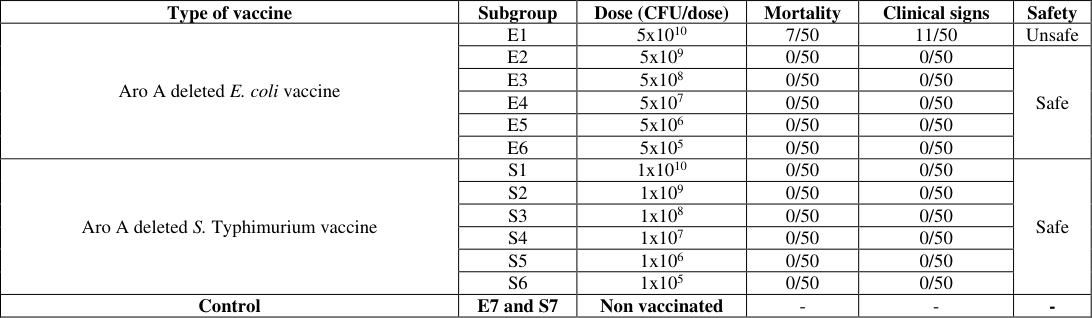 Table 2
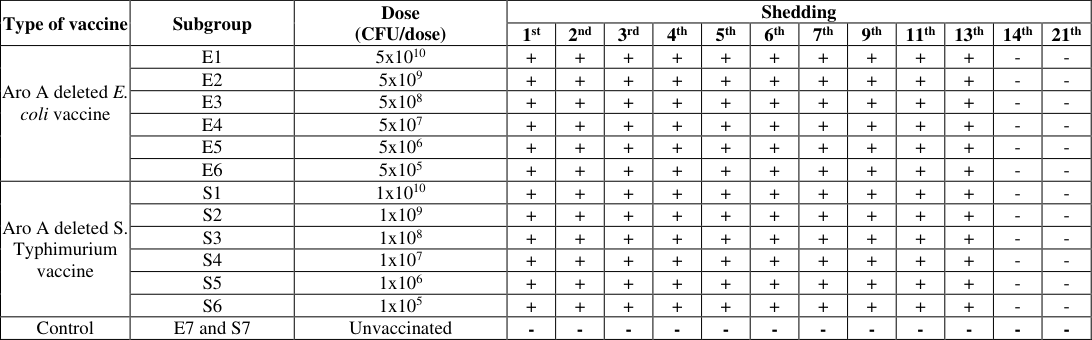 Table 3
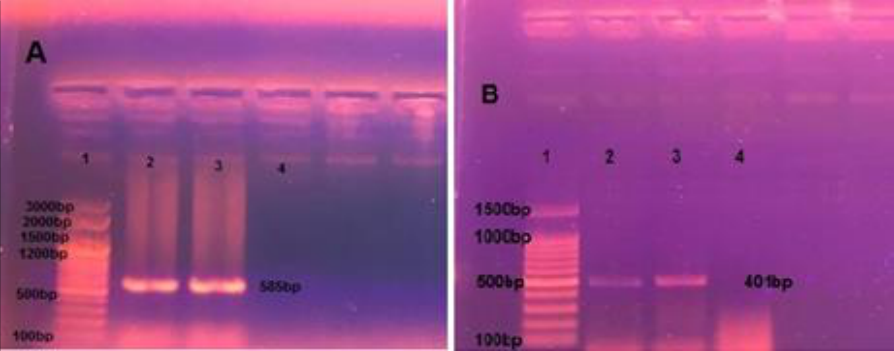 Figure 1
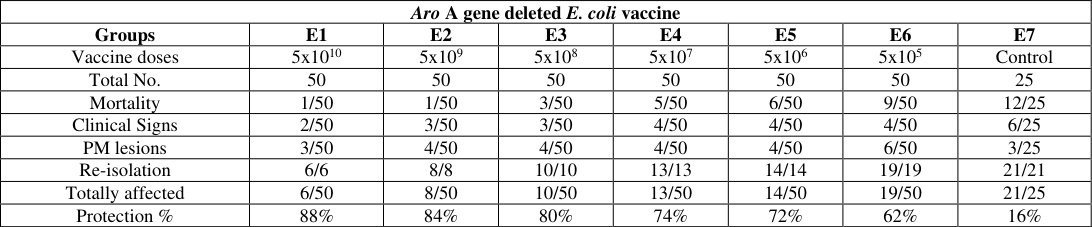 Table 4
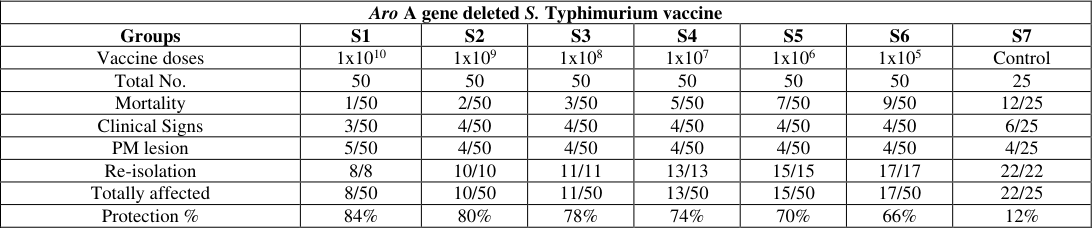 Table 5
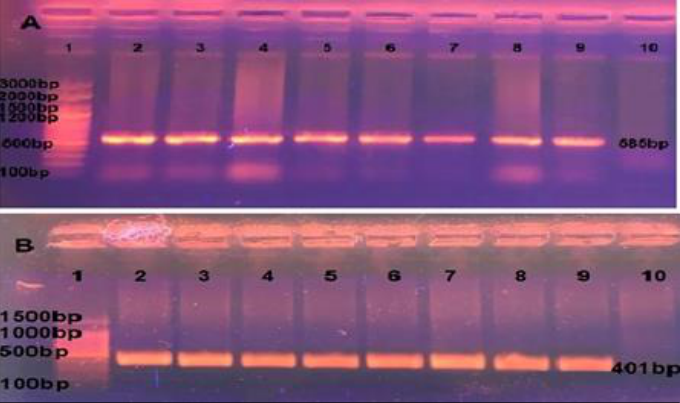 Figure 2
Introduction
Enterobacteriaceae are a large family of gram negative bacteria that includes many of the more familiar pathogens that colonize the small and large intestine such as E. coli and Salmonella (Mellen et al., 2014) [1] . Colibacillosis is one of the most important diseases of the poultry industry around the world. It causes considerable economic damage every year, due to directly increased mortalities and indirectly because of reduced weight gain, increased feed conversion rate and carcass condemnation (Saif, 2008) [2] . S. Enteritidis and S. Typhimurium are important causes of food-borne illness. Based on surveillance studies, the main vehicles of S. Enteritidis and S. Typhimurium infection include raw meat, eggs and poultry products (Thung et al., 2016) [3] . Due to the frequency of antimicrobial resistance and the number of resistance determinants in Salmonella and E. coli have raised markedly, vaccination plays an important role in the overall bio-security system on animal farms, typically chicken farms to prevent E. coli and Salmonella infections (Jawale et al., 2012) [4] . Veterinary vaccines must be safe, pure, potent, and effective. Potency for most animal health vaccines was demonstrated by means of vaccination in specific host and subsequent challenge of the vaccinates with the live pathogenic agent but animal welfare considerations, cost, assay duration, and assay variability have all been drivers for the animal health industry to find alternative assays. For many vaccines containing live antigens, these tests have been largely replaced by in vitro assays that titrates the live antigen content in the vaccines (CFR, 2016) [5] .
The main target of this study was the use of enumeration of viable bacterial count as an alternative method to challenge test to quantify the colony-forming units (CFU) of specified live bacterial poultry vaccines. With additional considerations in developing appropriate in vitro assays include the correlation of the assay to host animal efficacy. Typhimurium were used and illustrated in Table (1). [6] , while it was 95 °C for 2 min, then 30 cycles each at 95 °C for 1 min, 57 °C for 1 min and 72°C for 2min.; lastly 72 °C for 5 min in case of S. Typhimurium (Alvarez et al 2004) [7] . The PCR products were analyzed on 1% agarose gel.
Material and
Enumeration of viable bacterial count using spread surface plate method (Sadeyen et al., 2014) [8] The vial of vaccine was rehydrated in the required amount of MRD (maximum recovery diluent) in a way that the test portion represented one dose of vaccine then thoroughly mixed. A range of ten-fold serial dilutions was used then two inoculums of 0.1ml/each were pipetted into the surface of separate TSA agar plates per each dilution. The inoculum was spread rapidly over the entire agar surface using a thin bent glass rod. The plates are incubated for 24-48 hours at 37 °C.
Colonies were counted on each of two plates using bacterial colony counter. The colonies were counted as an average of two plates inoculated with the selected dilution. Number of colony forming unit (CFU)/ml = N x 10 n x 10 where N = no. of colonies on the plate at the selected dilution n.
The viable colony count for E. coli vaccine was 5x10 7 CFU/dose while it was 1x10 8 CFU/ dose for S. Typhimurium vaccine. Different doses for each vaccine above and below the vaccinal dose were calculated and adjusted
Experimental design
A total of 650 one day old SPF chicks were used. Half of these chicks were used to study the live E. coli vaccine as they were subdivided into equal 6 groups (50 each) named from E1 to E6. These chicks received the live E. coli vaccine orally in a concentration of 5x10 10 , 5x10 9 , 5x10 8 , 5x10 7, 5x10 6 and 5x10 5 CFU/dose while the rest 7 th group E7 (25 chicks) was kept as a control unvaccinated group. The same program was typically applied regarding the live S. Typhimurium vaccine but the vaccine concentrations used were 1x10 10 , 1x10 9 , 1x10 8 , 1x10 7 , 1x10 6 and 1x10 5 CFU/dose and the groups named from S1 to S6 respectively and the 7 th group was unvaccinated control group S7 (25 chicks). Shedding of the vaccinal organisms was followed for 3 weeks post vaccination. The fecal samples were processed and samples containing typical E. coli or Salmonella colonies were confirmed by PCR using and S. Typhimurium specific primers. Four weeks post vaccination, these vaccinated chicks were challenged with the virulent bacteria (1x10 6 CFU/dose E. coli O78 for E. coli vaccinated and control groups and 1x10 7 CFU/dose S. Typhimurium for Salmonella vaccinated and control groups). Challenged birds were observed daily for 2 weeks and examined for abnormal clinical signs, mortalities and PM lesions with re-isolation of challenge strains from the affected birds. After the observation period, all rest birds were sacrificed and examined for postmortem lesions.
Results
Results
Identity of vaccinal strains:
In the present study, the identity of the tested live attenuated E. coli and S. Typhimurium vaccines was performed to identify the target antigens. Firstly, the genomic DNAs of both vaccines were extracted, fractionated on 0.7% agarose and the estimated size of the genomic DNA was more than 23kbp. The target antigen of E. coli vaccine was confirmed as E. coli by its specific primer giving rise to a PCR product of 585 bp as shown in Figure (1A). Also the antigen of S. Typhimurium vaccine was confirmed as S. Typhimurium by using its specific primer giving rise to a PCR product of 401 bp as shown in Figure (1B).
Enumeration of viable bacterial count
The viable colony count for E. coli vaccine was 5x10 7 CFU/dose and for S. typhimurium vaccine was 1x10 8 CFU/dose.
Safety of different doses of used vaccines.
No mortalities or clinical signs attributable to the vaccine were observed in all groups during observation period except for subgroup E1 (received 10 10 CFU/dose of the E. coli vaccine) where the mortality rate was 7 out of 50 birds and 11 birds showed depression, lower body weight and diarrhea as shown in Table (2).
Post challenge immune status assessment
As regards to the protection percent obtained in chickens vaccinated with different doses of E. coli vaccine after challenge with E. coli O78 strain, the protection percent were 88, 84, 80, 74, 72 and 62% in subgroups E1, E2, E3, E4, E5 and E6 respectively while it was 16% in the unvaccinated chicken control group (E7) as shown in Table (4). On the other hand, the protection percent obtained in chickens vaccinated with different doses of S. Typhimurium vaccine after challenge with S. Typhimurium strain were 84, 80, 78, 74, 70 and 66% in subgroups S1, S2, S3, S4, S5 and S6 respectively while it was 12% in the unvaccinated chicken control group (S7) as shown in Table ( 5)
Discussion
Colibacillosis is a serious disease of poultry caused by Avian Pathogenic E. coli (APEC) which is one of the most important causes of extra-intestinal diseases in the poultry industry including airsacculitis, pericarditis, perihepatitis and cellulitis. Colibacillosis results in significant economic losses to the poultry industry through mortality, morbidity, cost of treatment and condemnation at processing plant (Nagano et al., 2012) [9] . More than one hundred E. coli serotypes have been reported but the infection in chickens was mostly belonged to serogroups O 1 , O 2 and O 78 (Chart et al., 2000) [10] .
Salmonellosis is an important disease of chicken all over the world. Avian host specific salmonellae include Salmonella Gallinarum (S. Gallinarum) and Salmonella Pullorum (S. Pullorum) which causes fowl typhoid and pullorum disease respectively (Rajagopal and Mini, 2013) [11] . By contrast, nonhost-specific Salmonella like Salmonella typhimurium or Salmonella enteritidis are commensal in poultry and can persist in the gastrointestinal tract. They are mainly asymptomatic but are associated with widespread human illness. Food vehicles such as poultry meat, eggs, and poultry by-products are among the most common sources of Salmonella infections to human (Dunkley et al., 2009) [12] . Live vaccines based on defined mutations that impair virulence and non-revering have been shown to reduce the virulence of E. coli and Salmonella strains. In the present study the identity of the tested live attenuated E. coli and S. Typhimurium vaccines were performed to identify the target antigens. Firstly, the genomic DNAs of both vaccines were extracted, fractionated on 0.7% agarose and the estimated size of the genomic DNA was more than 23 kbp. The target antigen of E. coli vaccine was confirmed as E. coli by using its specific primer giving rise to a PCR product of 585 bp. This result was confirmed by 585 bp region of E. coli chromosome which amplified from E. coli isolates identified by Khatun et al. (2015) [13] from naturally healthy broiler chickens in Bangladesh by PCR using the same primer and Tonu et al. (2011) [6] who used PCR to detect the pathogenic E. coli through pathological study of the colibacillosis affected birds. Also the antigen of S. Typhimurium vaccine was confirmed as S. Typhimurium by using S. Typhimurium primer giving rise to a PCR product of 401 bp. The same PCR product obtained by Alvarez et al. (2004) [7] who developed a multiplex PCR technique for detection and epidemiological typing of Salmonella in human clinical samples. The bacterial count was applied on each vaccine and the viable colony count for E. coli vaccine was 5x10 7 CFU/dose and was 1x10 8 CFU/ dose for S. Typhimurium vaccine. Different doses for each vaccine above and below the vaccinal dose were calculated and adjusted then inoculated in different groups of one day old SPF chicks and observed for 3 weeks for safety and shedding of the vaccinal organisms. As regard to the safety in E. coli vaccinated birds, the vaccine administered at a dose of 5x10 9 , 5x10 8 , 5x10 7, 5x10 6 and 5x10 5 was found to be safe and didn't cause any mortalities, clinical illness or affect growth rate while at a dose of 5x10 10 the mortality was 7 out of 50 birds and 11 birds showed depression, lower body weight and diarrhea. Ahlam et al. (2017) [14] revealed that neither mortalities nor colibacillosis lesions were observed in 70 day old broiler chicks vaccinated with aro A mutant E. coli vaccine with a dose containing 5.2x10 6 -9.1x10 8 CFU/chick. Also Salehi et al. (2012) [15] confirmed the safety of aro A mutant E. coli vaccine administered at a dose of 10 8 CFU. These studies proved the safety of the maximum release titer of the vaccine (5x10 8 ) which means the expected highest number of viable E. coli allowed per dose and safety of its ten field dose (5x10 9 ). On the other hand the administration of S. Typhimurium vaccine was found to be safe at all doses 1x10 10 , 1x10 9 , 1x10 8 , 1x10 7 , 1x10 6 and 1x10 5 . Alderton et al., (1991) [16] concluded that the inoculation of aro A S. Typhimurium deletion mutant orally in day-old chicks at a doses of 10 9 , 10 9.7 and 10 10 CFC/bird didn't adversely affect the weight gain of chickens, survived the experiment and showed no adverse reactions. Also Groves et al., (2016) [17] concluded that the safety of live attenuated aro A deletion mutant S. Typhimurium STM-1 strain vaccine at its recommended dose 10 8 CFU/dose. From this study, the approved maximum release dose for aro A deleted mutant S. Typhimurium vaccine was 10 9 CFU/dose. Also inoculation of tenfold dose of MRD (maximum release dose) was found to be safe. The shedding of each vaccine organism was observed for 3 weeks post inoculation and organisms were found to be eliminated by day 14 post inoculation. So, the onset of immunity was demonstrated to be 14 days post vaccination and limited protection is expected prior to that point as stated also by EMA (2012) [18] for E. coli vaccine. Alderton et al., (1991) [16] examined the fecal swabs 2, 5 and 14 days post inoculation of S. Typhimurium vaccine and concluded that all chickens were excreting the organism within 5 days but the organism was eliminated by day 14. On the contrast with Revolledo and Ferreira (2010) [19] who evaluated antibiotic-mutant strains of S. Typhimurium and stated that the fecal shedding persisted at 1 st , 2 nd and 3 rd weeks. John (2015) [20] evaluated S. Typhimurium vaccine against S. Typhimurium, S. Enteritidis and S. Gallinarum infection and stated that the fecal shedding ended by day 10 post vaccinations. Regarding the vaccination challenge assay for E. coli vaccine, the highest protection percent obtained with highest dose 10 10 which reduced from 88% to be 62% with the dose of 5x10 5 . This finding conclude the efficacy of the vaccine in terms of its ability to reduce the colonization of virulent O78 strain compared by the control group that gave protection 16% only. Also the study demonstrated that the minimum vaccinal dose that gave the approved protection percent was 5x10 6 CFU/dose. So, it could be concluded that the expected lowest number of viable organism required per dose in E. coli vaccine verified by efficacy (minimum release titer) was 5x10 6 CFU/dose. Ahlam et al (2017) [14] concluded that the cumulative collibacillosis rates one week after challenge were 28.6% in one day chicks vaccinated by aroA mutant vaccine with a dose containing 5.2x10 6 -9.1 x10 8 CFU/chick as compared by 93.3% in control group. From the vaccination challenge assay for S. Typhimurium vaccine, the protection percent ranged from 84% to 66% with reduced doses. From this study, the minimum protective dose for Salmonella vaccine was 10 6 CFU/dose. A preliminary study on the response to different dosages of STM-1 applied by Alderton et al. (1991) [16] showed that the higher vaccine doses (10 6 and 10 10 CFU/bird) stimulated rapid and higher antibody response than a lower dose (10 4 CFU/bird). This may explain our results of higher protection with higher doses. Also Alderton et al (1991) [16] explained that oral vaccination at 10 8 caused a cessation in virulent STM excretion 35 days post challenge. Finally, EMA 2012 [18] concluded that the approved titer range per dose is 5.2x10 6 to 9.1x10 8 CFU for aroA deleted E. coli vaccine and 10 6 to 10 9 CFU for S. Typhimurium vaccine. So, from the previous mentioned data, it could be concluded that the expected highest number allowed per dose (maximum release titer) for aro A gene deleted E. coli vaccine was 5x10 8 CFU/dose while it was 1x10 9 for aro A gene deleted S. Typhimurium vaccine. On the other hand, the minimum vaccine dose that gave the approved protection percent (minimum release titer) is 5x10 6 for aro A gene deleted E. coli vaccine while it was 1x10 6 for aro A gene deleted S. Typhimurium vaccine. Also the onset of immunity was demonstrated to be 14 days post vaccination and limited protection is expected prior to that point.
Figures and tables from the paper
| Primer | Primer Sequence | Product | Reference |
|---|---|---|---|
| 16s rRNA E. coli | F5-GACCTCGGTTTAGTTCACAGA-3 | 585 bp | Tonu et al., 2011 [6] |
| R5-CACACGCTGACGCTGACCA-3 | |||
| S. Typhimurium | F5-TTGTTCACTTTTTACCCCTGA-3 | 401 bp | Alvarez et al., 2004 [7] |
| R5-CCCTGACAGCCGTTAGATATT-3 |
Table text extracted from the original PDF; superscript letters are shown inline. The original table image is below.
View original table image
| Type of vaccine | Subgroup | Dose (CFU/dose) | Mortality | Clinical signs | Safety |
|---|---|---|---|---|---|
| Aro A deleted E. coli vaccine | E1 | 5x10¹⁰ | 7/50 | 11/50 | Unsafe |
| E2 | 5x10⁹ | 0/50 | 0/50 | Safe | |
| E3 | 5x10⁸ | 0/50 | 0/50 | ||
| E4 | 5x10⁷ | 0/50 | 0/50 | ||
| E5 | 5x10⁶ | 0/50 | 0/50 | ||
| E6 | 5x10⁵ | 0/50 | 0/50 | ||
| Aro A deleted S. Typhimurium vaccine | S1 | 1x10¹⁰ | 0/50 | 0/50 | Safe |
| S2 | 1x10⁹ | 0/50 | 0/50 | ||
| S3 | 1x10⁸ | 0/50 | 0/50 | ||
| S4 | 1x10⁷ | 0/50 | 0/50 | ||
| S5 | 1x10⁶ | 0/50 | 0/50 | ||
| S6 | 1x10⁵ | 0/50 | 0/50 | ||
| Control | E7 and S7 | Non vaccinated | - | - | - |
Table text extracted from the original PDF; superscript letters are shown inline. The original table image is below.
View original table image
| Type of vaccine | Subgroup | Dose (CFU/dose) | Shedding | — | — | — | — | — | — | — | — | — | — | — |
|---|---|---|---|---|---|---|---|---|---|---|---|---|---|---|
| 1st | 2nd | 3rd | 4th | 5th | 6th | 7th | 9th | 11th | 13th | 14th | 21th | |||
| Aro A deleted E. coli vaccine | E1 | 5x10¹⁰ | + | + | + | + | + | + | + | + | + | + | - | - |
| E2 | 5x10⁹ | + | + | + | + | + | + | + | + | + | + | - | - | |
| E3 | 5x10⁸ | + | + | + | + | + | + | + | + | + | + | - | - | |
| E4 | 5x10⁷ | + | + | + | + | + | + | + | + | + | + | - | - | |
| E5 | 5x10⁶ | + | + | + | + | + | + | + | + | + | + | - | - | |
| E6 | 5x10⁵ | + | + | + | + | + | + | + | + | + | + | - | - | |
| Aro A deleted S. Typhimurium vaccine | S1 | 1x10¹⁰ | + | + | + | + | + | + | + | + | + | + | - | - |
| S2 | 1x10⁹ | + | + | + | + | + | + | + | + | + | + | - | - | |
| S3 | 1x10⁸ | + | + | + | + | + | + | + | + | + | + | - | - | |
| S4 | 1x10⁷ | + | + | + | + | + | + | + | + | + | + | - | - | |
| S5 | 1x10⁶ | + | + | + | + | + | + | + | + | + | + | - | - | |
| S6 | 1x10⁵ | + | + | + | + | + | + | + | + | + | + | - | - | |
| Control | E7 and S7 | Unvaccinated | - | - | - | - | - | - | - | - | - | - | - | - |
Table text extracted from the original PDF; superscript letters are shown inline. The original table image is below.
View original table image
| Aro A gene deleted E. coli vaccine | — | — | — | — | — | — | — |
|---|---|---|---|---|---|---|---|
| Groups | E1 | E2 | E3 | E4 | E5 | E6 | E7 |
| Vaccine doses | 5x10¹⁰ | 5x10⁹ | 5x10⁸ | 5x10⁷ | 5x10⁶ | 5x10⁵ | Control |
| Total No. | 50 | 50 | 50 | 50 | 50 | 50 | 25 |
| Mortality | 1/50 | 1/50 | 3/50 | 5/50 | 6/50 | 9/50 | 12/25 |
| Clinical Signs | 2/50 | 3/50 | 3/50 | 4/50 | 4/50 | 4/50 | 6/25 |
| PM lesions | 3/50 | 4/50 | 4/50 | 4/50 | 4/50 | 6/50 | 3/25 |
| Re-isolation | 6/6 | 8/8 | 10/10 | 13/13 | 14/14 | 19/19 | 21/21 |
| Totally affected | 6/50 | 8/50 | 10/50 | 13/50 | 14/50 | 19/50 | 21/25 |
| Protection % | 88% | 84% | 80% | 74% | 72% | 62% | 16% |
Table text extracted from the original PDF; superscript letters are shown inline. The original table image is below.
View original table image
| Aro A gene deleted S. Typhimurium vaccine | — | — | — | — | — | — | — |
|---|---|---|---|---|---|---|---|
| Groups | S1 | S2 | S3 | S4 | S5 | S6 | S7 |
| Vaccine doses | 1x10¹⁰ | 1x10⁹ | 1x10⁸ | 1x10⁷ | 1x10⁶ | 1x10⁵ | Control |
| Total No. | 50 | 50 | 50 | 50 | 50 | 50 | 25 |
| Mortality | 1/50 | 2/50 | 3/50 | 5/50 | 7/50 | 9/50 | 12/25 |
| Clinical Signs | 3/50 | 4/50 | 4/50 | 4/50 | 4/50 | 4/50 | 6/25 |
| PM lesion | 5/50 | 4/50 | 4/50 | 4/50 | 4/50 | 4/50 | 4/25 |
| Re-isolation | 8/8 | 10/10 | 11/11 | 13/13 | 15/15 | 17/17 | 22/22 |
| Totally affected | 8/50 | 10/50 | 11/50 | 13/50 | 15/50 | 17/50 | 22/25 |
| Protection % | 84% | 80% | 78% | 74% | 70% | 66% | 12% |
Table text extracted from the original PDF; superscript letters are shown inline. The original table image is below.
View original table image
References
20 in the original paper- Mellen M, Kačániová M, Jana P, Henrieta A, Marcela C, Peter H. Enterobacteriaceae genera representation of chicken's gastrointestinal tract after feed Additives application. Animal Science and Biotechnologies. 2014; 47 (2):370-374.
- Saif YM. Diseases of poultry. Blackwell Publishing. 2008; Oxford.
- Thung TY, Mahyudin NA, Basri DF, Wan Mohamed Radzi CWJ, Nakaguchi Y, Nishibuchi M et al. Prevalence and antibiotic resistance of Salmonella Enteritidis and Salmonella Typhimurium in raw chicken meat at retail markets in Malaysia. Poultry Science. 2016; 95:18881893.
- Jawale CV, Chaudhari AA, Jeon BW, Nandre RM, Lee JH. Characterization of a novel inactivated Salmonella enterica serovar Enteritidis vaccine candidate generated using a modified cI857/λPR/gene E expression system. Infection and Immunity. 2012; 80:1502-1509.
- United States Code of Federal Regulations. Title 9Animals and Animal Products, Chapter 1-Animal and Plant Health Inspection Service, Department of Agriculture, Subchapter E-Viruses, Serums, Toxins, and Analogous Products; Organisms and Vectors-Part 113.304. Feline Panleukopenia Vaccine. Available at: http://www.aphis.usda.gov/animal health/vet_biologics/vb_cfr.shtml. 2016.
- Tonu NS, Sufian MA, Sarker S, Kamal MM, Rahman MH, Hossain MM. Pathological study on colibacillosis in chickens and detection of E. coli by PCR. Bangl J Vet Med. 2011; 9:17-25.
- Alvarez J, Sota M, Ana BV, Perales I, Cisterna R, Rementeria A et al. Development of multiplex PCR technique for detection and epidemiological typing of salmonella in human clinical samples. Journal of Clinical Microbiology, 2004, 1734-1738.
- Sadeyen JR, Kaiser P, Stevens MP, Dziva F. Analysis of immune responses induced by avian pathogenic E. coli infection in turkeys and their association with resistance to homologous re-challenge. Veterinary Research. 2014; 45(19):1-12.
- Nagano T, Kitahara R, Nagai S. An attenuated mutant of avian pathogenic E. coli serovar O78: a possible live vaccine strain for prevention of avian colibacillosis. Microbiol. Immunol. 2012; 56:605-612.
- Chart H, Smith HR, La ragione RM, Woodward MJ. An investigation into the pathogenic properties of Escherichia coli strains BLR, BL21, DH5α, and EQ1. J Appl. Microbiol.2000; 89:1048-1058.
- Rajagopal R, Mini, M. Outbreaks of salmonellosis in three different poultry farms of Kerala, India. Asian Pac. J Trop. Biomed, 2013; 3(6):496-500.
- Dunkley KD, Callaway TR, Chalova VI, McReynolds JL, Hume ME, Dunkley CS et al. Foodborne Salmonella ecology in the avian gastrointestinal tract. Anaerobe. 2009; 15:26-35.
- Khatun MN, Mahbub ATM, Ahmed S, Parvej MS, Akhter S, Ansari WK. Frequency of drug resistant E. coli isolated from commercial broiler chicken in Bangladesh. Int. J Nat. Soc. Sci. 2015. 2(4):1-5.
- Ahlam AG, Ahmed MHm, Ashraf AM, Mohammed FF. Protective efficacy of a commercial live attenuated vaccine against avian pathogenic E. coli challenge in broilers. Zagazig Veterinary Journal, 2017; 45(4):366-375.
- Salehi TZ, Tabatabaei S, Karimi V, Fasaei BN, Derakhshandeh A, Jahromi OAN. Assessment of immunity against avian colibacillosis induced by an aroA mutant conaining increased serum survival gene in broilers. Brazilian Journal of Microbiology, 2012, 363370.
- Alderton MR, Fahey KJ, Colo PJ. Humeral responses and Salmonellosis protection in chickens given a vitamindependent Salmonella typhimurium mutant. Avian Disease. 1991; 35:435-442.
- Groves PJ, Sharpe SM, Muir WI, Pavic A, Cox JM. Live and inactivated vaccine regimens against caecal Salmonella typhimurium colonization in laying hens. Australian Veterinary Journal. 2016; 94(10):387-393.
- EMA (European Medicines Agency). CVMP Assessment Report for Poulvac E. Coli. EMA/CVMP/298291/2012, London, UK.
- Revolledo L, Ferreira AJP. Salmonella antibiotic-mutant strains reduce fecal shedding and organ invasion in broiler chicks. Poultry Science. 2010; 89:2130-2140.
- John HL. Protection against Salmonella typhimurium, Salmonella gallinarum and Salmonella enteritidis infection in layer chickens conferred by a live attenuated Salmonella typhimurium strain. Immune Network. 2015; 15(1):27-36.