
Research article · 2020 · Full text
International Journal of Statistics and Applied MathematicsModelling and prediction of coastal Andhra rainfall using ARIMA and ANN models
Volume 5(6) · Pages 104–110
Research areasHydrological Forecasting Using AIStock Market Forecasting MethodsEnergy Load and Power Forecasting
Abstract
Author-writtenPrecipitation and climate forecasting in the Coastal Andhra are extremely needed for the agriculture and water resource management system. Most challenging factor in this study is nature of rainfall data. Due to drastic climatic conditions, the rainfall becomes nonlinear and dynamic in nature. Conventional statistical models are not enough to predict the actual rainfall trend, which require contemporary computer modelling and simulation techniques for accurate prediction. In this paper, we are using both traditional statistical technique autoregressive integrated moving average (ARIMA) and contemporary AI model Artificial Neural Network (ANN) for prediction of rainfall. In order to evaluate the forecasting efficacy, we used of 117 years of mean annual rainfall data from year 1901 to 2017 of Coastal Andhra (India). The models were trained with 100 years of annual rainfall data. The ARIMA and the ANN methods are used to the data to draw the accuracy. The accuracy of the model was assessed by using remaining 17 years of data. The study explains that ANN model can be used as a significant prediction tool to forecast the rainfall when compare with ARIMA model.
Summary
Source-checkedPlain-language reading of the full paper, prepared with AI and checked against the text. Each point links to the authors' own words.
Why it matters
- Accurate rainfall and climate forecasting in Coastal Andhra is critical for managing water resources and supporting agriculture. View evidence ↗
- Because rainfall is nonlinear and dynamic due to extreme climatic conditions, traditional statistical models often fail to predict trends accurately, necessitating modern computer modeling. View evidence ↗
- Rainfall occurring from June to September is essential for India's economy, hydrological strategies, disaster management, and agricultural requirements. View evidence ↗
The question
- The study aims to predict rainfall by comparing a traditional statistical method (ARIMA) with a contemporary artificial intelligence model (ANN). View evidence ↗
What they did
- The researchers used 117 years of mean annual rainfall data from Coastal Andhra, India, spanning from 1901 to 2017. View evidence ↗
- The models were trained using the first 100 years of data, while the remaining 17 years were used to test the prediction accuracy of the ARIMA and ANN models. View evidence ↗
- The study area is defined as Coastal Andhra, located between 12°41' and 19.07° N latitude and 77° and 84°40’ E longitude. View evidence ↗
What they found
- The ANN model showed a lower Root Mean Squared Error (RMSE) of 59.03 compared to the ARIMA model's RMSE of 76.78. View evidence ↗
- Evaluation using Theils U indicated that the ANN model provided a better forecast than the ARIMA model. View evidence ↗
- Visual analysis of the prediction plots for the testing data set showed that the ANN model performed better than the ARIMA model. View evidence ↗
What it means
- The authors conclude that the Artificial Neural Network (ANN) method is a more effective tool for modeling and forecasting annual rainfall than the ARIMA model. View evidence ↗
- The study recommends the ANN model as a significant tool for rainfall prediction due to its superior performance over the ARIMA model. View evidence ↗
Visual summary
3 visualsIllustrations explain the paper; charts are replotted from the paper's own table values.
Comparison of Prediction Models
AI-generated conceptual illustration (Coastal Andhra landscape with rainfall). It explains the idea and does not show study data.
View source evidence ↗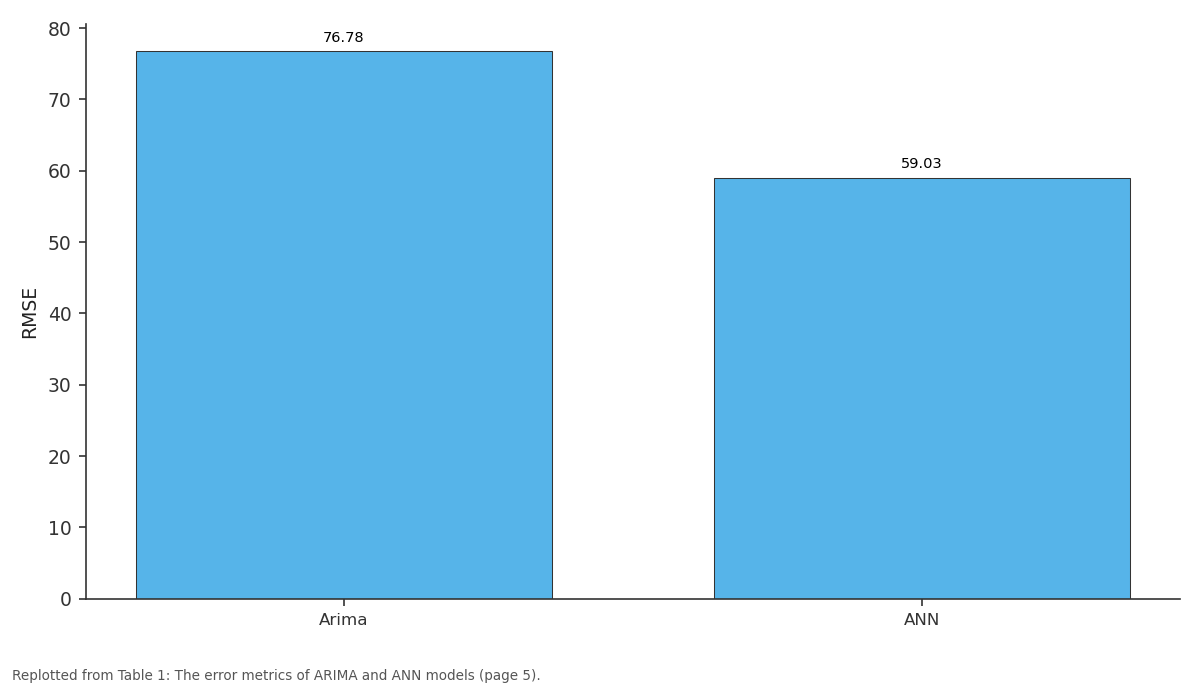
RMSE: Arima vs ANN
Replotted from Table 1 (page 5) of the original paper. Every bar is the paper's own table value.
View source evidence ↗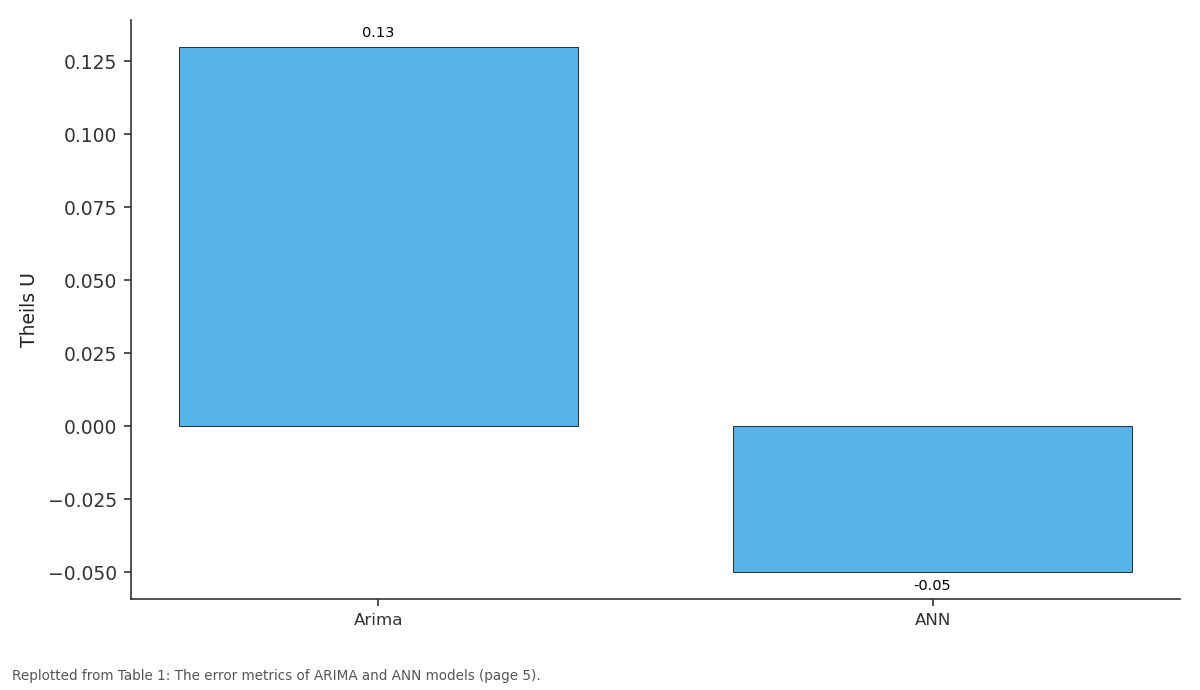
ACF1: Arima vs ANN
Replotted from Table 1 (page 5) of the original paper. Every bar is the paper's own table value.
View source evidence ↗Figures & tables
From the original paper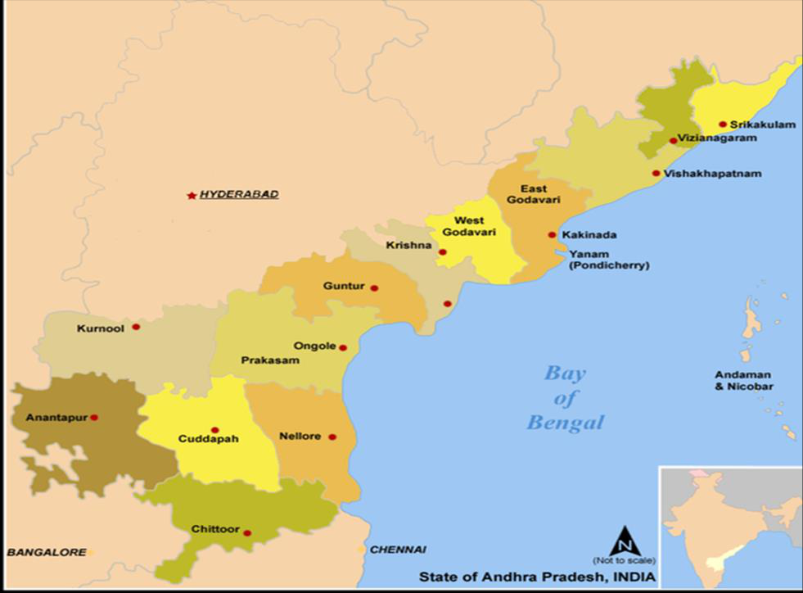 Figure 1
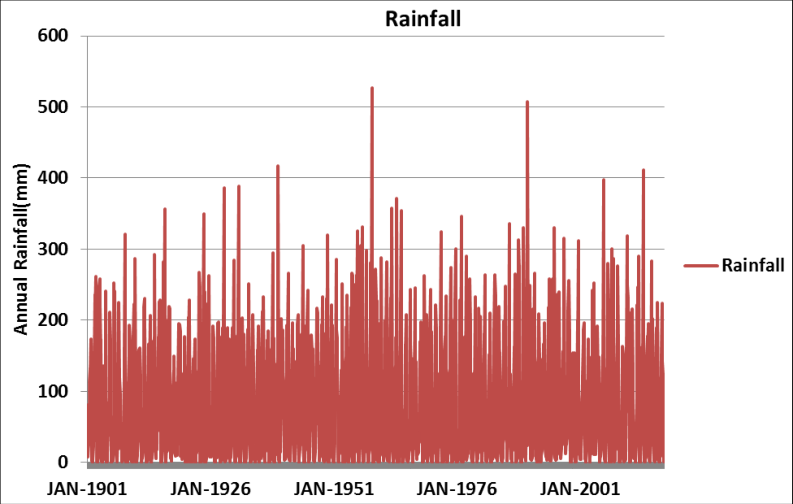 Figure 2
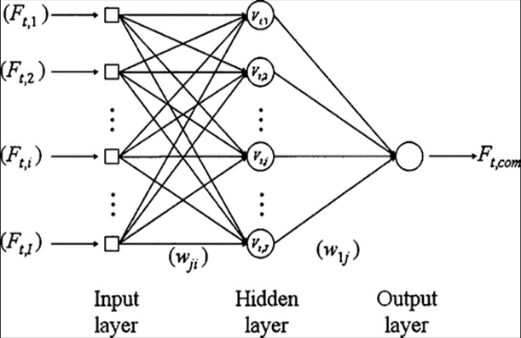 Figure 3
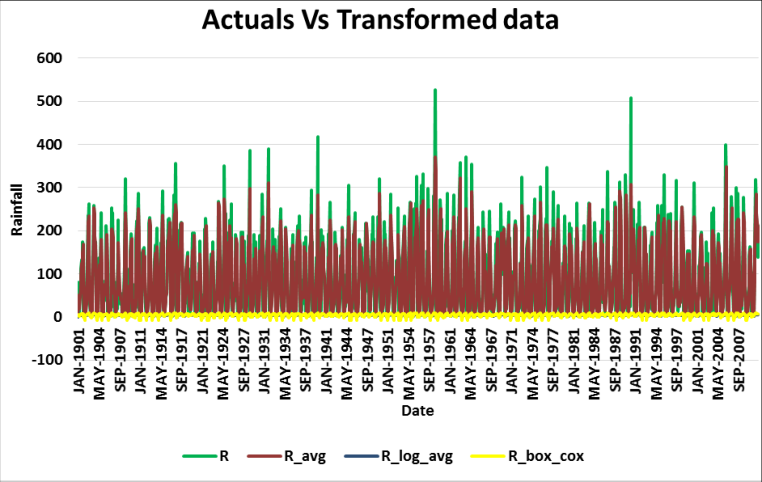 Figure 4
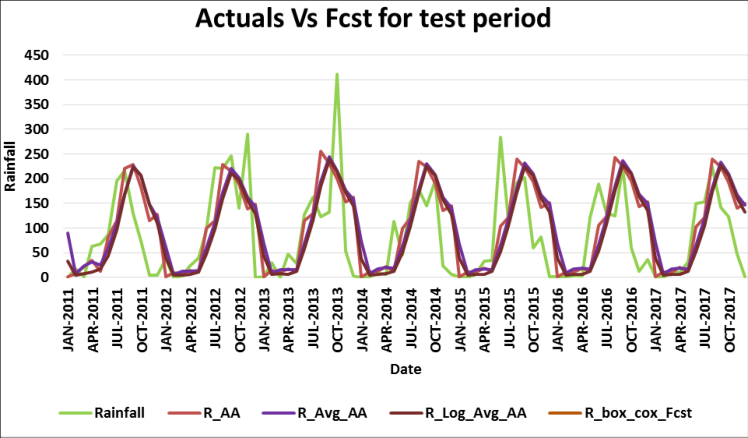 Figure 5
 Table 1
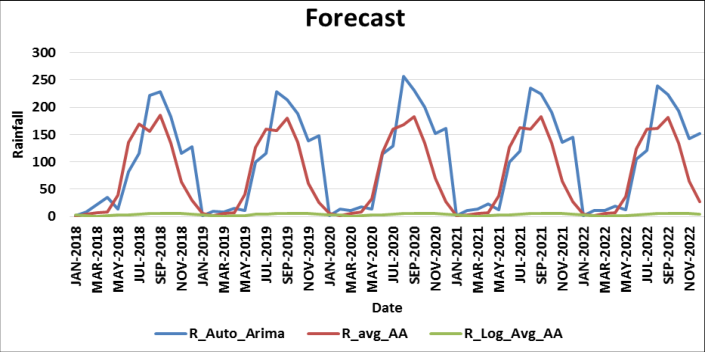 Figure 6
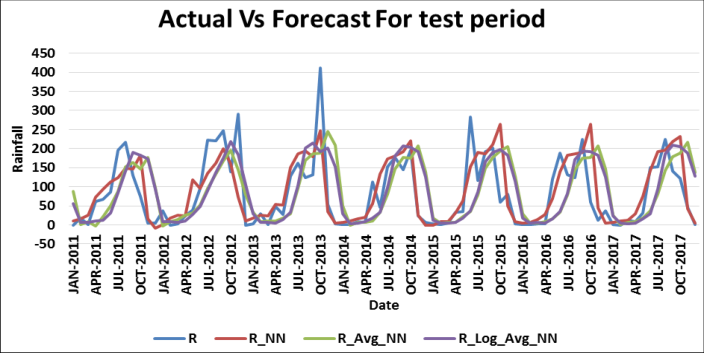 Figure 7
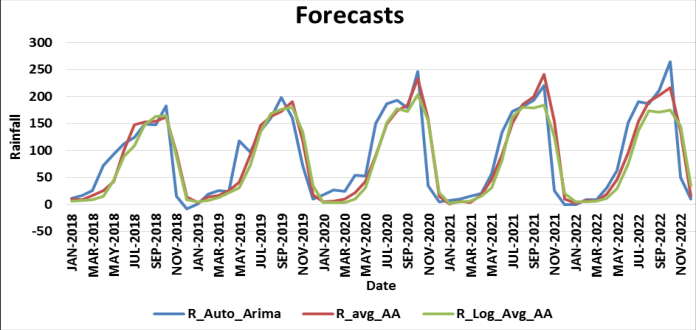 Figure 8
Introduction
Prediction of the Precipitation is the most significant and challenging subject in the present era. Agriculture is one of the major businesses in country like India, the relevance of rainfall forecast is necessary for to meet the future course of demands. Across the globe, several contributions have been developed to predict rainfall behaviour using numerous traditional and modern methods. In the present study, we have used two models to predict the rainfall pattern like: traditional statistical method autoregressive integrated moving average ARIMA and the contemporary artificial intelligence model artificial neural network ANN. Data appropriateness is the core content for any model fitting. Conventional statistical methods are performing well when the data is balanced as well as linear. But it is not possible in all cases. The actual rainfall trend for previous decades is abnormal and data is nonlinear in nature. In this case, the solicitation of ANN for prediction of time series model is fairly good (Mirko & Christian 2000). ANN is powerful technique to deal estimated nonlinear functions. This method designed based on human neurological system, It contains of a sequence of fundamental computing elements, called as neurons interrelated together to form a network, [Rummelhart & McClelland 1996]. The parallel-distributed processing architecture of ANN has end up being an extremely ground-breaking computational techniques which is presently being utilized in a few fields to show the dynamic cycles effectively [Mirko and Christian 2000; Mary 2002] including the precipitation [Singh and Chowdhury 1986; Cigizoglu 2002] [28,10] . This method can take in and sum up from guides to create important arrangements. Among every climate occurring, precipitation has the most basic influence in human life. Human development generally relies on its recurrence and sum to different scales. A few stochastic models have been endeavoured to gauge the models of precipitation, to examine its occasional inconstancy, to figure yearly/month to month precipitation over some topographical region Recent exploration exercises in artificial neural organization have indicated that ANNs have amazing design of classification with proper behavioural pattern identification capacity. Roused by organic frameworks, especially by investigation into the human mind, ANNs can gain from and sum up for a fact.
In present days, ANNs are being utilized for a wide assortment of undertakings in various fields of business, industry and science. The current work convincingly shows the upsides of utilizing ANN over that of ARIMA procedure to demonstrate the precipitation conduct.
Study area
The data for annual rainfall Coastal Andhra, which is lies between 12°41' and 19.07° N latitude and 77° and 84°40' E longitude, is being used for the present study. Coastal Andhra summer monsoon trend pattern is dynamic based on the climatic changes. In India, June to September rainfall is vital for the Agricultural needs disaster management, economy development, and hydrological strategies of the country. Still agriculture is one of the major sectors for Indian economic development. Floods and famine due to heavy rainfall and in some cases like droughts due to weak monsoons becomes crucial for the country. Hence, it is significant to observe meticulously the pattern of rainfall variation across the country on monthly, seasonal and annual time scale is necessary. This long-term rainfall time series data is collected from Indian Meteorological Department (http://www.data.gov.in). This consists of the mean annual rainfall from year 1901 to 2017 (117 years) as shown in Fig. 2. The pattern of rainfall is nonlinear over the periods. The first 100 years of monthly rainfall time series data is used for training model and the remaining 17 years considered for prediction by using traditional statistical model ARIMA and contemporary machine learning technique ANN models. [23] Reveals that Traditional ARIMA is most preferable model to predict the rainfall, but when compare with ANN, ANN is one most useful and appropriate technique for better prediction of rainfall behaviour. Fadhilah Yusof et al. (2013) [15] Initiated to implement hybrid ARIMA-GARCH for the serial dependency and volatility in the rainfall data. Also suggested that Seasonal ARIMA model predicts well for dynamic behaviour of the rainfall. Rahman et al. (2013) [21] proved that the conventional statistical models ARIMA and SARIMA are the appropriate techniques with more efficacy than other modelling techniques like Adaptive neuro-fuzzy inference system ANFIS. Pinky Saikia Dutta (2014) established the ARIMA model by considering the parameters like: mean sea level, temperature and wind speed to predict the rainfall behavioural pattern. H. Yasin et al., (2016). Empirical approach determines the number of hidden nodes in which ANN is reinstructed with fluctuating number of hidden layers, and the output error is depending on the function of the number of hidden layers. Swapnil S. Potdar et al. (2019) [29] used regression analysis, MK-test and Sen's analysis to analyse the long-term time series data for prediction of rainfall. This explains that the momentum of spatial variability shows much impact on the behaviour of the rainfall pattern. Lata, K et al. (2020) [18] constructed SARIMA model for prediction of rainfall behaviour. This model explains, stochastic modeming is also best one, to predict the rainfall. Shuni Qian et al. (2020) build the conventional statistical models based on GCMs and SST dipoles with bias and without bias correction to prediction of monsoon rainfall in the Yangtze River basin. These models are the most appropriate dipoles for the forecaster and it creates a functional relationship between the SST dipoles and monsoon rainfall. The primary task in the ARIMA (p,d,q) modelling is to test whether the time series data is stationary or not. If the data is non-stationary then it should be converted into a stationary time series by applying appropriate degree of differentiation by selecting proper value of d. The values of p is the number of autoregressive terms, and q is the number of lagged forecast errors in the prediction equation that are chosen by examining the autocorrelation function (ACF) and partial autocorrelation function (PACF) of the time series data.
Forecasting methods and parameters
Forecasting methods and parameters
ANN Model
An ANN is a tremendous parallel distributed processor that has a neural affinity for keeping away the experimental information and making it accessible for additional utilization. It looks like the human cerebrum whose speed and effectiveness has been continually intriguing to scientists for a serious long time. The mission to comprehend these cycles and to take care of the related issues has prompted the improvement of ANN strategy. Neural networks basically include a nonlinear displaying approach that gives a genuinely precise general estimate to any capacity. Its control originates from the parallel processing of the data from information. No previous presumption of the model structure is needed in the model structure measure. All things considered, the organization model is generally controlled by the qualities of the information. Single shrouded layer feed forward network is the most generally utilized model structure for time series modelling and predicting. As forecasting is accomplished via forecasting of future behavioural pattern from examples of previous behaviour, it is a perfect modelling area for neural networks, at least in principle [Koizumi k 1999]. In the forward process the inputs are functioning through input layer and its impact is spread through network, layer by layer. The net impact is processed as the weighted amount of the yield of the neurons of the past layer. The amount of squared deviation of the yield from the objective incentive at the hubs of the yield layer characterizes the blunder signal that will be spread back to past layers with the end goal that the boundaries are acclimated to limit the mistake in additional calculations As shown in Fig. 3, an ANN contains of different stratums of neurons. The model is characterized by a network of three stratums of simple processing units, which are associated to each other. The first stratum collects the input data and it is called an input layer. The last stratum produces the output information can be known as output layer. Between output and input layers there are many hidden layers and the Information is transferred through the networks between nodes in different layers.
Data analysis and model selection
One of the greatest challenges in the contemporary data analysis is to extract the meaningful inferences about a complex data from a single dignified parameter. To measure the forecasting performance of models, the data can divide
Results and Discussion
Figure 4 explains that the plot of Transformed data and Actual (observed) rainfall data from 1901 to 2017. Figure 5 and figure 7 show the plot of predicted and observed rainfall for testing data set using ARIMA and ANN respectively. Similarly figure 6 and figure 8 clearly shows that predicted mean rainfall using ARIMA and ANN from Jan 2018 to Dec 2022.Based on this plots we observe that ANN model forecasting is performing well than the ARIMA.
Error metrics
Error metrics
Conclusions
Nonlinear behavioural pattern of annual rainfall data has been studied using ARIMA and ANN techniques. Monthly rainfall data during the period of 1901-2017 of Coastal Andhra region was utilized to train and test the models. Root mean square error and Theils U values for the rainfall data was used to find out the best model fit for forecasting. This research discloses that ANN model will be the significant prediction tool to predict the rainfall, which performs better when compare with the ARIMA model.
Figures and tables from the paper
References
29 in the original paper- Ahaneku IE, Otache YM. Stochastic characteristics and modeling of monthly rainfall time series of Ilorin, Nigeria. Open J. Mod. Hydrol 2014;4:67-79.
- Aitken AP. Assessing systematic errors in rainfall runoff models, J of Hydrology 1973;20:121-136.
- Akaike H. Information theory and an extension of the maximum likelihood principle. In Proceedings of the Second International Symposium on Information Theory, Tsahkadsor, Armenia 1973,267-281.
- Bang S, Bishnoi R, Chauhan AS, Dixit AK, Chawla I. Fuzzy logic based crop yield prediction using temperature and rainfall parameters predicted through ARMA, SARIMA, and ARMAX models. In Proceedings of the 2019 Twelfth International Conference on Contemporary Computing (IC3), Noida, India 2019,1-6.
- Box GEP, Jenkins GM, Reinsel GC. Time Series Analysis Forecasting and Control; Prentice-Hall: Upper Saddle River, NJ, USA, 1994. ISBN 0253-9624.
- Breinl K, Turkington T, Stowasser M. Simulating daily precipitation and temperature: Aweather generation framework for assessing hydro meteorological hazards. Meteorol 2015;22:334-347.
- Burlando P, Rosso R, Cadavid LG, Salas JD. Forecasting of short-term rainfall using ARMA models. J Hydrol. 1993;144:193-211.
- Chang TJ, Kavvas ML, Delleur JW. Daily precipitation modelling by discrete autoregressive moving average processes. Water Resour. Res 1984;20:565-580.
- Chatfield C. Time-Series Forecasting, 1st ed.; Chapman and Hall/CRC: Boca Raton, FL, USA, 2000. ISBN 9781-4200-3620-6.
- Cigizoglu HK. Forecasting of meteorological data by Artificial Neural Networks, In: Advances in Soft Computing (Proc. Sixth Int. Conf. On Neural Networks and Soft Computing, Zakopane, Poland 2002.
- Cujia A, Agudelo-Castañeda D, Pacheco-Bustos C, Teixeira EC. Forecast of PM10 time-series data: A study case in Caribbean cities. Atmos. Pollut. Res 2019;10:2053-2062.
- Sutiksno DU, Gio PU, Caraka RE, Ahmar AS. "Brief Overview of STATCAL Statistical Application Program," J Phys. Conf. Ser 2018,1028.
- Dabral PP, Murry MZ. Modelling and forecasting of rainfall time series using SARIMA. Environ. Process 2017;4:399-419.
- Etuk EH, Moat IU, Chims BE. Modelling monthly rainfall data of Port Harcourt, Nigeria by Seasonal Boxjenkins methods. Int. J Sci 2013;2:1-8.
- Fadhilah Yusof, Kane IL, Yusop Z, Structural break or long memory: an empirical survey on daily rainfall data sets across Malaysia. Hydrol. Earth Syst. Sci 2013;17:1311-1318,
- Hazards 2016 81, 1811-18272. Venkata, R.R.; Krishna, B.; Kumar, S.R.; Pandey, N.G. Monthly rainfall prediction using wavelet neural network analysis. Water Resour. Manag 2013;27:3697-3711.
- Wu J, Jin L. "Daily rainfall prediction with SVR using a novel hybrid PSO-SA algorithms," in Communications in Computer and Information Science 2011;163CCIS:508515.
- Lata K, Misra AK. The influence of forestry resources on rainfall: A deterministic and stochastic model. Appl. Math. Model 2020;81:673-689.
- Lee T. Stochastic simulation of precipitation data for preserving key statistics in their original domain and application to climate change analysis. Theor. Appl. Climatol 2015;124:91-102.
- Mahmud I, Bari SH, Ur Rahman MT. Monthly rainfall forecast of Bangladesh using autoregressive integrated moving average method. Environ. Eng. Res 2017;22:162168.
- Nury AH, Hasan K, Alam MJB. Comparative study of wavelet-ARIMA and wavelet ANN models for temperature time series data in northeastern Bangladesh. J King Saud Univ. Sci 2017;29:47-61.
- Pandey OP, Somvanshi VK, Agrawal PK, Kalanker NV, Prakash MR. Modelling and prediction of rainfall using artificial neural network and ARIMA techniques J Ind. Geophys. Union 2006;10(2):141-15.
- Papalaskaris T, Panagiotidis T, Pantrakis A. Stochastic monthly rainfall time series analysis, modeling and forecasting in Kavala City, Greece, North-Eastern Mediterranean Basin. Procedia Eng 2016;162:254-263.
- Caraka RE, Bakar SA. "Evaluation Performance of Hybrid Localized Multi Kernel SVR (LMKSVR) In Electrical Load Data Using 4 Different Optimizations," J Eng. Appl. Sci 2018;13:17.
- Caraka RE et al., "Ecological Show Cave and Wild Cave: Negative Binomial Gllvm's Arthropod Community Modelling," Procedia Comput. Sci 2018;135:377-384.
- Singh VP, Chowdhury PK, Comparing some methods of estimating mean area rainfall. Water Resources Bulletin 1986;22(2):275-282.
- Swapnil Potdar S, Kulkarni S, Patil P, Pawar RP, Jakhalekar VV, Nade DP. The long-term trend analysis of rainfall data from 1901 to 2015 for Maharashtra and Goa region from India International Journal of Water 13(3):293-309.
- Valbuena DL. Geomorfología y Condiciones Hidráulicas del Sistema Fluvial del RÍO SINÚ. Integración Multiescalar. 1945-1999-2016. Ph.D. Thesis, Universidad Nacional de Colombia, Bogotá, Colombia, 2017.
- Wang S, Feng J, Liu G. Application of seasonal time series model in the precipitation forecast. Math. Comput. Model 2013;58:677-683.
Cited by 13
From OpenAlex, OpenCitations and reference lists read by Scinovex
- Long-term climatic trends in rainfall pattern analysis over Madhya Pradesh
Ajar Nath Yadav, Vineesha Singh · International Journal of Geography Geology and Environment · 2023
Climate change is a long-term process and main issue of research now a days. The rainfall, it’s trends and variability are also affected by climate change and hence the study of rainfall, variability and future predictions are very much important for planning and management. MP is the second largest state, in India and the fifth largest state in population. Its total area is 308,252 km2 and occupies 9.38% area of the country comprises of two meteorological subdivisions viz. East MP & West MP and ten agro-meteorological zones. The varying climatic conditions along with various geographical feat
- Modeling Average Rainfall in Nigeria With Artificial Neural Network (ANN) Models and Seasonal Autoregressive Integrated Moving Average (SARIMA) Models ↗
Ikpang Nkereuwem Ikpang, Ekom-obong Jackson Okon · International Journal of Statistics and Probability · 2022
Rainfall prediction is one of the most essential and challenging operational obligations undertaken by meteorological services globally. In this article we conduct a comparative study between the ANN models and the traditional SARIMA models to show the most suitable model for predicting rainfall in Nigeria. Average monthly rainfall data in Nigerian for the period Jan. 1991 to Dec.2020 were considered.…
❝ 7PDF - Enhanced Spatio-Temporal Modeling for Rainfall Forecasting: A High-Resolution Grid Analysis ↗
N. M. Alam, Sabyasachi Mitra, Surendra Kumar Pandey, Chayna Jana, Mrinmoy Ray, Sourav Ghosh et al. · Water · 2024
Rainfall serves as a lifeline for crop cultivation in many agriculture-dependent countries including India. Being spatio-temporal data, the forecasting of rainfall becomes a more complex and tedious process. Application of conventional time series models and machine learning techniques will not be a suitable choice as they may not adequately account for the complex spatial and temporal dependencies integrated within the…
❝ 6PDF - Enhanced Forecasting of Groundwater Level Incorporating an Exogenous Variable: Evaluating Conventional Multivariate Time Series and Artificial Neural Network Models ↗
Md Abrarul Hoque, Asib Ahmmed Apon, Md Arafat Hassan, Sajal Kumar Adhikary, Md Ariful Islam · Geographies · 2024
Continuous and uncontrolled extraction of groundwater often creates tremendous pressure on groundwater levels (GWLs). As a part of sustainable planning and effective management of water resources, it is crucial to assess the existing and forecasted GWL conditions. In this study, an attempt was made to model and forecast GWL using artificial neural networks (ANNs) and multivariate time series models. Autoregressive…
❝ 5PDF - Development of rain attenuation prediction in south west Nigeria on terrestrial link using artificial neural Network ↗
Kadiri Kamoru, Keshinro Kazeem Kolawole, Omotayo Mayowa, E. Arijaje Theophilus · International Journal of Communication and Information Technology · 2021
The predicted precipitation accuracy in light of the current global climate change is very important. The Back-Propagation Neural Network (BPNN) technique then utilized the Artificial Neural Network (ANN) to correctly forecast rainfall. The study is based on data from three Nigerian terrestrial microwave connections operating at frequencies of 23 and 38 GHz. At 23 GHz, a normal distribution with an…
❝ 3PDF - Examining the variability of rainfall, temperature and runoff data in the Niger and Benue confluence catchment in Lokoja, Kogi State north central, Nigeria ↗
Ozi-Isah Mustapha, Mashi Sani Abubakar, Oguche Christopher Joseph · International Journal of Research in Human Resource Management · 2021
The study examined the influence of climate (rainfall and temperature) variability on the runoff of Rivers Niger and Benue confluence at Lokoja, Kogi state, Nigeria. Remotely sensed climatic data (rainfall and temperature) for 1979-2014 was obtained from global weather data for soil water assessment tools website (SWAT), water runoff data was generated using Soil Conservation Service Curve Number method (SCS-CN),…
❝ 2PDF - Prediction of rainfall by using extreme gradient boost (XG boost) in Vishakapattanam area, Andhra Pradesh
Kesavulu Poola, P Hema Sekhar · International Journal of Statistics and Applied Mathematics · 2021
Now-a-days the prophecy of rainfall in a particular time periods is scientifically challenging and tough jobs because, we found anomalous changes in climatic conditions. In the contemporary fast moving world, forecasting of Rainfall, it is very helpful for planning and satisfying Agricultural needs. There are many research institutes are rigorously trying to find the rainfall predictions by using different techniques. This paper describes, how XG Boost Analysis predicts the rainfall in Monthly Scales. In the paper we recommend that XG-Boost Model is best fit to forecast the rainfall up to 3 to
- Rainfall prediction using machine learning models in Anantapuramu District, Andhra Pradesh
Addanki Himaja, Shaik Nafeez Umar, Shaik Shameem · International Journal of Statistics and Applied Mathematics · 2025
Rainfall is a critical determinant of agricultural productivity and water resource management in India, where approximately 60% of cultivated land relies on monsoon rains.In 2024, India recorded an average annual rainfall of 1190 mm.However, Andhra Pradesh experienced slightly below-average precipitation, receiving only 920 mm.The situation was particularly concerning in the Anantapuramu District a semiarid and drought-prone region where the annual rainfall was limited to just 470 mm.In such vulnerable areas, timely and accurate rainfall forecasting is essential for strategic planning and sust
- Development of rain attenuation prediction in south west Nigeria on terrestrial link using adaptive artificial neural network ↗
Keshinro Kazeem Kolawole, E. Arijaje Theophilus, Omotayo Mayowa · International Journal of Computing Programming and Database Management · 2022
The predicted precipitation accuracy in light of the current global climate change is very important. The Back-Propagation Neural Network (BPNN) technique then utilized the Artificial Neural Network (ANN) to correctly forecast rainfall. The study is based on data from three Nigerian terrestrial microwave connections operating at frequencies of 23 and 38 GHz. At 23 GHz, a normal distribution with an…
❝ 0PDF - Assessing the mechanisms of saakpenwa-bori-kono road infrastructure influencing residential property values in bori, rivers state, Nigeria ↗
Oba Peter Tomonidie S, Nkpite Bari-ene Samuel · International Journal of Circuit Computing and Networking · 2022
This study is aimed at examining the mechanisms of road infrastructure influencing residential property values in Bori Urban of Rivers State, Nigeria. The purpose is to identify the features of road infrastructure influencing residential properties rental/capital values. Structured questionnaires were administered on some purposely selected 125 landlords and tenants living in residential properties along newly dualalized Saakpenwa-Bori-Kono road under study…
❝ 0PDF - Exposure of kharif crops production to climate change ↗
Dr. Amita Rani · International Journal of Financial Management and Economics · 2022
Present study is an attempt to estimate and forecast the impact of moderate climate change projection on two major food crop- Maize and Rice productivity under the question of providing food security along with sustainability. The study attempted to analysis the impact of moderate rise in Kharif season climatic variables, mean maximum temperature and mean rainfall is 1.63 °C and…
❝ 0PDF - Plan of precipitation collecting organization ↗
Angco Margarita · International Journal of Structural Design and Engineering · 2021
In the contemporary training, an effort has remained skilful to examine the contemporary position of marine condition and planned rooftop precipitation harvesting probable in the university property. Construction and property of campus placed in Mohegan, Pune and the normal twelve-monthly rainwater in the homework expanse be situated 763 mm is engaged underneath the present-day homework. The wished-for assignment is absolutely…
❝ 0PDF - Rainfall-Runoff modeling using fuzzy technique ↗
Ahiauzu Boisa · International Journal of Cloud Computing and Database Management · 2021
In the existing work, an endeavour has to germinate fuzzy logic based flow prediction model victimization contemporary day’s precipitation as stimulant and daily runoff as output for a Harsul turning point of Godavari geographic area in the Nashik zone of Maharashtra, India. The foggy conception is for a mathematical kind of inexactness and uncertainty in human experience and is used…
❝ 0PDF