
Research article · 2018 · Full text
International Journal of Statistics and Applied MathematicsImpact of the use of social media on students’ academic performance and behavior change
Volume 3(1) · Pages 299–302
Research areasOnline and Blended Learning
Abstract
Author-writtenThe purpose of this research study is to examine the impact of social media on students’ academic performance. A structural questionnaire was constructed to elicit information from 345 randomly selected students of Mawlana Bhashani Science and Technology University (MBSTU), Tangail, Bangladesh. Both univariate and multivariate analysis were used to meet he objective. The descriptive statistics were used to analyze the demographic data and educational information while a multiple regression model was applied to show the influence of social media on students’ academic performance. Research findings showed that a large number of respondents experienced negative effects such as late submission of assignment, less study time and poor academic performance due to the heavy participation on social media networks. A portion of the students provided positive feedback about the involvement with the terrorist and militant activities and the tendency to the predisposition with the political issues due to social media. To this end, the study suggested that social media should be used for educational purposes as well; social networking sites should be expanded and new pages should be created to enhance academic activities, avoid setbacks in the students’ academic performance; and students should be monitored by teachers and parents on how they use social networking sites.
Summary
Source-checkedPlain-language reading of the full paper, prepared with AI and checked against the text. Each point links to the authors' own words.
Why it matters
- Social media consists of electronic communication platforms, such as websites, used by people to share ideas, information, and personal messages. View evidence ↗
- While social media has benefits, it poses risks to students, including reduced study time, poor academic performance, and a decline in social behavior. View evidence ↗
The question
- The study aims to examine how the use of social media impacts the academic performance of students. View evidence ↗
What they did
- Researchers used simple random sampling to collect data via a structured questionnaire from 345 students at Mawlana Bhashani Science and Technology University. View evidence ↗
- The analysis involved univariate analysis for student characteristics and multiple regression analysis to determine the influence of social media on academic performance. View evidence ↗
- The key variables measured were average daily study time and time spent on Facebook, YouTube, and WhatsApp. View evidence ↗
What they found
- The majority of the study participants were male, accounting for 55.8% of the respondents. View evidence ↗
- Nearly half of the students reported studying for less than two hours per day on average. View evidence ↗
- Facebook was the most preferred social media platform (72.4%), followed by YouTube (19.6%). View evidence ↗
- Approximately 58.5% of the variation in academic results was explained by average study time and time spent on Facebook, YouTube, and WhatsApp. View evidence ↗
- The regression model indicated that while study time has a positive influence on academic results, time spent on Facebook, YouTube, and WhatsApp has a negative influence. View evidence ↗
- Study time, Facebook usage, and YouTube usage had partially significant effects on academic performance, whereas WhatsApp usage had an insignificant effect. View evidence ↗
What it means
- The authors concluded that academic performance increases with more study time and decreases with increased time spent on social networking websites. View evidence ↗
- The authors recommend that teachers provide counseling to students to reduce time wasted on irrelevant social media chatting. View evidence ↗
- The authors suggest increasing the use of LinkedIn due to its professional benefits, such as connecting employees with employers and posting resumes. View evidence ↗
Visual summary
2 visualsIllustrations explain the paper; charts are replotted from the paper's own table values.
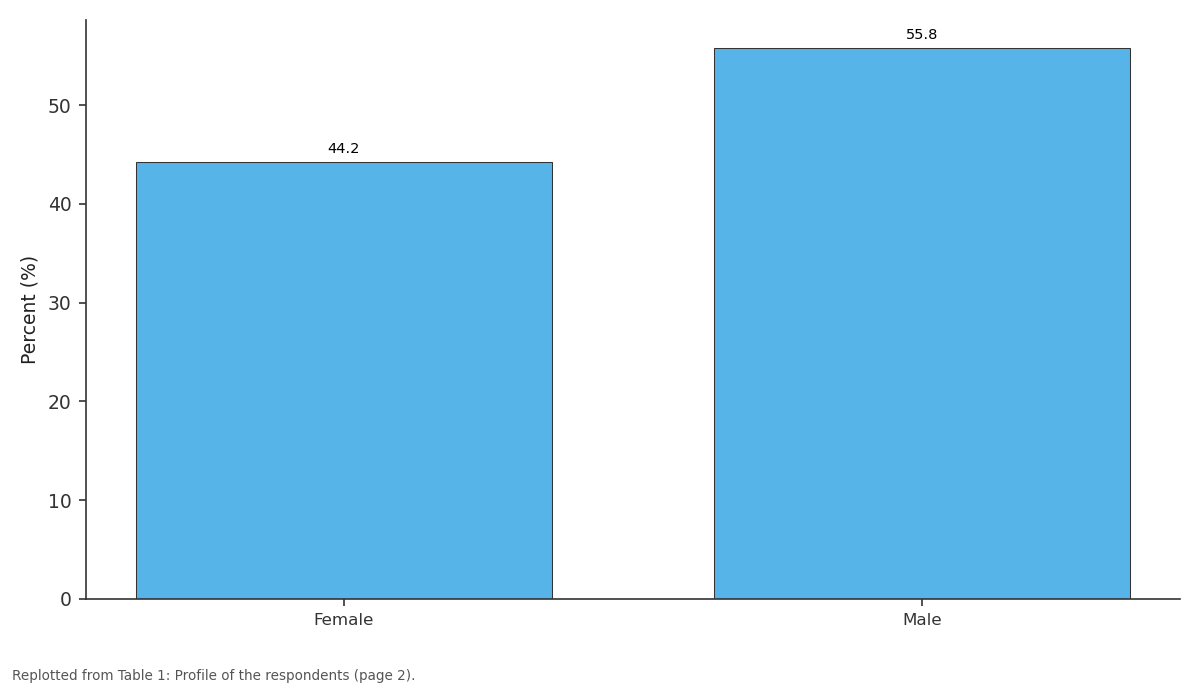
Percent (%): Female vs Male
Replotted from Table 1 (page 2) of the original paper. Every bar is the paper's own table value.
View source evidence ↗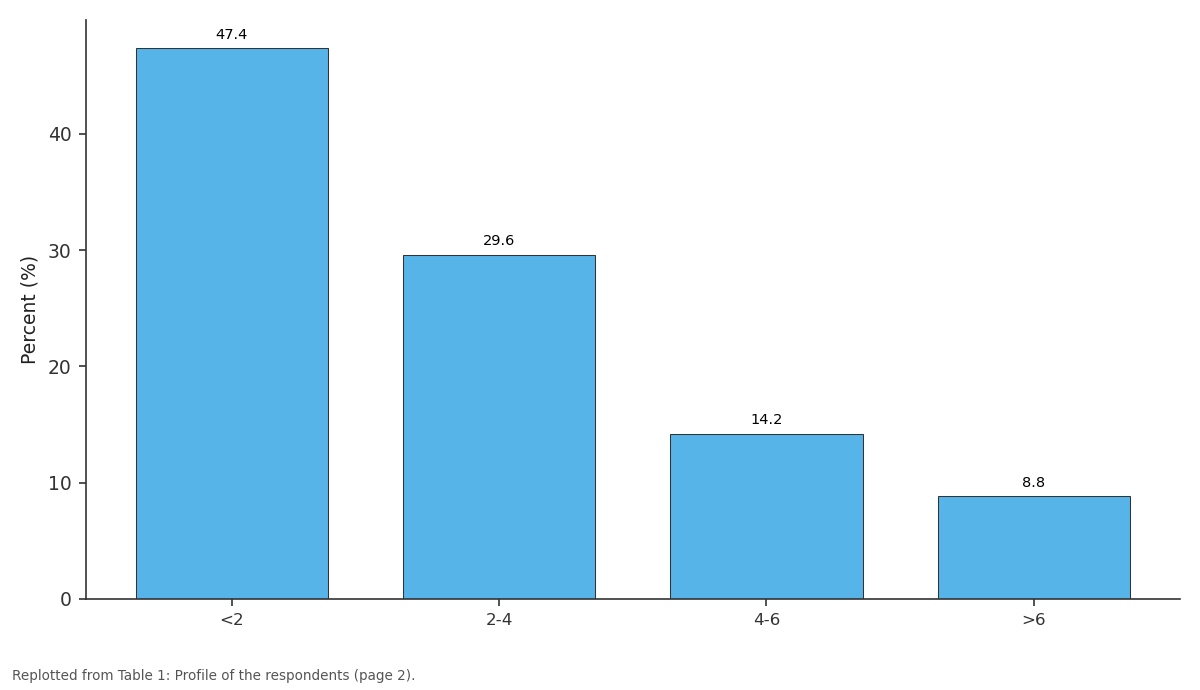
Percent (%): <2 vs 2-4 vs 4-6 vs >6
Replotted from Table 1 (page 2) of the original paper. Every bar is the paper's own table value.
View source evidence ↗Figures & tables
From the original paper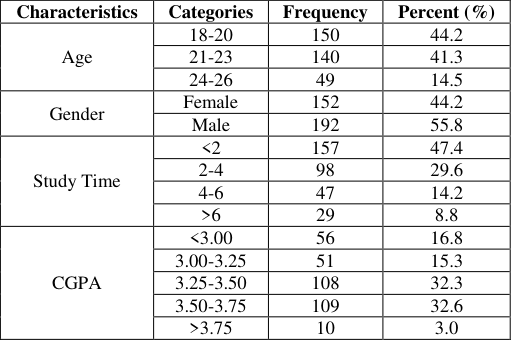 Table 1
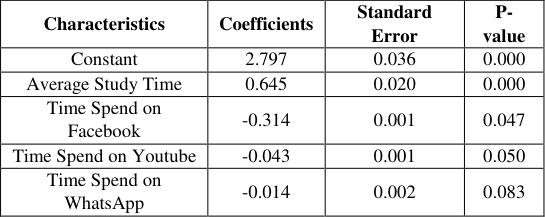 Table 3
 Table 4
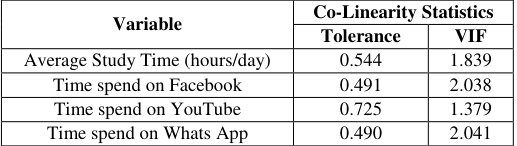 Table 2
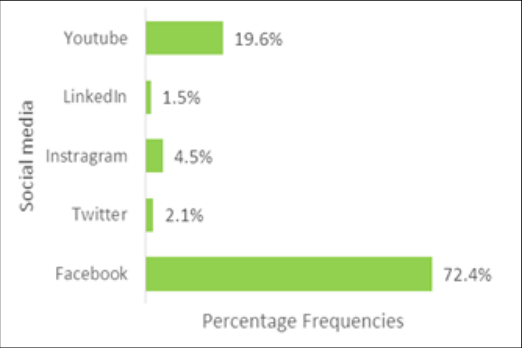 Figure 1
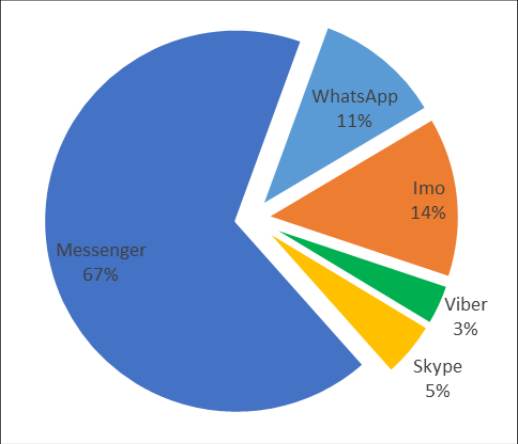 Figure 2
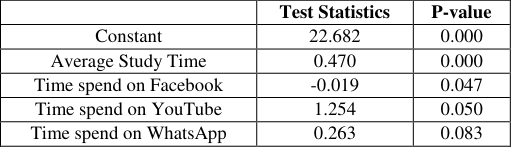 Table 5
Introduction
Social media is defined as forms of electronic communication (such as websites) through which people creates online communication to share information, ideas, personal messages etc. Social media has become very popular and important to all ages of people. It contains several channels like audios/videos callings, blogging, communicating, texting, sharing contents all over the world and so many characteristics. At present social media is becoming a prominent part of life for many youth today. The uses of social media are increasing rapidly all over the world. In recent years, people are shifting from watching television and listening to radios to use social media. Thus the social media is impacting on human being living styles and on society especially on the students. In spite of having many positive aspects, there are many risks that come with the use of sites such as less study time, poor academic performance due to the heavy participation on social media networks and decadence of social behavior etc. In order to make the right choices about social media we must explore the current scenario by doing the research on the topic thoroughly. Now a day's people are introduced with various types of social media such as Facebook, Twitter, Whats App, Linked In and so on. These are helping one to communicate with another instead of long distance. Thus technology is not only making people advanced, but also making them social. People from different stages are getting the benefits from the social media. Specially, students from schools, colleges and universities are being interested to get connected with various social media through Smartphone, computer and other technologically improved electronic devices. Lin et al. (2011) focusing on a study conducted primarily on the Facebook outcomes, which are used by international students in the USA shown that social media is one of the most important factors that affect students' academic performance. The researchers found that Facebook usage contributed to student ability to participate socially and culturally in their new environment. Choney, (2010) [2] , Meh Mood & Taswir, (2013) [10] , Kist (2008) [7] , Jacobsen & Forste, (2011) [5] , believe that the use of technology such as internet is one of the most important factors that can influence educational performance of students positively or adversely. Junco, Heibergert, and Loken et al (2011) [6] a study is conducted on 132 students in order to examine the relationship of social media and engagement of students with it and social media and grades of students. To examine this relationship the students were divided into two groups, one group use twitter and the other group did not use twitter account. It was used to make discussions about study material, organize the study groups in a manner, also post the announcements of class, and remain in touch with class fellows. Junco and his coworkers (2011) [6] surprised that the students of Twitter group achieve greater GPAs and higher scores than the other group. Martin, (2008) and Lusk, (2010) [8] also found that most of the people used social media like Facebook, Blogs, Twitter, My Space and LinkedIn for the purpose of communication, sharing photos as well as videos. However for the purpose of this study social media is captured within the use of internet through Facebook, WhatsApp, Twitter, Skype, Myspace as well as Yahoo Messenger for communication sharing of ideas, sharing of photos and videos by users. The increased use of Social Networking Websites has become an international phenomenon in the past several years. Shambare et al. (2012) [11] conduct a study on Social networking habits among students and shows that Facebook is most widely used by a large number of students and have multiple effects on student's life. The high speed and quickly approach to internet and the development of smart phone technology are most important drivers behind the adoption and connectivity with social networking websites and conclude that SNS enhance their knowledge level. In a study Ahmad (2011) [1] showed that social networking sites have number of advantages for their users, it enable the community to keep in touch with their peers and relink with old ones and help to find new friends according to your interest from all around the and a large number of persons are linking with these networks. Hence the network of social media is growing globally. Davis et al (2012) [3] refer to social media technology (SMT) as "web-based and mobile applications that allow individuals and organizations to create, engage, and share new usergenerated or existing content in digital environments through multi-way communication". Popular social network platforms on mobile and web applications include Facebook, Twitter, YouTube, Whats App, Instagram, snap chat, Google Plus etc. These platforms have specific roles, functions and modes of communication although their functions are mostly related. Modern technology has many positive aspects but in the same time, it may become hazardous for the users. It is therefore, the study is conducted, for the university students, how they feel and think the effects of social media on their academic performance and their behavior change. The main objective of this study is to explore the effects of social media participation on the student's academic performance.
Rationale of study
Rationale of study
Data and methodology
The study used a structured questionnaire to collect information on 345 students from Mawlana Bhashani science and Technology University by simple random sampling. Univariate analysis was used to explore the student characteristics and multiple regression analysis was used to show the influence of social media on students' academic performance. The important variables considered in this study are Average Study Time (Hours per day), Time spent on Facebook, Time spent on YouTube and Time spent on WhatSapp. SPSS and Microsoft office was used as software.
Result and Discussion
Result and Discussion
Profile of the respondent
The basic information of the respondent such as Age, Gender, Education etc. are showed in Table 1. The table shows that majority (55.8%) of the respondents was male. The table also reveals that 44.2 percent, 41.3 percent and 14.5 percent respondents' belonging to the age groups 18-20, 21-23 and 24-26 respectively. The table also shows that higher percentage of children obtained CGPA more than 3.50 followed by CGPA 3.25 to 3.50. It is very important to note that a very small percent (3.0 %) student achieved CGPA more than 3.75. One very important determinant of CGPA is study hours per day. The table shows that almost half of the students read on average less than two hours in a day. A very small portion of student reads more than 6 hours in a day on average. For this reasons higher CGPA obtained student are less compared to others student.
| Characteristics | Categories | Frequency | Percent (%) |
|---|---|---|---|
| Age | 18-20 | 150 | 44.2 |
| 21-23 | 140 | 41.3 | |
| 24-26 | 49 | 14.5 | |
| Gender | Female | 152 | 44.2 |
| Male | 192 | 55.8 | |
| Study Time | <2 | 157 | 47.4 |
| 2-4 | 98 | 29.6 | |
| 4-6 | 47 | 14.2 | |
| >6 | 29 | 8.8 | |
| CGPA | <3.00 | 56 | 16.8 |
| 3.00-3.25 | 51 | 15.3 | |
| 3.25-3.50 | 108 | 32.3 | |
| 3.50-3.75 | 109 | 32.6 | |
| >3.75 | 10 | 3.0 |
Table text extracted from the original PDF; superscript letters are shown inline. The original table image is below.
View original table image
Students' favorite social media
The respondents were asked about their most favorite social media. The findings of this analysis are described in Figure 1 below. The majority respondents preferred Facebook (72.4%) and YouTube (19.6%) followed by Instagram, LinkedIn and Twitter. Figure 2 shows that, the highest percentage of (67%) respondents' most favorite social media was messenger for talking over social media and lowest proportion of students (3%) liked Viber to talk. Multicollinearity check is very important to fit multiple regression models. The table 2 shows that the tolerance of average study time is 0.544, Time spent on Facebook is 0.491, Time spent on YouTube is 0.725 and Time spent on Whats App is 0.490 meaning the tolerance value of each variable is more than 0.2. The VIF value of Time spent on Facebook is 2.038, Time spent on YouTube is 1.379, and Time spent on Whats App is 2.041 meaning the VIF value of each variable is less than 10. Since all the tolerance value is more than 0.2 and VIF value is less than 10 of each independent variable, so this research is free from Multicollinearity.
| Variable | Co-Linearity Statistics | — |
|---|---|---|
| Tolerance | VIF | |
| Average Study Time (hours/day) | 0.544 | 1.839 |
| Time spend on Facebook | 0.491 | 2.038 |
| Time spend on YouTube | 0.725 | 1.379 |
| Time spend on Whats App | 0.490 | 2.041 |
Table text extracted from the original PDF; superscript letters are shown inline. The original table image is below.
View original table image
Regression coefficients
The Regression Coefficients are the constants in the regression equation that tells about the change in the value of dependent variable corresponding to the unit change in the independent variable. The value coefficient of determination (R 2 =0.585) implies that 58.5% of the variation in academic results is explained by the variations in the average study time; time spend on Facebook, YouTube and WhatsApp. The observed R 2 suggests that the multiple regression line fit the data reasonably. The other 41.4% variations not explained by the repressors are considered as for other explanatory variables that are not considered in this study. The result in the above table, the multiple regressions equation can be defined as, 𝑦 ̂= 2.797 + 0.645𝑥 1 -0.314𝑥 2 -0.043𝑥 3 -0.014𝑥 4 According to the fitted model, if the influences of the independent variables are not considered then the average CGPA is 2.797. The equation also shows that, there is positive influence of average study time(X1); negative influence of time spent on Facebook (X2), time spent on YouTube (X3) and time spent on WhatsApp (X4). That indicates that the average academic results increase for spending more time on study and academic results decrease for spending more time on social media. 4 shows that the p-value is 0.00(<0.05). Therefore, there is sufficient evident to reject the null hypothesis at 5% level of significant. It means that the average study time, time spends on Facebook, YouTube and WhatsApp significantly affect the student's academic performance.
F-test
F-test
t-test
The t-test is used to determine whatever there is any partial effect of each independent variables to the dependent variable. Table 5 shows that, the average study time; time spend on Facebook and YouTube have partially significant effects on student's academic performance. But the partial effect of time spend on WhatsApp is insignificant.
| — | Test Statistics | P-value |
|---|---|---|
| Constant | 22.682 | 0.000 |
| Average Study Time | 0.470 | 0.000 |
| Time spend on Facebook | -0.019 | 0.047 |
| Time spend on YouTube | 1.254 | 0.050 |
| Time spend on WhatsApp | 0.263 | 0.083 |
Table text extracted from the original PDF; superscript letters are shown inline. The original table image is below.
View original table image
Conclusion and Recommendation Conclusion
The primary objective of the research undertaken was to throw light on how effectively the usage of social networking sites has affected the students by evaluating both the positive and negative aspects. Social media serve to students' purpose of connecting them with people all across the globe by not hampering their working hours and schedules. Despite the several benefits that come with the participation of the students on social media networks, its misuse could badly affect the academic performance. The findings of this study showed that, there is positive consequence of average study time and negative impact of time spending on various social networking websites on students' academic performance. It indicates that, the educational performance increases by giving more time on study and decreases for spending more time on social networking websites. Above all, in the era of globalization and technology, a single day can't be thought without using social networking sites, but should be used in a limited and positive way without getting addicted.
Recommendation
Based on the findings and conclusions of this study, the following recommendations are made, The teachers may encourage the students to minimize time wastage on chatting and other irrelevant engagements which are not of major importance by counseling about the negative influence of social media. Bangladesh Telecommunication Regulatory Commission (BTRC) and parents should monitor activities of the students on social media in order to protect them pornographic and other unwarranted materials. The use of LinkedIn should be increased because the site gives the facilities of linking employers with potential employees, provides a place for individuals to post resumes and offers referrals and for employers to post current job openings.
Figures and tables from the paper
| Characteristics | Coefficients | Standard Error | P- value |
|---|---|---|---|
| Constant | 2.797 | 0.036 | 0.000 |
| Average Study Time | 0.645 | 0.020 | 0.000 |
| Time Spend on Facebook | -0.314 | 0.001 | 0.047 |
| Time Spend on Youtube | -0.043 | 0.001 | 0.050 |
| Time Spend on WhatsApp | -0.014 | 0.002 | 0.083 |
Table text extracted from the original PDF; superscript letters are shown inline. The original table image is below.
View original table image
| — | Sum of Squares | df | F | P-Value |
|---|---|---|---|---|
| Regression | 2.53 | 5 | 6.525 | 0.000 |
| Residual | 11.94 | 154 | 0.078 | |
| Total | 14.47 | 159 |
Table text extracted from the original PDF; superscript letters are shown inline. The original table image is below.
View original table image
References
11 in the original paper- Ahmad A. Rising of Social Network Websites in India Overview. International Journal of Computer Science and Network Security. 2011; 11:155-158.
- Choney S. Facebook Use Can Lower Grades by 20 Percent, Study Says, 2010. http://www.msnbc.com/id/39038581/ns.technology_and_ science-tech_and_gadgets/.Retrieved 14/08/13
- Davis CHF, Canche MSG, Deil-Amen R, Rios-Aguilar C. Social Media in Higher Education: A Literature Review and Research Directions. Arizona: The Center for the Study of Higher Education at the University of Arizona and Claremont Graduate University, 2012.
- Heeter LS, Rainie L, Purcell K. Social networking sites and our lives, 2011. http://pewinternet.org/Reports/2011/Technology-andsocial-networks.aspx, pp 3-61.
- Jacobsen WC, Forste R. The Wired Generation: Academic and Social, 2011.
- Junco, Heibergert, Loken. The Impact Of Social Media And Social Networks On Education And Students Of Pakistan. IJCSI International Journal of Computer Science, 2011; 9:407-410.
- Kist W. I gave up MySpace for lent: New teachers and social networking sites. Journal of Adolescent & Adult Literacy. 2008; 52(3):245.247
- Lusk B. Digital Natives and Social Media Behaviors: An Overview. The Prevention Research. 2010; 17:3-6.
- Martin JL, Yeung K. Persistence of close personal ties over a 12-year period. Social Networks. 2006; 28:331362.
- Meh Mood S, Taswir T. the effect of social networking site on the Academic Performance on students in college of applies sciences, Nizwa, Oman. International Journal of Arts and Commence. 2013; 2(1):111-123
- Shambare R, Rugimbana R, Sithole N. Social networking habits among students. African Journal of Business Management. 2012; 6(2):578-786.
Cited by 15
From OpenAlex, OpenCitations and reference lists read by Scinovex
- Tingkat Kecanduan Media Sosial pada Remaja ↗
Rizki Aprilia, Aat Sriati, Sri Hendrawati · Majalah Keperawatan Unpad/Journal of Nursing Care · 2020
Aktivitas penggunaan media sosial di Indonesia didominasi oleh kalangan remaja. Media sosial memberikan dampak negatif pada remaja, salah satunya adalah kecanduan. Hal tersebut dikarenakan dapat mengganggu berbagai kegiatan, diantaranya belajar. Penelitian ini bertujuan untuk mengetahui gambaran tingkat kecanduan media sosial pada remaja. Penelitian ini merupakan penelitian deskriptif kuantitatif. Populasi pada penelitian ini adalah siswa-siswi SMAS Plus Al-Falah kelas X, XI…
❝ 113PDF - Impact of social media on student life ↗
Tuli Bhumika, Jyoti, Gautam Neha, Kumar Santosh · i-manager s Journal on Information Technology · 2022
The Internet has changed everyone's life. Social networks may have only been initiated with the help of the Internet. Today's generation is using the internet, which means social media like Snap-chat, Twitter, Facebook, etc., is increasing. Hence, the purpose of this paper is to understand the positive and negative outcomes of social media. In addition, this paper discusses the current…
❝ 16 - Association between social media addiction and sleep quality among undergraduate nursing students: a cross-sectional study ↗
Lilis Setyowati, Anggraini Dwi Kurnia, Windi Lestari, Sirikul Karuncharernpanit · Frontiers of Nursing · 2023
Abstract Objectives To examine the association between social media addiction and sleep quality among undergraduate nursing students. Methods This research is an analytical observational study with a cross-sectional approach. The sampling technique was purposive sampling of 150 nursing students at a private university in Malang, Indonesia. Respondents filled out a questionnaire about self-identity, a sleep quality questionnaire from the Pittsburgh…
❝ 9PDF - Treatment for social media addiction with hypnotic-oriented counseling ↗
Gian Sugiana Sugara, Rikza Fadhilah · Discover Psychology · 2024
Abstract Background Research has identified social media addiction as a new and often unrecognized clinical disorder that impacts users' ability to control social media use which can lead to relational, work, and social problems. Adolescent who experiences addiction to social media will be very dependent and willing to spend a long time accessing social media so that they experience addiction…
❝ 6PDF - Kontribusi Kontrol Diri terhadap Kecanduan Media Sosial Tiktok pada Remaja di Kabupaten Bekasi ↗
Wulan Puspitasari, Zulian Fikry · Jurnal Pendidikan Tambusai · 2023
Tujuan penelitian ini adalah untuk mengetahui kontribusi kontrol diri terhadap kecanduan media sosial Tiktok pada remaja di Kabupaten Bekasi. Jenis penelitian yang digunakan dalam penelitian ini menggunakan metode kuantitatif. Populasi penelitian adalah remaja berusia 13-18 tahun berdomisili di Kabupaten Bekasi dan menggunakan media sosial Tikok minimal 5 jam sehari dengan menggunakan teknik sampel accidental sampling. Subjek penelitian ini adalah sebanyak…
❝ 3PDF - Social Media Application for Recruitment Using Pythagorean Fuzzy ↗
Ganapavarapu Leela Krishna · Iraqi Journal of Science · 2022
The growth of social media is now utilized all over the world. In the past several years social media is used to communicate between person for information sharing and entertainment but now social media is also used for the hiring. This work collects data through questionnaire and online dataset on the recruitment process for three social media i.e. Facebook, Twitter,…
❝ 3PDF - EFEK KECANDUAN MEDIA TIK TOK TERHADAP PERILAKU SOSIAL REMAJA ↗
Lisa Sis Mona, Irman Irman · JURNAL MAHASISWA BK AN-NUR BERBEDA BERMAKNA MULIA · 2024
Tiktok social media is one of the fastest growing social media platforms in the world, excessive use of social media by teenagers will have a negative impact on academic performance at school, teenagers become lazy and irresponsible with their duties, resulting in teenagers not having time to study. This research uses qualitative research with a descriptive approach. A person's social…
❝ 2PDF - PENGARUH HARGA DIRI DAN ADIKSI SOSIAL MEDIA TERHADAP TINGKAT KECEMASAN SOSIAL PADA REMAJA YANG MENGGUNAKAN TIKTOK ↗
Kadek Anggita Darma Putri, Stefani Virlia · Jurnal Psikologi · 2023
Pertumbuhan media sosial sangat cepat di Indonesia. Media Sosial sudah menjadi hal yang penting di kehidupan remaja. Tiktok merupakan media sosial yang akhir - akhir ini populer di kehidupan remaja. Tidak hanya berdampak baik, penggunaan media sosial juga mampu berdampak buruk bagi remaja seperti meningkatnya kasus kecemasan sosial yang dialami remaja. Peneliti menduga jika kecemasan sosial yang dialami remaja bisa…
❝ 2PDF - Hubungan Self-Regulated Learning Dalam Pembelajaran IPS dengan Adiksi Media Sosial Tiktok pada Peserta Didik di SMP Pasundan 12 Bandung ↗
Ressa Risma Yanti, Acep Supriadi, Muhammad Arief Rakhman · Moderasi Jurnal Studi Ilmu Pengetahuan Sosial · 2025
One of the most popular social media platforms among students is TikTok, a short-video sharing platform widely used for entertainment. However, excessive and uncontrolled use of TikTok can negatively impact learning activities, such as decreasing the ability to manage time, plan tasks, and complete academic responsibilities independently. These abilities are referred to as Self-Regulated Learning (SRL). In social studies (IPS)…
❝ 1PDF - LITERATURE REVIEW: THE RELATIONSHIP OF THE USE OF SOCIAL MEDIA TO THE INCIDENCE OF ANXIETY IN ADOLESCENTS IN INDONESIA ↗
Indah Ayu Afsari, Syifaul Lailiyah, Mohammad Zainal Fatah · Journal of Community Mental Health and Public Policy · 2023
Background: Social media is an example of technological advances. Social media users can experience social media addiction due to the high usage. Adolescents who are socially addicted have a higher potential for experiencing social anxiety disorder or anxiety. Purpose: This literature review study was to examine the relationship between social media use and anxiety disorders in adolescents in Indonesia. Methods:…
❝ 1PDF - Hubungan antara Self Esteem dengan Problematic Internet Use pada Siswa Sekolah Menengah Atas (SMA) di Sumatera Barat ↗
Putri Satya Anggara, Farah Aulia · TSAQOFAH · 2025
This study aims to examine the relationship between self-esteem and problematic internet use (PIU) among high school students in West Sumatra. A correlational quantitative approach was used with purposive sampling. The study involved 357 students who met the criterion of using the internet for more than five hours per day. The research instruments were validated self-esteem and PIU scales. Data…
❝ 0PDF - Exploring the Resilience among Pre-Service Teachers in an Evolving Academic Environment through Photovoice ↗
Esell Grace M. Gomez, Analyn S. Clarin, Genelyn R. Baluyos · 2025
In today’s fast-evolving academic landscape, pre-service teachers (PSTs) face increased demands in navigating digital tools, diverse classrooms, and emotional stress, particularly during their teaching internships. This study explored the resilience of pre-service teachers in an evolving academic environment in one of the private higher institutions in Misamis Occidental during the academic year 2024-2025. Using a qualitative approach through a participatory…
❝ 0PDF - IMPLEMENTASI LAYANAN BIMBINGAN KELOMPOK MELALUI TEKNIK SELF-MANAGEMENT TERHADAP PERILAKU KECANDUAN MEDIA SOSIAL SISWA KELAS XII SMAN 1 MARGAASIH ↗
Muhamad Iqbal Adhari, Nandang Rukanda, Tuti Alawiyah · FOKUS (Kajian Bimbingan & Konseling dalam Pendidikan) · 2022
This research is motivated by a phenomenon that occurs in SMA Negeri 1 Margaasih where some students experience social media addiction. As a from effort made to deal with these problems group guidance services with self-management techniques can be an alternative to reduce social media addiction behavior. Because it aims to make students able to determine the implementation of group…
❝ 0PDF - Harnessing Social Media to Improve Educational Performance of Adolescent Freshmen in Universities ↗
Munyaradzi Zhou, Cyncia Matsika, Tinashe Gwendolyn Zhou, Wilfreda Indira Chawarura · Advances in human and social aspects of technology book series · 2021
Social media use in different industries and commerce is high. Little exists on harnessing Facebook and YouTube to improve the educational performance of adolescent students. Researchers support that the use of social media has a positive correlation with educational performance. However, ‘little' or ‘no' research has been done on how social media platforms are customized to improve the academic performance…
❝ 0 - Analyses of Social Networks and their Social or Antisocial Impact ↗
Majlinda Fetaji · SEEU Review · 2019
Abstract The research focus is set in the investigation of positive and negative aspects of use of social networks using a ‘bifocal approach’ to social networks analysis. Our bifocal approach uses qualitative approach reviewing published literature primarely blogs, forums, web sites, etc and interchangeably compares and conveys the results with focus groups. The objective of the research study is to…
❝ 0PDF