
Research article · 2019 · Full text
International Journal of Statistics and Applied MathematicsPrime ideals and ideal symmetry in near- rings
Volume 4(5) · Pages 140–142
Research areasRings, Modules, and AlgebrasAdvanced Topics in Algebra
Abstract
Author-writtenThe most interesting and active field of current research in mathematics is theory of near- ring due to its wide application in coding theory, group theory, geometry, cryptography and block- designing etc. Near rings are one of the generalized structure of rings. Modern ring theory has very active mathematical discipline and studying rings in their own right. In this paper we study about 3- prime ideals and radicals in a Near-ring. Also, we study about 3- prime ideal and ideal symmetry in a Near-ring and its inter relationship between them.
Summary
Source-checkedPlain-language reading of the full paper, prepared with AI and checked against the text. Each point links to the authors' own words.
Why it matters
- Near-ring theory is a highly active area of mathematical research because it has broad applications in fields such as cryptography, coding theory, and geometry. View evidence ↗
- Near-rings serve as a generalized structure of traditional rings. View evidence ↗
The question
- The study aims to investigate 3-prime ideals and radicals in near-rings, as well as the relationship between 3-prime ideals and ideal symmetry. View evidence ↗
What they did
- The author defines a 3-prime ideal $I$ of a near-ring $N$ as one where $aNb ⊆ I$ implies that either $a$ or $b$ must be in $I$. View evidence ↗
- The study utilizes a graph $G_I(N)$ and defines it as 'ideal symmetric' if every pair of adjacent vertices $x$ and $y$ has at least one vertex with a degree equal to the degree of the zero vertex. View evidence ↗
What they found
- All equi-prime ideals are 3-prime ideals, although a 3-prime near-ring is not necessarily an equi-prime near-ring. View evidence ↗
- If an ideal $I$ is 3-prime, it functions as a strong vertex cut of the graph $G_I(N)$. View evidence ↗
- For a minimal 3-prime ideal $I$ of a near-ring $N$, the strong vertex connectivity $K(G_I(N))$ is equal to the cardinality of $I$. View evidence ↗
- In a zero-symmetric near-ring $N$ with a 3-prime ideal $I$, an element $x$ belongs to $I$ if and only if its degree in $G_I(N)$ equals the degree of the zero vertex. View evidence ↗
- If $N$ is a zero-symmetric near-ring and $I$ is a 3-semi-prime ideal that acts as a strong vertex cut of $G_I(N)$, then $G_I(N)$ is an ideal symmetric graph. View evidence ↗
- For a 3-prime ideal $I$ of a near-ring $N$, the graph $G_I(N)$ is bipartite if and only if $I$ consists only of the zero element. View evidence ↗
- The edge connectivity of the graph $G_I(N)$ is equal to the cardinality of the 3-prime ideal $I$. View evidence ↗
- If $I$ is a 3-prime ideal and $I = {0}$, then the resulting graph $G_I(N)$ is a planar graph. View evidence ↗
- The graph $G_I(N)$ cannot be a cycle graph when $I$ is a 3-prime ideal of a near-ring $N$. View evidence ↗
What it means
- The author concludes the study by establishing the interrelationship between 3-prime ideals and ideal symmetry within the context of near-rings. View evidence ↗
Visual summary
1 visualsIllustrations explain the paper; they do not show study data.
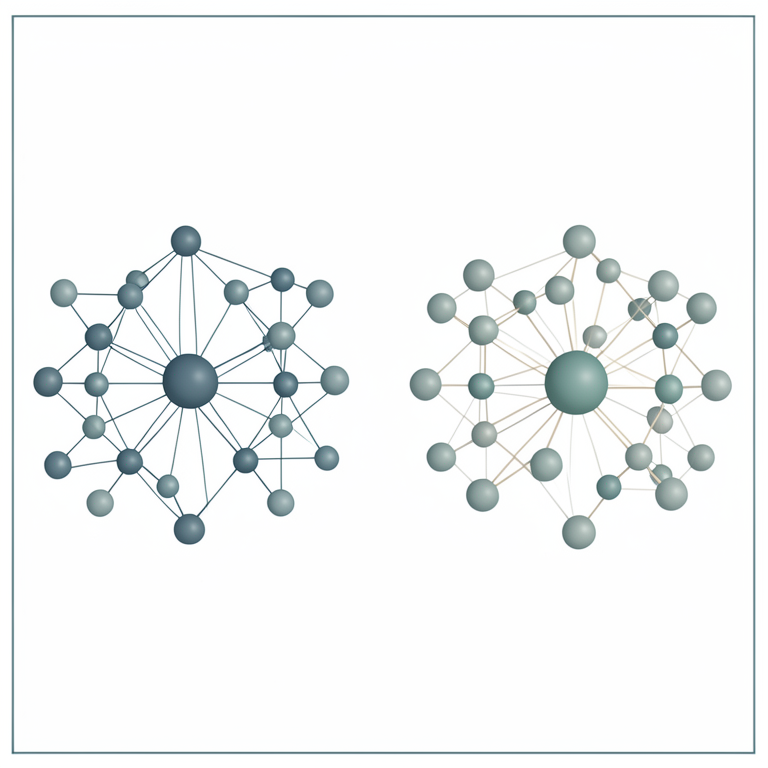
Ideal Symmetric Graph Concept
AI-generated conceptual illustration (A mathematical graph consisting of vertices and edges). It explains the idea and does not show study data.
View source evidence ↗Introduction
The most interesting and active field of current research in mathematics is theory of near-ring due to its wide application in coding theory, group theory, geometry, cryptography and blockdesigning etc. Near rings are one of the generalized structure of rings, The study and research on near-rings is very systematic and continuous. Near-rings around in all directions of mathematics and continuous research is being conducted, which show that their structure has power and beauty all its own. Modern ring theory has very active mathematical discipline and studying rings in their own right. The key ideas important to near-ring were formed by L.E. Dickson in 1905. Actually he gave the concept of near-field. In 1930 Wieland studied nearrings which were not near-fields. In this paper we study about 3-prime ideals and radicals in a Near-ring. Also, we study about 3-prime ideal and ideal symmetry in a Near-ring and its inter relationship between them.
𝟏prime ideal
An ideal 𝐼 of a near-ring 𝑁 is called 3prime ideal, if 𝑎, 𝑏 ∈ 𝑁 and 𝑎𝑁𝑏 ⊆ 𝐼 implies either 𝑎 ∈ 𝐼 𝑜𝑟 𝑏 ∈ 𝐼 and 𝑁 is called 3prime near ring if {0} is a 3prime ideal of 𝑁.
Example: Let 𝑁 = {𝑜, 𝑎, 𝑏, 𝑐} be a near-ring with addition and multiplication are defined as: 0 + 0 = 0,0 + 𝑎 = 𝑎, 0 + 𝑏 = 𝑏, 0 + 𝑐 = 𝑐. 𝑎 + 0 = 𝑎, 𝑎 + 𝑎 = 0, 𝑎 + 𝑏 = 𝑐, 𝑎 + 𝑐 = 𝑏, 𝑏 + 0 = 𝑏, 𝑏 + 𝑎 = 𝑏, 𝑏 + 𝑏 = 0, 𝑏 + 𝑐 = 𝑎, 𝑐 + 0 = 𝑐, 𝑐 + 𝑎 = 𝑐, 𝑐 + 𝑏 = 𝑎 and 𝑐 + 𝑐 = 0. 0.0 = 0, 0. 𝑎 = 0, 0. 𝑏 = 0, 0. 𝑐 = 0𝑎. 0 = 𝑎, 𝑎. 𝑎 = 𝑎, 𝑎. 𝑏 = 0, 𝑎. 𝑐 = 𝑎, 𝑏. 0 = 𝑏, 𝑏. 𝑎 = 𝑏. 𝑏. 𝑏 = 𝑏, 𝑏. 𝑐 = 𝑏, 𝑐. 0 = 𝑏, 𝑐. 𝑎 = 𝑐, 𝑐. 𝑏 = 𝑏, 𝑐. 𝑐 = 𝑐. Then {𝑜, 𝑎} is a 3prime ideal of 𝑁. Proposition 1.1: Every equi-prime ideal is 3-prime ideal but every 3-prime near ring need not be an equi-prime near ring.
Note: Equi-prime ideal ⇒ 3prime ideal-⇒ prime ideal.
Example: Let (𝑁, +, . ) be any group with at least three elements. We define multiplication on N as: 𝑎. 𝑏 = 𝑎, 𝑖𝑓 𝑏 ≠ 0 𝑎𝑛𝑑 0, 𝑖𝑓 𝑏 = 0 Then (𝑁, +, . ) is a zero-symmetric near-ring. Therefore for any non zero elements 𝑥, 𝑦 ∈ 𝑁 ⇒ 𝑥𝑛𝑦 = 𝑥 ≠ 0. Hence 𝑥𝑁𝑦 ≠ 0. This shows that N is 3prime. Let 0 not element of {𝑥, 𝑦} ⊆ 𝑁 such that 𝑥 ≠ 𝑦 then for each element n of N. 𝑥𝑛𝑥 = 𝑥, if 𝑛 ≠ 0 = 𝑥𝑛𝑦 𝑎𝑛𝑑 0, if 𝑛 = 0 Thus 𝑥𝑛𝑦 = 𝑥𝑛𝑥 for all 𝑛 ∈ 𝑁 but, 𝑥 ≠ 𝑦. Hence N is not an equi-prime near-ring. Corollary 1.2: Let 𝐼 and 𝐽 be ideals of a near ring 𝑁 such that 𝐼 ⊆ 𝐽, then 𝐺 {0} (𝑁) ⊆ 𝐺 𝐼 (𝑁) ⊆ 𝐺 𝐽 (𝑁) ⊆ 𝐺 𝑁 (𝑁).
Proof: Since 𝐼 ⊆ 𝐽 so, {0} ⊆ 𝐼 ⊆ 𝐽 ⊆ 𝑁. Therefore, we have the set of edges in 𝐺 {0} (𝑁) ⊆ 𝑇he set of edges in 𝐺 𝐼 (𝑁) ⊆ The set of edges in 𝐺 𝐽 (𝑁) ⊆ 𝑇he set of edges in 𝐺 𝑁 (𝑁). Hence from these we have 𝐺 {0} (𝑁) ⊆ 𝐺 𝐼 (𝑁) ⊆ 𝐺 𝐽 (𝑁) ⊆ 𝐺 𝑁 (𝑁). Definition: Let 𝐺 be a graph of with vertex set 𝑉(𝐺). A strong vertex cut of a graph 𝐺 is a subset 𝑆 ⊆ 𝑉(𝐺) such that (𝐺 -𝑆) is totally disconnected. The strong vertex connectivity of 𝐺 is define as (𝐺) = 𝑚𝑖𝑛(𝑛 ≥ 0, where 𝐾(𝐺) = strong vertex connectivity of 𝐺 there exists a strong vertex cut 𝑆 ≤ 𝑉(𝐺) such that |𝑆| = 𝑛 ). Theorem 1.5: Let 𝐼 be an ideal of a near ring 𝑁. If 𝐼 be 3prime, then 𝐼 is a strong vertex cut of 𝐺 𝐼 (𝑁). If 𝐼 is a 3semi-prime ideal of 𝑁 and a strong vertex cut of 𝐺 𝐼 (𝑁), then 𝐼 is 3prime. Converse of this theorem does not hold if the condition that 𝐼 is 3semiprime is omitted.
Example: Consider the graph 𝐺 𝐼 (𝑉 4 ) where 𝐼 = {0}. Here {0} is a strong vertex cut of 𝐺 𝐼 (𝑍 4 ), however 𝐼 = {0} is not a 3prime ideal since 2𝑁2 ⊆ {0}𝑏𝑢𝑡 2 ∉ 𝐼 = {0}. Example: In the graph 𝐺 𝐼 (𝑁), where 𝑁 = {0, 𝑎, 𝑏, 𝑐}, 𝐼 = {0, 𝑎} we can observe that 𝐼 is a 3-prime ideal of 𝑁. Example: In the graph 𝐺 𝐼 (ℤ 6 ), 𝐼 = {0}, we observe that 𝐼 = {0} is not a 3-prime ideal of ℤ 6 . Since 𝐼 = {0} is not a strong vertex cut.
Proposition 1.6: Let 𝐼 be a minimal 3prime ideal of a near-ring 𝑁, then 𝐾(𝐺 𝐼 (𝑁)) = |𝐼|.
Proof: Let 𝐼 be a minimal 3prime ideal of a near-ring 𝑁 that is 𝐼 ≠ {0} and if there is an another 3-prime ideal 𝐽 such that {0} ⊂ 𝐽 ⊂ 𝐼 then either 𝐽 = {0} or 𝐽 = 𝐼. Since 𝐼 is a minimal 3-prime ideal so, 𝐼 is a strong vertex cut of 𝐺 𝐼 (𝑁). If we remove 𝐼 from 𝐺 𝐼 (𝑁), then it is a totally disconnected graph. Hence 𝐾(𝐺 𝐼 (𝑁)) = |𝐼|. Theorem 1.7: Let 𝐼 be a 3prime ideal of a near-ring 𝑁 and 𝑥 be a vertex in 𝐺 𝐼 (𝑁) if 𝑑𝑒𝑔(𝑥) = 𝑑𝑒𝑔(0), then 𝑥 ∈ 𝐼. Theorem 1.8: Let N be a zero-symmetric near ring 𝑁 and 𝑥 be a vertex in 𝐺 𝐼 (𝑁) if 𝑥 ∈ 𝐼, then 𝑑𝑒𝑔(𝑥) = 𝑑𝑒𝑔(0). Theorem 1.8: Let 𝑁 be a zero-symmetric near ring 𝑁 and I be a 3prime ideal of 𝑁, then 𝑥 ∈ 𝐼 if and only if 𝑑𝑒𝑔(𝑥) = 𝑑𝑒𝑔(0) in 𝐺 𝐼 (𝑁). Theorem 1.9: Let |N| =n and 𝐼 be an ideal of a near ring 𝑁 then, if 𝑁 is a zero-symmetric near ring and 𝐼 is a minimal 3prime ideal of 𝑁, then |𝐼| = 𝐾(𝐺 𝐼 (𝑁)) ≤ 𝛿(𝐺 𝐼 (𝑁)).
Where 𝛿(𝐺 𝐼 (𝑁)) = minimum degree of the vertex in 𝐺 𝐼 (𝑁).
Prime ideal and Ideal symmetry
Ideal symmetric graph: The graph (𝐺 𝐼 (𝑁))is said to be ideal symmetric if for every pair of vertices 𝑥, 𝑦 in (𝐺 𝐼 (𝑁)) with an edge between them, either 𝑑𝑒𝑔(𝑥) = 𝑑𝑒𝑔(0) or, 𝑑𝑒𝑔(𝑦) = 𝑑𝑒𝑔(0).
Example: (𝐺 𝐼 (ℤ 4 )) is the ideal symmetry graph, where 𝐼 = {0, 2}𝑚𝑜𝑑(4) and ℤ 4 = {0,1,2,3}𝑚𝑜𝑑(4).
Proposition 2.1:
The ideal symmetry of 𝐺 𝐼 (𝑁) implies the symmetry determine by the automorphism group of 𝐺 𝐼 (𝑁).
Proposition 2.2:
Let 𝑁 be zero symmetric near-ring and 𝐼 be a 3semi-prime ideal of 𝑁 and If 𝐼 is a strong vertex cut 𝐺 𝐼 (𝑁) then, 𝐺 𝐼 (𝑁)is an ideal symmetric graph.
Proof: Suppose 𝑁 be zero-symmetric near-ring and 𝐼 be a 3semi prime ideal of 𝑁. Also if 𝐼 be a strong vertex cut of 𝐺 𝐼 (𝑁). So, 𝐼 is a 3prime ideal of 𝑁. Hence 𝐺 𝐼 (𝑁) is an ideal symmetric graph.
Proposition 2.3:
Let 𝑁 be a commutative ring with unit element 1. Let 𝐼 be completely semi-prime ideal of 𝑁. If 𝐺 𝐼 (𝑁)is ideal symmetric, then 𝐼 is completely -prime and 𝐼 is a strong vertex cut of 𝐺 𝐼 (𝑁).
References
8 in the original paper- Anderson FW, Fuller KR. Rings and Categories of Modules, 2 nd Edition, Springer-Verlag, New York, 1992.
- Bhavanari S, Vijyakumari. Graph a near-ring with respect to an ideal, Comm. Algebra, 2010; 38:1957-1967.
- Bondy JA, Murty USR. Graph theory with applications, 5 th Edition, The Macmillan Press Ltd, London, 1982.
- Booth GL, Groenewald NJ, Veldsman S. A Kurosh-Amitsur prime radicals for near rings, Comm. Algebra, 1990; 18(9):3111-3122.
- Ferrero CC, Ferrero G. Near-rings: Some developments linked to Semi-groups and groups, Kluwer Academic Publishers, Amsterdam, Netherland, 2002.
- Groenewald NJ. The completely prime radical in near-rings, Acta Math. Hungar, 1988; 51:301-305.
- Groenewald NJ. Different prime ideals in near-rings, Comm. Algebra, 1991; 19:2667-2675.
- Veldsman S. On equi-prime near-rings, Comm. Algebra, 1992; 20(9):2569-2587.
Cited by 1
From OpenAlex, OpenCitations and reference lists read by Scinovex
- Purity relative to a cyclic module
Ashok Kumar Pandey · International Journal of Statistics and Applied Mathematics · 2020
We study relative projectivity and injectivity classes of exact sequences with respect to the classes of cyclic modules. A characterization of cyclic pure exact sequences has given in terms of exactness of a certain sequence of submodules of the modules appearing in the given sequence. We also study the concept of relative divisibility of elements in submodules (known as - purity). We give the generalization of the proposition of Stenstrom. We characterize the preservation of exactness by cyclic modules where be a left ideal of the ring . We also relate the purity in Quasi- projective module [