
Research article · 2020 · Full text
International Journal of Statistics and Applied MathematicsPurity relative to a cyclic module
Volume 5(3) · Pages 55–58
Research areasRings, Modules, and AlgebrasAlgebraic structures and combinatorial modelsCommutative Algebra and Its Applications
Abstract
Author-writtenWe study relative projectivity and injectivity classes of exact sequences with respect to the classes of cyclic modules. A characterization of cyclic pure exact sequences has given in terms of exactness of a certain sequence of submodules of the modules appearing in the given sequence. We also study the concept of relative divisibility of elements in submodules (known as - purity). We give the generalization of the proposition of Stenstrom. We characterize the preservation of exactness by cyclic modules where be a left ideal of the ring . We also relate the purity in Quasi- projective module [9]. We also try to define Copure for a class of modules and co-relate Copure injective or Copure projective with it. We derive some results dualize certain results of R.B. Warfield.
Summary
Source-checkedPlain-language reading of the full paper, prepared with AI and checked against the text. Each point links to the authors' own words.
Why it matters
- Purity is a fundamental concept used in the study of abelian groups and module categories, specifically within the context of left R-module categories. View evidence ↗
The question
- The paper aims to investigate various aspects of purity specifically relative to a fixed cyclic module R/I, where I is a left ideal. View evidence ↗
What they did
- The study is conducted using the framework of left R-modules, where R is a ring with identity that is not necessarily commutative. View evidence ↗
- The author employs a method of characterizing cyclic pure exact sequences by analyzing the exactness of specific sequences of submodules. View evidence ↗
- The research involves defining the concept of S-Copure for a class S of modules and relating it to S-Copure injective and projective modules. View evidence ↗
What they found
- A submodule N of M is R/I-pure if and only if for any element m in M where Im is contained in N, there exists an element m' in M such that Im' = 0 and (m - m') is in N. View evidence ↗
- Given a class S of left R-modules meeting specific criteria (containing representatives of all simple modules and having a set-based subclass S*), any module A can be embedded into an S-copure sequence where the middle module is a direct product of modules in S. View evidence ↗
- A module P is identified as S-copure injective if and only if it is a direct summand of a direct product of modules from the class S. View evidence ↗
- The author finds that if the ideal I is two-sided, the resulting cyclic module R/I is always a quasi-projective module. View evidence ↗
What it means
- The author concludes that the results presented dualize findings by R.B. Warfield and generalize purity results from abelian groups to general module categories. View evidence ↗
Visual summary
1 visualsIllustrations explain the paper; they do not show study data.
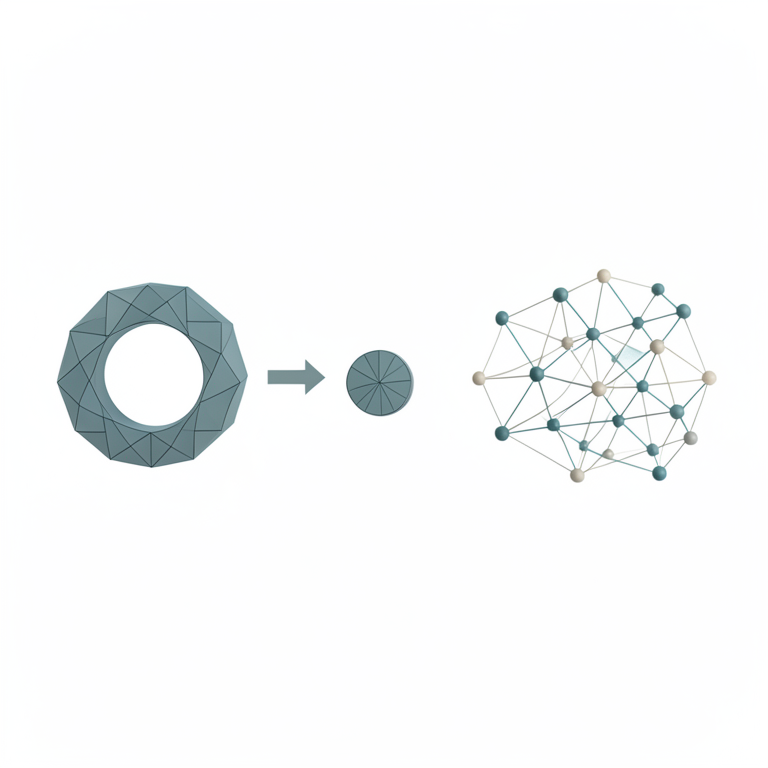
Study overview
AI-generated conceptual illustration (Abstract mathematical structures represented as geometric manifolds and interconnected nodes). It explains the idea and does not show study data.
View source evidence ↗Introduction
The notion of purity plays a fundamental role in the theory of abelian groups as well as in module categories. In similar manner module-purity plays an important role in the study of module categories. The aim of the present paper is to study some aspects of purity relative to a fixed cyclic module | for a left ideal . We try to give the characterization of cyclic pure exact sequences has given in terms of exactness of a certain sequence of submodules of the modules appearing in the given sequence. We also study the concept of relative divisibility of elements in submodules (known as RDpurity). We give the generalization of the proposition of Stenstrom [13] . We characterize the preservation of exactness by cyclic modules | where be a left ideal of the ring . We also relate the purity in Quasi-projective module [9] . We also try to define
Copure for a class of modules and corelate Copure injective or Copure projective with it. We derive some results dualize certain results of R.B. Warfield [15] . In this paper R refers to a ring with identity, which need not be necessarily commutative. Also by an module we always mean a left module.
Definition1.1. An exact sequence is said to be M-pure M ↓ 0 → → → → 0 if given : ⟶ , there exists : ⟶ such that . Now we shall consider purity with respect to a fixed cyclic left module | . Where is a left module and is a left ideal of R [6] .
⊆ ⇒ ∃ ′ with 0 and ∈ . We define : | ⟶ by . We want to show it is well defined.
Conversely, given ∈ with ⊆ , define : | ⟶ | by , then is well defined as ∈ ⇒ ∈ . By | purity of the lower sequence,
Definition1.3: Let be a left module. For a two sided ideal . we define ∈ . . 0 . Then is an submodule of . The following theorem is analogue of the corresponding results on purity in abelian groups [12] .
Theorem1.4: Suppose that be a fixed two sided ideal of and is | pure in , where | is a fixed cyclic left module. Then the following conditions are equivalent: is proved by using of 3 3 lemma [6] .
We have called an exact sequence Copure for a class of modules if objects of are injective with respect to the exact sequence 0 ⟶ → → ⟶ 0, Where , , ∈ , and we call a module
Copure injective or Copure projective if it is respectively injective or projective relative to Copure sequences. The following results dualize certain results of R.B. Warfield [15] , and at the same time, they generalize certain results in purity in abelian group in Fuchs [12] to module categories.
Definition1.5: An
module is said to be Concyclic, if it is a submodule of , for some simple module . These are nothing but the subdirectly irreducible modules.
Proposition1.6: Let be a class of left -modules containing the modules where are a representative class of of all simple modules, such that there is a subclass * which is a set with the property that for any ∈ , there is an ∈ * with , then for any module , there is an copure sequence 0 → → → ′ → 0 such that is a direct product of copies of modles in .
Proof: Let Λ be the set of pairs , with ∈ * and ∈ , and for each ∈ Λ denote the corresponding and by and . Let ∏ ∈ and let : → be the product map of the maps . Since ∅ , then ∅ is injective because can be embedded into a direct product of .
Theorem1.7:
A module P is S-copure injective if and only if it is a direct summand of direct product of copies of modules in S.
Notes: Proof of this theorem is similar as in [8] .
Corollary1.8: Let be the class of all cocyclic modules, then for any module there is an copure sequence 0 → → → → 0 such that is the direct product of copies of cocyclic modules in . Notes: Proof of this theorem is similar as in [8] .
Corollary1.9: A left module is cocyclic copure injective if and only if it is a direct summand of a direct product of cocyclic modules. Notes: Proof of this theorem is similar as in [8] . Proposition1.10: A submodule of an -module is pure in if and only if given ∈ and ∈ : , there exists ∈ such that 0 and ∈ . Now we take vary over all left ideals and give the generalization of the following proposition of Stenstrom [13] . , then ⊆ and hence the condition holds. Conversely, given the condition holds and ∈ ,we take , then ⊆ and ⊆ and so, | is Quasi-projective.
Proposition1.15:
If is a two sided ideal, then | is a Quasiprojective module.
Remark1.16:
Recall that a ring is called * -ring if all cyclic modules are quasi-projective (Koehler [16]). We get that a ring * -ring if and only if given any ∈ and any left ideal , there exists ∈ such that ⊆ .
Remark1.17: All commutative and duo rings are * -rings.
Proposition1.18: If is a two sided ideal of a left * -ring , then | is a left * -ring. Proof: Given ∈ and a left ideal ⊆ , there exists ∈ such that ⊆ . Then | ⊆ | and hence the result follows.
References
16 in the original paper- Ashok Kumar Pandey, Prime Ideals and Ideal symmetry in Near-rings, International journal of Statistics and applied Mathematics. 2019; 4(5):140-142.
- Ashok Kumar Pandey, Prime Ideals and radical of ideals in Near-rings, International journal of Statistics and applied Mathematics. 2019; 4(4):66-68.
- Ashok Kumar Pandey, Manoj Pathak. Torsion purity in Ring and Modules, International journal of Algebra. 2013; 7(8):391-398.
- Ashok Kumar Pandey, Manoj Pathak, M-Purity. Torsion purity in Modules, International journal of Algebra. 2013; 7(9):421-427.
- Abdullah Harmand, Burcu Ungor, Sergio Roberto Loper Permouth, On the Pure-infectivity profile of a ring, Communication in Algebra, 2015; 4984-5002.
- Ashok Kumar Pandey, Some problems in ring theory, Ph. D. thesis, University of Allahabad, 2003.
- Ashok Kumar Pandey, Choudhury DP. Ideal Purity and absolute Purity in Modules, Journal of International Academy of Physical Sciences. 2007; 11(1-4):05-10.
- Choudhury DP, Ashok Kumar Pandey. Cyclic Purity and Cocyclic Copurity in Module Categories Journal of International Academy of Physical Sciences. 2000; 4:99106.
- Choudhury DP, Tewari K. Torsion Purities, Cyclic quasiprojectives and Cocyclic Copurity, Commn. In Algebra. 1979; 7:1559-1572.
- Fieldhouse DJ. Pure theories, Math. Ann. 1970; 184:0118.
- Anderson FW, Fuller KR. Rings and Categories of Modules, 2 nd Edition, Springer-Verlag, New York, 1992.
- Fuchs L. Infinite abelian groups, Academic press, 1970, 1.
- Stenstrom B. Pure submodules, Arkiv. Math. 1967; 7:159-171.
- Madox BH. Absolutely pure modules, Proc. Amer. Math. Soc. 1967; 18:155-158.
- Warfield RB Jr. Purity and algebraic compactness for modules, Pacific J. Math. 1969; 28:699-719.
- Koehler A. Rings for which every cyclic module is Quasi-projective, Math. Ann. 1970; 189:311-316.