
Research article · 2020 · Full text
International Journal of Statistics and Applied MathematicsSome control strategies for road traffic flow in Nigeria
Volume 5(4) · Pages 56–61
Research areasTraffic Prediction and Management TechniquesTraffic control and managementTransportation Planning and Optimization
Abstract
Author-writtenThis paper examines some management and control strategies for road traffic flow in Nigeria. The aim of applying control strategies to road traffic is to eliminate road traffic gridlocks. Because a relationship exists between the speed of vehicles and frequency of vehicles on the road, the control strategies are discussed focusing on two main tools of gridlock vectors: frequency of vehicles on the road, and the speed of vehicles on the road.
Summary
Source-checkedPlain-language reading of the full paper, prepared with AI and checked against the text. Each point links to the authors' own words.
Why it matters
- Road transportation is the primary means of moving people and goods in most Nigerian urban areas, accounting for over 90% of such movement. View evidence ↗
- Despite having approximately 200,000 km of roads, Nigeria's road network and management are ranked among the poorest globally regarding safety and infrastructure. View evidence ↗
- Road users perceive traffic congestion as being caused by factors such as poor road design, traffic light failures, uncontrolled street trading, and a lack of mass transit. View evidence ↗
The question
- The primary objective of the study is to apply control strategies to road traffic in order to eliminate gridlocks. View evidence ↗
- The authors aim to develop mathematical models to explain the dynamics of road traffic flow congestion. View evidence ↗
What they did
- The researchers used a Samsung ES65 digital camera to record vehicle volumes and traffic scenes at busy locations in Benin City. View evidence ↗
- Data collection occurred during weekday peak periods: 7:00–9:00 am, 1:00–3:00 pm, and 4:00–6:00 pm. View evidence ↗
- The study utilizes existing mathematical expressions from previous research to demonstrate how vehicle frequency and speed contribute to congestion. View evidence ↗
What they found
- At speeds below 9 km/hr, a vehicle frequency of 1334 cars per hour can result in a queue of 2218 cars, whereas a frequency of 288 cars per hour results in a queue of 637 cars. View evidence ↗
- The study found that when vehicle speed is low, an increase in the frequency of cars on the road leads to a corresponding increase in queue length. View evidence ↗
- Poorly constructed turning areas in Benin City cause congestion because vehicles often cannot complete a u-turn in one attempt, blocking the road. View evidence ↗
- Motor-bikes frequently disrupt traffic flow by clogging the front of vehicle queues at red traffic lights. View evidence ↗
What it means
- The authors conclude that to control traffic flow, vehicles must be prevented from driving below the 'critical speed' specific to that road segment. View evidence ↗
Visual summary
1 visualsIllustrations explain the paper; they do not show study data.
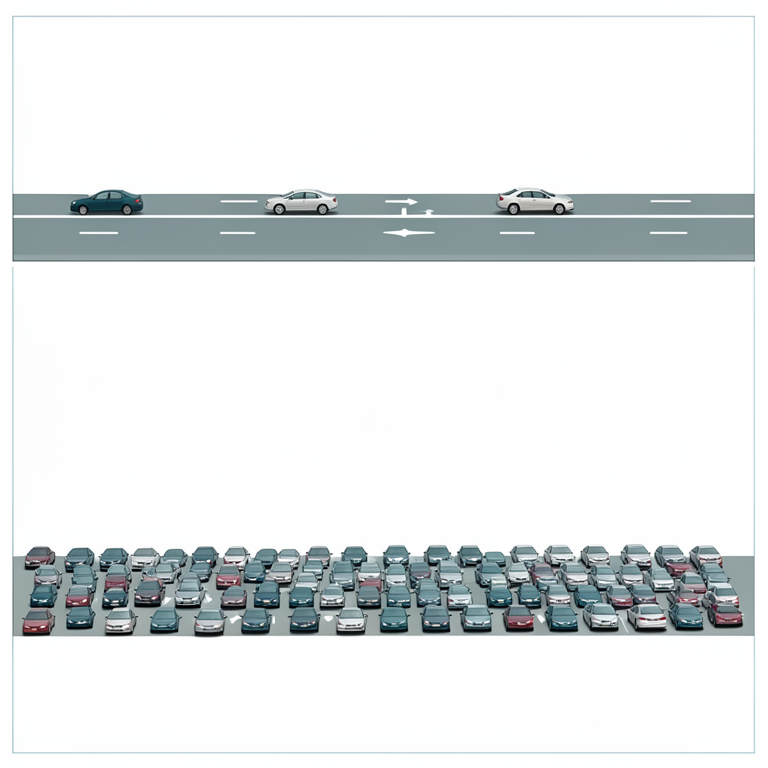
Relationship between Frequency and Queue Length
AI-generated conceptual illustration (cars on a Nigerian urban road). It explains the idea and does not show study data.
View source evidence ↗Figures & tables
From the original paper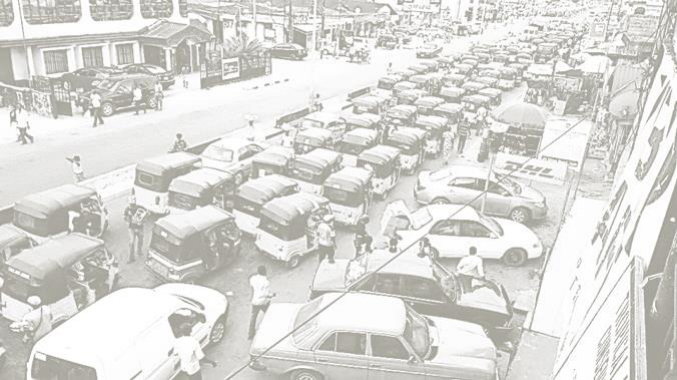 Figure 1
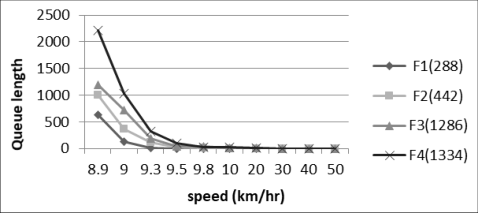 Figure 2
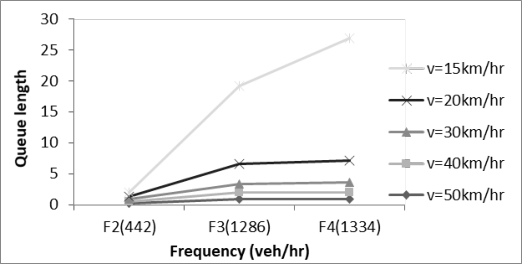 Figure 3
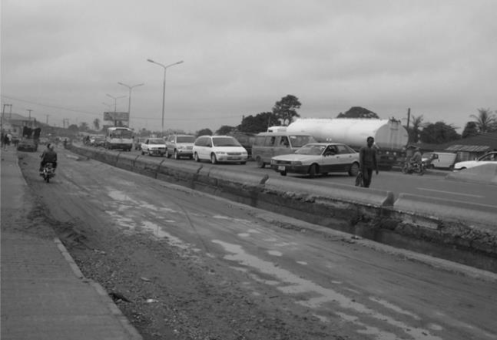 Figure 4
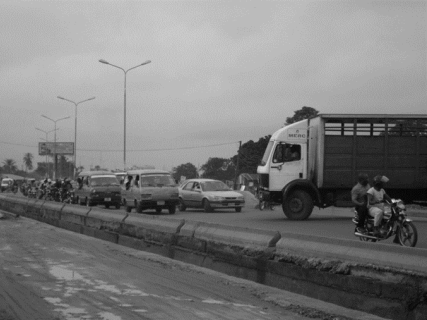 Figure 5
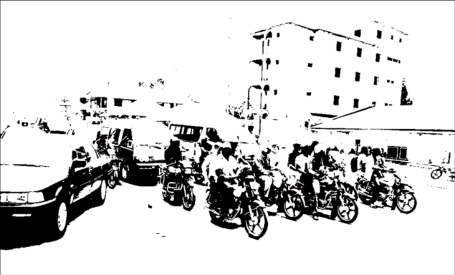 Figure 6
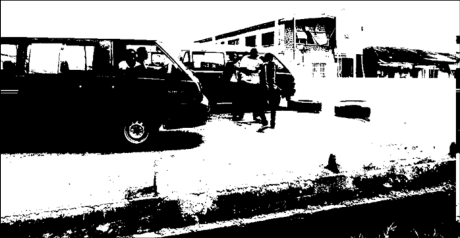 Figure 7
Introduction
Nigeria is a relatively large country of 923,768 square kilometers and with a population of over 140 million (Nigeria vision 2020 program, 2009) [13] . Road transportation accounts for more than 90% of the movement of goods and passenger in most Nigerian towns and cities (National Transport Policy, 2010; Khaleel, 2011) [12] . As at 2005, Nigeria was estimated to have a total road length of 193,200 kilometers, comprising 34,123 km Federal roads, 30,500 km State roads, and 129,577 km Local Government roads (National Transport Policy, 2010) [12] . However, Nigeria roads with approximately 200,000 km were ranked among the poorest in the world in terms of safety facilities, road network and management (Nnadi, 2010) [14] . Congestion in Nigeria roads has become a common phenomenon. Figure 1 shows a photograph of road congestion scene in one of the cities in Nigeria. Multiple agencies of Federal, State and Local Government Area (LGA) are involved in the enforcement of road transport regulations and the violation of traffic and safety rules (Obiadi, 2013) [15] . This has led to duplicated efforts on many occasions. Lack of coordination in the construction and maintenance of the various road networks and a lack of a consistent national road policy, unstable regulation and application of road standards are some of the characteristics of Nigerian roads. The apparent failure in the management of roads in Nigeria is partly due to poor and bad implementation of road traffic rules, misplaced priorities, disrespect by the affluence and privileged circumstances (Obiadi, 2013) [15] . There have been several efforts in the management of road transportation in Nigeria. Oni (2010) [23] describes the origin and prevailing factors contributing to the increase of road traffic congestion on Nigerian roads. Poor traffic state and bad roads were identified as reasons for road traffic congestion (Ajanaku and Okwuobi, 2002) [18] . The strategy to reduce congestion includes the reactivation and integration of the various elements and modes of transport (Oni, 2010) [23] . Aworemi et al. (2009) [3] examine the causes and effects of road traffic congestion in some selected areas of Lagos State, Nigeria. The authors used a structured questionnaires and personal interviews to obtain their data. No mathematical model was developed. Poor road condition, accidents and drivers' behaviour were identified as some of the factors responsible for traffic congestion. Omidiji (2010) [20] investigates the causes of road traffic crashes on major intersections within Abuja. Using data obtained from a survey, it was proposed that traffic engineering calming measures such as speed warning signs, zebra crossing and speed bumps reduce road traffic crashes. The study identifies the need to have data on road crashes on routine basis so that studies can be carried out on how to reduce crashes on our roads. Ogunbodede (2007) [17] assesses traffic congestion in Akure (south-west of Nigeria) using the Geographic Information System (GIS) approach and concludes that the tool is critical for decision making in the management of traffic congestion. Nigeria is faced with the challenge of increasing traffic congestion in major cities. Factors responsible are numerous and controlling traffic has become essential, hence the need for Information Transportation System, ITS. Spontaneous measures to congestion problems, poor implementation of policies (wherever they exist), road users' 'irrational' behaviour and non compliance to existing traffic rules have not yielded the desired reduction in road traffic congestion in Nigeria (Omiunu, 1998; Ogunsanya, 2002 [18] ; Omosigho and Igbinosun, 2004; Olufemi and Oluseyi, 2007; Aworemi et al., 2009; Oni, 2010) [21,18,24,19,3,23] . The free flow speed for cities and urban arterials is usually 48 km/hr (Lo, 1999; and Wang, 2010) [11,28] , however, the central area of Benin City for example presents acute traffic congestion. The main causes as perceived by road users according to are uncontrolled street trading, indiscriminate on-street parking, lack of adequate public mass transit buses, poor traffic control and management of roads, traffic light failure, too many cars on the roads, poor road design and poor drainage.
Traffic assignment and travel demand modes play significant roles in traffic flow prediction (Weijermars, 2007; Oyedepo and Makinde, 2009) [29,24] . The varying problems of transportation across cities and villages call for fundamental research towards providing evidence based and practical solutions to the recurring threat of traffic congestion. Road Traffic agencies should enforce all laws and regulations that will ensure sanity but should respect road users' respective jurisdiction by working in harmony to achieve the desired objectives of road safety for road users. Aderamo and Atomode (2012) argue that road traffic wardens and parking problems are the greatest causes of delays at road intersections. Uwadiegwu (2013) [27] uses physical, technical, land use and human factors to explain the causes of congestion at a major bus stop along Agbani road in Enugu.
The author agreed to the construction of 'bye-passes' concluding that it has been one of the effective devices for redressing traffic congestion, citing the Benin 'bye-pass' as an example. But we argue that roads need scientific investigation and understanding to arrive at management control strategy. Building of 'bye-passes' alone without effective management can lead to 'Braess' paradox'. In order to avert the incessant power outage and its adverse consequences on traffic management, Uwadiegwu (2013) [27] recommended the use of small generators for the control of traffic lights. The author's point is that they are "quite inexpensive and costs between N9, 000.00 -N12, 000.00 per generator and quite readily available". In a vast country like Nigeria, the cost implication, environmental pollution and the security of the generators make it impracticable planting generators to power traffic lights.
There has been lack of mathematical models in existing literature to explain the dynamics of road traffic flow problems in Nigeria. It is clear that transport systems management (TSM), as a process, has become an indispensable means for efficient urban transport systems management. Unfortunately, the existing ad-hoc approach to issues of road traffic congestion in Nigeria is not consistent with the requirements of the TSM. Because of the complexity and dynamism of urban road traffic, the analysis, control and management of road traffic must also be pro-active and scientific.
Road transport plays an important role in linking people together economically, socially and politically. The continual growth in the demand for, and the utilization of, road transportation pose a lot of challenges, amongst which is congestion. Our review of the literature on road traffic flow shows that existing models are based on simplified assumptions. In Nigeria, there have been studies of road traffic congestion in several major cities. For example, congestion in Lagos metropolis (Aworemi et al., 2009; Oni, 2010) [3,23]`, Abuja and Port Harcourt area (Omidiji, 2010; Ukpata and Etika, 2012) [20,26] Akure (Ogunbodede, 2007) [17] , Ilorin, Benin City (Igbinosun et al., 2013) [5] , Enugu (Uwadiegwu, 2013) [27] have been reported. From the review, it shows that road traffic congestion takes the same form and shape all over Nigeria. Therefore, analyzing any road segment in any city will be a reflection of what goes on in the entire country and results can be applied to all the roads in Nigeria.
Our intention in this study is to develop mathematical models that will provide explanation to road traffic flow congestion problem. Our models will provide timely pieces of information for the management of road traffic flow. It is worth noting that obtaining mathematical models based on reasonable assumptions to study road traffic flow is expedient; we hope to achieve this in this thesis. Studies of road traffic flow phenomenon from different parts of the world employ data collected by various devices and methods. For example, data on road traffic flow in the UK is available online at www.dft.gov.uk/traffic-count/. However, this is yet to be implemented in Nigeria. Most studies on road traffic flow in Nigeria use data collected on ad-hoc basis especially survey methods. We shall use the ad-hoc method on a need basis to collect data for the analysis of our work in this paper.
Control strategies for road traffic flow
In this section, discussions on some Road traffic Control strategies is presented and will illustrate the need for data collection, use of real time information for Intelligent Transportation Systems (ITS), and road architecture. Road traffic Control strategies describe those measures which seek to manage traffic flow, which has already made the decision to travel on the road network, through regulatory mechanisms.
Whenever there is an increase in the spatial efficiency of the infrastructure, the traffic on the network will have to be assessed and managed. Management decisions depend on the amount of traffic that uses the infrastructure. Since road traffic is dynamic in nature, then there is need for a dynamic traffic management (or traffic control). Some measures such as diverters, roundabouts, channelization, speed humps, speed tables, etc. have been applied to ease road traffic congestion (Leonard and Davis, 1997) [10] . In recent years, efforts have been aimed at taking advantage of the advances in communications, electronics, and Information Technology in order to improve the efficiency and safety of transportation systems. Within the transportation community, this effort is generally referred to as the ITS (Leduc, 2008) [9] . ITS (applied to transport infrastructure and vehicles) seeks to improve transport outcomes such as transport safety, transport productivity, informed travel choices, social equity, environmental performance and network operation resilience.
The nature of the traffic system is continuously changing, new vehicle and infrastructure technology creates new traffic conditions.
Broadly speaking, traffic control measures can be categorized under a number of headings, listed below. Intelligent Transport System (ITS), which uses on-road technology to influence traffic flow in response to observed behaviour. Examples include ramp metering, variable speed limits, and incident detection, see; Capacity Enhancement, which increases road capacity within the existing boundaries, but supported by a management function. Some examples are Hard Shoulder Running and reversible traffic lanes; Priority measures, which dedicate lanes to specific user types, such as public transport, freight, or high occupancy vehicles; Information sources provided pre-trip or during a trip which assist users in making appropriate responses to avoid congestion; and Network control through the use of national, regional or local control centres. For example, the Park-and-Ride Facilities (OECD, 2007) [16] .
Methodology
We undertake an empirical study of road traffic flow in Nigeria. We use a digital camera (Samsung ES65) to collect video films on volume of vehicles and other scenes at some selected busy locations in Benin City. Also, data on road traffic flow frequency was collected at three different locations in Nigeria, one at kilometer thirty-four on Kaduna-Lokoja Road, Abuja, another at Nwaniba road, by University of Uyo Main campus junction, Uyo and the third at kilometer three on Benin-Asaba Road, Benin City. Traffic parameters were from the road section during the morning, afternoon and evening peak periods between 7:00-9:00am, 1:00-3:00pm and 4:00-6:00pm during weekdays. Improving public transport is also a measure to control road traffic flow by encouraging the use of public vehicles: One of the objectives of the stated control measures is to discourage the use of too many cars on the road. We use the expression for the expected number of vehicles on a link given by Kakooza et al. (2005) [6] and Baykal-Gürsoy et al. (2009) [4] to demonstrate that higher frequencies of cars on the road with fairly constant speed leads to congestion.
where, is the average number of vehicles arriving at an intersection per unit time; r is the rate of disappearance or clearance of the delays; f is the rate of occurrence of delays; and 0 denotes the service rate with no delays. F is the frequency of vehi cles per hour (this was obtained from the data collected from the different locations). The service rate is obtained by using
where the speed of the vehicles in km/h is v .
Results and discussion
We assume that the rates of occurrence and clearance of incidences are the same; Figure 2 explains the implication of having too many vehicles on the road. Note that the congestion level reduces when frequency of cars is low. For example, there can be as many as 2218 cars in the queue if the frequency of cars using the road is 1334 cars per hour compared to 637 cars when the frequency is 288 cars per hour for a speed of less than 9km/hr. Figure 3 shows the queue length of vehicles for different frequencies and that the higher the frequency of cars on the road, the higher the queue length when the speed of cars is low. Work on traffic management techniques and infrastructure for road traffic management is available in literature; see Lam (2006) [8] , Leduc (2008) [9] , Zhang and Liu (2009) [30] , Cetiner et al. (2010), Aderinola et al. (2016) [2] , Abdulrahman et al.
(2016) [1] and Shou-Kui and Jing (2019) [25] . In Nigeria, road traffic control strategies have been put in place in some states. These strategies are in the form of laws, for example, Lagos state government recently enacted the road traffic law titled, 'a law to provide for road traffic administration and make provisions for road traffic and vehicle inspection in Lagos state and other connected purposes'.
The law seeks to among other things bring some measure of sanity to the roads in Lagos state by imposing restrictions and or penalty. Some of the restrictions include the: (a) Prohibition or restriction of the use of any specified highway by vehicles of specified class or description; (b) Prohibition of driving or propelling of vehicles on any specified highway otherwise than in a specified direction.
For details of the law, see Lagos State of Nigeria Official Gazette (2011) [7] . A review of the Lagos road traffic law shows that there are provisions to deter deviant behaviours by motorists in Nigeria. However, it is common practice in some urban areas of Nigeria (Benin City for example) to see drivers driving against traffic, driving on the walkways, disobedient to road traffic lights and the exhibition of some other deviant drivers' behaviour. It has also been observed that drivers reduce their speed because traders display wares on walkways and some portions of the road, this reduces the efficiency of the road. It is however an offence to display wares on walkways or for commercial buses to pick or drop passengers on some designated routes. Some roads in Benin City have been reconstructed to ease traffic flow and reduce congestion. For example, a segment of Benin-Lagos road from Uselu shell to the University of Benin (Uniben main gate, Ugbowo) now has approximately five (5) turning points (as at 2 nd February, 2013) as against making every point of the stretch of the road a turning point. The aim of having very few turning points in the three and half kilometre (3.5km) stretch of road is to restrict drivers' deviant behaviour of making a u-turn at every gap acceptance and to increase free flow of vehicles. However, these turning points may not always provide the expected results. The way the turning areas are constructed makes it difficult for many vehicles to manoeuvre properly without blocking part of or the entire road. It is sometimes difficult for vehicles to make a complete u-turn in a single attempt. Figure 4 and Figure 5 show two different turning points along the 3.5km stretch of road. Observe that the two vehicles in the photographs are unable to make a u-turn in a single attempt. This usually leads to congestion. Thus, road architecture is very important in the control of road traffic congestion. In Nigeria, the use of motor-bikes has been banned in many states. Reasons for such decisions are two-dimensional: on the one hand, it has been argued that motor-bikes are used by hoodlums to perpetrate criminal activities because of their size and ease of movement. Secondly, they have been used as means of transportation with little or no sense of driving ethics. There have been reported cases of road traffic crashes (FRSC, 2009) arising from reckless use of motor-bikes. It is not uncommon to see motor-bikes clogging the front of vehicles at the turn of red phase of traffic light at road intersections. Figure 6 shows a scene where motor-bikes disrupt the flow of traffic at a road intersection. At places where there are no traffic personnel, some 'bus conductors' including uniform personnel on their own journey take undue advantage of the condition and turn themselves into unauthorised road traffic wardens, they ensure that the lane in which their vehicles are in the queue is giving priority to the detriment of the system. Figure 7 shows a chaotic scene resulting from some unauthorised persons controlling road traffic. Some motorists do not obey these 'illegal' traffic wardens, thereby causing more confusion.
Conclusion and recommendations
From equations ( 1) and ( 2), observe that that the number of vehicles in the queue can be determined. When the frequency of vehicles using a particular road is high, the queue length is high if the speed is reduced. For example, from figure 2, there can be as many as 2218 cars in the queue if the frequency of cars using the road is 1334 cars per hour compared to 637 cars when the frequency is 288 cars per hour for a speed of less than 9km/hr. The volume of vehicles in a queue is a function of both the road type and the critical speed allowed for that road. Igbinosun et al. (2013) [5] argued that there is a 'critical speed' for every road, below which congestion results. In controlling the traffic flow therefore, vehicles must not be allowed to drive below the critical speed for that stretch of road.
Also in this section, we present some recommendations to help ameliorate the road traffic gridlock on our roads. These recommendations are based on our study. Acquire giant car parks, this will remove vehicles that are indiscriminately parked and abandoned on the roads. The use of Inter-city buses, bus (dedicated) lanes should be encouraged to allow for free flow of vehicles. Driving on any available space during congestion should be discouraged and fines imposed on law breakers. The road architecture should make it impossible for vehicles to drive against traffic. All road intersections should be controlled and ITS instruments should be deployed to roads (CCTV cameras, vehicle registration data base should be continuously updated to monitor and ascertain the true number of vehicles in the country). This will help in tracking down erring motorist. Time is wasted when a road junction is not well monitored. Absence of road traffic control can force vehicles to stop in all directions. Mechanism such as controlled motor vehicle registration should be introduced in Nigeria to help check the increase in vehicle ownership. This can be achieved by (a) imposing high vehicle registration fees (a) having a quota vehicle license allocated to states each year and using bidding process to acquire the license (e.g. obtaining authorization before purchasing a vehicle). Traffic lights should be checked periodically by changing their cycle times to meet current realities of traffic flow and the dynamics of the road junction. Off-peak vehicle usage should be introduced and enforced to reduce the frequency of vehicles on the roads. This can be enforced by providing special colour tags for off-peak and weekend vehicles. Sanctions in the form of fines should be imposed when such vehicles ply the roads outside their mandatory periods. We recommend actions such as charging a fee to use a road link, restricted use of a road link and the use of other means of transportation (e.g. rail and water system). These have been found to reduce the frequency of vehicles using a road link. This paper summarises the control strategies to reduce road traffic congestion in Nigeria. There are laws enacted to restrict vehicle drivers from causing road traffic congestion, the study shows the need to collect road traffic Data and the application of ITS.
References
30 in the original paper- Abdulrahman AL, Adebayo OO, Ajayi SA. Indices of Traffic Congestion on Major Roads in Akure, a Developing City in Nigeria. International Journal of Scientific & Engineering Research. 2016; 7(6):434-443.
- Aderinola OS, Owolabi DO. Traffic Regulation at Critical Intersections: A Case Study of Odole Intersection, Akure, Ondo State, Nigeria. Open Journal of Civil Engineering. 2016; 6:94-104.
- Aworemi JR, Abdul-Azeez IA, Oyedokun AJ, Adewoye JO. A study of the causes, effects and ameliorative measures of road traffic congestion in Lagos metropolis. European journal of social sciences. 2009; 11(1):119128.
- Baykal-Gürsoy M, Xiao W, Ozbay K. odeling traffic flow interrupted by incidents. European Journal of Operational Research. 2009; 195(1):127-138.
- Igbinosun LI, Omosigho SE, Enwemasorb OE. Effect of road traffic frequency and speed of vehicles on congestion. Journal of Mathematical Sciences. 2013; 2(1):315-326
- Kakooza R, Luboobi LS, Mugisha JYT. "Modelling Traffic Flow and Management at Un-signalized, Signalized and Roundabout Road Intersections" Journal of Mathematics and Statistics. 2005; 1(3):194-202.
- Lagos State of Nigeria Official Gazette. A law to provide for road traffic administration and make provisions for road traffic and vehicle inspection in Lagos state and other connected purposes' 2011; 44(39).
- Lam WHK, Tang YF, Tam M. Comparison of two nonparametric models for daily traffic forecasting in Hong Kong. J Forecast. 2006; 25(3):173-192.
- Leduc G. "Road Traffic Data: Collection Methods and Applications", European Commission Joint Research Centre Institute for Prospective Technological Studies, 2008.
- Leonard II JD, Davis WJ. Urban traffic calming measures conformance with AASHTO and MUTCD guidelines. In 'Traffic congestion and traffic safety in the 21 st century. Challenges, innovations and opportunities.' Ed. Rahim, F. (Ry) Benekohal. ASCE, 1997, 14-20
- Lo HK. A novel traffic signal control formulation. Transport Research Part A: Policy and Practice. 1999; 33(6):433-448.
- National Transport Policy. Federal Government of Nigeria. Draft National Transport Policy. August, 2010.
- Nigeria vision 2020 (2009). Report of the Vision 2020 National Technical Working Group on Transport. July, 2009.
- Nnadi F. Annual Report for the Year Ended 2010 on Road Safety Efforts in Nigeria -APRI's Perspective, 2010. Available at http://www.kabissa.org/blog/roadsafety-nigeria. Accessed 16/04/2013.
- Obiadi B. Death traps on Nigeria roads. Viewpoint. Vanguard online newspapers, 2013. Available at: http://www.vanguardngr.com/2013/04/death-traps-onnigeria-roads/, Accessed on 04/04/2013.
- OECD. Managing urban traffic congestion. European Conference of Ministers of Transport (ECMT). OECD Publishing 2, rue André-Pascal, 75775 PARIS CEDEX 16, France, 2007.
- Ogunbodede EF. Assessment of traffic congestion in Akure (Nigeria) using GIS approach: Lessons and challenges for urban sustenance, 2007. Available at: download.sue-mot.org/conference 2007/paper/ogunbodede.pdf.
- Ogunsanya AA. 'Maker and Breaker of Cities'. The 59 th Inaugural Lecture series of the University of Ilorin, Nigeria, 2002.
- Olufemi OB, Oluseyi MS. The urban poor and mobility stress in Nigerian cities. Environmental Research Journal. 2007; 1(1-4):1-8.
- Omidiji AA. Observational studies of road traffic engineering measures of Federal Capital Territory roads in Abuja, Nigeria. Proceedings of the 20 th Canadian Multidisciplinary Road Safety Conference, Niagara Falls, Ontario. 2010; 6(9):1-13.
- Omiunu FGI. Flooding and traffic management in Benin City region. In 'Environmental issues and management in Nigerian development.' eds., P.O.Sada and F.O. Odenerho. Evans, Ibadan, 1998.
- Omosigho SE, Igbinosun LI. A case study of road traffic queues and delays. Nigeria Annals of Natural Sciences. 2004; 5(1):78-89.
- Oni OAG. Tackling road traffic congestion in a developing country -A contemporary approach; Journal of Applied Sciences Research. 2010; 6(5):529-542.
- Oyedepo OJ, Markinde OO. Regression model of household trip generation of Ado-Ekiti Township in Nigeria. European Journal of scientific research. 2009; 28(1):132-140.
- Shou-Kui H, Jing L. A Study of Urban City Traffic Congestion Governance Effectiveness Based on System Dynamics Simulation*. International Refereed Journal of Engineering and Science. 2019; 8(1):37-47.
- Ukpata JO, Etika AA. Traffic Congestion in Major Cities of Nigeria.International Journal of Engineering and Technology. 2012; 2(8):1433-1438.
- Uwadiegwu BO. Factors Responsible for Traffic Congestion in Nigeria, A Case Study of Mayor Bus Stop and Coal Camp Along Agbani Road in Enugu City, Nigeria. Journal of Environment and Earth Science. 2013; 3(3):71-78.
- Wang P. Conditional Cell Transmission Model for TwoWay Arterials In oversaturated Conditions. PhD dissertation, The University of Alabama, 2010.
- Weijermars W. Analysis of urban traffic patterns using clustering. PhD Research thesis: TRAIL Thesis Series T2007/3, The Netherlands TRAIL Research School, 2007.
- Zhang Y, Liu Y. Comparison of parametric techniques for non-peak traffic forecasting. World Academy of Science, Engineering and Technology. 2009; 51:8-14.
Cited by 1
From OpenAlex, OpenCitations and reference lists read by Scinovex
- Revenue generating model for transportation companies
O Izevbizua, Igbinosun LI · International Journal of Statistics and Applied Mathematics · 2023
This work considers the seats on airplanes, trains, buses and cars as non-regular fixed lifetime inventories and developed a revenue generating function for each trip embarked upon by any of these means of transportation. Numerical examples on the use of the revenue generating function was also discussed.