
Research article · 2018 · Full text
International Journal of Statistics and Applied MathematicsStochastic analysis of a two-unit redundant system with preventive maintenance
Volume 3(2) · Pages 83–92
Research areasReliability and Maintenance OptimizationAdvanced Queuing Theory AnalysisSoftware Reliability and Analysis Research
Abstract
Author-writtenThis manuscript deals with a new class of the stochastic model of a two-unit cold stand by system is analyzed. There is a single repair facility to repair the failed unit. A unit is repaired in two phases and each phase the repair is performed in two parts. Therefore, the repair time distribution in each phase is assumed to be two-stage Erlangian with parameters (2, λ) and (2,µ) in phase I and in phase II respectively. The repair facility repairs both the phases of repair and can repair one unit at a time. After phase II repair a units works as good as new. Using suitably chosen regeneration points the system model is analyzed probabilistically to obtain various useful reliability measures as in earlier chapters. we consider a two-unit standby system with preventive maintenance of the operative unit. There is a transfer switch to connect online the standby unit. The transfer switch operates instantaneously at the time of need with some fixed probability. There is also a repair facility, which repairs the failed unit. The repair facility is also takes some random time in arriving at the system. Considering failure and appearance time of repair facility as exponential and all other distributions time dependent, the system model is analysed to obtain the various performance measures.
Summary
Source-checkedPlain-language reading of the full paper, prepared with AI and checked against the text. Each point links to the authors' own words.
Why it matters
- Two-unit redundant systems that incorporate preventive maintenance are a subject of extensive study in reliability engineering. View evidence ↗
- Preventive maintenance is used during the operation of a unit to increase its efficiency and extend its overall lifetime. View evidence ↗
The question
- The study aims to analyze a two-unit standby system with preventive maintenance to determine performance measures including reliability, expected lifetime, system uptime, and the busy periods of repair and maintenance facilities. View evidence ↗
What they did
- The model consists of a two-unit standby system where the operative unit receives preventive maintenance and a transfer switch is used to activate the standby unit. View evidence ↗
- The analysis assumes exponential distributions for unit failure and repair facility arrival, while repair, maintenance, and inter-arrival times are treated as time-dependent or arbitrary functions. View evidence ↗
- The authors use Laplace transforms and matrix equations to solve the recursive relations for system reliability and availability. View evidence ↗
What they found
- The steady-state transition probabilities from state S0 are derived, where the probability of transitioning to S1 is 1 minus the probability of transitioning to S3. View evidence ↗
- The mean sojourn time for state S6 (one unit under repair, one waiting) is equal to the mean repair time n1. View evidence ↗
- In the particular case where all distributions are exponential, the transition probability from S0 to S1 is λ/(λ+κ) and from S0 to S3 is κ/(λ+κ). View evidence ↗
What it means
- The authors conclude that the proposed stochastic model successfully provides a framework for calculating key reliability and performance metrics for a two-unit redundant system with preventive maintenance. View evidence ↗
Visual summary
1 visualsIllustrations explain the paper; they do not show study data.
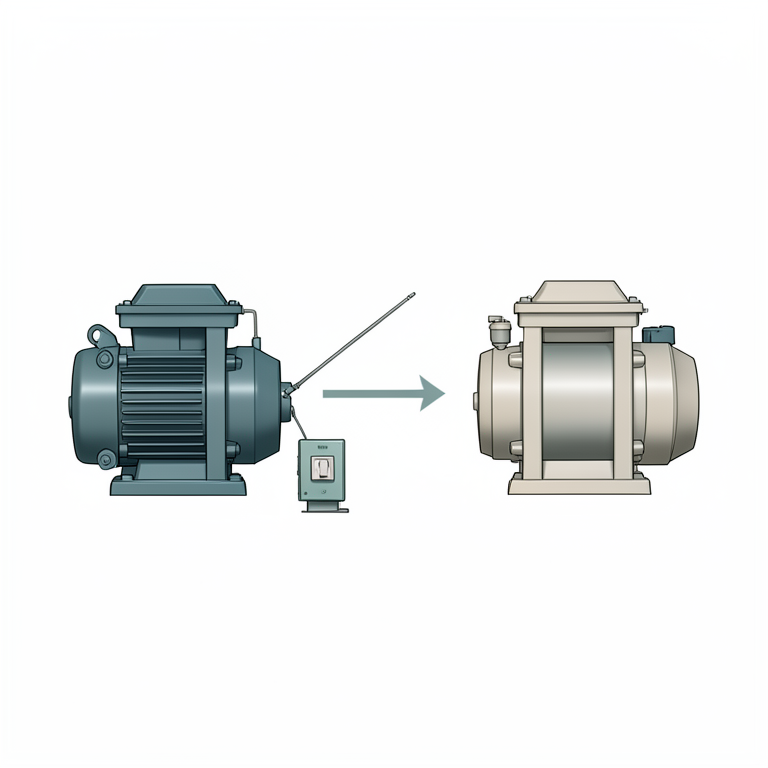
Study overview
AI-generated conceptual illustration (Two industrial electric pumps in a standby redundant configuration with a transfer switch). It explains the idea and does not show study data.
View source evidence ↗Introduction
Two-unit redundant system with preventive maintenance have been studied extensively. Osaki and Asakura (1970) have analysed a system model with preventive maintenance. Lau (1983) has explained the following three types of actions in preventive maintenance (i) Regular care of the system such as lubrication, refuelling, cleaning, adjustments and depending on other requirements of the components. (ii) Checking and repairing of failed components. It is a function of probabilities. (iii) Replacing or overhauling near wearout components. It depends on wearout characteristics of the components. Gupta and Pandya (1998) have analysed a system model having a transfer switch which takes some random time for switch over. Gupta and Sammerawar (2000) have considered a system having a transfer switch working instantaneously, which connects a protection device to main unit. In the present paper we consider a two-unit standby system with preventive maintenance of the operative unit. There is a transfer switch to connect online the standby unit. The transfer switch operates instantaneously at the time of need with some fixed probability. There is also a repair facility, which repairs the failed unit. The repair facility is also takes some random time in arriving at the system. Considering failure and appearance time of repair facility as exponential and all other distributions time dependent, the system model is analysed to obtain the various performance measures such as : transition probabilities and mean sojourn times, reliability and expected life time of the system, expect uptime of the system during (0,t), Expected busy period of the repair and maintenance facilities particular case with all exponential distributions is considered.
System Description and Assumptions
A two-unit cold standby system is considered. During operation a unit requires its preventive maintenance to prolong its life time and improve the efficiency. There is a maintenance facility which performs the preventive maintenance at random epochs of time. The unit operates during its maintenance and may fail in that duration. As soon as the unit under preventive maintenance fails, its preventive maintenance is stopped immediately and the repair facility is called for the repair of the unit. The repair facility takes some random time before starting the repair of the failed unit. During the presence of repair facility the preventive maintenance of the other operative unit is not required. The repair facility repairs the units one by one. The first come first served rule is followed for repair. The preventive maintenance and repairs are perfect. The failure time distribution of the unit is exponential while the repair time distribution are time dependent. Interarrival time of maintenance facility and maintenance time distributions are also considered as arbitrary functions of time. The arrival of repair facility follows the exponential distribution.
Notations and States of the System
(a) We define the following symbols for the states of the system: Mode symbols of the units O : One good unit in operating mode. S : One good unit is kept as cold standby. F : Unit in failed mode or a failed unit. P : Operative unit under preventive maintenance.
Suffix symbols r : unit under repair w : waiting for repair
Using the above symbols and inview of system description and assumptions of section 3.2, we define the following possible states of the system.
One unit operative and the other is standby.
Transition Diagram
The other notations not given here may be seen from the Glossary of general notations given at the starting of the thesis. The transition diagram of the system model along with transition rates or transition time cdfs is shown in Fig. 3.1. It may be observed that the epoch of transition S2 to S6 is non-regenerative, while entry from S5 to S6 is a regeneration point. Therefore, S6 is non-regenerative as well as the regenerative state.
Transition Probabilities and Expected Sojourn Times (a) As defined earlier is the cdf of transition time from regenerative state Si to Sj. As the states defined in E are regenerative, by simple probabilistic arguments, the non-zero elements of the matrix Q= are as follows : = Probability that the system transits from state S0 to S1 during time t =
[System transits from S0 to S1 durin (u,u+du) while it is not transited to S3 up to time u ] = .
To write the expression for , suppose that the system transits from state S2 to S6 during (u,u+du), ut ; the probability of this event is .
. Further, suppose that the system passes from S6 to S2 during the interval in (u,t) with probability Therefore, = Changing the limits of integration, we have
The unconditional probability that the system will transit from state Si to any state on or before time t is = ∑ ∑ Thus, = 1
The steady-state transition probabilities are given by lim → and lim → Therefore,
We observe the following relationships
, 1 (15-20) (a) Mean sojourn time in state Si is defined as the expected time for which the system stays in Si. In particular .
= . Obviously the following relations may be observed.
Analysis of Reliability and MTSF
Assuming the failed states S5 and S6 as absorbing states and employing the arguments used in the theory of regenerative process, the following relations among may be obtained:
For an illustration, the equation for is the sum of the following mutually exclusive contingencies: (i) System sojourns in state S0 upto time. The probability of this contingency is , say (ii) The system transits from state S0 to S1, during (u,u+du), u t, and then starting from state S1, it survives for the remaining time duration (t-u). The probability of this event is = (iii) The system transits from state S0 to S3 during (u,u+du), u t, and then starting from state S3, it survives for Taking the inverse Laplace transform of expression (T), we may get the reliability of the system when system initially starts from state S0. To obtain the MTSF, we use the following formula lim → *
Using * 0 and * 0 , we get
Expected Up Time Of The System During (0,t) In order to find the expected up time of the system due to the operation of a unit, we define, Ai(t) as the probability that the system is up (operative) at epoch t when initially the time starts from state ∈ . Using the similar probabilistic arguments as in section 2.6 of paper-II, pointwise availability Ai(t) are seen to satisfy the following relations.
Taking Laplace transform of the set of relations (1-7), the solution for * can be written in the matrix form as follows : * , * , * , * , * , * , * * * , * , * , * , * , 0,0 , ( 8 Now to obtain the steady-state probabilities that the system will be operative, we proceed as follows: * 0 = , 0,1,2,3,4.
and using the result * (0)= , we have Adding all the columns of the above determinant into first column and using the relations (15-20) of section 3.4, we observe that all the elements of first column of D2(0) become zero. Therefore, 0 =0 (13) Now the steady state probabilities that the system will be operative due to operation of a unit is given as follows: Similarly, we have
The expected uptime of the system due to the operations of a unit during (0,t) is (17) so that * * ⁄
Expected Busy Period Of The Repair And Maintenance Facilities During (0,t) Let and be the probabilities that the maintenance and repair facilities are busy respectively in maintenance and repair of operative/failed unit at time t when the system initially starts from regenerative state Si. Using the similar probabilistic arguments as in section 2.7, in respect to the above definition of , we have the following recursive relations:
For an illustration is the sum of the following mutually exclusive contingencies: (i) The maintenance facility remains busy in state S3 upto time t in the maintenance of a unit. The probability of this event is ̅ (ii) The system transits from state S3 to S0 during (u,u+du), ut and then the maintenance facility remains busy in maintenance at Similarly the results of section 3.4 c will be as follows:
References
12 in the original paper- Singh SK, Singh RP. Profit evaluation of a two unit cold standby system with a proviso of rest, Microelectron. Reliab., 1989; 29:705-709.
- Singh SK, Singh RP. Stochastic analysis of a complex system with two types of repair facilities and patience time of repair, IJOMS, 1989; 5(1):43-56.
- Singh SK, Mishra AK. Profit evaluation of a two unit cold standby redundant system with two operating systems. Microelectron Reliab., 1994; 34(4):747-750.
- Smith CO. Introduction to Reliability Design, Mc Graw Hill Kogakusha, New York., 1976, 23-30.
- Sridharan V, Mohanavadiva P. Stochastic behaviour of a two-unit standby system with two types of repairmen and patience time, Math. Comput. Modelling, 1998; 28:6371.
- Wand, Kuo-Hsiung, Dong, Wen-Li, Ke Jyh-Bin. Comparison of reliability and the availability between four systems with warm standby components and standby switching failure, Applied Math. Comput, http://cat.inist.fr/?a Modele=affiche N & cpsidt-18442281., 2006; 28:17-21.
- Weibull, W. A Statistical theory of the strength of materials Ing. Vetenskaps Akad. Handal, 1939, 151.
- Yamashiro M. Analysis of a degraded multistate system with general repair time distributions, Microelectron, Reliab, 1980; 20:647-650.
- Yamashiro M. A repairable system with N failure modes and one standby unit, Microelectronics and Reliability, 1980; 20:831-835.
- Yamashiro M. A repairable system with partial and catastrophic failure modes, Microelectron, Reliab. 1981; 21:97-101.
- Yamashiro M. A repairable system with N failure modes and k standby units, Microelectronics and Reliability, 1982; 22(1): 53-57.
- Yadavalli VSS Natrajan R, Chandrashekhar P, Malada P. A study of a two-unit parallel system with Erlangian repair time : Bulletin of the Allahabad Mathematical Society, 2005; 20:25-34.