
Research article · 2017 · Full text
International Journal of Statistics and Applied MathematicsThe stress-intensity factors for two Griffith-cracks opened by forces at crack faces in an isotropic stress-free rectangle
Volume 2(6) · Pages 286–295
Research areasElasticity and Material ModelingMechanical Behavior of CompositesOptical measurement and interference techniques
Abstract
Author-writtenThe exact expressions for normal stress and for crack shape has been obtained by using Fourier transform method. It is observed that normal stress possess Cauchy type singularity at crack tips while crack shape function is smooth.
Summary
Source-checkedPlain-language reading of the full paper, prepared with AI and checked against the text. Each point links to the authors' own words.
Why it matters
- Fail-safe design concepts in machine manufacturing rely heavily on understanding crack shape and stress-intensity factors. View evidence ↗
- Because rectangular plates are widely used, investigating their displacement and stress components is a significant problem. View evidence ↗
The question
- The study aims to determine the stress-intensity factors for two Griffith-cracks in an isotropic, stress-free rectangle that are opened by forces at the crack faces. View evidence ↗
What they did
- The mathematical model uses a rectangle with a length of 2a and a width of 2δ. View evidence ↗
- The authors used the Fourier transform method to obtain exact expressions for crack shape and normal stress. View evidence ↗
- The analysis assumes that plane-strain conditions are present in the material. View evidence ↗
- The problem is reduced to a Fredholm integral equation of the second kind to find the solution. View evidence ↗
What they found
- The normal stress exhibits a Cauchy-type singularity at the crack tips, whereas the crack shape function remains smooth. View evidence ↗
- Smaller crack lengths result in smaller crack opening displacements. View evidence ↗
- When the rectangle length (2a) increases from 1 to 8, the trend of smaller crack opening displacement for small crack lengths is maintained. View evidence ↗
- Increasing the length of the rectangle (2a) results in a decrease in the stress-intensity factors. View evidence ↗
Visual summary
1 visualsIllustrations explain the paper; they do not show study data.
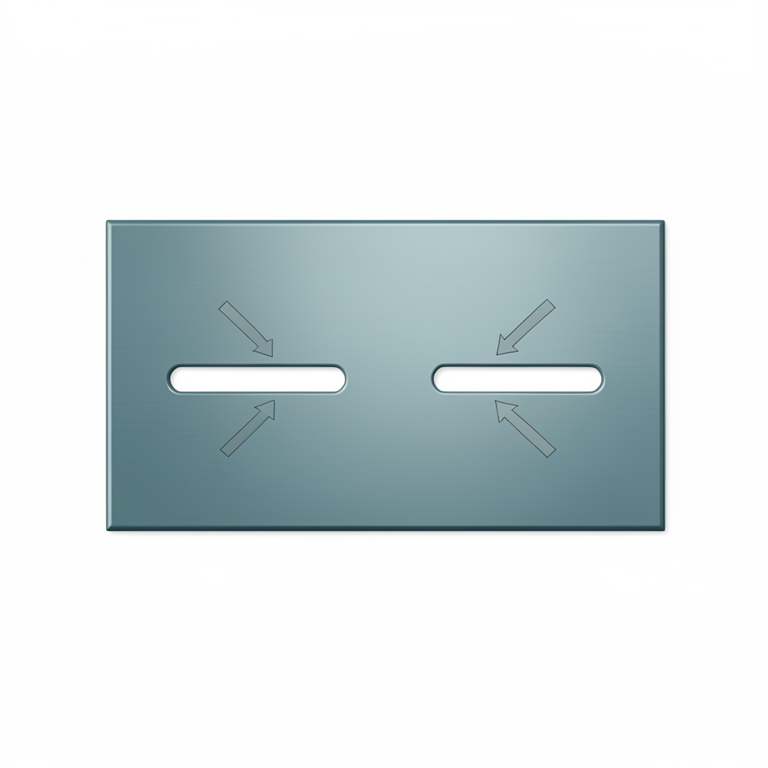
Problem Geometry
AI-generated conceptual illustration (An isotropic stress-free rectangular metal plate with two internal Griffith-cracks). It explains the idea and does not show study data.
View source evidence ↗Figures & tables
From the original paper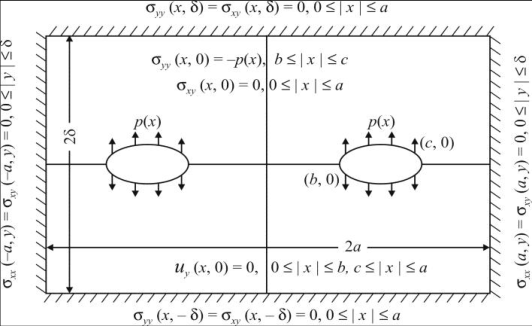 Figure 1
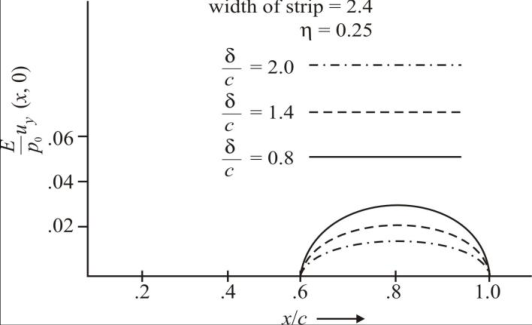 Figure 2
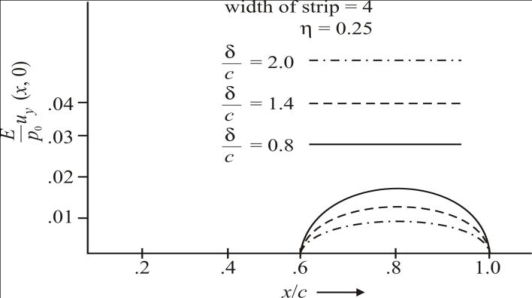 Figure 3
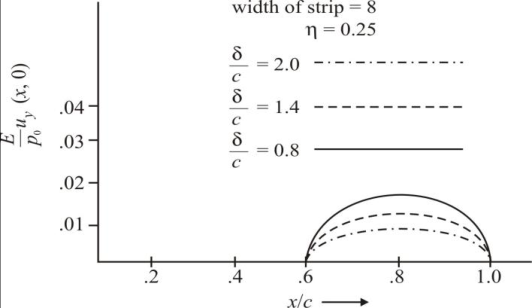 Figure 4
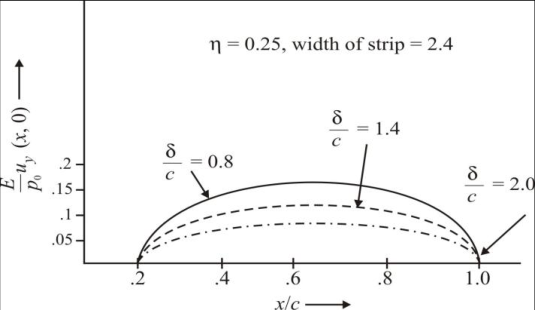 Figure 5
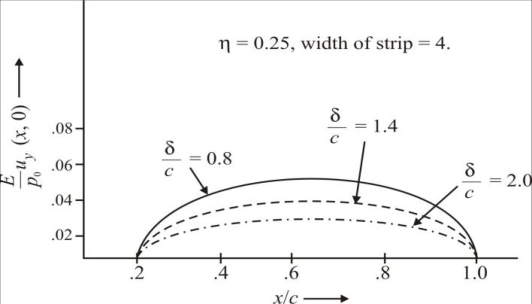 Figure 6
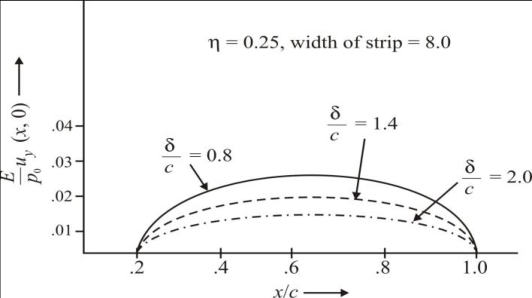 Figure 7
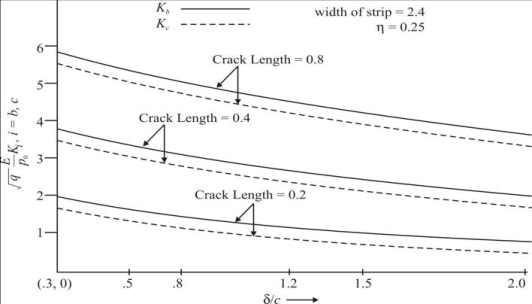 Figure 8
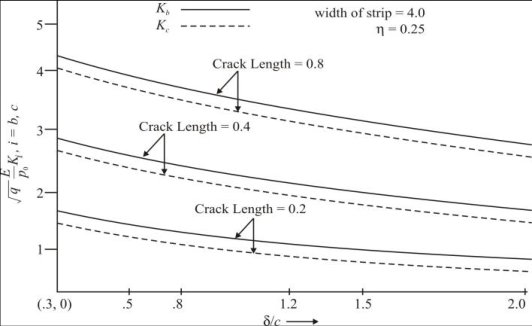 Figure 9
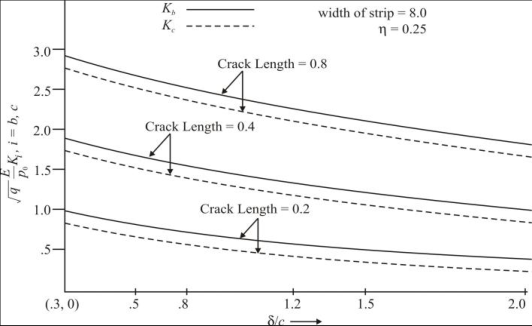 Figure 10
Introduction
Now a days, the fail-safe-design concepts play an important role in manufacturing of machines etc. These design concepts depend mainly on crack-shape and stress-intensity factors. The rectangular plates are very common in use. Therefore, the title problem is important to investigate the displacement & stress-components. In 1920 AA Griffith advanced the adequate theory of cracks which requires consideration of cohesion of molecular force acting near the edge of the crack. He gave the energy balance theory first time. In brittle materials, surface energy is the only source of dissipation. There is good account of crack problems in [1,2,3] . These encompasse rectangular, cylindrical and spherical shape type bodies. The cracks in the medium are discontinuity in the continuum. Therefore, the crack problems in mathematical theory of elasticity generates mixed-boundary value problems. Sneddon [4] used transform method in crack problem for the first time. Srivastava and Lowengrub [5] used triple integral equation in solving two cracks problem in infinite medium. Parihar and Kushwaha [6] extended the problem to infinite isotropic strip with rigidly lubricated edges. Kushwaha [7] extended to rectangular domains with rigidly lubricated edges. Kushwaha [8] had done for crack opening due to body forces in orthotropic infinite medium. Parihar and Sowdamini [9] had done three crack problem in infinite isotropic medium. The authors of [9] had extended the problem to orthotropic infinite medium in [10] . There are some more work in [11][12][13][14] . The title problem is important for fail-safe designs. Thus we see that the cracks occupy the region 0 , .
The rectangle is of length 2a and width 2 . The cracks lie on x-axis while the y-axis passes through the middle of width. Thus the physical problem is reduced to mathematical mixed-boundary value problem as below.
It is assumed that plane-strain conditions prevail. The geometry, see figure 1, of the problem is symmetrical, therefore, the solution space will reduce to [ 0 , ] [ 0 , ] a and the boundary conditions (1.1) -(1.5) will reduce to, ( , ) ( , ) 0 , 0
It is being checked throughout, see Burnishton [15] . Where we have chosen µ (Modulus of rigidity) as unit of measurement for stress and is Poisson ratio.
Where (,) over quantities refere to differential and ij e are strain components and i u , are displacement components and ij are stress components. The solutions of (2.1) is sought through Airy's function method [16] . The solution of (2.1) is assumed in terms of displacement components which will satisfy (2.1) through (2.2). We take
are six constants which are to be determined by given six conditions.
Reduction to triple series equation
The boundary conditions second of (1.6) -(1.7) and (1.8) after using (2.1) -(2.4), we get,
Thus through five relations (3.1)-(3.3) we can find five constants in terms of sixth. Now the mixed-boundary conditions (1.9) -(1.10) and using above relations between constants we get the following triple series equation.
Thus the solution of physical problem is reduced to the solution of triple series equation (3.10) - (3.11).
Solution of Triple series Equations
To solve the triple series equation (3.10) -(3.11) we use the method of Parihar [17] . We assume the trial solution as,
then the substitution of (4.1) -(4.2) into (3.10) and using (4.3), it is satisfied identically if,
The substitution of (4.1) into (3.11) and using the series
and then using [17] for inversion, we get
D is an arbitrary constant to be determined by (4.6) and (4.4). And
The equation (4.6) is Fredholm integral equation of second kind.
Physical Quantities
The physical quantities of interest in fracture mechanics are crack shape and stress-intensity factors. The crack shape is nothing but graph of crack opening displacement. By knowing crack shape experimentally we can calculate required pressure to generate such crack. The stress intensity factors are defined in terms of stress components at crack tips.
Crack Shape
The crack shape will be plotted through the value of ( , 0 ) ,
which will be the value of series of left hand side in equation (3.10).
where g(t) will be obtained from the solution of Fredholm integral equation of second kind.
Stress Components
therefore it will not play any role.
( , 0 ) xx x can be evaluated through the values of ( , 0 ) . yy x Therefore, ( , 0 ) yy x is important to evaluate. It is evaluated through the value of series in (3.11) after transferring the right hand terms, except () px , to the left hand side. It is given as
Now using g(t) from (4.6) and then evaluating the integrals we get,
Stress-Intensity Factors
The stress-intensity factors at crack tip are defined as
is in crack opening mode, therefore, it is more important in fracture mechanics. Now we use (5.3) in (5.7) and evaluate the limits we get, 1
(5.9) while 1 () x will be obtained from (5.4). 5 () Fx does not possess the singularity at crack tips, therefore in limit it contributors zero.
Solution of Fredholm
Where F, E and are complete elliptic integrals of first, second and third type, respectively, see Gratshteyn & Rizhik [18] . We make a substitution in the integrals which have limit of integration as (b, c),
Then limit changes to ( 0 , / 2 ).
The integrals becomes numerically tractable. The limit of interval is divided into m equal intervals defined as,
Thus knowing () gt from (6.9) -(6.11) we can easily plot crack shape from (5.1) with 0 .2 5 . Similarly the stress-intensity factors are evaluated from (5.10) -(5.11) and 1 () x from (5.4). The numerical results are shown graphically in next section. We could have used the method of Fox and Goodwin [19] . with width of strip as 8.0.
Discussion and Conclusion Discussion
D1 In getting the solution of equations of equilibrium (2.1) we used the Principle of Linear Superposition [1] .
D2 For getting the solution of Fredholm integral equation of second kind (4.6), first we expanded the non-singular kernel ( , )
, n = 1, 2, … m and then evaluated certain integrals and summed some series involved there.
D3 When /1 c we need only upto n = 1, 2, 3, 4 which gives fast convergence while stability of solution is also maintained.
When /1 c we need more terms and convergence is also slow. D4 We used Simpson's one third rule for numerical evaluation of integrals. D5 The linear system of equations given by (6.9) -(6.11) are solved by Gruss-Jordan Method.
Conclusion
C1 As / c (thickness) increases the crack opening is becoming smaller (Figures 2,3,4) C2 When crack length is small then crack opening displacement is also small (Fig. 2, 3, 4, 5, 6, 7). C3 When length of rectangle i.e. 2a increases from 1, 2, 4, 8 then trend of C2 follows. (Figures 1234567).
Figures and tables from the paper
References
19 in the original paper- Sneddon IN, Lowengrub M. Crack problems in Classical Theory of Elasticity, John Viley, New York, 1969.
- Sih GC. Dynamic Crack Propagation" Noordhoff International Publisher Leyden, 1972.
- Sih GC. Mechanics of Fracture-3 Plates and Shells with Cracks" Noordhoof International Publisher, Leyden, 1977.
- Sneddon IN. Transform Solutions of Crack Problems in the theory of Elasticity ZAMM. 1969; 49:15-25.
- Srivastava KN, Lowengrub M. Finite Hilbert Transform Technique for Triple Integral Equations with Trigonometric Kernels Proc. Roy. Soc. Edinb. 1970; A68:309-321.
- Parihar KS, Kushwaha PS. The Stress Intensity Factor for Two Symmetrically Located Griffith-cracks in an Elastic Strip in Which Symmetrical Body Forces are Acting." S.I.A.M.J. Appl. Math. 1975; 28:399-410.
- Kushwaha PS. Some Two Dimensional Crack Problems in the Mathematical Theory of Elasticity". A Ph.D. Thesis, I.I.T. Bombay, 1975.
- Kushwaha PS. Stress Intensity Factors in Orthotropic Medium in the Presence of Symmetrical Body Forces. Int. J. Fracture. 1978; 5:443-451.
- Parihar KS, Sowdami S. Three Collineon Cracks in an Infinite Elastic Medium. Int. J. Fracture. 2002; 23(2):151-161.
- Parihar KS, Sowdamini S. Crack Located on a Single Line in an Orthotropic Elastic Medium in which Body Forces are Acting. International J. Engng. Sci. 2005; 25(6):735-754.
- Kassir MK, Sih GC. Mechanics of Fractures-2, Three Dimensional Cracks Problems Noordh off International Publisher, Leyden. 1975.
- Singh DV, Kushwaha PS. The Stress-Intensity Factors for Two Griffith-Cracks Opened by Two Similar Exterior Wedges in Stress-Free Isotropic Rectangle. Int. J. of Maths Sci and Engineering applications. 2012, 369-379.
- Singh DV, Singh H, Kushwaha PS, Kumar S. The Stress-Intensity Factors for three Griffith-Cracks Opened by Body Forces in Stress-Free Isotropic Rectangle. Global Journal of Pune and Applied Mathematics. 2012; 8(3):263-273.
- Tripathi P, Kushawaha PS. The Stress-Intensity Factors for a Griffith-Crack in Isotropic Stress-Free Rectangle" Proceeding of 11 th Annual Conference of Vijnana Parishad of India and Symposium and Mathematical Modelling of Real Life Problems and Computer Applications May 12-15 at Anand Engineering College, Agra-Mathura Road, Keetham, Agra. 2005, 282007.
- Burniston EE. An Example of a Partially Closed Griffith-Crack, Int. J. Fracture Mech. 1959; 5:17-24.
- Sneddon IN. Fourier Transform" Mc. Graw Hill, New York, 1951.
- Parihar KS. Some Triple Trigonometrical Series Equations and their applications. Proc. Roy. Edinb. 1971; A-69:355-365.
- Gratshteyn IS, Ryzhik IM. Tables of Integrals, Series and Products Academic Press, New York, 1965.
- Fox L, Goodwin ET. The Numerical Solution of Non-Singular Linear Integral Equations. Phil. Trans. Roy. Soc. 1960; A245:501-511.