
Research article · 2019 · Full text
International Journal of Statistics and Applied MathematicsMHD free convection heat transfer having vertical fin in a square wavy cavity
Volume 4(3) · Pages 32–38
Research areasNanofluid Flow and Heat TransferHeat Transfer and OptimizationHeat Transfer Mechanisms
Abstract
Author-writtenMHD free convection heat transfer in a square wavy cavity with single vertical fin attached to its lower heated wall has been numerically simulated in this paper. The bottom wall is kept at a constant heat temperature Tn and the upper wall is kept at a constant cold temperature Tc, while the wavy vertical walls are kept at adiabatic. The magnetic field of strength is applied parallel to x-axis. Finite element method based Galerkin weighted residual technique is used to solve the governing equation. The Prandlt number for the flow inside the enclosure is 0.71. A parametric study has been carried out to investigate the effect of Rayleigh number and Hartmann number on the fluid flow and heat transfer characteristic inside the cavity. The obtained results indicated that the heat transfer rate is enhanced with the growth of Rayleigh number when Hartmann number is kept constant. A set of graphical results are presented in terms of streamlines, isotherms, velocity profiles, temperature profiles, local Nusselt number and average Nusselt number. The results are validated comparing with the previous published works.
Summary
Source-checkedPlain-language reading of the full paper, prepared with AI and checked against the text. Each point links to the authors' own words.
Why it matters
- Free convection is a critical phenomenon in thermal systems with diverse applications, including nuclear reactor cooling, solar energy collectors, and electronic cooling devices. View evidence ↗
- There is limited existing research regarding heat transfer in wavy enclosures that specifically incorporate a vertical fin. View evidence ↗
The question
- The study aims to analyze how a vertical fin in a square wavy cavity affects the increase of the fluid's heat transfer rate. View evidence ↗
What they did
- The researchers numerically simulated MHD free convection in a square wavy cavity where the bottom wall is heated, the top wall is cold, and the wavy vertical walls are adiabatic. View evidence ↗
- The governing equations were solved using the Galerkin weighted residual technique within a finite element method, implemented via COMSOL Multiphysics software. View evidence ↗
- The parametric study used a Prandtl number of 0.71, a fin length of 0.30, position of 0.5, and thickness of 0.02, while varying the Rayleigh number from 10³ to 10⁶ and the Hartmann number from 0 to 50. View evidence ↗
What they found
- The numerical model was validated against existing literature, showing a maximum deviation of 1.55% for the average Nusselt number at a Rayleigh number of 10⁶. View evidence ↗
- Increasing the Rayleigh number from 10³–10⁵ to 10⁶ increased the buoyancy strength, causing the flow to transition from two elliptic-shaped eddies to four. View evidence ↗
- Higher Rayleigh numbers caused isotherms to concentrate around the fin and bend more, indicating an increase in convective heat transfer. View evidence ↗
- The dimensionless temperature profiles along the horizontal center line increased as the Rayleigh number increased. View evidence ↗
- As the Hartmann number increased, the isotherms became nearly parallel to the horizontal walls, indicating a shift toward conduction-dominant heat transfer. View evidence ↗
- Fluid velocity decreased as the Hartmann number increased, with the highest velocities observed at the lowest Hartmann numbers. View evidence ↗
- The dimensionless temperature along the horizontal center line increased as the Hartmann number decreased. View evidence ↗
- The average Nusselt number increased with higher Rayleigh numbers for any given Hartmann number, with the most significant enhancement occurring at high Rayleigh and low Hartmann numbers. View evidence ↗
What it means
- The authors conclude that velocity, temperature, and the heat transfer rate are enhanced by increasing the Rayleigh number or decreasing the Hartmann number. View evidence ↗
- The study concludes that the most effective way to enhance the heat transfer rate in this configuration is to combine a high Rayleigh number with a low Hartmann number. View evidence ↗
Visual summary
1 visualsIllustrations explain the paper; they do not show study data.
Heat Transfer Optimization
AI-generated conceptual illustration (A square wavy cavity containing a conductive fluid and a vertical fin). It explains the idea and does not show study data.
View source evidence ↗Figures & tables
From the original paper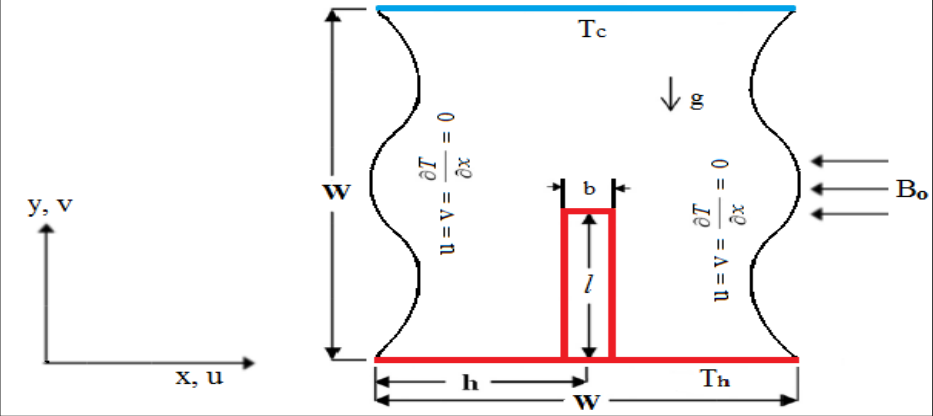 Figure 1
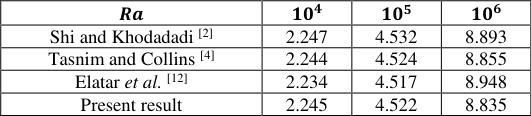 Table 1
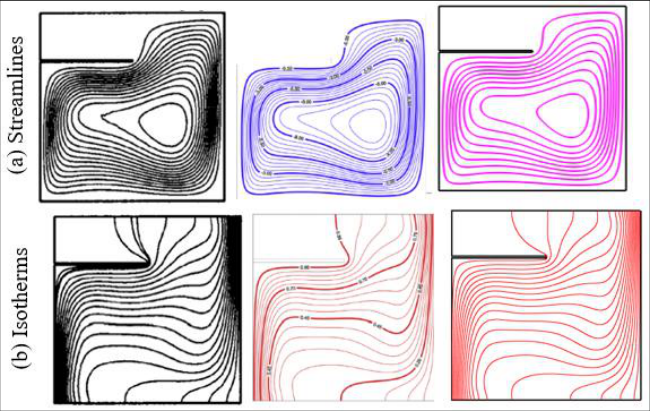 Figure 2
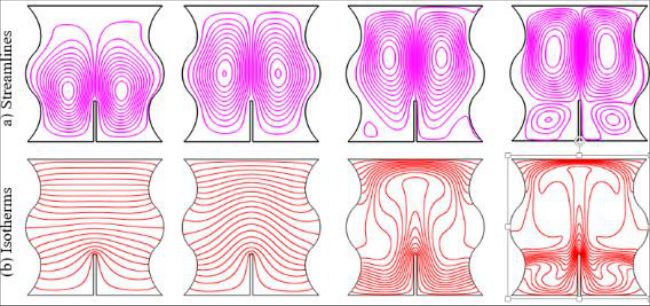 Figure 3
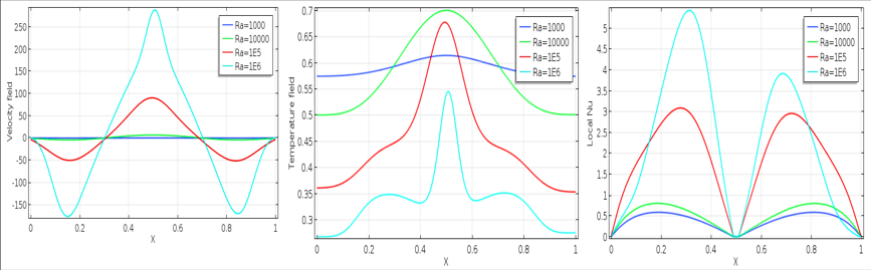 Figure 4
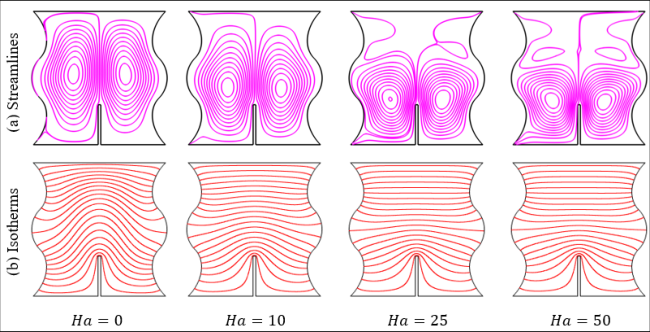 Figure 5
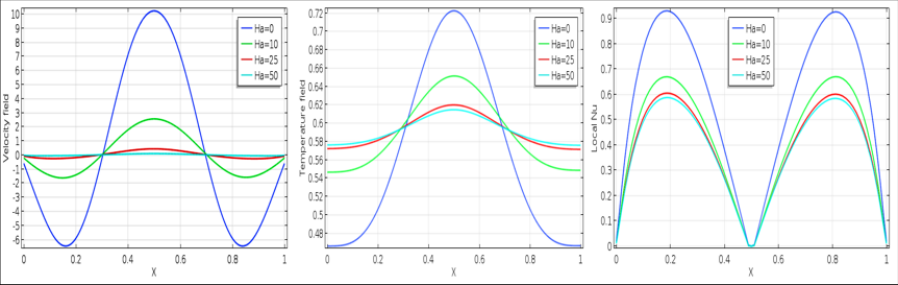 Figure 6
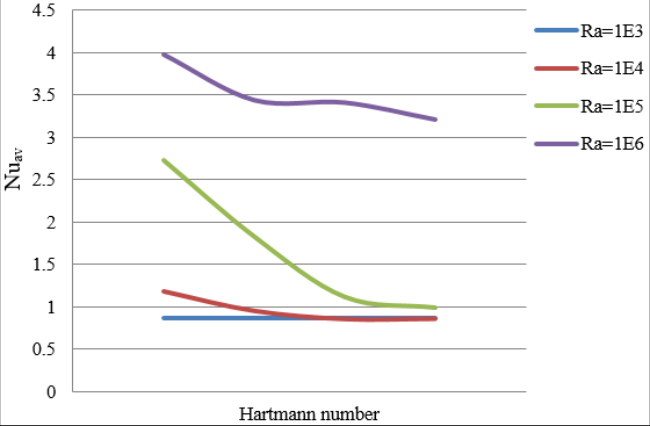 Figure 7
Introduction
Free convection is one of the most important phenomena in thermal systems because of its wide range of applications. The relevant research output has numerous applications such as solar energy collectors, cooling of nuclear reactors, ventilation of rooms, fire prevention, electronic cooling devices, biological and geothermal devices etc. A large number of research works have been done on different shapes of cavities. Bilgen [1] studied numerically natural convection heat transfer inside a differentially heated cavity with a horizontal fin attached to the hot wall. The result showed that the heat transfer rate was minimum with the fin attached to the middle or near the middle of the heated wall. Shi and Khodadadi [2] investigated the steady laminar natural convection heat transfer in a differentially heated square cavity due to a thin fin on the hot wall. They found that for higher value Rayleigh number, heat transfer rate was enhanced irrespective of the fin position or length. Ben-Nakhi et al. [3] studied numerically conjugate natural convection in a square enclosure with inclined thin fin of arbitrary length. Tasnim et al. [4] investigated numerically natural convection heat transfer in a square cavity with a baffle on hot wall. They observed that the effect of fin position on the heat transfer rate was depended strongly affected by Rayleigh number and the fin length. Jani et al. [5] carried out the effect of magneto hydrodynamic free convection fluid flow in a square cavity heated from below and cooled from other walls. They showed that free convection parameter and Hartmann number have notable effect on flow structure and temperature field. Xu et al. [6] reported the effect of fins and their height on natural convection flow transition cavity. They found that the flow near the finned wall changes from a steady to periodic unsteady flow at a critical Rayleigh number that is sensitive to the fin length. Sun et al. [7] reported the effect of triangular fins on mixed convection in a lid-driven cavity. They observed that the triangular fin is a good control parameter for flow structure, temperature field and rate of heat transfer. Pirmohammadi et al. [8] . Studied steady laminar free convection flow in presence of a magnetic field in an enclosure heated from left and cold from right wall.
The result showed that with increasing Hartmann number the rate of convective transfer and the average Nusselt number increase. Mahmud and Faster [9] investigated the magneto hydrodynamic free convection and entropy generation in a square porous cavity. They found that the fluid velocity is reduced with increasing the value of Hartmann number. Xu and Saha [10] studied the transition to an unsteady flow due to an adiabatic fin on the sidewall of a square cavity. Gdhaidh et al. [11] investigated analytically the enhancement of natural convection heat transfer within closed enclosure using parallel fins. They observed that as the fin number increases the maximum heat source temperature decreases. Elatar et al. [12] performed a numerical study on laminar natural convection inside square enclosure with adiabatic horizontal wall with a single horizontal fin at different length and positions attached to the hot wall. They investigated the effect of Rayleigh number, fin lengths and fin positions of the enclosure on fluid flow structure and heat transfer characteristics. Ali et al. [13] studied the magneto hydrodynamic mixed convection flow in a hexagonal enclosure. They found that Hartmann number and Richardson number have considerable effect on the flow field and temperature field. Rostami [14] numerically simulated the unsteady fluid flow and heat transfer behavior in a cavity with vertical wavy walls and horizontal straight walls. Abu-Nada and Chamkha [15] examined the mixed convection flow of nanofluid in liddriven cavity with a wavy wall. Sheremet et al. [16] studied the flow and convective heat transfer in a partially heated wavy porous cavity filled with a nanofluid. Alsabery et al. [17] reported the effect of rotating solid cylinder on entropy generation and convective heat transfer in a wavy porous cavity heated from below. Based on the above literature survey and to the best of author's knowledge, it appears that very little work reported on the wavy enclosure having vertical fin. There is no present study on MHD free convection heat transfer having vertical fin in a square wavy cavity will be numerically analyzed in this present study. The objective of this present study is to analyze the increase of the heat transfer rate in fluid through wavy cavity having vertical fin.
Physical Configuration
The physical model and boundary conditions of the present problem under consideration are shown in Fig. 1. Which represents of two dimensional square wavy enclosure with side length W. The bottom wall is kept at a constant heat temperature 𝑇 ℎ and the upper wall is kept at a constant cold temperature 𝑇 𝑐 (𝑇 ℎ > 𝑇 𝑐 ), while the wavy vertical walls are kept at adiabatic. A heated fin of length (𝑙) and thickness (𝑏) is attached to the bottom wall at a position (ℎ) from the left surface. The gravitational force acts in the vertically downward direction and a uniform external magnetic field of strength (B0) is applied along the horizontal direction.
Mathematical Formulations
The physical domain is shown in Fig. 1. The flow is considered steady, laminar, incompressible and two-dimensional, which is filled with electrically conducting fluids 𝑃𝑟 = 0.71 interact.The governing differential equations for free convection flow using conservation of mass, momentum and energy can be written as:
where 𝑢 and 𝑣 are the velocity components along x and y directions respectively, 𝑝 is the pressure, 𝜌 is the density, 𝜇 is the dynamic viscosity, 𝛽 is the coefficient thermal expansion, 𝜎 is the electrical conductivity, 𝐵 0 is the magnetic field, 𝑇 is the temperature, 𝑔 is the gravitational force, 𝑣 = 𝜇 𝜌 is the kinematic viscosity and 𝛼 is the thermal diffusivity.
Boundary conditions
The boundary conditions for the present problem are specified as follows:
On the top wall: 𝑢 = 0, 𝑣 = 0, 𝑇 = 𝑇 𝑐 On the left vertical wall: 𝑢 = 0, 𝑣 = 0, Using the following dimensionless parameters, the governing equations can be converted to the dimensionless forms:
where, X and Y are the coordinates varying along horizontal and vertical directions, U and V are the velocity components in the X and Y directions respectively, 𝜃 is the dimensionless temperature and P is the dimensionless pressure. After substitution of the dimensionless variables into equations ( 1) -( 4), we get the following dimensionless equations:
In the above equations, 𝑃𝑟 is the Prandtl number, 𝐻𝑎 is the Hartmann number or magnetic parameter and 𝑅𝑎 is the Rayleigh number defined by:
Nusselt Number
First, the heat transfer by conduction was equated to the heat transfer by convection
where 𝑛 is the normal distance to coordinate surface. By introducing the dimensionless variables, defined in equation ( 5) into equation (11), local Nusselt number is defined as:
The average Nusselt number on the cold wall is obtained as follows:
Numerical Technique
The nonlinear governing partial differential equations, i.e., mass, momentum and energy conservation equations are transformed into a system of integral equations by using the Galerkin weighted residual method of finite-element formulation. The nonlinear algebraic equations so obtained are modified by imposition of boundary conditions. These modified nonlinear equations are transferred into linear algebraic equations with the help of Newton's method. Lastly, these linear equations are solved by applying Triangular factorization. For numerical computation and post processing, the software COMSOL Multiphysics is used.
Program Validation and Comparison with Previous Work
In order to check the accuracy of the numerical results obtained in this problem, a comparison is made between results of the average Nusselt number obtained from this study with other published results for enclosure without a fin as shown in Table 1. The maximum derivation found was 1.55% for the case of 𝑅𝑎 = 10 6 .
| 𝑹𝒂 | 𝟏𝟎𝟒 | 𝟏𝟎𝟓 | 𝟏𝟎𝟔 |
|---|---|---|---|
| Shi and Khodadadi [2] | 2.247 | 4.532 | 8.893 |
| Tasnim and Collins [4] | 2.244 | 4.524 | 8.855 |
| Elatar et al. [12] | 2.234 | 4.517 | 8.948 |
| Present result | 2.245 | 4.522 | 8.835 |
Table text extracted from the original PDF; superscript letters are shown inline. The original table image is below.
View original table image
Table 1:
Comparison of average Nusselt number obtained from the present study and those reported in the literature.
𝑹𝒂 𝟏𝟎 𝟒
𝟏𝟎 𝟓 𝟏𝟎 𝟔 Shi and Khodadadi [2] 2.247 4.532 8.893 Tasnim and Collins [4] 2.244 4.524 8.855 Elatar et al. [12] 2.234 4.517 8.948 Present result 2.245 4.522 8.835
In addition, a comparison of the streamlines and isotherms is made for the present results with those of Tasnim and Collins [4] and Elatar et al. [12] at (𝑅𝑎 = 10 5 , 𝐵 = 0.01, 𝐿 = 0.5 𝑎𝑛𝑑 𝐻 = 0.75) as shown in Fig. 2. The shapes of streamline contours are almost identical. For the isotherms, one can see the strong agreement of the present results with those by Tasnim and Collins [4] and Elatar et al. [12] as seen in the figure.
Tasnim and collins [4] Elatar et al. [12 Present results
Effect of Rayleigh number
The results are presented in terms of streamlines, isotherms in Fig. 3 and in terms of velocity profiles, temperature profiles and local Nusselt number along the bottom heated wall are shown in Fig. 4. In Fig. 3(a) shows that when 𝑅𝑎 between 10 3 and 10 5 the strength of buoyancy inside the cavity is significant and two elliptic-shaped eddies inside the cavity, Again when 𝑅𝑎 = 10 6 the strength of buoyancy inside the cavity is more significant and four elliptic-shaped eddies appear inside the cavity. Conduction dominant heat transfer is observed from the isotherms in Fig. 3
Effect of Hartmann number
The results are presented in terms of streamlines, isotherms in Fig. 5 and in terms of velocity profiles, temperature profiles and local Nusselt number along the bottom hot wall are shown in Fig. 6. Fig. 5(a) shows that when 𝐻𝑎 = 0 the strength of buoyancy inside the cavity is significant and two elliptic-shaped eddies appear inside the cavity. Again when Hartmann number increases, the strength of the buoyancy inside the cavity is more significant and two elliptic-shaped eddies move downward and close to the bottom wall appear. Conduction dominant heat transfer is observed from the isotherms in Fig. 5
Conclusion
The effect of magnetic field on the flow structure and heat transfer behaviors for free convection flow and heat transfer within a square wavy cavity with single vertical fin has been studied numerically by using finite element method. The numerical procedure
Figures and tables from the paper
References
20 in the original paper- Bilgen E. Natural convection in cavities with a thin fin on the hot wall", International Journal of Heat and Mass Transfer. 2005; 48:3493-3505.
- Shi Xu, Khodadadi JM. Laminar natural convection heat transfers in a differentially heated square cavity due to a thin fin on the hot wall", ASME Journal of Heat Mass and Transfer. 2003; 125:624-634.
- Ben-Nakhi A, Chamkha AJ. Conjugate natural convection in a square enclosure with inclined thin fin of arbitrary length", International Journal of Thermal Sciences, 2007; 46:467-478.
- Tasnim SH, Michael R Collins. Numerical analysis of heat transfer in a square cavity with a baffle on hot wall", International Commun. Heat and Mass Transfer. 2004; 31:639-650.
- Jani S, Mahmoodi M, Amini M. Magneto hydrodynamic free convection in a square cavity heated from below and cooled from other walls", International Journal of Mechanical Aerospace Industrial and Mechatronics Engineering. 2013; 7:331-336.
- Xu F, Patterson JC, Lei C. Effect of fin length on natural convection flow transition in a cavity", International Journal of Thermal Sciences. 2013; 70:92-101.
- Sun C, Yu B, Oztop HF, Wang Y, Wei J. Control of mixed convection in a lid-driven enclosures using conductive triangular fin", International Journal of Heat and mass Transfer. 2011; 54:894-909.
- Pirmohammadi M, Ghassemi M, Sheikhzadeh GA. Effect of a magnetic field on buoyancy-driven convection in differentially heated square cavity, IEEE Transactions on Magnetics. 2009 45:407-411.
- Mahmud S, Fraser RA. Magneto hydrodynamic free convection and entropy generation in a square porous cavity", International Journal of Heat and Mass Transfer. 2004; 47:3245-3256, 2004.
- Xu F, Saha SC. Transition to an unsteady flow induced by a fin on the sidewall of a differentially heated air-filled square cavity and heat transfer", International Journal of Heat and Mass Transfer. 2014; 71:236-244.
- Gdhaidh FA, Hussain K, Qi HS. Enhancement of natural convection heat transfer within closed enclosure using parallel fins", International Journal of Mechanical Aerospace Industrial and Mechatronics Engineering. 2015; 9:355-360.
- Elatar A, Teamah MA, Hassab MA. Numerical study of laminar natural convection inside square enclosure with single horizontal fin", International Journal of Thermal Sciences. 2016 99:41-51.
- Ali MM, Alim MA, Ahmed SS. Magneto hydrodynamic mixed convection flow in a hexagonal enclosure", Procedia Engineering. 2017; 194:479-486.
- Rostami J. Unsteady natural convection in an enclosure with vertical wavy walls", Heat and Mass Transfer. 2008; 44:10791087.
- Rostami J. Unsteady natural convection in an enclosure with vertical wavy walls", Heat and Mass Transfer. 2008; 44:10791087.
- Abu-Nada E, Chamkha AJ, Mixed convection flow of a nanofluid in a lid-driven cavity with a wavy wall", International Communications Heat and Mass Transfer. 2014; 57:36-47.
- Sheremet M, Cimpean D, Pop I. Free convection in a partially heated wavy porous cavity filled with a nanofluid under the effects of Brownian diffusion and thermophoresis, Applied Thermal Engineering. 2017; 113:413-418.
- Alsabery AI, Tayebi T, Chamkha AJ, Hashim I. Effect of rotating solid cylinder on entropy generation and convective heat transfer in a wavy porous cavity heated from below, International Communications Heat and Mass Transfer. 2018; 95:197209.
- Taylor C, Hood P. A numerical solution of the Navier-Stokes equations using finite element technique, Computers and Fluids. 1973; 1:73-89.
- Dechaumphai P. Finite Element Method in Engineering, 2nd ed. Chulalongkorn University Press, Bangkok. 1999.
Cited by 6
From OpenAlex, OpenCitations and reference lists read by Scinovex
- Thermal influence of heated fin on MHD natural convection flow of nanofluids inside a wavy square cavity ↗
Tinni Saha, Tarikul Islam, Sabina Yeasmin, Nazma Parveen · International Journal of Thermofluids · 2023
MHD free convective thermal transport and fluid flow in a square cavity with the top wavy wall and a heated single fin that is attached vertically at the middle of the bottom wall filled with Al2O3-H2O nanofluid is studied numerically. The top wavy wall is heated at a low heat T = Tc while the left, right, and, bottom walls…
❝ 70PDF - Numerical simulations of energy storage performance in a close configuration: A Galerkin finite element-based computation ↗
Afraz Hussain Majeed, Dong Liu, Ahmed Refaie Ali, Hammad Alotaibi, Zhang Jia Yin, Ren Huan Yi · Alexandria Engineering Journal · 2024
The energy storage features on natural convection in Casson fluids are investigated in this work using the finite element method. By measuring cylinders and wavy surfaces, we may examine flow patterns and the effectiveness of heat transmission systems. We study the variation of the mass and heat transfer rates as a function of the cylinder geometry. To approximately determine velocities…
❝ 50PDF - Impact of undulation on magneto-free convective heat transport in an enclosure having vertical wavy sides ↗
Md. Fayz-Al-Asad, Md. Nur Alam, Ahmed Mohammed Rashad, Md. Manirul Alam Sarker · International Communications in Heat and Mass Transfer · 2021
❝ 29 - Semi-analytical modeling of compact flow with mass and heat exchange: a python-based approach ↗
Davood Domiri Ganji, Fateme Nadalinia Chari, Mehdi Mahboobtosi · International Journal of Thermofluids · 2025
In this paper, the compact flow with mass and heat exchange for a two-dimensional incompressible viscous fluid between two parallel plates is investigated using semi-analytical methods. The study of compact flow with mass and heat exchange has numerous applications in medicine, including modeling blood flow in vessels, designing controlled drug delivery systems, simulating heat transfer in the body, and designing…
❝ 25PDF - Effect of Fin Length and Location on Natural Convection Heat Transfer in a Wavy Cavity ↗
M. Fayz-Al-Asad, Md. Jahirul Haque Munshi, M. M. A. Sarker · International Journal of Thermofluid Science and Technology · 2020
The present study aims to analyze the natural convection flow and heat transfer in a wavy cavity with a single horizontal fin attached to its hot wall. Galerkin weighted residual finite element technique has been employed to solve the governing nonlinear dimensionless equations. The effects of model parameters like Rayleigh number, fin length and location on the fluid flow and…
❝ 15PDF - Computational study of natural convection in a rectangular porous enclosure with partially active wall in different heater and cooler positions
Sumona Huq, MM Rahman, M. Enamul Karim, Amin Amin · International Journal of Statistics and Applied Mathematics · 2019
Natural convection heat transfer and fluid flow through a two-dimensional rectangular porous enclosure with partially active thermal walls are investigated numerically in this study. A small part of two sidewalls are partially cooled at a constant temperature θc and a small part of the bottom wall is kept at constant temperature θh (θh > θc), where the top and the remaining part of the bottom wall and the side walls of the enclosure are assumed to be insulated. The physical problems are presented mathematically by different sets of governing equations (such as the mass, momentum and energy bal