
Research article · 2017 · Full text
International Journal of Statistics and Applied MathematicsSelf-similar processes in magnetogasdynamics shock waves
Volume 2(5) · Pages 97–100
Research areasFluid Dynamics and Turbulent FlowsComputational Fluid Dynamics and AerodynamicsGas Dynamics and Kinetic Theory
Abstract
Author-writtenSelf-similar motion is of great importance in fluid dynamics, for example, in the determination of shock velocity and the flow-field behind the shock front. In such type of motions, the flow variables do not depend on coordinates and time separately, but depend only on particular combination of them. Thus for one-dimensional motion, only one independent variable appears instead of two variables r and t. Therefore the flow can be described by ordinary differential equations rather than by partial differential equations, and this simplifies the problem by numerical integrations considerably from a mathematical point of view.
Summary
Source-checkedPlain-language reading of the full paper, prepared with AI and checked against the text. Each point links to the authors' own words.
Why it matters
- Self-similar motion is critical in fluid dynamics for determining the flow-field behind a shock front and the velocity of the shock. View evidence ↗
- Using self-similar motion allows flow to be described by ordinary differential equations instead of partial differential equations, which significantly simplifies numerical integration. View evidence ↗
- In self-similar motion, the shape of a flow-variable distribution (such as pressure) remains constant over time, while only the pressure and length scales change. View evidence ↗
The question
- The study aims to analyze the spherical symmetric one-dimensional unsteady flow of an ideal, electrically conducting gas, accounting for radiation heat-flux, heat conduction, a gravitational field, and an azimuthal magnetic field. View evidence ↗
What they did
- The mathematical model utilizes independent space (r) and time (t) coordinates to track density, pressure, fluid velocity, azimuthal magnetic field, magnetic permeability, gas mass, gravitational constant, internal energy, and heat flux. View evidence ↗
- The model assumes infinite electrical conductivity (ignoring electrical resistivity and magnetic field diffusion) and negligible gas viscosity. View evidence ↗
- The medium is assumed to behave as a perfect gas. View evidence ↗
- The researchers substituted scale relations into the governing equations to derive reduced functions of a similarity variable. View evidence ↗
What they found
- The study found that all scales in the self-similar motion exhibit a power law dependence on time. View evidence ↗
- The analysis indicates that exponential self-similarity is a possible alternative to power law self-similarity. View evidence ↗
Visual summary
1 visualsIllustrations explain the paper; they do not show study data.
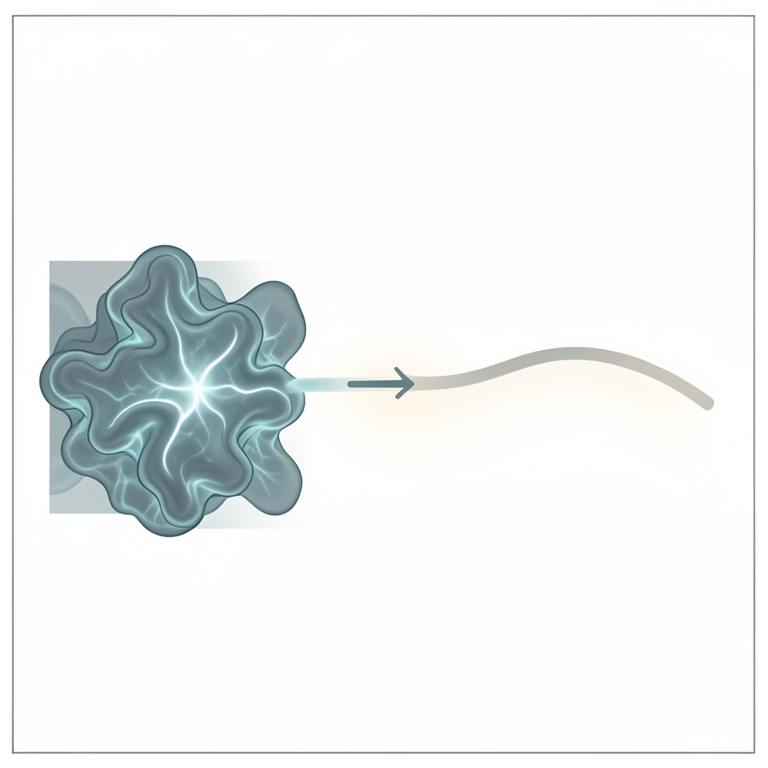
PDE to ODE Transformation
AI-generated conceptual illustration (magnetogasdynamic shock wave in a plasma fluid). It explains the idea and does not show study data.
View source evidence ↗Introduction Self-similar motions
There exist motions whose distinguishing property is the similarity in the motion itself. These motions are called self-similar ( [1,2,3] ). In such a motion the distribution of any of the flowvariable, for example the pressure p, envolves with time in a self-similar motion in such a manner that only the scale of the pressure π(t) and the length scale R(t) of the region included in the motion change, but the shape of the pressure distribution remains unaltered. The p(r) curves corresponding to different time t can be made the same by either expanding or contracting the π and R scales. The function p(r,t) can be written in the form p(r,t)=π(t) P( r R ), where the dimensional scales π and R depend on time in some manner, and the dimensionless ratio
is a universal (in the sense that it is independent of time) function of the new dimensionless coordinates r R
. Multiplying the variable P and by the scale functions π(t) and R(t), we can obtain from the universal function P ( ) the true pressure distribution curve p(r) as a function of position for any time t. The flow variables velocity, density etc. are expressed similarly. For self-similar motions the system of partial differential equations describing the one dimensional fluid motion reduces to a system of ordinary differential equations in new unknown functions of the similarity variable r R
. For example, we consider the spherical symmetric one-dimensional unsteady flow of an electrically conducting and ideal gas with heat conduction and radiation heat-flux taken into account in present of an gravitational field and an azimuthal magnetic field, described by equations [4,5] ;
where r and t are independent space and time coordinates, ρ is the density, p the pressure, u the fluid velocity, h the azimuthal magnetic field, μ the magnetic permeability, m the mass of the gas contained in the sphere of radius r, G the gravitational constant, e the internal energy per unit mass and q the heat flux. The total heat flux q, which appears in the energy equation may be decomposed as.
where c q is the conduction heat flux, and R q the radiation heat flux. According to Fourier's law of heat conduction.
where K is the coefficient of thermal conductivity of the gas and T is the absolute temperature.
Assuming local thermodynamic equilibrium and using the radiative diffusion model for an optically thick grey gas, the term , R q which represents radiative heat flux, may be obtained from the differential approximation of the radiation transport equation in the diffusion limit as.
where σ is the Stefan-Boltzmann constant and R is the Rosseland mean absorption coefficient.
The electrical conductivity of the gas is assumed to be infinite. Therefore the diffusion term from the magnetic field equation is omitted, and the electrical resistivity is ignored. Also the effect of viscosity on the flow of the gas is assumed to be negligible.
The above system of equations should be supplemented with an equation of state. A perfect gas behavior of the medium is assumed, so that
where is the gas constant and γ is the ratio of specific heats.
The thermal conductivity K and the absorption coefficient R are assumed to vary with temperature and density. These can be written in the form of power laws, namely.
where subscript '0' denotes a reference state. The exponents in the above equations should be compatible with the conditions of the problem and the form of the required solution. Now, we represent the solution of the partial differential equations (1) to (5) in terms of products of scale functions and new unknown functions of the similarity variable , r , R
R=R(t) (11)
The fluid velocity u, density , pressure p, azimuthal magnetic field h, mass m and total heat flux q and length scales are not all independent of each other. If we choose R, 1 and 1 h as the basic scales then the quantity as the heat-flux scale.
This does not limit the generality of the solution, as the scale is only defined to within a numerical coefficient which can always be included in the new unknown functions. We seek a solution of the form [4] .
where U, D, P, H, N and Q are new dimensionless functions of the similarity variable in terms of which the differential equations are to be formulated. These functions are here termed the reduced velocity, density, pressure, azimuthal magnetic field, mas and heat flux respectively. The scales are time dependent in some as yet unknown manner. We now substitute the relations (12) into equations ( 1) to (5). The differentiation of scales with respect to time and differentiation of the reduced functions with respect to similarity variable is denoted by a prime. After rearrangement we obtain the equations.
In order to get ordinary differential equations for reduced functions U ( ), D ( ), P ( ), H ( ), N ( ), Q ( ),
Where A and are constants (A is dimensional and is a pure number) and . Thus all the scales in the self-similar motion have a power law dependence on time and the similarity variable has the form (Stanyukovich [6] .
Has noted that, in addition to power law self-similarity it is also possible to have exponential self-similarity, in which
where A , B , m and n are constants. The exponential solution satisfies the equation .
RV
V =constant for constant=1. The recent important work on shock propagation using exponential self-similarity are [7] .) Now, equation ( 6) is transformed by using equation (8) (9) (10) into the ordinary differential equation,
Where X is a functions P ( ) , D ( ) exponents cR , and non-dimensional heat transfer parameters cR , (see []). In the derivation of equation ( 21), it was necessary to use the following relations amongst the exponents
Thus, all the partial differential equations governing the flow as transformed into a system of six ordinary differential equations (13) to ( 17) and (21) for the six unknow functions U ( ) , D ( ) , P ( ) , H ( ) , N ( ) a n d Q ( ).
The system contains the unknow constant exponent (similarity exponent ) . In a similar manner, the boundary and initial conditions of the problem are made dimensionless and in true transformed into conditions on the functions U, D, P, H, N, and Q. Let us consider the outward propagation of a spherical shock wave in a gas in which the spatial distribution of the density and azimuthal magnetic field are given by a power of the type . Thus unknow similarity exponents is determined in terms of known exponent w. Since the length scale R is uniquely related to time, we can consider the velocity, density, pressure, azimuthal magnetic field, mass and heat flux scales to be functions of the length scale R, rather than of time. Using the relation ( 18) and (19) we find
Now, the variables u, , p, h, m and q given by equations (12) can be expressed in any of the equivalent form: The constants occurring in these equations can be determined from initial boundary conditions of the problem. Also the distribution of functions U, D, P, H, N and Q againt can be obtained by numerical integration of ordinary differential equations (13) to ( 17) and (21) along with the transformed boundary conditions (shock conditions).
References
7 in the original paper- Sedov LI. Similarity and Dimensional Methods in Mechanics, Academic Press, New York, 1959.
- Zel'dovich Ya B, Raizer Yu P. Physics of Shock Waves and High Temperature Hydrodynamic Phenomena, Academic Press, New York, 1967, 2.
- Taylor GI. The formation of a blast wave by a very intense explosion, I, Proc. Roy. Soc. A, 1950; 201:159.
- Singh AK. Magnetogasdynamic shock wave in a gravitating gas with heat conduction and radiation heat flux, Int. J. of research abd reviews applicable mathematics. 2013; 3(1):1-17.
- Vishwakarma JP, Singh AK. A self-similar flow behind a shock wavr in a gravitating or non-gravitating gas with conduction and radiation heat flux, J. Astrophy. Astr. 2009; 30:53-69.
- Stanyukovich KP. Unsteady motion of continuous media, Pergamon Press, New York, 1960.
- Vishwakarma JP, Nath G. Similarity solutions for the flow behind an exponential shock in a non-ideal gas, Meccanica, 2007; 42:331.