
Research article · 2019 · Full text
International Journal of Statistics and Applied MathematicsStability of stratified elastico-viscous Rivlin-Ericksen fluid in the presence of variable magnetic field and rotation saturating porous medium
Volume 4(5) · Pages 85–92
Research areasRheology and Fluid Dynamics StudiesFluid Dynamics and Thin FilmsLattice Boltzmann Simulation Studies
Abstract
Author-writtenThe influence of viscosity, viscoelasticity, medium permeability and medium porosity on the stability of a stratified elastic-viscous Rivlin –Ericksen fluid is examined for viscoelastic polymeric solutions in the simultaneous presence of a variable horizontal magnetic field and uniform horizontal rotation in porous medium. The effects of coriolis force on the stability are chosen along the direction of the magnetic field and transverse to that of the gravitational field . Assuming the exponential stratifications in density, viscosity and viscoelasticity, the appropriate solution for the case of free boundaries is obtained using a linearized stability theory and normal mode analysis method. The dispersion relation is obtained and the behaviour of growth rates with respect to kinematic viscosity, kinematic viscoelasticity, medium permeability and medium porosity is examined numerically using Newton-Raphson method through the software Fortran-90 and Mathcad. In contrast to the Newtonian fluids, the system is found to be unstable, for stable stratifications, for small wavelength perturbations. It is found that the magnetic field stabilizes the certain wave number band, for unstable stratification in the presence of rotation and this wave number range increases with the increase in magnetic field and decreases with the increase in kinematic viscoelasticity implying thereby the stabilizing effect of magnetic field and kinematic viscoelasticity and the kinematic viscosity has a stabilizing effect on the system for the low wave number range. The medium permeability has enhancing effect on the growth rates with its increase for a fixed wave number. These results are shown graphically.
Summary
Source-checkedPlain-language reading of the full paper, prepared with AI and checked against the text. Each point links to the authors' own words.
Why it matters
- Studying fluid flow through porous media is highly relevant to geophysical fluid dynamics. View evidence ↗
- Understanding the impact of magnetic fields on these flows is critical for studying the Earth's core and mantle, where conducting fluids in porous media can become unstable. View evidence ↗
- Rivlin-Ericksen viscoelastic fluids are used in various industrial applications, including aerospace parts, tires, and biomedical appliances. View evidence ↗
What they did
- The researchers used linearized stability theory and normal mode analysis, assuming exponential stratifications for density, viscosity, and viscoelasticity with free boundaries. View evidence ↗
- Growth rates were numerically analyzed using the Newton-Raphson method implemented in Fortran-90 and Mathcad software. View evidence ↗
What they found
- Unlike Newtonian fluids, this system is unstable for small wavelength perturbations even when stratifications are stable. View evidence ↗
- A magnetic field stabilizes specific wave number bands during unstable stratification with rotation; this stabilizing range expands as the magnetic field increases and shrinks as kinematic viscoelasticity increases. View evidence ↗
- Kinematic viscosity acts as a stabilizing agent for the system within the low wave number range. View evidence ↗
- Increasing medium permeability enhances the growth rates of disturbances for a fixed wave number. View evidence ↗
What it means
- The authors conclude that the magnetic field is effective in stabilizing potentially unstable stratifications for perturbations with small wavelengths. View evidence ↗
- The range of wave numbers that are stabilized increases with a stronger magnetic field and decreases with higher kinematic viscoelasticity. View evidence ↗
Visual summary
1 visualsIllustrations explain the paper; they do not show study data.
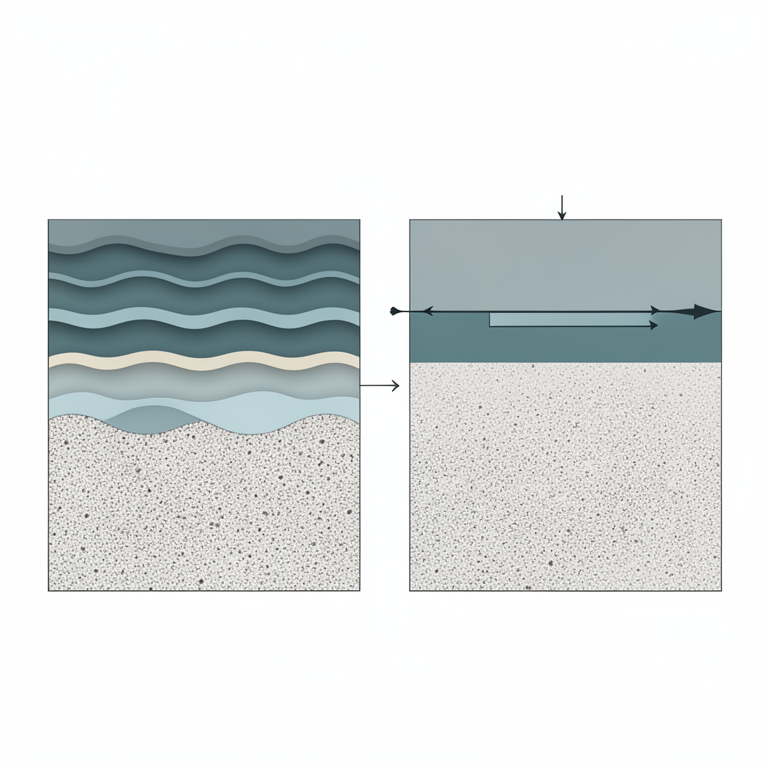
Magnetic Field Stabilization Effect
AI-generated conceptual illustration (A stratified Rivlin-Ericksen fluid within a porous medium). It explains the idea and does not show study data.
View source evidence ↗Figures & tables
From the original paper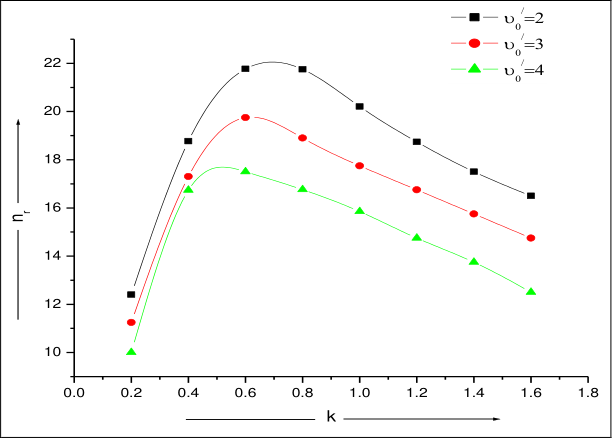 Figure 1
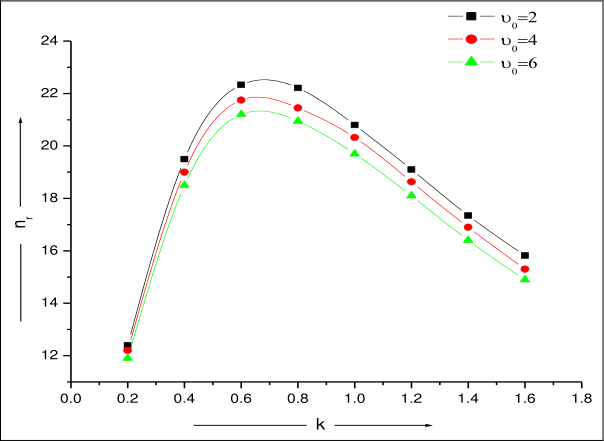 Figure 2
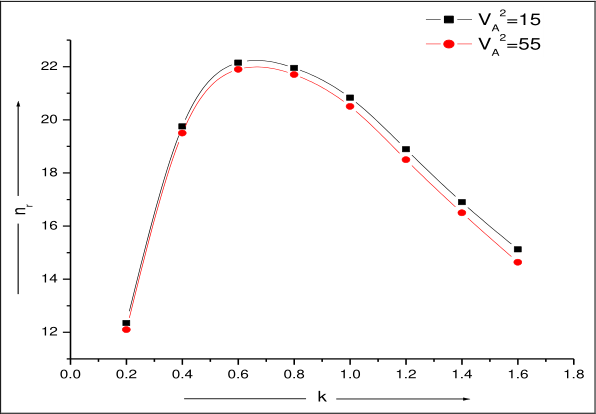 Figure 3
Introduction
The flow through porous medium has been of considerable interest in recent years particularly among geophysical fluid dynamics. When we consider flow in porous medium, some additional complexities arise which are due to the interaction between the fluids and the porous medium. Here we consider those fluid flows for which Darcy's law is applicable. This law is empirical in nature and is usually considered valid for creeping flows where the Reynolds's number as defined for a porous medium is less than one. Darcy's law states that the gross effect, as the fluid slowly percolated through the pores of rock, is that usual viscous term in the equation of elastic-viscous fluid motion will be replaced by the resistance terms
, where and are the coefficients of viscosity and viscoelasticity, of Walters' (model B') fluid, 1 k is the medium permeability and q is the Darcian (filter) velocity (seepage) of the fluid. The stability of flow of a single component fluid through porous medium taking into account the Darcy's resistance has been studied by Lapwood [1] and Wooding [2] . The effect of the Earth's magnetic field on the stability of such a flow is of interest in geophysics particularly in the study of Earth's core where the Earth's mantle, which consists of conducting fluid, behaves like a porous medium which can become convectively unstable as a result of differential diffusion. The physical properties of comets and meteorites strongly suggest importance of porosity in astrophysical context (McDonnell) [3] .
The stability derived from the character of the equilibrium of an incompressible heavy fluid of variable density (i.e. of a heterogeneous fluid) was investigated by Rayleigh [4] . He demonstrated that the system is stable or unstable according as the density decreases everywhere or increases everywhere. An experimental demonstration of the development of the Rayleigh-Taylor instability was performed by Taylor [5] . The effect of a vertical magnetic field on the development of Rayleigh-Taylor instability was considered by Hide [6] . Reid [7] studied the effect of surface tension and viscosity on the stability of two superposed fluids. The Rayleigh-Taylor instability of a Newtonian fluid has been studied by several authors accepting varying assumptions of hydrodynamics and hydromagnetics and Chandrasekhar [8] in his celebrated monograph has given a detailed account of these investigations. Bellman and Pennington [9] further investigated in detail illustrating the combined effects of viscosity and surface tension. Gupta [10] again studied the stability of a horizontal layer of a perfectly conducting fluid with continuous density and viscosity stratifications in the presence of a horizontal magnetic field. The Rayleigh-Taylor instability problems arise in oceanography, limnology and engineering. There are many viscoelastic fluids which cannot be characterized either by Maxwell's constitutive relations or by Oldroyd's constitutive relations. One such class of the viscoelastic fluids is the Rivlin-Ericksen fluid. Rivlin and Ericksen [11] have proposed a theoretical model for such viscoelastic fluid. This and other class of polymers is used in the manufacture of parts of space-crafts, aeroplanes, tyres, belt conveyers, ropes cushions, seats, foams, engineering equipments etc. Recently, polymers are also used in agriculture, communication appliances and in biomedical appliances. Joshi [12] has discussed the viscoelastic Rivlin-Ericksen incompressible fluid under time-dependent pressure. The stability of partially ionized superposed plasmas in the presence of variable horizontal magnetic field has been studied by Sharma and Thakur [13] . Srivastava and Singh [14] have studied the unsteady flow of a dusty viscoelastic Rivlin-Ericksen fluid through channel of different crosssections in the presence of the time-dependent pressure gradient. Sharma and Kumari [15] have studied the stability of stratified fluid in porous medium in the presence of suspended particles and variable magnetic field. In another study, Garg et al. [16] have studied the rectilinear oscillations of a sphere along its diameter in a conducting dusty Rivlin-Ericksen fluid in the presence of a uniform magnetic field. Sharma and Gupta [17] also have studied the stability of stratified rotating viscoelastic Rivlin-Ericksen fluid in the presence of variable magnetic field. Generally, the magnetic field has a stabilizing effect on the instability, but there are a few exceptions also. For example, Kent [18] has studied the effect of a horizontal magnetic field which varies in the vertical direction on the stability of parallel flows and has shown that the system is unstable under certain conditions, while in the absence of magnetic field the system is known to be stable. In stellar atmospheres and interiors, the magnetic field may be (and quite often is) variable and may altogether alter the nature of the instability. Coriolis force also plays an important role on the stability of the system. In all the above studies the fluid has been assumed to be Newtonian. With the growing importance of non-Newtonian fluids in modern technology and industries, the investigations of such fluids are desirable. Fredricksen [19] has a good review of non-Newtonian fluids whereas Joseph [20] has also considered the stability of viscoelastic fluids. There are many viscoelastic fluids which cannot be characterized either by Maxwell's constitutive relations or by Oldroyd's constitutive relations. This class of fluids is used in the manufacture of parts of space cafts, aeroplane, tyres, beltconveyors, rops, cushions, seats, foams, plastics, engineering equipments etc. The magnetic field stabilizes the system. The viscoelasticity of the medium has damping effects on the growth rates but has enhancing effects for certain ranges of the wavenumbers. Keeping in mind the importance of non-Newtonian fluids, medium permeability and medium porosity in modern technology and their various applications mentioned above, the present paper is devoted to consider the stability of rotating stratified elasticoviscous Rivlin -Ericksen fluid in the presence of variable magnetic field and rotation in porous medium.
Materials and Methods
The initial stationary state whose stability we wish to examine is that of an incompressible, heterogeneous infinitely extending and conducting elastico-viscous Rivlin -Ericksen fluid of thickness d bounded by the planes
and of variable density, kinematic viscosity and viscoelasticity, arranged in horizontal strata in a porous medium of variable porosity and medium permeability so that the free surface is almost horizontal and the electrical conductivity
.The character of the equilibrium of this stationary state is determined by supposing that the system is slightly disturbed and then, following its further evolution. The equations expressing conservation of momentum, mass, incompressibility and Maxwell's equations for the elastico-viscous Rivlin -Ericksen fluid are
Where e , the medium permeability, is assumed to be constant. Equation ( 3) represents the fact that the density of a particle remains unchanged as we follow it with its motion. Let
. Then the equations ( 1)-( 5) after perturbations in the cartesian form become
Analyzing the disturbances into normal modes, we seek solutions whose dependence on z y x , , and time t is given by
is the some function of z -only; x k , y k are the wave-numbers in the x -and y -directions, respectively,
is the resultant wave-number and n is the growth rate of the disturbance which is, in general, a complex constant.
Equations ( 15)-(23) using expression (24) become
Now substituting the values of
and z h from equations (31)-(33) in equations ( 25)-( 27), we get
, is the z -component of vorticity.
Multiplying equations ( 34) and ( 35) by y ik and x ik , respectively, and then adding we get
(square of the Alfvén's velocity).
Substituting the value of z in equation ( 35), we get
Multiplying equations ( 34) and (36) by
, respectively, and then adding and using (28), we obtain
Eliminating u , v and p from equations ( 35)-(39) using equations ( 29), after little algebra, we get
Equation ( 40) is the general equation formulating the effect of variable magnetic field and uniform rotation on the stability of stratified Rivlin -Ericksen fluid saturating porous medium.
The case of exponentially varying stratifications
In order to obtain the solution of the stability problem of a layer of Walters' (model B ) fluid, we suppose that the density , viscosity , viscoelasticity medium porosity and medium permeability vary exponentially along the vertical direction i.e.
are constants and so the kinematic viscosity
, the kinematic viscoelasticity
are constant everywhere. Using the stratifications of the form (41), equation (40) transforms to
Considering the case of two free boundaries, we must have
The appropriate solution of equation (42) satisfying the above boundary condition is
Where's m is an integer and 0 A is a constant. Substituting the value of w from equation (44) in equation ( 42) we obtain dispersion relation
Equation ( 45) is biquadratic in n and is the dispersion relation governing the effects of uniform rotation, variable horizontal magnetic field, viscosity, viscoelasticity medium permeability and medium porosity on the stability of stratified Rivlin -Ericksen fluid.
Results and Discussions
Results and Discussions
Case of stable stratifications
, Equation (45) does not admit any positive real root or complex root with positive real part using Routh-Hurwitz criterion; therefore, the system is always stable for disturbances of all wavenumber.
Case of unstable stratifications (i.e.
, the constant term in the equation ( 45) is negative and therefore has at least one root with positive real part using Routh-Hurwitz criterion; so the system is unstable for all wave-numbers satisfying the inequality
Where is the angle between x k and k i.e.
, equation (45) does not admit of any positive real root or complex root with positive real part, therefore, the system is stable. The system is clearly unstable in the absence of magnetic field, rotation and for non-viscoelastic fluid.
For 1 0 , the constant term in the equation ( 45) is negative and therefore has at least one root with positive real part therefore the system is clearly unstable. The magnetic field, therefore, stabilizes potentially unstable stratifications for small wave-length perturbations
Also, it is clear that the wave-number range, for which the potentially unstable system gets stabilized, increases with the increase in magnetic field and decreases with the increase in kinematic viscoelasticity. All long wave-length perturbations satisfying equation (48) remain unstable and are not stabilized by magnetic field.
The behaviour of growth rates with respect to kinematic viscosity 0 , kinematic viscoelasticity 0 and square of the Alfvén
, 3 and 4 respectively. These values are the permissible values for the respective parameters and are in good agreement with the corresponding values used by Chandrasekhar [8] while describing various hydrodynamic and hydromagnetic stability problems. The graph shows that for fixed wave-numbers, the growth rate increases for certain wave number with the increase in kinematic viscoelasticity 0 , which indicates the destabilizing effect of viscoelasticity whereas the growth rate decreases for certain wave numbers implying thereby the stabilizing effect of kinematic viscoelasticity on the system in the presence of medium permeability and medium porosity for low wave numbers range.
Figure (2) shows the variation of growth rate r n (positive real value of n ) with respect to the wave-number
for three values of 0 2, 4 and 6 respectively. The graph shows that for fixed wave-numbers, the growth rate increases for certain wave number with the increase in kinematic viscosity 0 which indicates the destabilizing influence of kinematic viscosity, whereas the growth rate decreases for certain wave numbers, implying thereby the stabilizing effect of kinematic viscosity on the system in the presence of medium permeability and medium porosity. V for certain wave number which indicates the destabilizing influence of the square of the Alfvén velocity, whereas growth rate decreases for certain wave numbers, implying thereby the stabilizing effect of the square of the Alfvén velocity on the system in the presence of medium permeability and medium porosity.
Figures and tables from the paper
References
20 in the original paper- Lapwood ER. Convection of fluid in a porous medium, Proc. Camb. Phil. Soc. 1948; 48:508.
- Wooding RA. Rayleigh instability of a thermal boundary layer in flow through a porous Medium, J Fluid Mech. 1960; 9:183.
- McDonnel JAM. Cosmic Dust. John Wiley and Sons, Toronto, 1978, 330.
- Rayleigh L. Proc. London Math. Soc. 1883; 14:170.
- Taylor GI. The instability of liquid surfaces when accelerated in direction perpendicular to their Planes, Proc. Roy. Soc. (Lon.). 1950; A201:192.
- Hide R. Waves in a heavy, viscous, incompressible, electrically conducting fluid of a variable density in the presence of a magnetic field, Proc. Roy. Soc. (London,). 1955; A233:376.
- Reid WH. The effect of surface tension and viscosity on the stability of two superposed fluids. Proc. Camb. Phil. Soc. 1960; 57:415.
- Chandrasekhar S. Hydrodynamic and hydromagnetic stability. Dover Publication, New York, 1961.
- Bellman R, Pennington RH. Effect of surface tension and viscosity on Taylor Instability. Quart. Appl. Math. 1952; 12:151162.
- Gupta AS. Rayleigh-Taylor instability of a viscous electrically conducting fluid in the presence of a horizontal magnetic field. J. Phys Soc. Japan. 1963; 18:1073.
- Rivlin RS, Ericksen JL. Stress-deformation relations for isotropic materials. J Rat. Mech. Anal. 1955; 4:323.
- Joseph DD. Stability of fluid motion II. Springer-Verlag, New York, 1976.
- Sharma RC, Thakur KB. Nuova Cimento. 1982; 71B:218.
- Srivastava RK, Singh KK. Bull. Cal. Math. 1988; Soc. 80:286.
- Sharma RC, Kumari V. Stability of Stratified Rivlin-Ericksen fluid in porous medium in the presence of suspended particles and variable magnetic field. Jnanabha. 1999; 27:53-64.
- Garg A, Srivastava RK, Singh, KK. Proc. Nat. Acad. Sci. India. 1994; 64A (III):355.
- Sharma V, Gupta S. Stability of stratified rotating viscoelastic Rivlin-Ericksen fluid in the presence of variable magnetic field. Presented in National Seminar on Algebra and Continuum Mechanics held at Himachal Pradesh University. Shimla, August, 2009.
- Kent A. Instability of laminar flow of a magnetofluid.1966; Phys. Fluids, 9, 1286.
- Fredricksen AG. Principles and applications of Rheology. Prentice-Hall Inc, New Jersey, 1964.
- Joseph DD. Stability of fluid motion II, Springer-Verlag, New York, 1976.