
Research article · 2017 · Full text
International Journal of Statistics and Applied MathematicsComparision of profit analysis of a two – Unit cold standby system with instruction and preparation time for repair
Volume 2(6) · Pages 312–320
Research areasEngineering Diagnostics and ReliabilityEngineering Technology and Methodologies
Abstract
Author-writtenThe comparative study of the profit of a two-unit cold standby system with instruction and preparation time for repair is carried out. The repair man (who is an expert) does not come alone but he comes with his assistant. If the expert repair man is busy in repairing a failed unit and second unit fails then the assistant repairman repairs the latter unit after getting instructions from expert repairman. The paper consists of two models. In model-1 expert repairman takes the unit for repair from his assistant if he completes the repair earlier than his assistant whereas in model-2 either of the repairman (expert or his assistant) do not leave the repair till its completion.
Summary
Source-checkedPlain-language reading of the full paper, prepared with AI and checked against the text. Each point links to the authors' own words.
Why it matters
- Research into the reliability of two-unit systems is a significant area of investigation. View evidence ↗
- In practical scenarios, an expert repairman may be accompanied by an assistant to handle system failures. View evidence ↗
- Repair processes often involve a preparation phase where the expert organizes necessary tools and materials before starting the actual repair. View evidence ↗
The question
- The study aims to investigate a two-unit cold standby system that accounts for both instruction time and preparation time for repair. View evidence ↗
What they did
- The authors compared two models: Model-1, where the expert can take over a unit from the assistant if they finish their own task first, and Model-2, where neither repairman leaves a unit until its repair is complete. View evidence ↗
- The analysis was conducted using regenerative processes and semi-Markov-Renewal Processes. View evidence ↗
- The study measured system effectiveness through steady-state availability, mean time to system failure (MTSF), the expert repairman's busy time fraction, the number of expert visits, and expected profit. View evidence ↗
- For the particular case analysis, the authors assumed that instruction time, repair time, and preparation time follow an exponential distribution. View evidence ↗
What they found
- The profit for both models decreases as the failure rate increases and increases as the instruction rate increases. View evidence ↗
- At an instruction rate of 1, Model-2 is more profitable when the failure rate is below 0.260585, while Model-1 is more profitable when the failure rate exceeds 0.260585; they are equal at 0.260585 with a profit of 340.836. View evidence ↗
- At an instruction rate of 10, Model-2 is superior when the failure rate is below 0.230832, and Model-1 is superior when it is above 0.230832; they coincide at 0.230832 with a profit of 387.063. View evidence ↗
What it means
- The authors conclude that the optimal model depends on the failure rate: Model-2 is better for lower failure rates, while Model-1 is better for higher failure rates. View evidence ↗
Visual summary
1 visualsIllustrations explain the paper; they do not show study data.
Comparison of Repair Models
AI-generated conceptual illustration (two industrial refrigeration units and two repair technicians). It explains the idea and does not show study data.
View source evidence ↗Figures & tables
From the original paper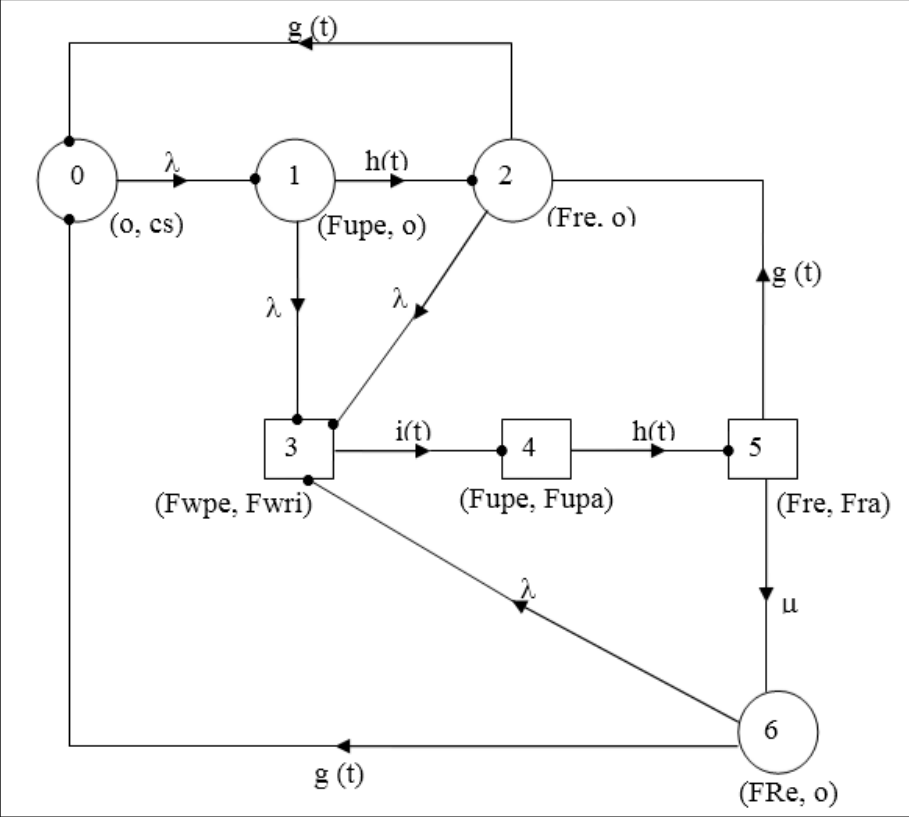 Figure 1
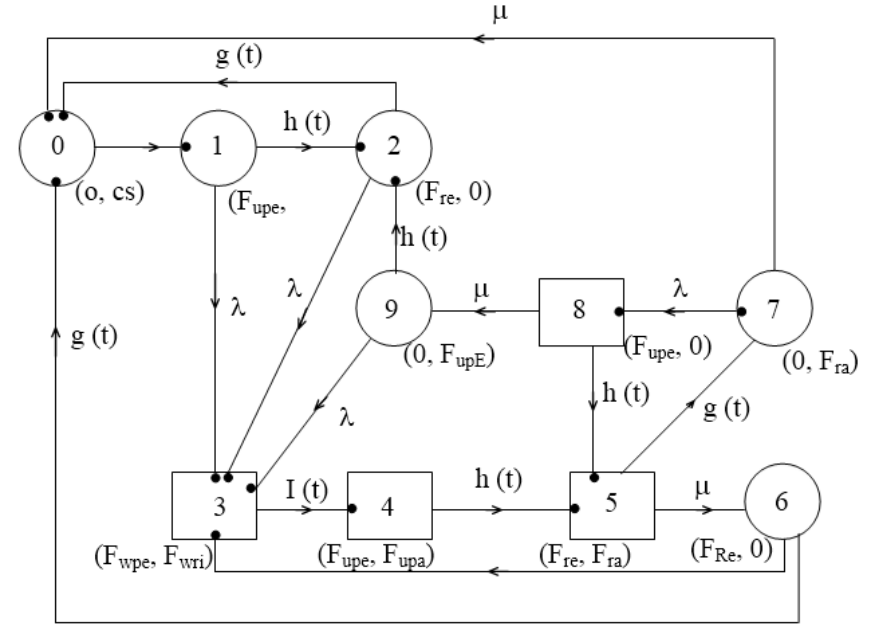 Figure 2
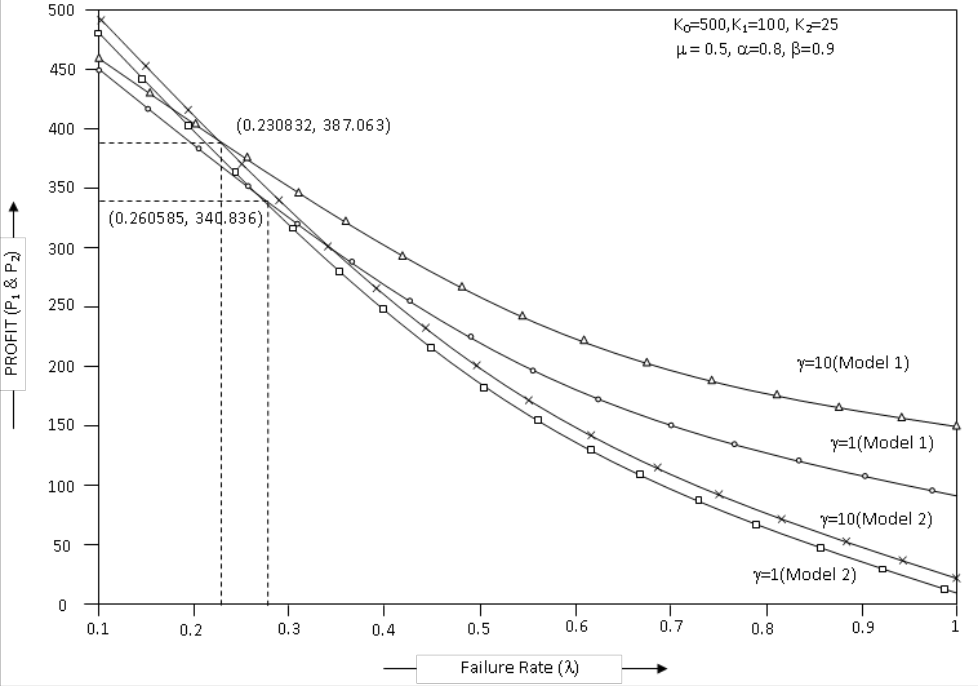 Figure 3
Introduction
Many investigations concerning the reliability of two-unit system are being made. Various authors including [1][2][3] discussed two-unit cold standby systems assuming that whenever the operative unit fails, it goes under repair immediately i.e. preparation time for repair is negligible. Guo Tong De [4] and some others studied two-unit systems with preparation time for repair and with one repairman serving at a time. However, practically there may be situations when on failure of a unit the expert repairman does not come alone but he comes with his assistant. The assistant repairman repairs the failed unit only after getting instructions from expert which are given at the time of system failure so that both the failed unit go under repair of both the repairmanone under expert and the other under his assistant. So, in this paper, we have investigated a two-unit cold stand by system with instruction and preparation time for repair. Whenever a unit fails, we call an expert repairman immediately to repair the failed unit. He comes with his assistant who does the repair of failed unit perfectly only if instructions are given to him by the expert. The expert repairman first prepare himself for repair i.e. he makes the arrangement of tools and other essential materials which are necessary for repair the failed unit and then he starts repair. If a unit is under repair/preparation for repair of the expert and at that time a second unit fails the repairman leaves the repair/preparation for repair of former unit and starts giving instruction to his assistant. It is assumed that after getting instructions the assistant repairman repairs perfectly. Former unit goes under repair of expert and the later under repair of his assistant with the assumptions that both the repairmen first prepare themselves for repair. The paper consists of two models. In model-1 expert repairman takes the unit for repair from his assistant if he completes the repair earlier than his assistant whereas in model-2 either of the repairman (expert or his assistant) do not leave the repair till its completion. The system is analysed by making use of semi-Markov-Renewal Processes and regenerative processes and determine the expressions for the various measures of system effectiveness such as mean time to system failure (MTSF), steady-state availability, total fraction of busy time of the repairman, expected number of visits by the expert repairman and expected profit earned by the system. Graphs are plotted and comparison between models is made through graphs.
Notations
o/cs operative/cold-standby Fup unit in F mode and under preparation for repair Fre/Fra unit in F-mode and under repair of expert/assistant. FRe unit in F-mode and repair is continued by an expert repairman from earlier state. Fwri unit in F-mode and waiting for repair when instructions are being given to assistant. Constant failure rate of an operative unit. Constant repair rate of assistant repairman. h(t), H(t) pdf and cdf of time to preparation for repair of failed unit. g(t), G(t) pdf and cdf of time to repair by expert. i(t), I(t) pdf and cdf of time when expert gives instructions to his assistant. For rest of the notations see reference [5] .
Model -1
In this model, the expert takes the unit for repair from his assistant if he completes the repair earlier than his assistant. Thus considering the above symbols, possible states of the system and the transitions into the states are shown in Fig. 1. The epoch of entrance into the states 6 from 5 is non regenerative.
Transition Probabilities and Soujourn Times
The non-zero elements pij of the transition probability matrix (t.p.m.) for the system are as follows:
By these transition probabilities, it can be verified that p01 = p34 = p45 = 1, p20 + p23 = p12 + p13 = 1
Now the MTSF, given that the system started at the beginning of state 0 is
Using L Hospital's rule and substituting the value of ** 0 (s) from equation ( 4), we have
Availability Analysis
As defined, Mi(t) denotes the probability that the system starting in up state (
Taking the Laplace transform of the above equations and solving them for * 0 AV (s) and then steady-state availability of the system is given by
Profit Analysis
The expected total profit incurred to the system in a steady-state is
where K0 is the revenue per unit up-time of the system, K1 is the cost per unit time for which the expert repairman is busy, K2 is the cost per unit visits by the expert repairman.
Particular Case
Assume that the preparation time for repair, repair time of expert repairman and instruction time are exponentially distributed as follows:
Using the above equations and equations ( 17), ( 26), (34) and finally equation (36), we get the expected total profit in study state.
Model 2
This model is discussed with the additional assumption that either of the repairman (expert and his assistant) do not leave the repair of unit till its completion. The transition diagram showing the various rate of transition is given in Fig. 2. The various characteristics are obtained as follows:
It can be verified that p12 + p13 = p20 + p23 = 1,
The unconditional mean time taken by the system to transit for any regenerative state I, when it is counted from the epoch of entrance into that state is, mathematically, stated as q (t) © A0(t) + (6) 53 q (t) © A3(t) + q57(t) © A7(t) A7(t) = M7(t) + q70(t) © A0(t) + q78(t) © A8(t) A8(t) = M8(t) + ( 9) 82 q (t) © A2(t) + (9) 83 q (t) © A3(t) + q85(t) © A5(t) (7178) Taking Laplace transform of equations and the letting s 0, we get
Figures and tables from the paper
References
10 in the original paper- Barlow RE, Proschan F. Mathematical Theory of Reliability, John Wiley, New York, 1965.
- Mokaddis GS, El-said KHM. Two models for two-unit warm standby redundant system with two different kinds of repair and tolerable time, Microelectron. Reliab. 1990; 30:327-374.
- Tuteja RK, Gulshan Taneja. Proper utilization of a system with two identical repairmen, Int. J. of Management and Systems, 1991; 7:273-281
- Guo Tong De. Stochastic behaviour of a two-unit cold standby system with preparation time for repair, Microelectron. Reliab. 1989; 29:125-129.
- Tuteja RK, Gulshan Taneja. Cost-benefit analysis of a two-server, two-unit, Warm standby system with different types of failure, Microelectron. Reliab. 1992; 32:1353-1359.
- Rander MC, Suresh K Gupta, Ashok Kumar. Cost Analysis of a two dissimilar cold standby system with preventive maintenance and replacement of standby system, Microelectron Reliab. 1994; 34(1):171-174,
- Ashok Kumar, Suresh K Gupta, Tuteja RK. Cost benefit analysis of a two-unit cold standby system with instruction time, IAPQR Transactions, 1997; 22(2):127-133
- Ashok Kumar, Suresh K Gupta, Gulshan Taneja. Probabilistic analysis of a two-unit cold standby system with instructions at need, Microelection. Reliab. 1995; 35(5):829-832.
- Kumar A, Gupta SK, Taneja G. Comparative study of the profit of a two server system including patience time and instruction time. 1996; 36(10):1595-1601.
- Suresh Kumar Gupta. Profit analysis of a two -unit cold standby system with instruction and preparation time for repair, International Journal of Advances in Engineering Sciences, 2016; 6(4).