
Research article · 2018 · Full text
International Journal of Statistics and Applied MathematicsBayesian analysis of truncated skew Laplace distribution
Volume 3(2) · Pages 185–193
Research areasStatistical Distribution Estimation and ApplicationsProbability and Risk ModelsStatistical Methods and Bayesian Inference
Abstract
Author-writtenThis paper describes the Bayesian inference and prediction of the Truncated Skew Laplace Distribution. The aim of this paper is to obtain the Bayesian inference of the unknown parameters under different loss functions. The Bayes estimates can be obtained and it has been used to compute the Bayes estimates and also to construct symmetric loss function. We consider the posterior predictive density of the future observations and also asymmetric loss function
Summary
Source-checkedPlain-language reading of the full paper, prepared with AI and checked against the text. Each point links to the authors' own words.
Why it matters
- The accuracy of statistical analysis is highly dependent on the choice of the probability model or distribution used. View evidence ↗
- Because most real-world phenomena are asymmetrical, the standard normal model is often an inadequate description of observed data. View evidence ↗
- Skewed models are essential for statistical modelers because they can account for varying degrees of asymmetry in data. View evidence ↗
The question
- The study aims to investigate a probability distribution derived from the Laplace distribution to better model real-world problems. View evidence ↗
- The research specifically seeks to determine the Bayesian inference for unknown parameters using various loss functions. View evidence ↗
What they did
- The authors use progressive sampling to perform a Bayesian analysis of a skew symmetric distribution related to the Laplace distribution. View evidence ↗
- The study derives Bayes estimators for the mean, survival function, and failure rate function using squared error and LINEX loss functions. View evidence ↗
- The analysis assumes an inverted gamma prior distribution for parameter 𝜙 and a gamma prior distribution for parameter 𝜆. View evidence ↗
What they found
- The authors successfully derived the posterior distribution of parameter 𝜆 based on the assumed prior distributions. View evidence ↗
- The posterior distribution of parameter 𝜙 was derived using the specified prior distributions for both 𝜙 and 𝜆. View evidence ↗
- The study provides a mathematical expression for the posterior mean of parameter 𝜆. View evidence ↗
- The study provides a mathematical expression for the posterior mean of parameter 𝜙. View evidence ↗
- The authors defined and derived the survival function for the truncated skew Laplace distribution. View evidence ↗
What it means
- The authors conclude that they have successfully derived the expressions for the posterior distribution and Bayes estimators for the parameters of the skewed Laplace distribution. View evidence ↗
Visual summary
1 visualsIllustrations explain the paper; they do not show study data.
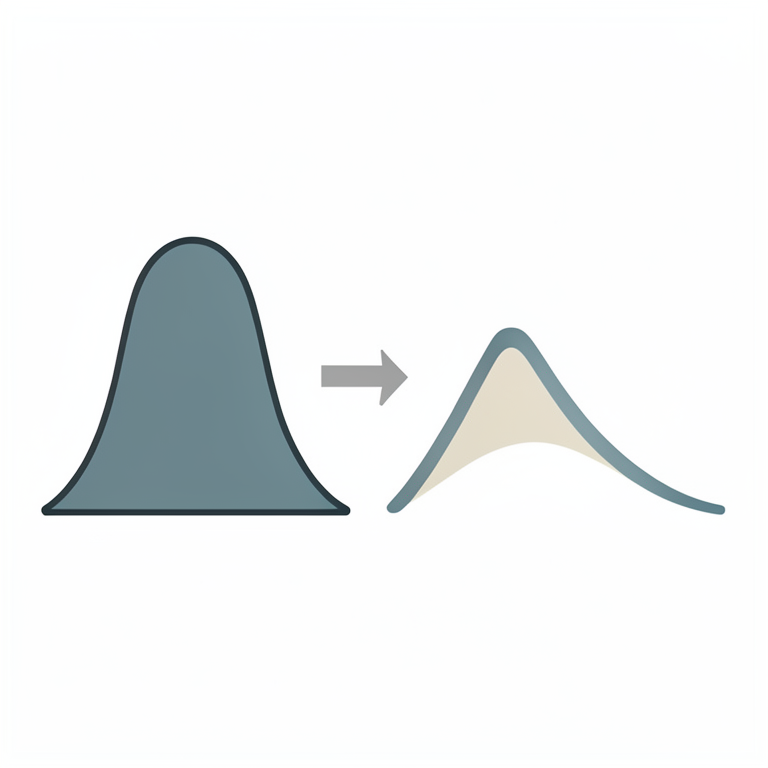
Symmetry vs. Asymmetry in Data Modeling
AI-generated conceptual illustration (mathematical probability density curves). It explains the idea and does not show study data.
View source evidence ↗Introduction
The quality of the procedures used in a statistical analysis depends heavily on the assumed probability model or distributions. Because of this, considerable effort over the years has been expended in the development of large classes of standard distributions along with relevant statistical methodologies, designed to serve as models for a wide range of real world phenomena. However, there still remain many important problems where the real data does not follow any of the classical or standard models. Very few real world phenomenon's that we need to statistically study are symmetrical. Thus the popular normal model would not be a useful model for studying every phenomenon. The normal model at a time is a poor description of observed phenomena. Skewed models, which exhibit varying degrees of asymmetry, are a necessary component of the modeler's tool kit. Genton, M. [8] mentions that actually an introduction of non-normal distributions can be traced back to the nineteenth century. Edgeworth examined the problem of fitting asymmetrical distributions to asymmetrical frequency data. The aim of the present study is to investigate a probability distribution that can be derived from the Laplace probability distribution and can be used to model various real world problems. In fact, we will develop two probability models namely the skew Laplace probability distribution and the truncated skew Laplace probability distribution and show that these models are better than the existing models some of the real world problems. The Laplace distribution is also known as the law of the difference between two exponential random variables consequently, it is also known as double exponential distribution, as well as the two tailed distribution. It is also known as the bilateral exponential law. In life testing experiments, for example, it is sometimes impossible or inconvenient to measure the life length of a device on a continuous scale; in many practical situations, in fact, reliability data are measured in terms of the number of runs, cycles, or shocks the device sustains before failing.
In survival analysis, one may record the number of days of survival for patients since therapy, or the time from remission to relapse is also usually recorded in the number of days. In all cases, a discrete random variable is the most appropriate model to fit the data. Various families of skew Laplace distributions appeared in the literature in recent years, see, e.g., McGill (1962) [2] , Holla and Bhattacharya (1968) [1] , Kozubowski and Podg Borski (2001) [3] , Among these, the asymmetric Laplace (AL) distributions given by, density over a flexible and natural extension of the traditional symmetric Laplace distribution. The AL laws proved valuable for stochastic modeling in a variety of fields including finance, economics, and sciences Additionally, they arise naturally as limits of random sums with geometrically distributed number of summands.
Thus, if the variable or process of interest can be viewed as a sum of a geometric number of independent increments with finite variance (which is the case in numerous applications, see, its distribution can be approximated by an AL law. Furthermore, AL laws are infinitely divisible, have maximum entropy property under specified mean and first absolute moment conditions, extend naturally to the multivariate setting, and are relatively simple to apply in practice, since their moments are finite and computationally reasonable estimators for all parameters are available. Our test of symmetry can be extended to accommodate other classes of skew distributions defined by the same procedure as the skew Laplace model (1). One such family consists of two-piece normal, or skew normal distributions introduced by Fechner (1897) [7] and rediscovered by Gibbons and Mylroie (1973) [9] in connection with fitting impurity profiles in ion-implantation research (for further applications see, e.g., Here, different scale factors are used on each side of the mode of a normal distribution. Statistical issues and properties of this family were Jrst considered by who obtained maximum likelihood and moment estimators of parameters, and proposed a test of symmetry. also considered the skew normal model and obtained asymptotic distributions of the estimators, developed a likelihood ratio test of symmetry, and compared it with that proposed by Only the asymptotic distributions of the test statistics were considered in these works. The skew normal laws also appeared recently in the context of Bayesian analysis. In fields such as petroleum engineering, civil engineering, geography and geology, spatial prediction is an important problem. Usually, data collected from these disciplines are thought as samples from realizations of random fields. The prevalent technique for statistical spatial prediction is Cressie, 1993. Most of the theories related to spatial prediction assume that the data are generated from a Gaussian random field. However, non-Gaussian characteristics, such as nonnegative continuous variables with skewed distribution, often with a heavy right or left tail, appear in many data sets. The present chapter considers the Bayesian analysis of skew symmetric distribution using progressive sampling specially related to the Laplace distribution. In this chapter we use some known skew distributions and investigate different characteristics of members of this class such as different characteristics of truncated skew Laplace distribution using modeling of progressive sampling. Using progressive sampling model find the Bayes posterior analysis of truncated skew Laplace distribution. Under the squared error loss function and LINEX loss function, the Bayes estimator of mean and survival function and the failure rate function (hazard function) have been derived.
Model and assumption
The probability density function (pdf) and cumulative distribution function of standard Laplce distribution are given by 𝑔
A random variable X follows the skew Laplace distribution if its pdf is given by 𝑓(𝑥) = 2𝑔(𝑥)𝐺(𝜆𝑥)
and for 𝑟 = 0, 𝑆 0 = 0 further we write
Hence the likelihood function (2.2.6) can be written as
Posterior Analysis 2 3.1Prior distribution
For the parameters 𝜙 and 𝜆 we assume the following prior distributions The prior distribution for ∅ is inverted gamma distribution with pdf
Further the prior distribution for 𝜆is gamma distribution with pdf
Posterior distribution
Theorem1: For the posterior analysis of skew Laplace distribution the posterior distribution of 𝜆 under the prior distribution given in equation (2.3.1) for the 𝜆 and (2.3.2) is given by
Proof
Combining the likelihood function (2.2.7) with the prior distribution (2.3.2) we obtain the posterior distribution of 𝜆 as
Let us find out the value of
which is the required result ∎ Theorem 3: The posterior mean of parameter 𝜆 is given by
Substituting the value of integral (3.22) in equation (3.19) we get
Theorem 4: The posterior mean of parameter ∅ is given by
Survival Analysis
The survival function for Truncated Skew Laplace distribution is given by 𝑆(𝑡) = 𝑃(𝑋 > 𝑡) 𝑆(𝑡) = 1 -𝐹(𝑡)
Concluding Remarks
The present paper deals with the Bayesian analysis of skewed Laplace distribution which received attention of many researchers in recent past and applied to model various survival data. The expressions for posterior distribution and Bayes estimators for parameters are derived
References
11 in the original paper- Holla MS, Bhattacharya SK. On a compound Gaussian distribution, Annals of the Institute of Statistical Mathematics Tokyo. 1968; 20:331-336.
- McGill WJ. Random fluctuations of response rate, Psychometrika. 1962; 27:3-17.
- Kotz S, Kozubowski TJ, Podgorski K. The Laplace distribution and generalizations. Birkhauser Boston Inc., Boston, MA. Revisit with applications to communications, economics, engineering, and finance, 2001.
- Kotz S, Kozubowski TJ, Podgorski K. Maximum likelihood estimation of asymmetric Laplace parameters. Ann. Inst. Static. Math. 2002; 54(4):816-826.
- Kozubowski T, Nadarajah S. Multitude of Laplace distributions, Statistical Papers, Springer. 2010; 51(1):127-148.
- Britton E, Fisher P, Whitley J The inflation report projections: understanding the fan chart, Bank of England Quarterly Bulletin. 1998; 38:30-37.
- Fechner GT. Kollektivmasslehre. Engelmann, Leipzig, 1897.
- Feunou B, Jahan-Parvar MR, Te´dongap R. Modeling market downside volatility, Review of Finance. 2013; 17:443-481.
- Gibbons J, Mylroie S. Estimation of impurity profiles in ion-implanted amorphous targets using joined half-Gaussian distributions, Applied Physics Letters. 1973; 22:568-569.
- Hansen BE. Autoregressive conditional density estimation, International Economic Review. 1994; 35:705-730.
- Azzalini A. A class of distributions that includes the normal ones. Scand. J Statist. 1985; 12:171-178.