
Research article · 2018 · Full text
International Journal of Statistics and Applied MathematicsMHD flow in porous medium with small internal heat generation under variable electrical conductivity
Volume 3(5) · Pages 156–167
Research areasNanofluid Flow and Heat TransferHeat Transfer MechanismsHeat Transfer and Optimization
Abstract
Author-writtenMHD convective flow of a viscous incompressible fluid of variable electrical conductivity along a vertical isothermal porous plate in presence of external transverse magnetic field and small internal heat generation (E. Pr £ 1) along the plate. While the heat generation decays exponentially, electrical conductivity of the fluid is considered to be the function of fluid temperature. Using similarity transformation techniques and considering fluid flow of low Prandlt Number, numerical solutions and results are obtained for different values of Darcy Number using Runge-Kutta and Shooting methods. The results are shown graphically for absent and present of internal heat generation within the fluid. Variation of Skin-friction and the Rate of heat transfer at the plate for various values of physical parameters are also shown. The results show significant effects of heat generation and external field on flow and heat transfer under consideration.
Summary
Source-checkedPlain-language reading of the full paper, prepared with AI and checked against the text. Each point links to the authors' own words.
Why it matters
- Liquid metals are commonly used as coolants due to their high thermal conductivity and low Prandtl numbers, typically in the range of 0.01 to 0.1. View evidence ↗
- Magnetohydrodynamic (MHD) flow using electrically conducting fluids under a magnetic field allows for the control of cooling rates. View evidence ↗
The question
- The study aims to analyze the MHD convective flow of a viscous incompressible fluid along a porous vertical plate, specifically examining the effects of internal heat generation and variable electrical conductivity under a transverse magnetic field. View evidence ↗
What they did
- The researchers used similarity transformation techniques and solved the resulting equations numerically using Runge-Kutta and Shooting methods for various Darcy numbers. View evidence ↗
What they found
- Fluid velocity increases exponentially away from the plate when internal heat generation is absent (S=0.0), but increases linearly when it is present (S=1.0). View evidence ↗
- Increasing the Darcy number (Da) causes fluid velocity to decrease slowly when S=0.0, but causes it to increase linearly when S=1.0. View evidence ↗
- Without internal heat generation (S=0.0), fluid temperature increases sharply away from the plate; however, with heat generation (S=1.0), the temperature first increases and then gradually decreases. View evidence ↗
- The variation of skin friction (τ) relative to the Darcy number (Da) is nearly opposite when comparing cases of no heat generation (S=0) with low M and Pr, against cases with heat generation (S ≥ 1) and high M and Pr. View evidence ↗
- The Nusselt number (Nu), representing the rate of heat transfer, decreases exponentially as the Darcy number (Da) increases for almost all parameter values, except when S=0.0, Pr=0.001, and M=0.5. View evidence ↗
What it means
- The authors conclude that both internal heat generation and the external magnetic field have significant effects on the fluid flow and heat transfer. View evidence ↗
Visual summary
1 visualsIllustrations explain the paper; they do not show study data.
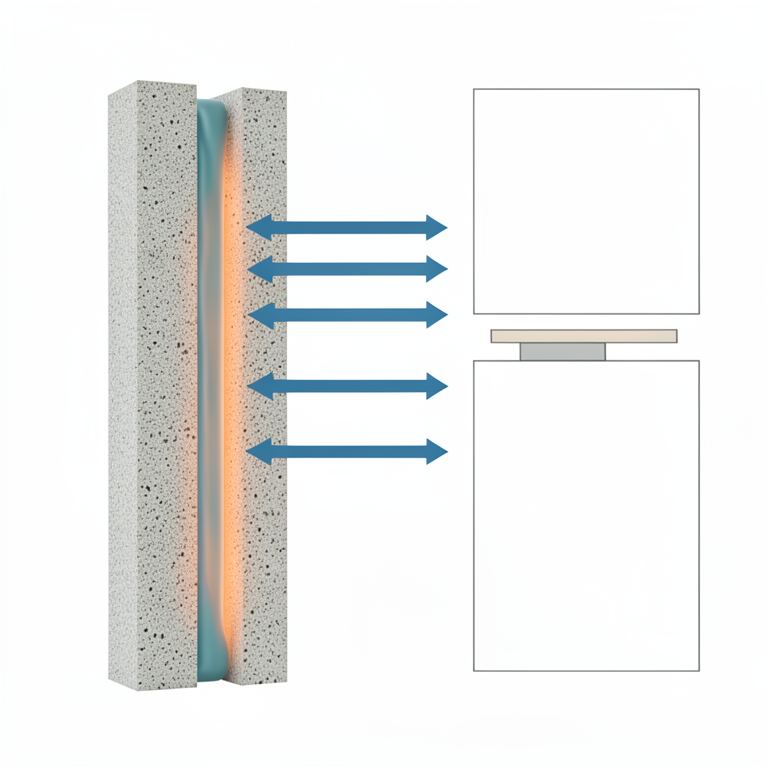
System Setup
AI-generated conceptual illustration (a vertical porous plate in a fluid). It explains the idea and does not show study data.
View source evidence ↗Figures & tables
From the original paper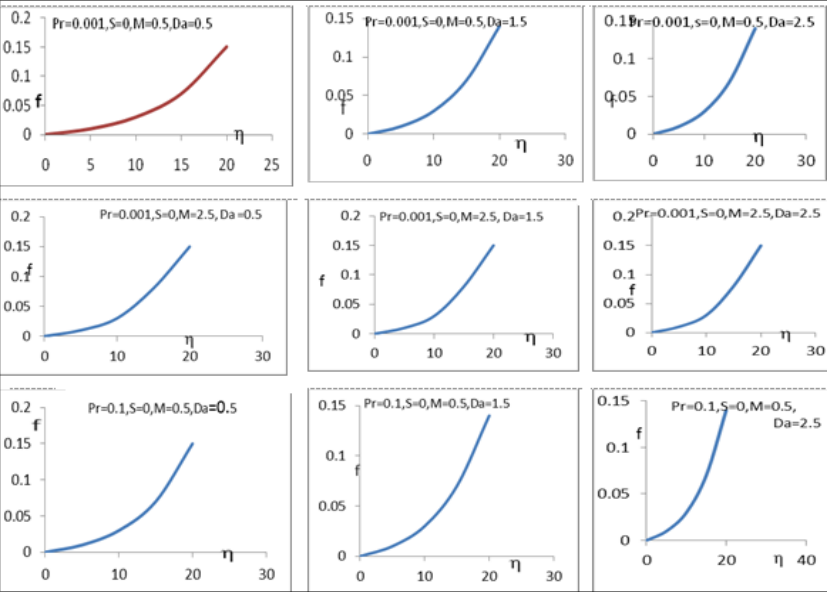 Figure 1
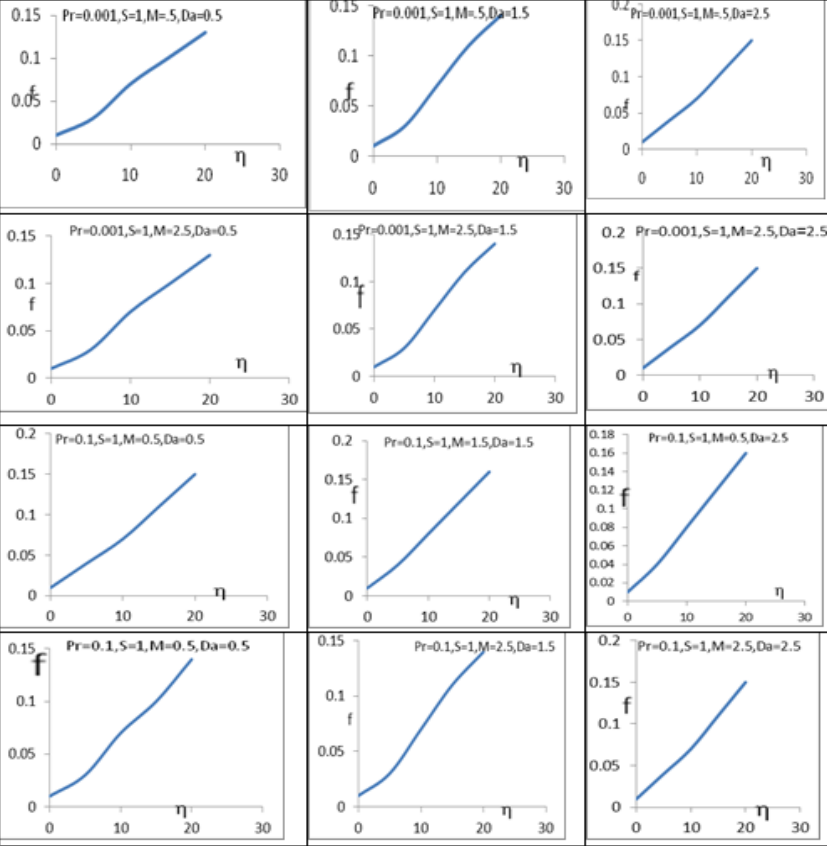 Figure 2
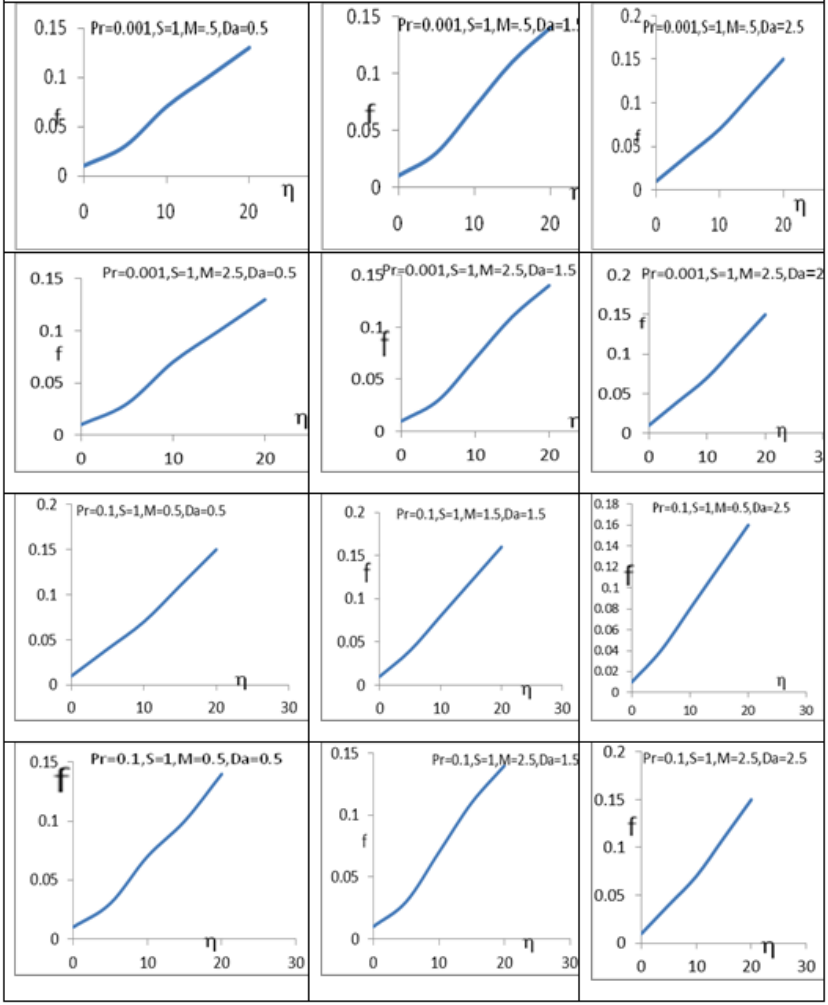 Figure 3
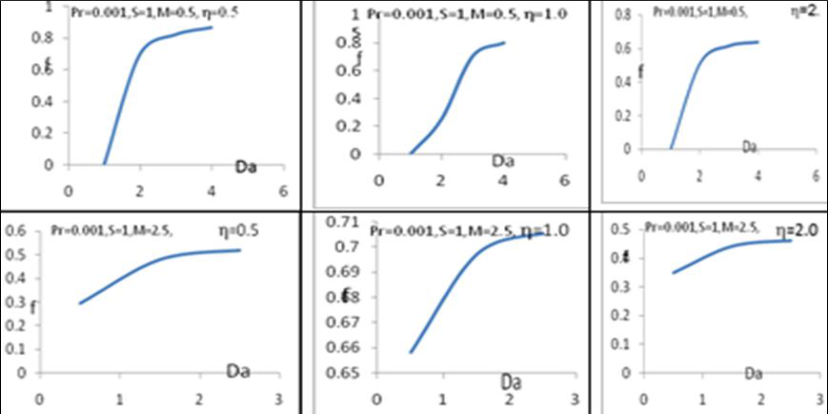 Figure 3
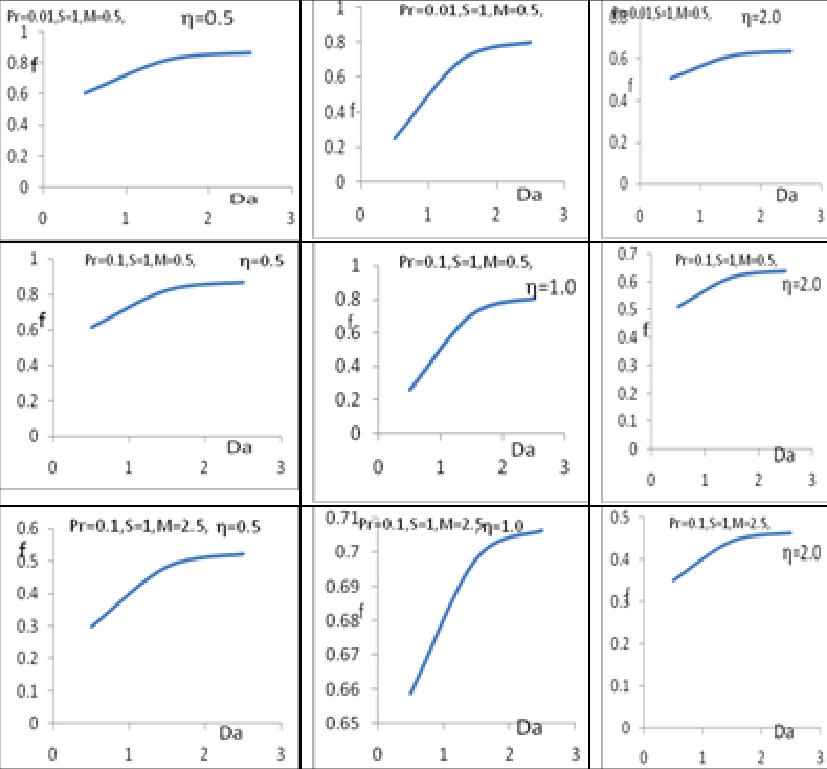 Figure 4
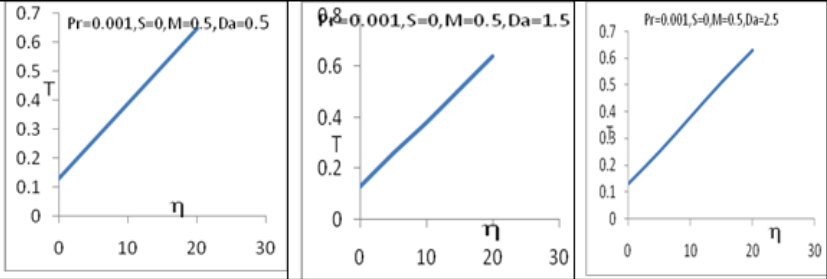 Figure 5
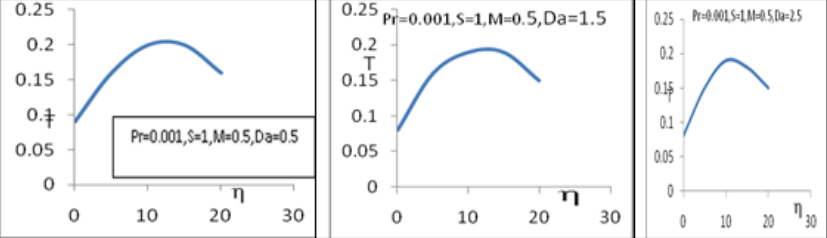 Fig. 6
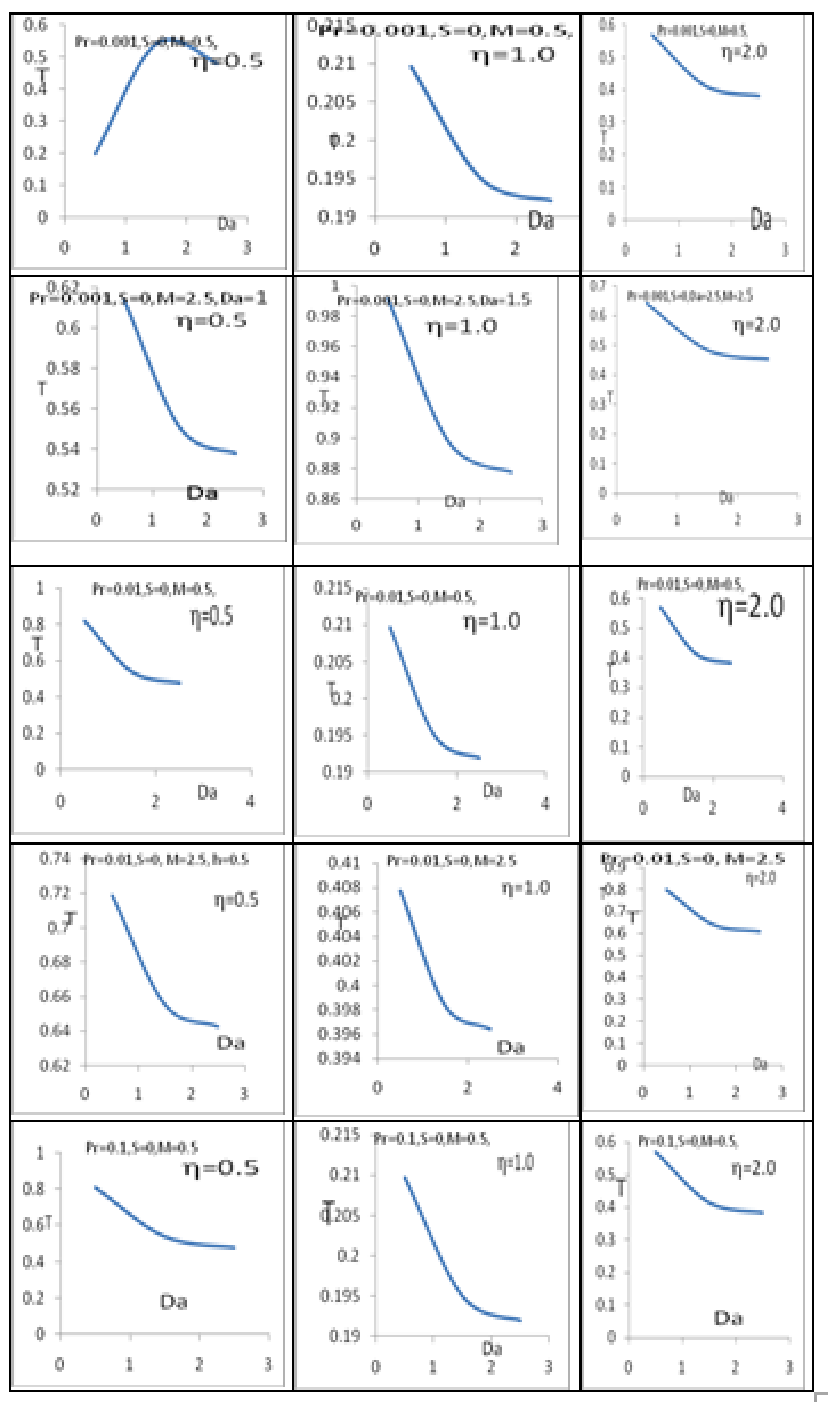 Figure 7
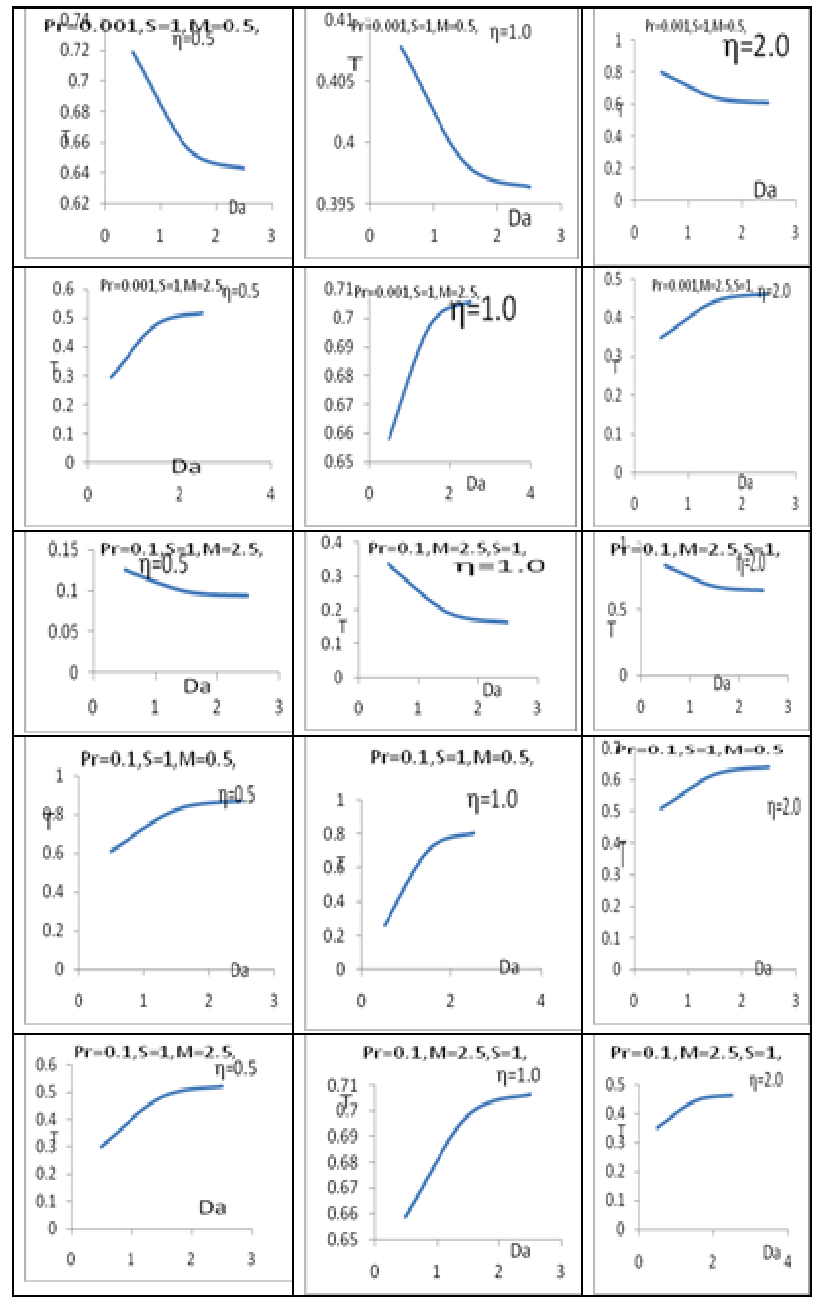 Figure 8
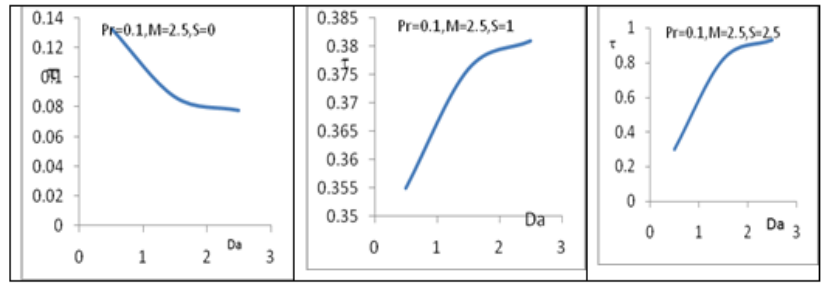 Figure 9
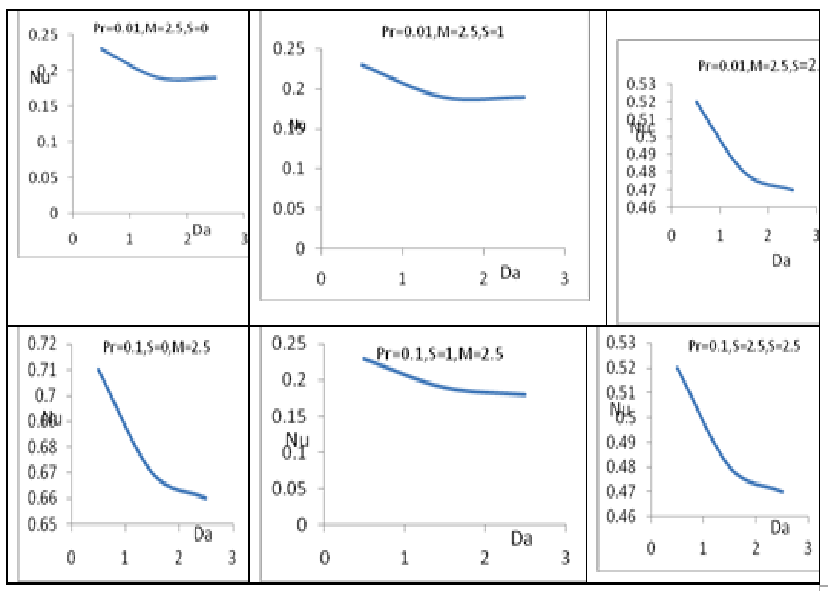 Fig. 10
Introduction
The effect of heat generation or absorption in MHD flows can be effectively dealt by taking into account the variation of fluid properties along with temperature field, Herwig, et al. (1986) [14] . The effect of internal heat generation is especially pronounced for low Prandtl Number fluid 0.001 to 1.0) e.g. liquid metal like Mercury, Bismuth, KCl solution, NaCl solution etc. This is because of the fact that they have smaller Prandtl number but higher thermal conductivity which provides them ability to transport heat even if small temperature difference exists. The MHD flow with suitable electrically conducting fluid under magnetic field can control the rate of cooling while achieved desired results, Chakrabarti et al. (1979) [7] . Liquid metals having smaller Prandtl Number of the order 0.01 to 0.1; e.g. Bismuth=0.01, Mercury =0.023 at 20 0 temperature etc. are generally used as coolants because of higher thermal conductivity. Many authors have studied problems of natural convection flow along vertical isothermal plate with such fluids of low Prandtl number. Flow of such kind of fluids at stagnation point have been discussed by Pai et al. (1956) [16] . Kay reported that thermal conductivity of liquids with low Prandtl number varies linearly with temperature in range of 0°F to 400°F. Arunachalam and Rajappa (1978) [3] , considered forced convection in liquid metals with variable thermal conductivity and capacity in potential flow and derived explicit closed form of analytical solution. Chen (1998) [6] , considered laminar mixed convection flow adjacent to vertical, continuously stretching sheet. Molla et al. (2004) [15] , studied the natural convection flow along a horizontal cylinder in the presence of heat generation. Recently, Gorla et al, (2013) [11] , Alam M. S. (2011) [4] , Chain, T. C, (1998) [5] , Hazen A. Allia (2002) [12] , and many others have studied MHD flow with heat generation problem with various geometries. Boracic et al. (2010) [4] , has studied natural convection MHD flow with variable electrical conductivity and heat generation along an isothermal plate. Crepeau, and Clarksean (1997) [10] , had studied Natural Convection with internal heat generation. Chamkha and Khalad. 2001) [9] had given solutions for hydromagnetic simultaneous heat and mass transfer by natural convection from an inclined plate with internal heat generation or absorption. More recently, Sharma and Singh (2012) [18] , have studied steady MHD natural convection flow with variable electrical conductivity and heat generation along an isothermal vertical plate.
In this paper, MHD convective flow of a viscous incompressible fluid of variable electrical conductivity along a porous plate is discussed where fluid is sucked through vertical plate and maintained at constant suction velocity under the action of internal heat generation (small Eckert Number) and variable electrical conductivity in presence of transverse magnetic field. It is supposed that the heat generation decays exponentially and electrical conductivity of the fluid is considered to be the function of fluid temperature. Using similarity transformation techniques and considering fluid flow of low Prandlt Number, numerical solutions and results are obtained for different values of Darcy Number using Runge-Kutta and Shooting methods. Considering the energy dissipation due to porosity of the medium, the nature of flow parameters like fluid velocity, temperature, skin friction and heat transfer at the plate are analyzed graphically and thereby drawn to some conclusions.
Mathematical Formulation
Let us consider steady laminar natural convection flow of a viscous incompressible fluid over a vertical non-conducting plate in a medium. It is considered that the plate is porous and at constant temperature that generates an internal volumetric heat within the plate that affect fluid flow while the fluid electrical conductivity varies inversely with temperature. The x-axis is taken along the plate and y-axis is normal to the plate. A uniform magnetic field of intensity B o is applied normal to the plate. It is assumed that the electrical field due to polarization of charges and Hall Effect are negligibly small. Incorporating the Boussinesqs approximation within the boundary layer, the governing equations of continuity, momentum and energy, (Schlichting (1968) [17] , respectively are given as follows. (1)
The boundary conditions are y = 0 : u = 0, v = 0, T = T w y∞: u 0, TT
Method of Solution
Following Crepeau and Clarksean (1997), the volumetric rate of heat generation is Q=S{k(
Since equation ( 1) is identically satisfied equation ( 6), using equations ( 6), (7), and (8), equations ( 2) and (3), along with the equation ( 4), the resulted coupled non-linear ordinary differential equations, given are as follows
𝜃 + θ ´ +3 P r 𝜃 ´f [16
The boundary conditions are reduced to
The governing boundary layer equations ( 9) and ( 10) with boundary conditions (11) are solved using Runge-Kutta fourth order technique along with double shooting technique.
Skin Friction Coefficient
) 1 4 𝑓 ´´(0) (12) where, () y=0 = µ ( ∂u ∂y + ∂v ∂x ) y=0 , shear stress at the plate and u 0 = {gβx(T w -Tα)}, convective fluid velocity near the plate.
Rate of Heat Transfer
The rate of heat transfer in terms of the Nusselt number at the plate is given by
Numerical Solutions
The system of non-linear ordinary differential equations (9 -10) together with the boundary conditions (11) are solved numerically using Nachtsheim-Swigert shooting iteration technique (guessing the missing values) along with fourth order Runge-Kutta initial value solver. Chakraborty et al. (2001) [8] , Hazarika et. al. (2002) [13] , Alam et al (2011) [2] have also used same technique to solve their problems.
Results
Results
Figures and tables from the paper
References
18 in the original paper- Alam MM, Hossain MD, Hossain MA. JNAME. 2011; 10:332.
- Arunachalam M, Rajappa NR. Forced convection in liquid metals with variable thermal conductivity and capacity, Act Mechanica. 1978; 31:25-31.
- Boracic ZB, Nikodijevic DD, Milenkovic DR, Stamenkovic ZM, Zivkovic DS, Jovanovic MM. Unsteady plane MHD boundary layer flow of a fluid of variable Electrical Conductivity, Original Scientific paper. 2010; 621:452.01.
- Chain TC. Heat transfer in a fluid with variable thermal conductivity over a linearly stretching Sheet. 1998; 129:63-72.
- Chen CH. Laminar mixed convection adjacent tovertical, continuously stretching sheet, Heat and MassTransfer. 1998; 33:471-476.
- Chakrabarti A, Gupta AS. Hydromagneticflow and heat transfer over a stretching sheet, Quarterly Journal of Applied Mathematics, 1979; 37:73-78.
- Chakraborty S, Borkakati AK. Theoretical &ApplMech. 2001; 25:137-142.
- Chamkha AJ, Khalad ARA. Similarity Solutions for Hydromagnetic Simulataneous Heat and Mass Transfer by Natural Convection from an inclined Plate with Internal Heat Generation or Absorption", Heat and Mass Transfer. 2001; 37:117-123.
- Crepeau JC, Clarksean R. Similarity Solution of Natural Convection with Internal Heat Geneation. 1997; 119:183-185.
- Gorla RSR, Darvishi MT, Khani F. Effect of Variable Thermal conductivity on Natural Convection and Radiation in Porous Fins, Thermal Energy and power Engineering. 2013; 2:79-85.
- Hazen Allia A. Unsteady MHD flow and heat transfer of dusty fluid between parallel plates with Variable physical properties, Applied Mathematical Modeling. 2002; 26:863-875.
- Hazarika GC, Sarma U. Matematica. 2002; 2:45-54.
- Kay, W.M. (1966), Convective Heat and Mass Transfer,McGraw-Hill Book Co., New York, 1986.
- Molla MM, Hossain MA, Paul MC. Natural Convection flow along a vertical Wavy surface with Heat Generation/Absoption, International Journal of Thermal of Engineering Science. 2004; 44:949-958.
- Pai SI. Viscous Flow Theory I: Laminar Flow, D. VanN ostrand Co., New York, 1956.
- Schlichting H. Boundary Layer Theory. McGraw-Hill Book Co., New York, 1968.
- Sharma PR, Singh G. Natural convection MHD flow with variable electrical conductivity and heat generation along an isothermal plate, Tamkang Jr. Sc. and Engineering. 2012; 13(3):235-242.
- Shercliff JA. A Textbook of Magnetohydrodynamics, Pergamon, Press London, 1965.