
Research article · 2017 · Full text
International Journal of Veterinary Sciences and Animal HusbandryEvaluation of galactogogue activity of a polyherbal formulation in cattle
Volume 2(5) · Pages 01–03
Research areasLivestock Management and Performance Improvement
Abstract
Author-writtenThe experiment was conducted to study the effect of a poly-herbal galactogogue on milk production and some haemato-biochemical constituents of blood in lactating cows. The animals were fed with a poly-herbal galactogogue consisting of Lepidium sativum 50% and Dioscorea bulbifera 50% @ 100 g/day/animal for 15 consecutive days. Haemato-biochemical parameters viz. haemoglobin, serum calcium, serum phosphorus, serum total protein and serum glucose and milk yield was recorded on 0th, 15th and 30th day of experiment. The present study revealed that haemoglobin concentration decreased with increased in milk yield. Serum calcium was increased significantly in all groups whereas serum total protein was improved significantly in early, mid lactating cows and non-significantly in late lactating cows. Marginal reduction in serum glucose and phosphorus was recorded in all the groups with increasing milk yield. In all the groups due to supplementation of poly-herbal galactogogue milk yield increased significantly by 11.61% to 16.86% in cows. Form the present study; it is clearly suggest that supplementation of poly-herbal galactogogue has significant effect on milk production in cows at each stage of lactation.
Summary
Source-checkedPlain-language reading of the full paper, prepared with AI and checked against the text. Each point links to the authors' own words.
Why it matters
- Milk production per animal in India is considered very low due to genetic and environmental factors, including poor husbandry and lack of quality feed. View evidence ↗
- Ayurvedic herbal plants containing active principles like alkaloids are recognized for their galactogenic properties, which can help with milk let-down in dairy animals. View evidence ↗
- Herbal galactogogues are known to have a beneficial effect on increasing milk production. View evidence ↗
The question
- The study aimed to evaluate the efficacy of a low-cost, safe polyherbal galactogogue composed of 50% Dioscorea bulbifera and 50% Lepidium sativum. View evidence ↗
What they did
- The experiment involved 45 cows, divided equally into three groups of 15 based on their lactation stage: early, mid, and late. View evidence ↗
- Each cow received 100 g of the polyherbal galactogogue daily via concentrate feed for 15 consecutive days. View evidence ↗
What they found
- Supplementation with the polyherbal galactogogue significantly increased milk yield by 11.61% to 16.86% across all groups. View evidence ↗
- A marginal reduction in serum glucose and phosphorus was observed in all groups, which the authors attribute to the increased drainage of glucose as lactose into the increased milk yield. View evidence ↗
What it means
- The authors conclude that the polyherbal galactogogue significantly increases milk production in cows regardless of their stage of lactation. View evidence ↗
Visual summary
1 visualsIllustrations explain the paper; charts are replotted from the paper's own table values.
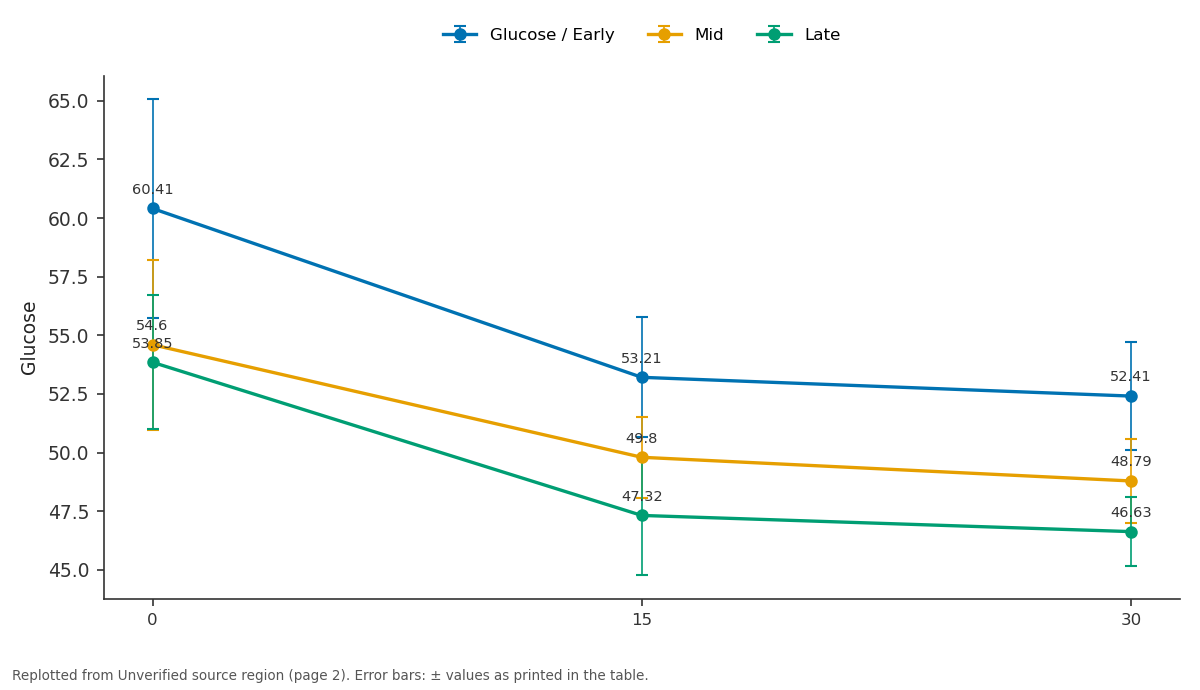
Glucose / Early and Mid and more: 0 vs 15 vs 30
Replotted from a table (page 2) of the original paper. Every bar is the paper's own table value.
View source evidence ↗Figures & tables
From the original paper Table 1
Introduction
India has large cattle but, still the milk production per animal in India is very low this lower productivity can be attributed to many factors including the genetic and environmental factors such as non-availability of good quality feed resources, poor husbandry management practices and the small-scale dairy production units (Sharma, 2003). In order to restore the animal's productivity and to optimize the milk production in individual animals for better profits, various drugs, herbal preparations, hormones, mineral supplements and feed additives have been tried with variable results (Ramesh et al., 2000) [10] . A number of herbal plants have been emphasized in Ayurveda, which contain large number of chemical active principles including alkaloids, have galactogenic properties and can be used as herbal medicine for the purpose of milk let-down in dairy animals. The uses of herbal galactogogues are known to have beneficial effect on milk production (Bharti et al., 2012) [5] . Therefore, it is envisaged in the present study to evaluate a polyherbal galactogogue (Dioscorea bulbifera 50% and Lepidium sativum 50%) which are low cost, safe, free from side effect and easily available.
Material and Methods
The present study was undertaken to evaluate the efficacy of a poly-herbal galactogogue containing Lepidium sativum 50% and Dioscorea bulbifera 50% on milk yield in lactating cows in different stage of lactation i.e. early lactation, mid lactation and late lactation. Total 45 cows were selected and divided into three groups as early lactating, mid lactating and late lactating with 15 animals in each group. All the groups were fed with 100 g of poly-herbal galactogogue through concentrate feed daily for 15 consecutive days. Blood and serum samples were collected on first day, fifteen day and thirty day of experiment and haemoglobin, serum calcium, serum phosphorus, serum total protein and serum glucose were estimated. Milk production of all animals was recorded.
Result and Discussion
In the present study in early lactating cows haemoglobin concentration in blood was slightly improved. Marginal decline in concentration was observed in late lactation; however, slight improvement in mid lactating. Similar observation was reported by Tomar et al. (1996) [14] and Adam (1999) [2] who observed that non-significant alteration in haemoglobin after feeding Lepidium sativum 100g to cows and 2% of feed in rats, respectively. The decreased haemoglobin level in early lactating and advance pregnant animal might be due to low protein intake provided in diet and increased demand of haemoglobin for milk production and foetus growth The serum calcium concentration increased in all lactating cows of all the stages of lactation. This indicates that herbal galactogogue has significant and positive effect on serum calcium level. The observations of the present study are well supported by the findings of (Bafeel and Ali 2009 and Sahajeela et al. 2011) [4] . The authors reported that Lepidium sativum and Dioscorea bulbifera are rich source of mineral especially calcium and phosphate, essential fatty acids. This increased in serum calcium might be due to supplementation of high calcium rich diet. The serum phosphorus level was slightly increased on supplementation of galactogogue which reduced at the end of experiment. In the present study observed fluctuating nonsignificant level of serum phosphorus with increased milk production may be due to increased absorption of this mineral and appears to be due to feed supplementation i.e. poly-herbal galactogogue. The observation of present study is in general agreement with the observation of Khalil et al. (2012) [6] who reported that Lepidium sativum contain high content of phosphorus i.e. 96.3 mg/ 100g. In cows at all stages of lactation serum total protein concentration increased supplementation of galactogogue which reduced at the end of experiment after cessation of supplimentation.The findings of the present study are in general agreement with that of Tomar et al. (1996) [14] who reported that feeding of Lepidium sativum in cattle does not alter serum total protein significantly. This slight alteration in protein concentaration might be due to nourishing effect and improved digestion effect of Lepidium sativum seeds ( Abo El -Nor 2007) [1] . In the present study declining trend in serum glucose level was observed in all the groups after feeding poly-herbal galactogogue. Similar observations were reported by Ahmed et al. (2009) [3] and Manohar et al. (2012) [8] . The decrease in glucose level in all the groups might be due to increased drainage of glucose in the form of lactose in milk as in all the groups the milk yield was increased. In lactating cows of different stages the milk production has increased after suplimentation of herbal galactogogue. In general, these findings are in agreement with the observation made by Kumar et al. (2011), Roy et al. (2012) [11] and Patel et al. (2013) [9] . This increased in milk production suggest that the herbal products are having galactogoue effect. The increase in milk yield may be due to increase in dry matter intake of the treatment cattle group.
Figures and tables from the paper
| — | Haemoglobin | — | — | Calcium | — | — | Phosphorus | — | — |
|---|---|---|---|---|---|---|---|---|---|
| Days | Early | Mid | Late | Early | Mid | Late | Early | Mid | Late |
| 0 | 9.17 ± 0.20 | 9.20 ± 0.25 | 9.43 ± 0.16 | 8.42 a ± 0.20 | 7.83 a ± 0.21 | 7.48 a ± 0.23 | 5.77 ± 0.25 | 5.50 ± 0.53 | 5.25 ± 0.26 |
| 15 | 8.87 ± 0.19 | 9.24 ± 0.15 | 9.41 ± 0.17 | 9.24 b ± 0.17 | 8.81 b ± 0.27 | 8.46 b ± 0.43 | 5.79 ± 0.31 | 5.27 ± 0.21 | 5.35 ± 0.27 |
| 30 | 8.96 ± 0.17 | 9.31 ± 0.19 | 9.25 ± 0.21 | 9.01 b ± 0.30 | 8.63 b ± 0.36 | 7.59 a ± 0.13 | 5.51 ± 0.18 | 5.13 ± 0.31 | 5.26 ± 0.35 |
| Significance | NS | NS | NS | * | * | * | NS | NS | NS |
Table text extracted from the original PDF; superscript letters are shown inline. The original table image is below.
View original table image
References
14 in the original paper- Abo El -Nor SAH, Khattab HM, Al -Alamy HA, Salem FA, Abdou MM. Effect of some medicinal plants seeds in the ration on the productive performance of lactating buffaloes. International Journal of Dairy science 2007; 2(4):348-355.
- Adam SEI. Effect of various levels of dietary Lepidium sativum L. Seeds in rats. American Journal of Chinese Medicine. 1999; 27(3-4):397-405.
- Ahmed Z, Mohd Z Chisti, Johri RK, Bhagat A, Gupta KK, Gandhi R et al. Antihyperglycemic and antidyslipidemic activity of aqueous extract of Dioscorea bulbifera tubers. Diabetologia Croatica. 2009; 38(3):6372.
- Bafeel SO, Ali SS. The potential liver toxicity of Lepidium sativum seeds in albino rats. Research Journal of Biological Sciences. 2009; 4(12):1250-1258.
- Bharti SK, Mishra NK, Gupta AK, Murari K, Kumar A. Pharmacological action and potential uses of diverse galactogogue in cattle. International Journal of Pharmacology and Therapeutics, 2012; 2(1):24-28.
- Khalil E, Esoh R, Rababah T, Ali M, Almajwal Alu'datt MH. Minerals, proximate composition and their correlations of medicinal plants from Jordan. Journal of Medicinal Plants Research. 2012; 6(47):5757-5762.
- Kumar S, Baghel RPS, Khare A. Effect of chandrasoor (Lepidium sativum) supplementation on dry matter intake, body weight and milk yield in lactating murrah buffaloes. Buffalo Bulletin. 2011; 30(4):262-266.
- Manohar D, Viswanatha GL, Nagesh S, Jain V, Shivprasad HN. Ethnopharmacology of Lepidium sativum Linn. (Brassicaceae): A review. International Journal of Phytotherapy Research. 2012; 2(1):1-7.
- Patel MD, Tyagi KK, Sorathiya LM, Fulsoundar AB. Effect of poly herbal galactagogue supplementation on milk yield and quality as well as general health of surti buffaloes of south Gujarat. Veterinary World: 2013; 214218.
- Ramesh PT, Mitra SK, Suryanarayana T, Sachen A. Evaluation of Galactin, a herbal galactogogue preparation in dairy cows. The Veterinarian, 2000; 24:15-16.
- Roy K, Shukla PC, Rao MLV, Gupta DK, Improved milk production in hypogalactic crossbred cows with holistic remedial therapies. Raksha Technical Review, 2012; 2(3):10-12.
- Shajeela PS, Mohan VR, Louis Jesudas L, Tresina Soris P. Nutritional and antinutritional evaluation of wild yam (Dioscorea spp.). Tropical and Subtropical Agro economics, 2011; 14:723-730.
- Sharma VP. Policy initiative for countering imbalance in dairy sector in the post -WTO era. Indian Dairyman 2003; 55(3):148-152.
- Tomar KS, Singh VP, Yadav RS. Effect of feeding maithy (Trigonellafoenum -graceum) and chandrasoor (Lepidium sativumL.) seeds on milk and blood constituent of murrah buffaloes. Indian Journal of Animal Sciences, 1996; 66(11):1192-1193.
Cited by 1
From OpenAlex, OpenCitations and reference lists read by Scinovex
- Use of Medicinal Plants with Galactogenic Effect, as a Food Supplement, in Order to Increase Milk Production, in Dairy Animals: A Review ↗
Paula Poşan, Andra Șuler, Lucica Nistor, Camelia Hodoşan, Marius Laurian MAFTEI, Alina Udroiu · Indian Journal of Animal Research · 2022
Raising animals at the household level occupies an important place in the rural economy, providing families with a relatively constant income and a source of food. The demand for organic products of animal origin, the prohibition or limitation use of medicinal substances for various treatments and and the search for alternatives to feed additives, are the key factors that determine…
❝ 2PDF