
Research article · 2017 · Full text
International Journal of Veterinary Sciences and Animal HusbandryIncidence of periparturient complications and calving pattern in cross bred dairy cows of Jammu region
Volume 2(1) · Pages 01–03
Research areasLivestock Management and Performance ImprovementReproductive Physiology in Livestock
Abstract
Author-writtenThe present study was conducted with an aim to access the incidence of peri-parturient reproductive disorders and to determine the seasonal calving pattern in cross bred cows of Jammu region. A total of 2638 calving records of cross bred dairy cows between 2010 – 2016 were screened retrospectively for peri-parturient reproductive disorders. The most common reproductive problems recorded in the present study were retained placenta (13.34%), still birth (6.36%), abortions (5.68%) and dystocia (2.19%). Incidence of retained placenta, still birth and dystocia were higher in winter season than in rainy and summer season. Whereas the incidence of abortion was higher in rainy season. Highest numbers of calving were recorded in winter season.
Summary
Source-checkedPlain-language reading of the full paper, prepared with AI and checked against the text. Each point links to the authors' own words.
Why it matters
- The peri-parturient period in cattle is the 2-3 weeks before and after birth, a time marked by endocrine changes necessary for milk production and calving. View evidence ↗
- Cows are more susceptible to diseases during this period because they commonly experience immunosuppression. View evidence ↗
- Reproductive disorders during the peri-parturient period cause economic losses by reducing milk production, increasing medication costs, and slowing reproductive rates. View evidence ↗
The question
- The study aimed to determine the seasonal calving patterns and the incidence of reproductive disorders during the peri-parturient period in crossbred cows in the Jammu region. View evidence ↗
What they did
- Researchers retrospectively screened 2,638 calving records from crossbred dairy cows between 2010 and 2016. View evidence ↗
- The data was sourced from records maintained at the Military dairy and other cattle farms in Jammu. View evidence ↗
- The cows involved were managed under a semi-intensive production system and received regular vaccinations and deworming. View evidence ↗
What they found
- The most frequent reproductive issues were retained placenta (13.34%), stillbirth (6.36%), abortions (5.68%), and dystocia (2.19%). View evidence ↗
- Calving was most frequent in winter (49.46%), followed by summer (27.21%) and the rainy season (23.31%). View evidence ↗
- The occurrence of dystocia, stillbirth, and retained placenta was higher during the winter than in the summer or rainy seasons. View evidence ↗
- Unlike other disorders, the incidence of abortion was higher during the rainy season. View evidence ↗
- Cows delivering male calves had a higher incidence of retained placenta (R.O.P) and dystocia compared to those delivering female calves. View evidence ↗
What it means
- The authors conclude that retained placenta is one of the most significant reproductive problems during the peri-parturient period in cattle herds. View evidence ↗
- The authors recommend a proactive management approach based on an awareness of how certain disorders are predisposed by the season. View evidence ↗
Visual summary
1 visualsIllustrations explain the paper; they do not show study data.
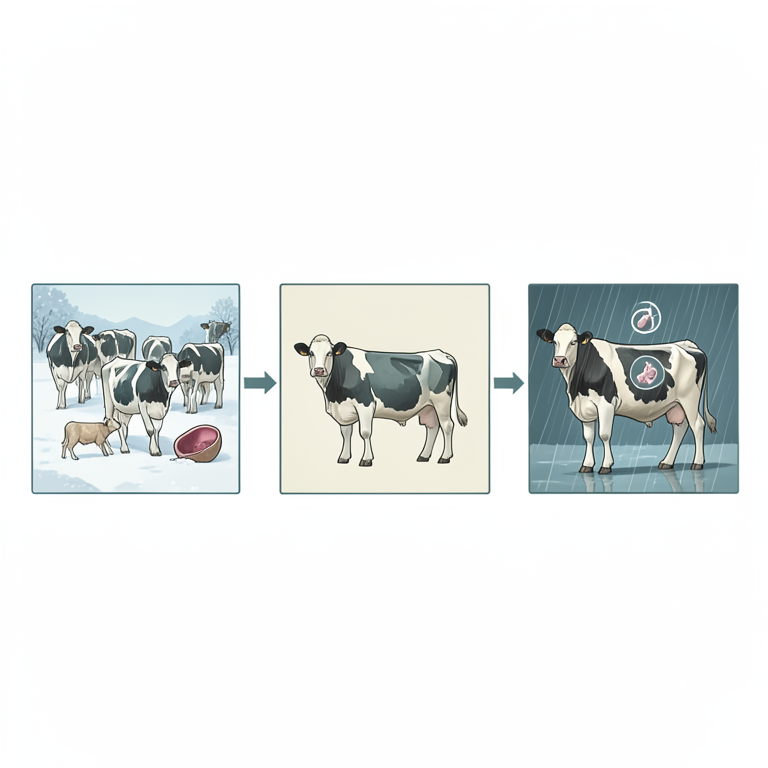
Seasonal Distribution of Calving and Disorders
AI-generated conceptual illustration (crossbred dairy cows). It explains the idea and does not show study data.
View source evidence ↗Figures & tables
From the original paper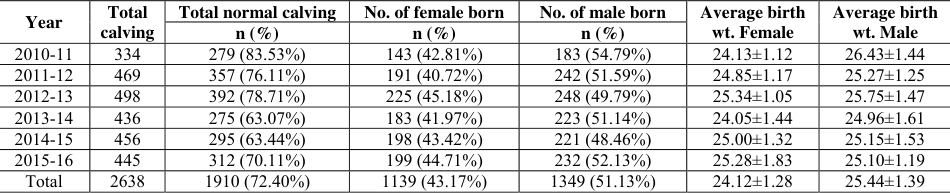 Table 1
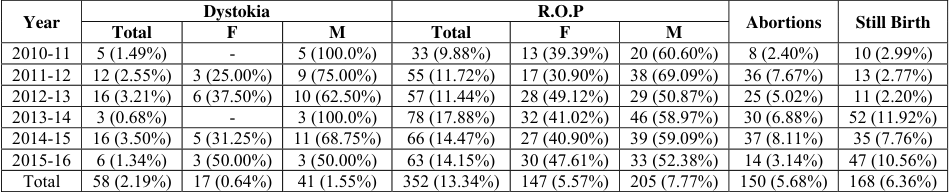 Table 2
 Table 3
Introduction
The peri-parturient period in cattle refers to the 2-3 weeks pre-and post-partum characterized by changes in endocrine status of the animal, to provide for lactogenesis and parturition (Kimura et al., 2006) [5] . During this period, immuno suppression commonly occurs and cows exhibit great susceptibility to a number of diseases. Peri-parturient disorders can dramatically affect reproductive efficiency of animals causing considerable economic loss to the dairy industry due to slower uterine involution, reduced reproductive rate, prolonged interconception period and calving interval, high cost of medication, drop in milk production, reduced calf-crop and early depreciation of potentially useful cows. Hence, a retrospective was planned to assess the incidence of peri-parturient reproductive disorders and determine seasonal calving pattern in cross bred dairy cattle of Jammu region.
Material and Methods
To assess the incidence of peri-parturient complications, a total of 2638 calving records maintained at Military dairy and others cattle farms of Jammu during the period from 2010 -2016 were utilized for present study. The study animals were of different age group, parities and body condition scores and were regularly dewormed and vaccinated and were managed by semi-intensive production system.
Result
The year wise total number of calving, total normal calving, total number of male and female born with average birth weight has been presented in Table 1. The overall incidence of Dystocia, retention of placenta, abortions and stillbirth was 2.19%, 13.34%, 5.68% and 6.36% respectively. Higher incidence of Dystocia and R.O.P were reported in cows delivered male calves than female calves. (Table 2) Seasonal analysis revealed higher number of calving in winter (49.46%) and summer (27.21%) season than in rainy season (23.31%). Dystocia followed calving trend, being higher in winter and summer season than in rainy. The occurrence of retained placenta was higher in winter and rainy season than in summer (Table 3).
| Season | Calving n (%) | ROP n (%) | Dystokia n (%) | Abortion n (%) | Still birth n (%) |
|---|---|---|---|---|---|
| Summer (March-June) | 718 (27.21%) | 99 (28.12%) | 18 (31.03%) | 48 (32.00%) | 42 (25.00%) |
| Rainy (July-Sept) | 615 (23.31%) | 102 (34.09%) | 10 (17.24%) | 60 (39.47%) | 42 (25.00%) |
| Winter (Oct-Feb) | 1305 (49.46%) | 151 (42.89%) | 30 (51.72%) | 42 (28.00%) | 84 (50.00%) |
| Total | 2638 | 352 | 58 | 150 | 168 |
Table text extracted from the original PDF; superscript letters are shown inline. The original table image is below.
View original table image
| Year | Dystokia | — | — | R.O.P | — | — | Abortions | Still Birth |
|---|---|---|---|---|---|---|---|---|
| Total | F | M | Total | F | M | |||
| 2010-11 | 5 (1.49%) | - | 5 (100.0%) | 33 (9.88%) | 13 (39.39%) | 20 (60.60%) | 8 (2.40%) | 10 (2.99%) |
| 2011-12 | 12 (2.55%) | 3 (25.00%) | 9 (75.00%) | 55 (11.72%) | 17 (30.90%) | 38 (69.09%) | 36 (7.67%) | 13 (2.77%) |
| 2012-13 | 16 (3.21%) | 6 (37.50%) | 10 (62.50%) | 57 (11.44%) | 28 (49.12%) | 29 (50.87%) | 25 (5.02%) | 11 (2.20%) |
| 2013-14 | 3 (0.68%) | - | 3 (100.0%) | 78 (17.88%) | 32 (41.02%) | 46 (58.97%) | 30 (6.88%) | 52 (11.92%) |
| 2014-15 | 16 (3.50%) | 5 (31.25%) | 11 (68.75%) | 66 (14.47%) | 27 (40.90%) | 39 (59.09%) | 37 (8.11%) | 35 (7.76%) |
| 2015-16 | 6 (1.34%) | 3 (50.00%) | 3 (50.00%) | 63 (14.15%) | 30 (47.61%) | 33 (52.38%) | 14 (3.14%) | 47 (10.56%) |
| Total | 58 (2.19%) | 17 (0.64%) | 41 (1.55%) | 352 (13.34%) | 147 (5.57%) | 205 (7.77%) | 150 (5.68%) | 168 (6.36%) |
Table text extracted from the original PDF; superscript letters are shown inline. The original table image is below.
View original table image
| Year | Total calving | Total normal calving | No. of female born | No. of male born | Average birth wt. Female | Average birth wt. Male |
|---|---|---|---|---|---|---|
| n (%) | n (%) | n (%) | ||||
| 2010-11 | 334 | 279 (83.53%) | 143 (42.81%) | 183 (54.79%) | 24.13±1.12 | 26.43±1.44 |
| 2011-12 | 469 | 357 (76.11%) | 191 (40.72%) | 242 (51.59%) | 24.85±1.17 | 25.27±1.25 |
| 2012-13 | 498 | 392 (78.71%) | 225 (45.18%) | 248 (49.79%) | 25.34±1.05 | 25.75±1.47 |
| 2013-14 | 436 | 275 (63.07%) | 183 (41.97%) | 223 (51.14%) | 24.05±1.44 | 24.96±1.61 |
| 2014-15 | 456 | 295 (63.44%) | 198 (43.42%) | 221 (48.46%) | 25.00±1.32 | 25.15±1.53 |
| 2015-16 | 445 | 312 (70.11%) | 199 (44.71%) | 232 (52.13%) | 25.28±1.83 | 25.10±1.19 |
| Total | 2638 | 1910 (72.40%) | 1139 (43.17%) | 1349 (51.13%) | 24.12±1.28 | 25.44±1.39 |
Table text extracted from the original PDF; superscript letters are shown inline. The original table image is below.
View original table image
Discussion
The number of calves born in the present study was 2488. Out of this 1349 was male and the rest 1139 were female and the ratio (male: female) was 54:46. Our findings are in agreement with the findings of Tesfu et al. (2014) [12] who reported sex ratio of 52:48 in dairy farms subjected to artificial insemination. In present study, the overall incidence of retained placenta was higher (13.34%) than reported by Pande et al. (2014) [6] and Gupta et al. (1999) in buffaloes. This variation in the incidence of RFM may be attributed to variations in predisposing factors to which the animals are subjected to among which include nutritional status and management. Higher incidence of retained placenta was recorded in dams with male fetuses than with female fetuses. Our finding are in agreement with that of Erb et al. (1958) [3] who reported 56% cases of retained placenta associated with birth of male calves. Moreover, retained placenta in cattle is also associated with dystocia, abortion, short or long gestation and twinning (Bhattacharyyn et al., 2009) [2] which also are important predisposing factor for occurrence of RFM. The reported incidence of dystocia varies widely between 2-11% (Roberts, 1984). Our study reports incidence of 2.19% which is in agreement with the findings of Sekhar and Rajani (2014) [9] who reported 2.9% prevalence of dystokia among cross bred cows of Chittoor District of Andhara Pradesh. High incidence of dystokia was observed with male calves which might be attributable to their higher birth weight (Patil et al., 2014) [7] . The Higher occurrence of dystokia in winter and summer season than rainy in the present study may be attributed to higher number of calvings occurring in these season.
The incidence of abortion (5.68%) recorded in this study is similar to the findings reported earlier by Shiferaw et al.
(2003) [10] and Kassahun (2003) [4] . This finding was also similar with the findings of Sekhar and Rajani (2014) [9] who have reported prevalence of 6.7% in dairy farms and at farmers in Andhra Pradesh. The lower incidence of abortion may be attributed to the increasing practice of AI in the study area where the semen is collected from bulls free from brucellosis and also due to the effect of vaccination against brucellosis in female animals. Incidence of still birth in the present study was estimated to be 6.36% which fairly agrees with 6% reported by Atashi (2011) [1] . The incidence of still birth was higher in winter season than in summer and rainy season. Similar findings were reported by Silva del Rio et al. (2007) [11] who observe higher incidence of still birth in cold season compared to warmer season. Mayer et al. (2001) also reported calving season as a significant factor affecting the incidence of still birth parturition.
Conclusion
The outcome of this study strongly suggest that retention of placenta is one the most important peri-parturient reproductive problem in cattle herd. Greater awareness about seasonal predisposition of certain disorders may draw attention towards a proactive approach for better management.
References
9 in the original paper- Kassahun M. Major clinical reproductive problems of smallholder dairy cows in and around Awassa. DVM thesis. Faculty of Veterinary Medicine, Addis Ababa University, Debre Zeit, Ethiopia, 2003.
- Kimura K, Reinhardt TA, Goff JP. Parturition and hypocalcaemia blunt calcium signals in immune cells of dairy cattle. Journal of Dairy Science. 2006; 89:25882595.
- Pande N, Agrawal RG, Agrawal R, Shrivasatava OP, Jain SK. Prevalance of periparturient reproductive disorders and calving pattern in buffaloes. Intas Polivet. 2014; 15(2):205-207.
- Patil AS, Rathod R, Nagaraja BN. Retrospective studies on occurrence of dystocia and its management in domestic animals. Intas Polivet. 2014; 15(2):269-276.
- Roberts SJ. Veterinary Obstetrics and Genital Diseases (Theriogenology). 3rd ed. CBS Publishers and Distributors, New Delhi, India, 1986.
- Sekhar CC, Rajani N. prepartum and postpartum reproductive problems in bovines-A retrospective study of 711 cows. Intas Polivet. 2014; 15(2):199-204.
- Shiferaw Y, Bekena M, Tenhagen BA, Kassa T. Reproductive performance of crossbred dairy cows in different production systems in the central highlands of Ethiopia. Tropical Animal Health Production. 2003; 35(6):551-561
- Silva del Rıo N, Stewart S, Rapnicki P, Chang YM, Fricke PM. An observational analysis of twin births, calf sex ratio, and calf mortality in Holstein dairy cattle. Journal of Dairy Science. 2007; 90:1255-1264.
- Tesfu T, Gebrekidan B, Afera B. Assessment and comparision of sex ratio following artificial insemination and natural mating in small scale and modern dairy farms in mekelle. Journal of reproduction and infertility. 2014; 5(20):58-64.
Cited by 4
From OpenAlex, OpenCitations and reference lists read by Scinovex
- The comparison between random forest and boosted trees for dystocia detection in dairy cows ↗
Daniel Zaborski, Witold S. Proskura, Wilhelm Grzesiak, Jolanta Różańska-Zawieja, Zbigniew Sobek · Computers and Electronics in Agriculture · 2019
❝ 15 - Cattle Reproductive Disorders Documented from Gaushalas of Nepal ↗
Meena Pun, Bhuwan Raj Bhatt, Shambhu Shah, Narayan Neupane, Krishna Kaphle · Veterinary Medicine International · 2024
Cow is the national animal of Nepal, yet it is one of the most abused animal species here. Under realized utilities of cow that is nonlactating or pregnant is the reason for demonic cruelty. Since the Vedic period, gaushalas have been caring for cows. At present, most gaushalas have responsibility to rescue, offer refuge, and treat poorly treated or confiscated…
❝ 2PDF - Effect of prepartum vitamin E and selenium supplementation along with cloprostenol or methylergometrine maleate during puerperal period on post-partum reproductive and productive performance of cross bred dairy cattle
Navjot Singh Resum, Palneez Kour, Harbir Singh · International Journal of Veterinary Sciences and Animal Husbandry · 2018
The present study was designed to evaluate the effect of vitamin E and selenium injected pre partum along with PGF2α or Methylergometrine maleate administered after calving on postpartum reproductive and productive performance in cross bred dairy cows. A total of 40 pregnant animals in their last trimester were selected and divided into 4 Groups with 10 animals in each group. Animals in Group I, II and III were given two injections of vitamin E and selenium (Inj. Repronol, cadila pharmaceutical ltd.) 7 days apart (Ist injection given at 30-60 days before the expected date of calving), while an
- Effect of Pre-insemination Intrauterine Antibiotics on Conception Rate in Crossbred Cows ↗
V.J. Revathy · Theriogenology Insight - An International Journal of Reproduction in all Animals · 2020
Uterine involution is the process of resumption of pregnant uterus to non pregnant state along with restoration of ovarian function which occurs during puerperium/post-partum period.Estrogen and progesterone hormones are responsible for changes in shape and size of uterus during pregnancy whereas, release of fetus, reduced oxytocin and increased PGF 2α help uterus to resume normal state.Fast involution of uterus is…
❝ 0PDF