
Research article · 2016 · Full text
International Journal of Statistics and Applied MathematicsApproximate Analytical Solutions of Fractional Nonlinear Physical Differential Equations
Volume 1(2) · Pages 06–12
Research areasFractional Differential Equations SolutionsIterative Methods for Nonlinear EquationsDifferential Equations and Numerical Methods
Abstract
Author-writtenIn this paper, we propose a new approximate method, namely homotopy perturbation natural transform method (HPNTM) to solve fractional differential equations arising in physics. This method is a combination of the natural transform method and the homotopy perturbation method. The results reveal that the method is very effective, simple and can be applied to other physical differential equations. The fractional derivatives are described in the Caputo sense.
Summary
Source-checkedPlain-language reading of the full paper, prepared with AI and checked against the text. Each point links to the authors' own words.
Why it matters
- The authors introduce the homotopy perturbation natural transform method (HPNTM), a new approach designed to find approximate solutions for fractional differential equations used in physics. View evidence ↗
- The HPNTM is developed by combining two existing mathematical techniques: the natural transform method and the homotopy perturbation method. View evidence ↗
- In this study, fractional derivatives are defined and handled according to the Caputo sense. View evidence ↗
The question
- The research aims to develop and test the effectiveness of the HPNTM for solving nonlinear fractional physical differential equations. View evidence ↗
What they did
- The authors apply the HPNTM to two specific physical models: the time-fractional sinh-Gordon equation and the nonlinear fractional Sharma-Tasso-Olver equation. View evidence ↗
What they found
- The authors find that the HPNTM is a simple and effective tool for solving physical differential equations. View evidence ↗
- The series solutions generated by the HPNTM are reported to converge very rapidly. View evidence ↗
What it means
- The authors conclude that the HPNTM provides realistic series solutions with rapid convergence for physical problems. View evidence ↗
- The authors state that the HPNTM is a promising tool applicable to a wide range of linear and nonlinear problems within fractional calculus. View evidence ↗
Visual summary
1 visualsIllustrations explain the paper; they do not show study data.

HPNTM Composition
AI-generated conceptual illustration (Abstract mathematical conceptualization of intersecting geometric sets). It explains the idea and does not show study data.
View source evidence ↗Figures & tables
From the original paper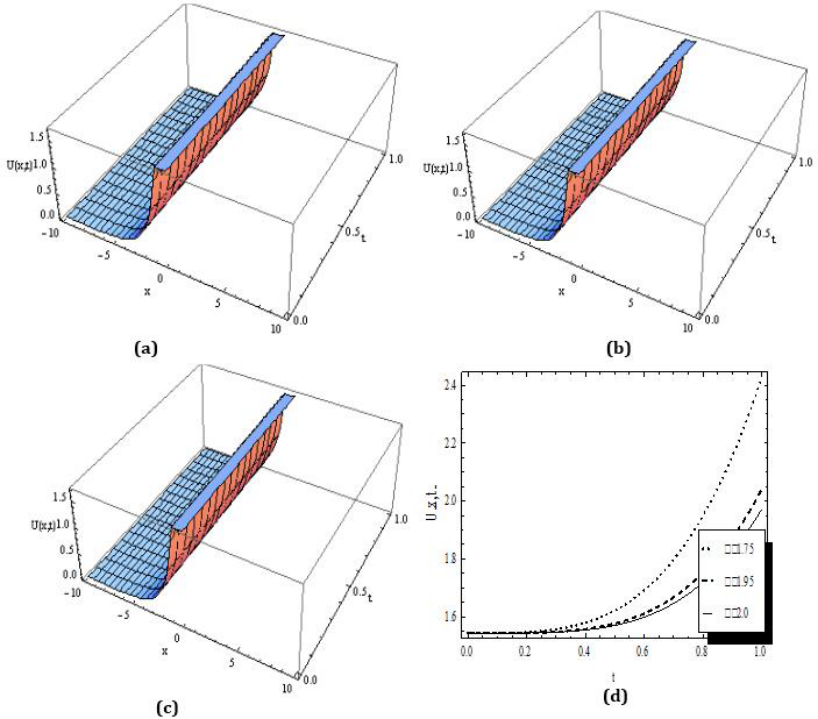 Figure 1
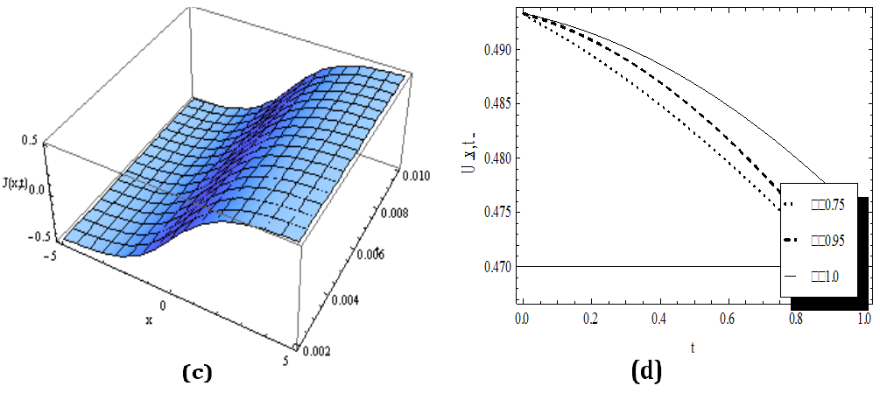 Figure 2
Introduction
The natural transform, initially was defined by Waqar et al. [1] as the N -transform, which studied their properties and applications. Later, Belgacem et al. [2,3] defined its inverse and studied some additional fundamental properties of this integral transform and named it the natural transform. Applications of natural transform in the solution of differential and integral equations and for the distribution and Bohemians spaces can be found in [3][4][5][6][7][8][9][10] . Now, we mention the following basic definitions of natural transform and its properties are introduced as follows: Definition 1.1 [11] . Over the set of functions
is the natural transformation of the time function ) (t f and the variables u and s are the natural transform variables.
Theorem 1.2:
We derives the relationship between Natural and Laplace, Sumudu transform in successive theorems [11] as follow:
Where g f * is convolution of two functions f and g .
If )] ( [ t f N
is the natural transform of the function ) (t f , then the natural transform of fractional derivative of order is defined as:
The natural transform of T-periodic function
The natural transform of T-periodic function
Homotopy perturbation natural transform method (HPNTM)
To illustrate the basic idea of this method, we consider the following nonlinear fractional differential equation:
, L is the linear differential operator, F is the nonlinear differential operator, and ) , ( t x q is the source term. Now, applying the natural transform on both sides of (12) we have:
Operating with natural inverse on both sides of (14):
Where ) , ( t x Q represents the term arising from the source term and the prescribed initial conditions. Now, applying the classical homotopy perturbation technique, the solution can be expressed as a power series in p as given below:
where the homotopy parameter p is considered as a small parameter [0,1] p . We can decompose the nonlinear term as:
where (18) By substituting ( 16) and ( 17) and using HPM we get:
This is coupling of natural transform and homotopy perturbation method using He's polynomials. By equating the coefficients of corresponding power of p on both sides, the following approximations are obtained as: ) , ( ) , ( :
Proceeding in the same manner, the rest of the components ) , ( ) , (
These series solutions generally converge very rapidly.
Applications 3.1 Application 1: Sinh-Gordon equation
Sinh-Gordon equation has wide applications in physics and engineering. It appears for example in integrable quantum field [12] , fluid dynamics [13] , non-commutative field theories [14] , kink dynamics ( [15][16][17] ) and many other scientific applications. There is a growing interest in the study of the sinh-Gordon equation ( [13,15,[18][19][20][21][22] ) due to the wide applications of sinh-Gordon type equations. Consider the following time-fractional sinh-Gordon equation
Subject to initial condition:
By applying natural transform on both sides of Eq.(25) subject to initial condition, we have
Operating with natural inverse on both sides of (26) we get:
Now, applying the classical homotopy perturbation technique, the solution can be expressed as a power series in p as given below:
where the homotopy parameter p is considered as a small parameter
By substituting (28) and (29) and using HPM [27] we get:
This is coupling of natural transform and homotopy perturbation method using He's polynomials. By equating the coefficients of corresponding power of p on both sides, the following approximations are obtained as: ) ( tanh 4 ) , ( :
)]] sinh( [ [ ) , ( : The nonlinear fractional Sharma-Tasso-Oliver equation is a Korteweg-de Vries-like equation, many physicists and mathematicians have considered it in recent years due to its appearance in scientific applications. The Sharma-Tasso-Olver equation plays an important role in describing the nonlinear wave phenomena. Exact solutions for it with different forms can describe different nonlinear waves. The solution of nonlinear fractional Sharma-Tasso-Olver equation is much involved. In general, there exists no method that yields an exact solution for a nonlinear fractional evolution equation. Only approximate solutions can be derived using the techniques of nonlinear analysis, such as a domian decomposition method (Saha Ray S. et al. 2005), homotopy analysis method (Cang J. et al. 2009; Liao A S. 1992) and etc. [31] .
where a is a real parameter, is a parameter describing the order of fractional time derivative, ) , ( t x U is an unknown function depending on temporal variable t and spatial variable
Subject to the initial condition:
where the exact solution of the Sharma-Tasso-Olver equation with
Conclusion
HPNTM has been utilized to derive the approximate analytical solutions for nonlinear fractional sinh-Gorden equation and fractional Sharma-Tasso-Olver equation. The method gives more realistic series solutions that converge very rapidly in physical problems. To demonstrate the validity of the proposed method, numerical results have been obtained which shows that the HPNTM strength lays in its ease of use and the possibility of using it as a tool to acquire approximate solutions of nonlinear fractional differential equation with excellent accuracy. Generally speaking, the proposed method is promising and applicable to a broad class of linear and nonlinear problems in the theory of fractional calculus.
Figures and tables from the paper
References
22 in the original paper- Waqar H. Zafar, Khan. N-transform -properties and applications, NUST J Engg Sci. 2008; 1:127-133.
- Belgacem FBM, Silambarasan R, Theory of natural transform, Math. Engg, Sci. Aerospace (MESA). 2012; 3:99-124.
- Silambarasan R, Belgacem FBM. Applications of the natural transform to Maxwell's equations, Prog. Electromagnetic Research Symposium Proc. Suzhou, China, 2011, 899-902.
- Al-Omari SKQ. On the applications of natural transform, International Journal of Pure and applied Mathematics. 2013; 85:729-744.
- Bulut H, Baskonus HM, Belgacem FBM. The analytical solution of some fractional ordinary differential equations by the Sumudu transform method, Abstract and Applied Analysis, 2013, 1-6. Article ID 2013875.
- Loonker Deshna, Banerji PK. Natural transform for distribution and Boehmian spaces, Math. Engg. Sci. Aerospace, 2013; 4:69-76.
- Loonker Deshna, Banerji PK. Natural transform and solution of integral equations for distribution spaces, Amer. J Math Sci. 2013.
- Loonker Deshna, Banerji PK. Applications of natural transform to differential equations. J Indian Acad Math. 2013; 35:151158.
- Podlubny, Fractional differential equations, Mathematics in Science and Engineering, Academic Press, San Diego, USA, 1999, 198.
- Silambarasan R, Belgacem FBM. Theory of natural transform. Mathematics in Engineering, Science and Aerospace (MESA), 2012; 3:99-124.
- Mosconi P, Mussardo G, Rida V. Boundary quantum field theories with infinite resonance states, Nuc. Phys. 2002; B621:571.
- Chow KW, Aclass of doubly periodic waves for nonlinear evolution equations, Wave Motion. 2002; 35:71-90.
- Cabrera-Carnero and M. Moriconi, Noncommutative integrable field theories in 2d, Nuc. Phys. B 673, (2003), 437-454.
- Khare Phys. Lett. A QES band-structure problem in one dimension, 2001; A 288:69-72.
- Khare S Habib, Saxena A. Exact thermodynamics of the double sinh-Gordon theory in 1+1 dimensions, Phys. Rev. Lett. 1997; 79:37-97.
- Habib S, Khare A, Saxena A. Statistical mechanics of double sinh-Gordon kinks Physica. 1998; D123:341-356.
- Sirendaoreji and J. Sun, Adirect method for solving sine-Gordon type equations, Phys. Lett. A 298, (2002), 133-139.
- Ablowitz MJ, Kaup DJ, Newell AC, Sehur H. Coherent pulse propagation, a dispersive, irreversible phenomenon. J Math Phys. 1974; 15:18-52.
- Clarkson PA, Mec Leod JB, Ramani A, Olver PJ. SIAM J Math Anal. 1986; 17:798.
- Qiao ZJ. Negative order MKdv hierarchy and a new integrable Neumann-like system, Physica. 1997; A243:141-151.
- Cuba G, Paunov R. Exact solution to double and triple Sinh-Gordon equations, Phys. Lett. 1996; B381:255.
- Zhang YW. Formation and solution to time-fractional Sharma-Taso-Olver equation via variational methods, department of mathematics, Hexi University, China, 2013.