
Research article · 2026 · Full text
International Journal of Agriculture and NutritionGrowth and reproduction performances of Eisenia fetida fed with different municipal waste materials
Volume 8(9) · Pages 184–187 · DOI: 10.33545/26646064.2026.v8.i9c.760 ↗
Research areasComposting and Vermicomposting TechniquesInvertebrate Taxonomy and EcologyWaste Management and Recycling
Abstract
Author-writtenThe present research is designed to evaluate the growth and reproduction rate of Eisenia fetida on different organic substrates of municipal solid wastes. The aim of this paper was to identify the organic waste that provide maximum biomass gain and cocoon production. The growth and reproduction of Eisenia fetida was measured by studying parameters like gain in body weight, clitellum development, no. of cocoons and emergence of hatchlings. The study was designed with 6 treatments, each having three replicates. In control treatment (T1), cow dung was used as the only food source for earthworm. In another five treatments, vegetable market wastes and fruit market wastes (T2), hotel and restaurant food wastes (T3), Garibnath temple wastes (T4) and banana plant wastes (T5) were used as food sources with cow dung as bedding material. The maximum weight gain of earthworm Eisenia fetida was (888 mg) for the food stuff of banana plant wastes (T5) showed a very similar weight gain of 864 mg for the food stuff of belpatra leaves and floral wastes (T4). The maximum cocoon number was observed in T5 whereas, the minimum number in Control (T1). The highest number of hatchlings were recorded in treatment 3 (T2) whereas least number of hatchlings was observed in control (T1). It was concluded that among the 5 different food sources, chopped banana plant sources were preferable food sources to the earthworm for growth and reproduction.
Summary
Source-checkedPlain-language reading of the full paper, prepared with AI and checked against the text. Each point links to the authors' own words.
Why it matters
- Vermicomposting is a process where earthworms convert organic waste materials into a useful fertilizer known as vermicast. View evidence ↗
- Eisenia fetida was chosen for this study because it is a voracious feeder of organic waste and possesses rapid growth and reproduction rates. View evidence ↗
The question
- The study aimed to identify which organic municipal waste substrates provide the maximum cocoon production and biomass gain for Eisenia fetida. View evidence ↗
What they did
- The experiment used 15 vermi-bins across 6 treatments, with each treatment having three replicates. View evidence ↗
- Treatments included a cow dung control (T1) and five waste types (T2: vegetable/fruit, T3: hotel/restaurant, T4: temple, T5: banana plant) mixed with cow dung bedding in a 60:40 ratio. View evidence ↗
- Ten healthy preclitellate Eisenia fetida were weighed and introduced into each vermi-bin after the waste mixture had pre-digested for 15 days. View evidence ↗
- Growth and reproduction were measured via body weight gain, clitellum development, cocoon count, and hatchling emergence, with data analyzed using one-way ANOVA. View evidence ↗
What they found
- The highest biomass gain was observed in banana plant waste (692.67 ± 0.57 mg), followed by temple waste (670.00 ± 1.00 mg), while the control had the lowest gain (465.67 ± 0.57 mg). View evidence ↗
- Cocoon incubation periods ranged from 24 days in the control (T1) to 28 days in banana plant waste (T5). View evidence ↗
- Banana plant waste (T5) yielded the maximum number of hatchlings (5 per cocoon), whereas vegetable and fruit waste (T2) yielded the minimum (1 per cocoon). View evidence ↗
Visual summary
3 visualsIllustrations explain the paper; charts are replotted from the paper's own table values.
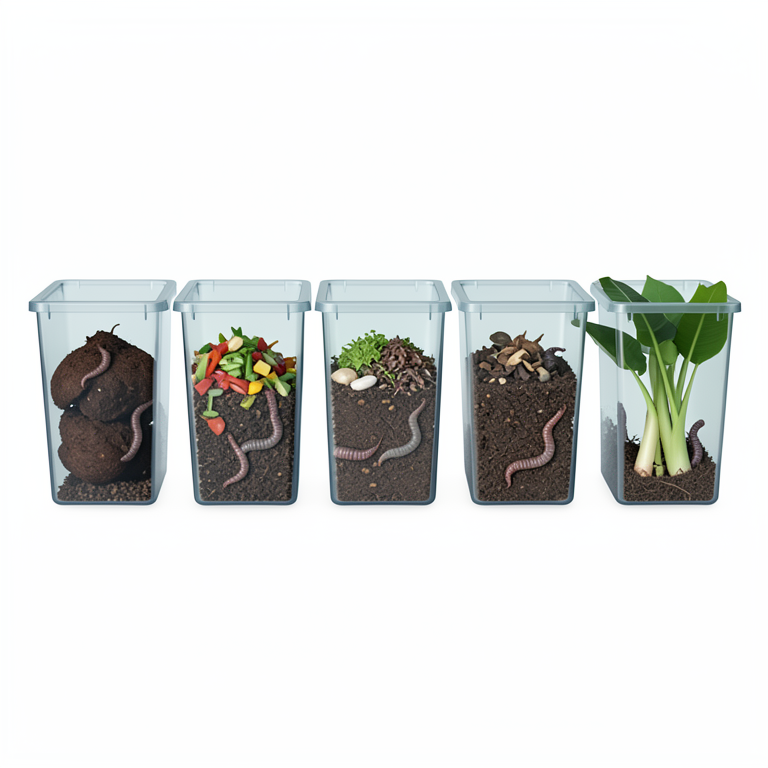
Experimental Treatment Groups
AI-generated conceptual illustration (Eisenia fetida (red wiggler earthworms) in organic waste bins). It explains the idea and does not show study data.
View source evidence ↗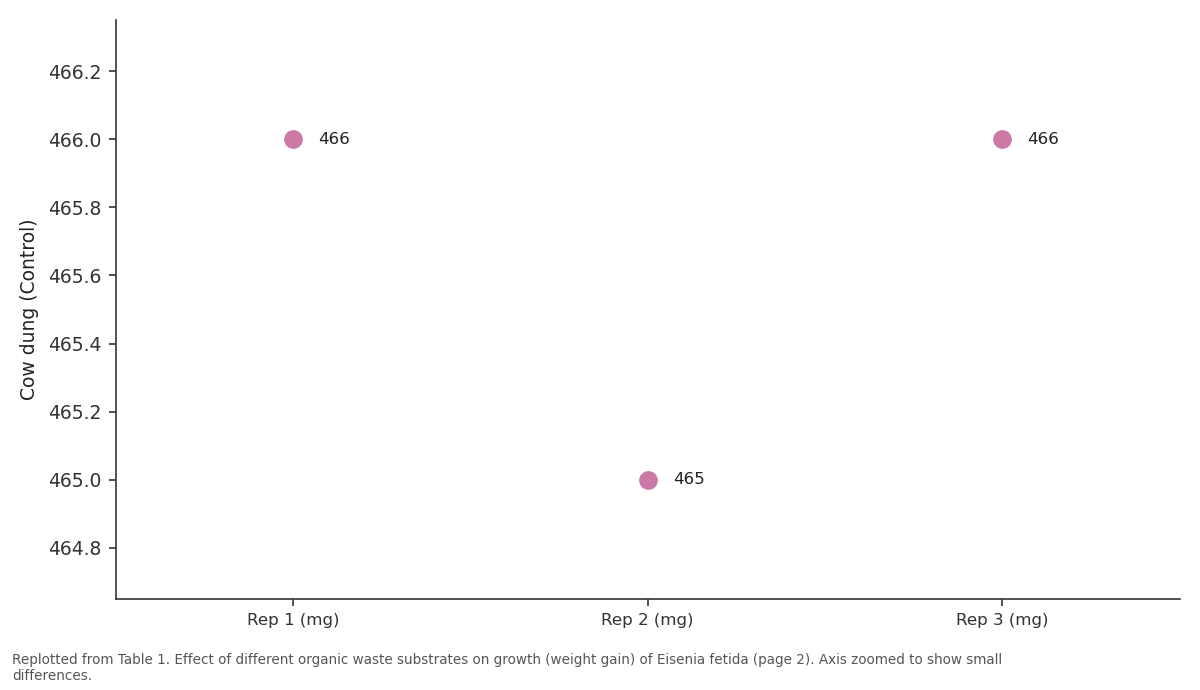
Cow dung (Control): Rep 1 (mg) vs Rep 2 (mg) vs Rep 3 (mg)
Replotted from Table 1 (page 2) of the original paper. Every bar is the paper's own table value.
View source evidence ↗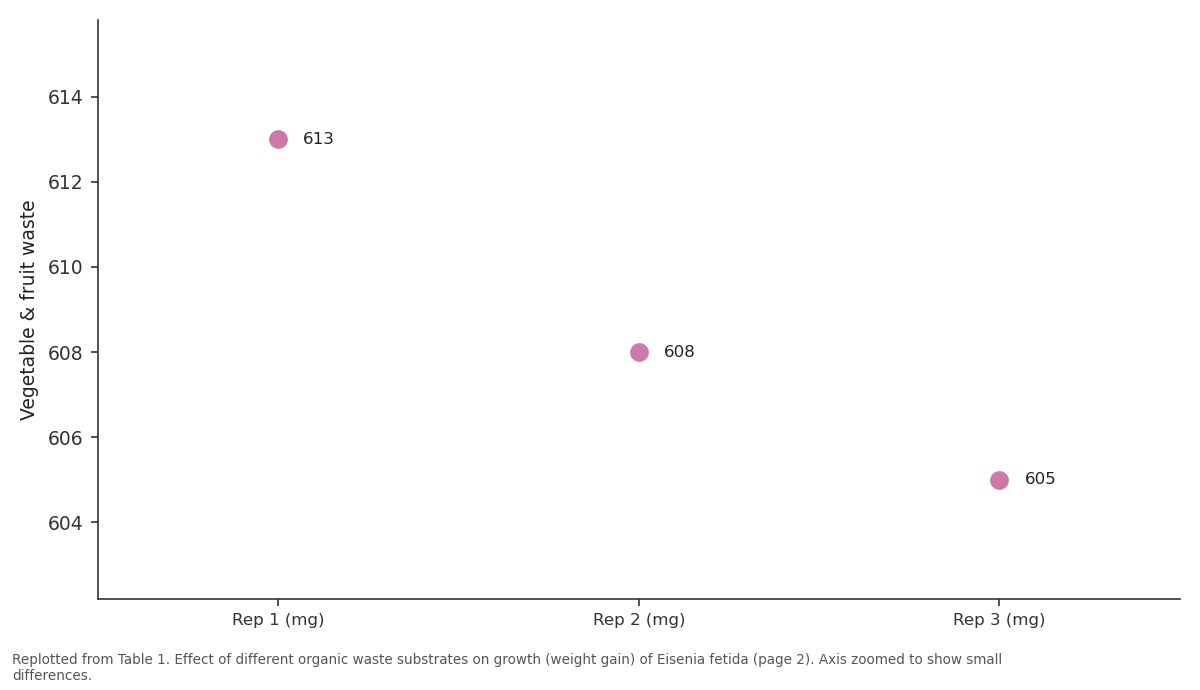
Vegetable & fruit waste: Rep 1 (mg) vs Rep 2 (mg) vs Rep 3 (mg)
Replotted from Table 1 (page 2) of the original paper. Every bar is the paper's own table value.
View source evidence ↗Figures & tables
From the original paper Table 1
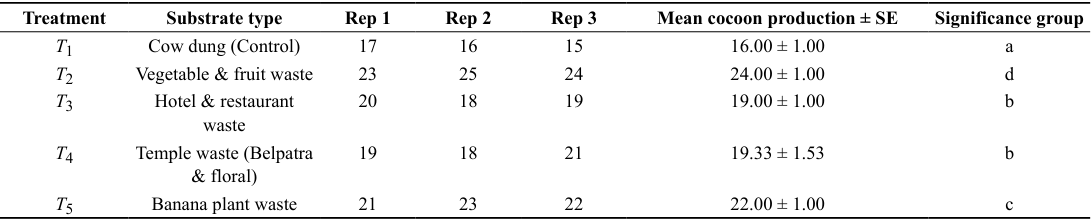 Table 2
 Table 3
Introduction
In recent years, Vermicomposting from agricultural wastes and cattle dung is becoming a well described process in organic farming. In this process organic waste material get converted into useful fertilizer (vermicast) by using Earthworms (Verma and prasad, 2005) [1] . This technique can also be used to convert organic municipal wastes into value added product. It is used for mustering the carbon-based portion of community solid wastes for meeting crop nutritive requirements. Vermicompost can rejuvenate the soil by enriching essential components and minerals by increasing aeration, water holding capacity, high porosity and microbial activity. Vermicompost is the casting of earthworm which has a beneficial effect on soil health by enhancing their physical, chemical and biological properties which results in better agrarian production (Chatterjee et al., 2020) [2] . The current research is designed to evaluate the growth and reproduction rate of Eisenia fetida on different organic substrates of municipal organic solid wastes and determining the most suitable substrate for their growth for more than a year in laboratory. The main criteria for selecting the Eisenia fetida species for this experiment was the rapid growth and reproduction rate as well as a voracious feeder of organic wastes (Yahyaabadi, 2018) [3] . The growth and reproduction of earthworms depend on the food substrates they feed (Jicong et al., 2005) [4] .
Material and methods
Material and methods
Study area
The experimental set up was installed at Gobarsahi, Muzaffarpur, Bihar, is located in India country in the district place category with the gps coordinates of 26.1197 0 N and 85.3910° E.
Raw materials
The different municipal organic substrates were collected from Chandwara dumping site, Muzaffarpur, Bihar. The cow dung was made available from local cow herder. The earthworm, Eisenia fetida species was procured from the Krishi Vigyan Kendra, Saraiya block, Muzaffarpur, Bihar. The materials used for vermicomposting were control treatment (T 1 ), cow dung was used as the only food source for earthworm. In an other five treatments, vegetable and fruit market wastes (T 2 ), hotel and restaurant food wastes (T 3 ), Garibnath temple Belpatra and floral wastes (T 4 ) and banana plant wastes (T 5 ).
Experimental design for determination of reproductive potential
The experiments were conducted in 15 vermi-bins. The solid organic wastes and cow dung were used in a ratio of 60:40 for better survival and growth of earthworms and microbes. Now, this mixture was allowed to pre-digest for about 15 days. Partial digestion of waste materials made them suitable for earthworm consumption. After 15 days, 10 preclitellate Eisenia fetida, in good health condition, were taken and rinsed with distilled water for removing adhered materials, dried with tissue paper, weighed with digital balance and finally, introduced in each vermi-bin during evening hours. Regular sprinkling of water had been done to maintain 70 to 80% moisture content, which was essential for proper growth of earthworms. The bin was then covered with jute bags to avoid loss of moisture content and to protect from birds & insects. At a regular interval of 15, 30, and 45 days the bed material was turned upside down for proper digestion of organic waste materials.
Cocoon production rate determination
For determining reproductive potential of earthworm two freshly clitellated earthworm in a good health condition, were collected from bins and rinsed with distilled water, dried with tissue paper, weighed with electronic balance and introduced in different treatments. The substrate in each bin was examined daily in order to determine the beginning of cocoon production. Once the cocoons produced, they were separated by hand sorting, washed with distilled water and counted to determine the total number of cocoon and the reproductive rate.
Methods used to study cocoon incubation period and number of hatchlings
The substrates in each bin were examined weekly to determine the phases of the life cycle means hatched cocoons. After cocoon production 10 freshly laid cocoons from each treatment were taken and placed in another container containing same substrates as their parent were placed and reared. Now, the containers in which the cocoons were placed observed daily to determine the emergence of hatchlings per cocoons. The hatchlings were removed daily using a paint brush and counted to determine the total number of hatchlings that had emerged from a single cocoon. The number of unhatched cocoons were also counted with the help of magnifying glass. Three replicates were prepared for each treatment to monitor growth and reproduction.
For determining biomass of earthworm
For determining biomass, the hatchlings were rinsed with distilled water, dried with tissue paper, weighed with digital balance and reared in different treatments. Three replications for each treatment were done. The bins were observed weekly to analyse maturation, three phases of life cycle were observed, pre-clitellate, clitellate and regression in which clitellum got lost as soon as clitellum appearance were identified the worms were weighed. On the basis of data obtained on the biomass of worm other parameters such as growth rate or biomass increase rate (g/earthworm /day), maximum weight achieved and net weight gain were calculated.
Statistical analysis
All the results presented here are mean of single measurements from each of the three replicates. The data were analysed using one way ANNOVA (analysis of varience).
Results
The effect of different organic waste substrates on the growth (weight gain) of Eisenia fetida is presented in Table 1. Earthworm biomass gain showed variation as it was recorded highest in T 5 (Banana plant waste) with 692.67 ± 0.57 mg, which was followed by T 4 (Temple Waste) with 670.00 ± 1.00 mg. In T 2 and T 3 treatments the growth was moderate showing mean weight gain of 608.67 ± 4.04 mg and 604.00 ± 1.73 mg respectively. The lowest weight gain was recorded in control with 465.67 ± 0.57 mg. The effect of different organic waste substrates on cocoon incubation period and the hatchling production of Eisenia fetida is presented in Table 3. Among different treatments, the incubation period varied from 24 to 28 days. The shortest incubation period was recorded in T 1 (Control) with 24 days, whereas, the longest incubation period of 28 days was observed in T 5 (Banana plant waste). T 2 (Vegetable and fruit waste), T 3 (Hotel and restaurant waste) and T 4 (Temple waste) showed a similar incubation period of 26 days.
| — | Treatment | Substrate type | Incubation period (days) | No. of hatchlings per cocoon |
|---|---|---|---|---|
| T1 | Cow dung (Control) | 24 | 2 | |
| T2 | Vegetable & fruit waste | 26 | 1 | |
| T3 | Hotel & restaurant waste | 26 | 3 | |
| T4 | Temple waste | 26 | 4 | |
| T5 | Banana plant waste | 28 | 5 |
Table text extracted from the original PDF; superscript letters are shown inline. The original table image is below.
View original table image
| Treatment | Substrate type | Rep 1 (mg) | Rep 2 (mg) | Rep 3 (mg) | Mean weight gain (mg) ± SE | Significance group |
|---|---|---|---|---|---|---|
| T1 | Cow dung (Control) | 466 | 465 | 466 | 465.67 ± 0.57 | a |
| T2 | Vegetable & fruit waste | 613 | 608 | 605 | 608.67 ± 4.04 | b |
| T3 | Hotel & restaurant waste | 605 | 605 | 602 | 604.00 ± 1.73 | b |
| T4 | Temple waste (Belpatra & | 671 | 669 | 670 | 670.00 ± 1.00 | c |
| floral) | ||||||
| T5 | Banana plant waste | 693 | 693 | 692 | 692.67 ± 0.57 | d |
Table text extracted from the original PDF; superscript letters are shown inline. The original table image is below.
View original table image
The number of hatchlings also showed difference among substrates. The minimum hatchling, only 1 hatchling per cocoon was produced in T 2 (Vegetable and fruit waste), while the maximum hatchling, 5 hatchling per cocoon was observed in T 5 (Banana plant waste). The number of hatchlings produced per cocoon in T 1 (Control), T 3 (Hotel and restaurant waste) and T 4 (Temple waste) were recorded as 2, 3 and 4 respectively.
Discussion
Many investigations have been done earlier by Sonia et al., 2016 [5] ; Ananthavalli et al., 2019 [6] ; Mashur et al., 2021 [7] ; Priya and Sudesh, 2022; Maharjan et al., 2023 [5] ; regarding various food sources in both natural habitats and vermicomposting units. Their findings confirmed that characteristics of substrate materials used in vermicomposting influence the growth and reproduction of earthworm like biomass gain, reproductive potential, no. of cocoon and hatchlings etc. The present findings revealed that different municipal organic waste substrates significantly influence the growth, reproductive potential, cocoon incubation period and hatchling production of earthworm Eisenia fetida. Among all substrates banana plant waste supported maximum biomass gain which suggest that banana plant waste is easily degradable, having high moisture content and rich in essential nutrients which supports favourable nutritional and physiochemical environment essential for earthworm growth. Banana waste contains high amount of easily degradable organic matter and essential nutrients which may enhance microbial activity which results in improving food availability for earthworms. Vermicompost of Temple waste also considered as a good substrate for high weight gain of earthworm. Among all treatments, vegetable and fruit waste facilitated maximum cocoon production indicating that the substrate provides highly favourable environment for earthworm reproduction. Another substrate which showed high cocoon production was Banana plant waste as it might create an optimum environment for earthworm activity and reproduction. Among different substrate medium for growth and reproduction the shortest incubation period was observed in control (Cow dung) which indicates that cow dung provides a favourable environment responsible for faster cocoon production as cow dung possess balanced moisture and microbial environment essential for embryonic development. Banana plant waste showed the longest incubation period but produced highest number of hatchlings per cocoon which suggests that although embryonic development require longer duration but, the conditions supported better survival and successful emergence of juveniles whereas, vegetable and fruit waste reported lowest number of hatchlings which may be due to fastest decomposition, acidic environment and fluctuation in microbial environment.
Conclusion
The present research work demonstrated that different organic waste substrates used during experiment significantly affected the growth, cocoon production, incubation period and hatchling emergence of earthworm Eisenia fetida. Among the substrates used during experiment, banana plant waste, vegetable and fruit waste proved to be the most appropriate substrates for enhancing the growth and reproductive potential of the earthworms. Maximum weight gain was reported in banana plant waste, which indicates its nutritional value, in vegetable and fruit waste, the highest number of cocoons were observed which proves that this substrate type provides suitable conditions for reproductivity. The highest number of hatchlings per cocoon was observed in banana plant wastes whereas, lowest growth and reproductive potential and the shortest incubation period was estimated in control (cow dung). The findings of experiment indicates that nutrient rich organic wastes, particularly banana plant waste, vegetable and fruit wastes, enhance the growth and reproductive performance of Eisenia fetida more efficiently than conventional food source cow dung.
Figures and tables from the paper
| Treatment | Substrate type | Rep 1 | Rep 2 | Rep 3 | Mean cocoon production ± SE | Significance group |
|---|---|---|---|---|---|---|
| T1 | Cow dung (Control) | 17 | 16 | 15 | 16.00 ± 1.00 | a |
| T2 | Vegetable & fruit waste | 23 | 25 | 24 | 24.00 ± 1.00 | d |
| T3 | Hotel & restaurant | 20 | 18 | 19 | 19.00 ± 1.00 | b |
| waste | ||||||
| T4 | Temple waste (Belpatra | 19 | 18 | 21 | 19.33 ± 1.53 | b |
| & floral) | ||||||
| T5 | Banana plant waste | 21 | 23 | 22 | 22.00 ± 1.00 | c |
Table text extracted from the original PDF; superscript letters are shown inline. The original table image is below.
View original table image
References
12 in the original paper- Verma S, Prasad K. Vermicomposting of agricultural wastes and cattle dung: A review. Indian Journal of Agricultural Sciences. 2005;75(4):210-215.
- Chatterjee S, Mishra S. Impact of vermicompost on soil health and agricultural productivity. Journal of Agronomy and Crop Science. 2020;36(2):145-152.
- Jicong Z, Organic X, Feed S. Influence of food substrates on the growth and reproduction of earthworms. Bioresource Technology. 2005;96(8):911-918.
- Sonia et al., Maharjan et al. (Note: These specific references are co-cited within modern vermicomposting studies-such as research published in the Journal of Applied and Natural Scienceto detail how feed structures directly impact biomass gain and cocoon yield). 2016, 2023.
- Ananthavalli R, Ramadas V, Paul JAJ, Selvi BK, Karmegam N. Seaweeds as bioresources for vermicompost production using the earthworm, Perionyx excavatus (Perrier). Bioresource Technology. 2019;275:394-401.
- Mashur M, Sukartono S, Santoso BB. Formulation of organic wastes as growth media for cultivation of earthworm nutrient-rich Eisenia foetida. Sustainability. 2021;13(18):10322.
- Arancon NQ, Edwards CA, Babenko A, Cannon J, Galvis P, Metzger JD. Influences of vermicomposts, produced by earthworms and microorganisms from cattle manure, food waste and paper waste, on the germination, growth and flowering of petunias in the greenhouse. Appl Soil Ecol. 2008;39:91-99.
- Moitra K. Socio impact of solid waste management: A case study of Muzaffarpur city. International Journal of Novel Research and Development. 2023;8:667-671.
- Ismail SA. The Earthworm Book. Mapusa: Other India Press; 2005.
- Yadav P, Rani S. Influence of autumn leaves on growth and reproductive performance of earthworms (Eisenia foetida). International Journal of Zoological Investigations. 2022;8(2):130135.
- Kumar V. Methodology for proposing and planning solid waste management in a religious city: case of Varanasi. International Journal of Innovative research in science Engineering and Technology. 2021;6:48-55. How to cite this article: Priyanka, Singh BKP. Growth and reproduction performances of Eisenia fetida fed with different municipal waste materials. International Journal of Agriculture and Nutrition. 2026;8(9):184-187. doi: https://www.doi.org/10.3354
- /26646064.2026.v8.i9c.760 International Journal of Agriculture and Nutrition https://www.agriculturejournal.net 26646072, 2026, 8(9), Downloaded from https://www.doi.org/10.33545/26646064.2026.v8.i9c.760 by International Journal of Agriculture and Nutrition on [01/10/2026]. See the Terms and Conditions (https://www.agriculturejournal.net) for rules of use; OA articles are governed by the applicable Creative Commons License