
Research article · 2026 · Full text
International Journal of Agriculture and NutritionReview: Field crop production: Scientific foundations, global trends, and opportunities for sustainably increasing productivity
Volume 8(9) · Pages 115–119 · DOI: 10.33545/26646064.2026.v8.i9b.752 ↗
Research areasClimate change impacts on agricultureAgricultural Productivity and Crop ImprovementAgriculture and Biological Studies
Abstract
Author-writtenField crop production is central to food security, nutrition, and the rural economy. However, increasing production is no longer simpl a matter of increasing input; it has become a multidimensional challenge encompassing improved yields, soil and water conservation, climate change adaptation, and reduced post-harvest losses. This article reviews the scientific basis for wheat, maize, rice, pulses, and oilseed production, and discusses the determinants of productivity from the variety and seed level to field management and the value chain. The latest FAO data shows that global cereal production reached 3.1 billion tons in 2024, a 27% increase compared to 2010, while the harvested area for major primary crops reached 1.5 billion hectares. Improved yields were the main driver of cereal production growth, while oilseed production growth was more closely linked to expanded acreage. 12 The review concludes that the greatest opportunities for improvement arise from an integrated package that includes suitable varieties, careful nutrient management, plant-specific irrigation scheduling, diversified crop rotations, integrated pest management, and improved storage. It also warns that extreme climate change scenarios, if not met with adaptation, could reduce staple grain yields by simulated rates ranging from 7 to 23% (Eyshi Rezaei et al., 2023) 3.
Summary
Source-checkedPlain-language reading of the full paper, prepared with AI and checked against the text. Each point links to the authors' own words.
Why it matters
- Field crop production is essential for maintaining the rural economy, nutrition, and global food security. View evidence ↗
- Increasing crop production is now a complex challenge that requires more than just increasing inputs; it involves adapting to climate change, conserving soil and water, improving yields, and reducing losses after harvest. View evidence ↗
What they did
- The authors conducted a synthetic scientific review by integrating meta-analyses, peer-reviewed studies, international reports, and official databases. View evidence ↗
What they found
- The total harvested area for major primary crops expanded by 197 million hectares from 2010 to 2024, totaling 1.5 billion hectares. View evidence ↗
- World Bank estimates indicate that grain losses can range from 7–10% during field operations and 4–5% during market stages. View evidence ↗
What it means
- The authors conclude that the best way to improve productivity is through an integrated approach combining improved storage, integrated pest management, diversified rotations, plant-specific irrigation, careful nutrient management, and suitable varieties. View evidence ↗
Figures & tables
From the original paper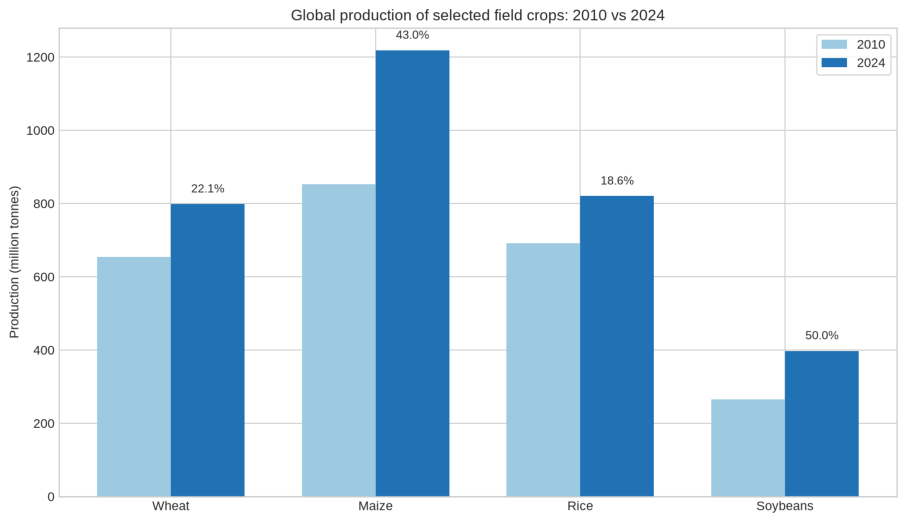 Figure 1
Introduction
Field crops are defined as crops that are often grown in large areas and with production systems that rely on mechanized or semi-mechanized processes. They include cereals such as wheat, maize, rice, and barley; legumes such as lentils, chickpeas, beans, and peas; and oilseed crops such as soybeans, sunflowers, canola, and peanuts. These crops differ in their physiological pathways; wheat and rice are C3 plants, while maize, millet, and sorghum are C 4 plants, a difference that affects their responses to heat, carbon dioxide, and water [3, 4] . Crop success should not be reduced to the total yield; yield is the product of harvested area and yield, and yield is the quantity of produce per unit area. Therefore, yield can increase due to horizontal expansion even with constant yields, or due to vertical improvement that increases production from the same land. According to the latest FAO statistics, the harvested area of major primary crops increased by 197 million hectares from 2010 to 2024, reaching 1.5 billion hectares, while cereal production rose by 27% to 3.1 billion tons. Improved yields were a key factor in this increase (FAO, 2025) [2] .
Article methodology and data sources
This article was prepared as a synthetic scientific review combining official databases, international reports, peer-reviewed studies, and meta-analyses. FAOSTAT was used as the primary source for comparative statistics between countries and commodities, utilizing the official summary of crop production 2010-2024. Quantitative data were then linked to published evidence on soil, water, climate change, pests, and post-harvest losses [1,2] . Furthermore, production in tons, area in hectares, and yield in tons per hectare were separated, as were observed figures and simulated estimates.
Global trends in field crop production
Statistical data shows that global crop production growth has been driven by a combination of acreage expansion and improved yields, but the contribution of each factor varies by crop and region. For cereals, global production rose to 3.1 billion tons in 2024 compared to 2010, with increased yields being the dominant factor. Oilseed production increased by 50% to 1.2 billion tons, with acreage expansion playing a more significant role, particularly for soybeans and oil palm fruit (FAO, 2025) [2] . This suggests that assessing sustainability should not solely focus on increased production but should also consider whether the increase stemmed from improved efficiency or the conversion of new land. Cereals remain the cornerstone of the global food supply, but they alone do not provide all nutritional requirements. Pulses add protein, fiber and minerals, and their inclusion in crop rotations can support bio-nitrogen fixation and break the cycles of some pests, while oilseed crops provide edible oils and feed protein, but in some areas, they may be associated with agricultural expansion that puts pressure on forests and biodiversity [4,5,6,7] .
Index
Index
Operational definition Common unit Its importance in evaluation
Operational definition Common unit Its importance in evaluation
Quantitative data on the production of major crops
Quantitative data on the production of major crops
Global production in 2010 and 2024
The following table shows global production data for wheat, maize, rice, and soybeans in 2010 and 2024. The values were extracted from downloadable data files in the Our World in Data Explorer, which dis-plays FAO/FAOSTAT data after processing and standardization. The values are measured in metric tons, while the relative change was calculated using the equation:
production 2024 -production 2010 production 2010
× 100 [1,4] . [1,4] . The data shows that maize saw the largest absolute increase, with production rising by approximately 366.2 million tons, while soybeans recorded the highest relative increase at 50.0%. However, these percentages do not necessarily imply that the increase was solely due to improved yields. Overall FAO data indicates that cereal growth was primarily linked to improved yields, while a significant portion of oilseed crop growth was attributed to expanded acreage (FAO, 2025) [2] . Therefore, a detailed causal analysis should consider both the harvested area and yield chains for each crop, rather than interpreting production alone as an improvement in efficiency.
Unit auditing and limitations of comparability
The figures above represent annual global production in metric tons, not yield or area. Furthermore, the definition of a crop can vary across databases; rice production may be reported in some statistics as paddy rice, while other sources may report milled rice or its processed products. For this reason, figures from different databases should not be combined before a standardized definition of the commodity and its unit of measurement is established. The FAO confirms that the field of crop and livestock production includes data on production and harvested area, with data on processed products available in a separate section (FAO, 2025) [2] .
Practical reading of data
These figures convey three agricultural messages. First, maize, wheat, and rice remain the base of grain supply, but their growth rates are not uniform; maize has grown faster than wheat and rice over the same period. Second, the 50% growth in soybean production highlights the expanding demand for oils, protein, and animal feed, and necessitates an analysis of the impact of land expansion and trade on forests and biodiversity. Third, the global increase alone is insufficient to demonstrate improved local food security, as the global average masks differences between countries in yields, water resources, storage capacity, and access to inputs and markets.
Scientific determinants of productivity
Scientific determinants of productivity
Variety and seed
Variety determines a significant portion of yield potential through its growth period, light interception efficiency, drought, heat, and disease resistance, and market suitability. [8,9,10] . Therefore, genetic improvement programs should treat variety as part of a management system, not as a product isolated from its environment.
Soil and its fertility
Soil is a vital medium for root anchoring, water storage, nutrient exchange, and support microorganisms. FAO guidelines for sustainable soil management emphasize that organic matter conservation, erosion reduction, improved soil structure, and salinity and acidity management are interconnected elements of sustainable production [11] . Evidence also shows that nitrogen-and organic matter-rich soils can support higher yields, but nutrient use efficiency is not uniform globally, necessitating local management based on soil analysis and crop requirements (Silver et al., 2021) [12] .
Practical soil management includes using plant residues or compost where appropriate, minimizing unnecessary tillage, mulching the soil surface, implementing crop rotations that combine cereals and legumes, adjusting machinery movement to prevent compaction, and improving drainage in waterlogged areas. There is no single approach for all fields; the response varies depending on soil texture, climate, depth, organic matter content, and irrigation water quality. [13,14,10] . Integrated nutrient management is based on four practical principles: the right source, the right rate, the right time, and the right place, incorporating mineral and organic fertilizers and biostabilization when conditions are suitable (Roy et al., 2006; Hou et al., 2023) [13,14] .
Nutrients and nitrogen use efficiency
Nutrients and nitrogen use efficiency
Water and irrigation
Water affects germination, leaf expansion, flowering, and grain filling; therefore, crop sensitivity varies according to the growth stage. Reviews of water productivity show that improving irrigation scheduling, field leveling, irrigation method selection, reducing evaporation from the soil surface, and improving root structure can increase yield per unit of water more than focusing solely on increasing the amount of water used [15,16,17,18] . In water-scarce regions, supplemental irrigation at critical stages may be more efficient than undirected overirrigation.
Pest and disease management
Insects, diseases, and weeds cause both pre-harvest and post-harvest losses, which vary depending on the crop, climate, and farming system. Global estimates suggest that pests and diseases can undermine a significant portion of potential production, but assessing the loss requires distinguishing between actual damage and excessive chemical protection (Oerke, 2006; Savary et al., 2019) [19,20] . Integrated pest management combines monitoring, economic thresholds, crop rotation, resistant varieties, biological control, agricultural practices, and the controlled use of pesticides when necessary [21,22] .
Climate change and production risks
Climate change impacts crops through rising temperatures, altered rainfall, increased droughts and heat waves, changing pest pressure, soil salinity, and disruption of planting schedules. A Nature Reviews Earth & Environment review shows that increased carbon dioxide may offset some of the climate impact on wheat and rice, but heat and drought can negate this offset, while C 4 crops benefit less from the fertilizing effect of carbon dioxide (Eyshi Rezaei et al., 2023) [3] . In a severe, non-adaptive scenario, simulated yield losses for staple cereals ranged from 7% to 23% (Eyshi Rezaei et al., 2023) [3] . Global modeling studies have also shown that maize, wheat, and rice do not respond to the same degree, and that outcomes depend on the climate scenario, water and nutrient management, planting date, variety, and the assumed impact of carbon dioxide (IPCC, 2022; [23,24,25,26,27,28,29] . Therefore, presenting a single climate figure as a definitive prediction should be avoided; it is more appropriate to present ranges and explain the sources of uncertainty.
Towards sustainable agricultural intensification
Sustainable intensification aims to produce more food from the same land while reducing environmental damage and improving farmers' resilience. Extensive reviews have concluded that the performance of sustainable technologies varies depending on the context; conservation agriculture, integrated fertilization, or intercropping may succeed in one location but require modification in another due to soil, labor, and market characteristics (Pretty et [30,31,6,32] . Therefore, scientific recommendation should not be a "one-size-fits-all" approach, but rather a decision package based on field-specific assessments.
The most generalizable package includes pre-fertilization soil analysis, certified and adapted seeds, a varied crop rotation, appropriate soil cover, water management based on soil moisture and physiological stage, regular pest monitoring, and the use of weather and remote sensing data when available. Effectiveness increases when these practices are supported by extension services, financing, insurance, and infrastructure, as limited access to inputs and markets may prevent farmers from implementing the correct technical recommendation (Pretty et al., 2018; HLPE, 2014; FAO, 2016) [30,33,34] . [35,36,37] . A review published in PMC, based on World Bank estimates, cited approximate ranges of grain losses of 7-10% in some field operations and 4-5% in the market stages, emphasizing that values vary considerably depending on the context (Affognon et al., 2015) [35] . Priority interventions include determining appropriate harvesting and storage humidity, rapid and safe drying, using airtight containers or well-ventilated storage facilities, controlling rodents and insects, and improving sorting, packaging, and transportation. When evaluating these interventions, quantity, quality, and safety must be measured, as weight reduction alone does not account for mycotoxins or nutritional deficiencies.
Post-harvest and value chain
Post-harvest and value chain
Proposed indicators for measuring the success of a crop production system
Evaluating a system based solely on yield is not recommended. A farm might achieve high yields but consume excessive water or nitrogen, or experience significant post-harvest crop loss. The following table suggests an indicator board that combines production, efficiency, and resilience.
Distance
Distance
Discussion
Evidence suggests that field crop production is determined by the interaction of four levels. The first level begins with genes and seeds, followed by the field level, which includes soil, water, nutrients, and pests. Next comes the farm level, encompassing crop rotation, labor, mechanization, and risk management. Finally, the value chain and policy level determines the producer's access to markets, storage, and financing. This interaction explains why the results of a successful experiment at a research station may not directly translate to farmers' fields. Increased global production does not mean the end of food security problems; higher production may coexist with unequal access, food poverty, high losses, and environmental degradation. Crop diversifi-cation remains important for improving food diversity and resilience, but diversification should consider market conditions, consumer needs, and the risks of alternative crops [4,38,39,40,41] . In arid regions, increasing water productivity may be more important than maximizing yields, while protecting soil from erosion may be a priority on sloping lands.
Conclusion and recommendations
Analysis shows that the future of field crop production depends more on increasing yields from existing resources than on uncontrolled land expansion. Global cereal production reached 3.1 billion tons in 2024, with improved yields being a major driver of growth since 2010, while the expansion of oilseed crops has been more closely linked to increased acreage (FAO, 2025) [2] . Meanwhile, climate models reveal that a lack of adaptation could lead to significant losses in staple cereal yields (Eyshi Rezaei et al., 2023) [3] . Therefore, the article recommends adopting production programs based on soil diagnosis, suitable seeds, integrated fertilization, precise irrigation scheduling, varied crop rotations, integrated pest management, and improved storage. Public investment should focus on extension services, data, and post-harvest infrastructure, rather than simply subsidizing inputs regardless of their efficiency. Future research needs to link field trials with climatic and economic models and simultaneously measure food, nutritional, profitability, and environmental impacts.
Figures and tables from the paper
References
42 in the original paper- FAO. Agricultural production statistics 2010-2024. 2025.
- Eyshi Rezaei E, Heidi W, Senthold A, Kenneth B. Climate change impacts crop yields. Nature Reviews Earth & Environment. 2023.
- Daryanto S, Wang L, Jacinthe PA. Global synthesis of drought effects on food legume production. PLoS ONE. 2015.
- Foley JA, et al. Solutions for a cultivated planet. Nature. 2011.
- Reynolds TW, et al. Environmental impacts and constraints associated with the production of major food crops. Food Security. 2015.
- Mueller ND, et al. Closing yield gaps through nutrient and water management. Nature. 2012.
- van Ittersum MK, et al. Yield gap analysis with local to global relevance. Field Crops Research. 2013.
- Cassman KG. Ecological intensification of cereal production systems. Proceedings of the National Academy of Sciences. 1999.
- Silver WL, Perez T, Mayer A, Jones AR. The role of soil in the contribution of food and feed. Philosophical Transactions of the Royal Society B. 2021.
- Roy RN, Finck A, Blair GJ, Tandon HLS. Plant Nutrition for Food Security: A Guide for Integrated Nutrient Management. FAO. 2006.
- Hou D, et al. Sustainable soil management for food security. Soil Use and Management. 2023.
- Zwart SJ, Bastiaanssen WGM. Review of measured crop water productivity values for irrigated wheat, rice, cotton and maize. Agricultural Water Management. 2004.
- Pereira LS, et al. Crop water use and productivity. Irrigation Science. 2012.
- UnNisa Z, et al. Crop water productivity in the Mediterranean basin under a changing climate. Irrigation and Drainage. 2022.
- Oerke EC. Crop losses to pests. Journal of Agricultural Science. 2006.
- Savary S, et al. The global burden of pathogens and pests on major food crops. Nature Ecology & Evolution. 2019.
- Mesterházy A, et al. Role of fungicides in food security. European Journal of Plant Pathology. 2020.
- IPCC. Climate Change 2022: Impacts, Adaptation and Vulnerability, Chapter 5: Food, Fiber and Other Ecosystem Products. 2022.
- Jägermeyr J, Christoph M, Alex CR, Elliott J. Climate impacts on global agriculture emerge earlier in new generation of climate and crop models. Nature Food. 2021.
- Lobell DB, Burke MB, Tebaldi C, Mastrandrea MD, Falcon WP, Naylor RL. Prioritizing climate change adaptation needs for food security in 2030. Science. 2008.
- Ortiz-Bobea A, Toby RA, Carlos MC, Robert GC, Lobell DB. Anthropogenic climate change has slowed global agricultural productivity growth. Nature Climate Change. 2021.
- Asseng S, Ewert F, Martre P, Rötter RP. Rising temperatures reduce global wheat production. Nature Climate Change. 2015.
- Zhao C, Liu B, Piao S, Wang X, Lobell DB, Huang M. Temperature increase reduces global yields of major crops in four independent estimates. PNAS. 2017.
- Challinor AJ, Watson J, Lobell DB. A meta-analysis of crops yields under climate change and adaptation. Nature Climate Change. 2014.
- Pretty J, et al. Global assessment of agricultural system redesign for sustainable intensification. Nature Sustainability. 2018.
- Tilman D, et al. Global food demand and the sustainable intensification of agriculture. PNAS. 2011.
- Rockström J, et al. Sustainable intensification of agriculture for human prosperity and global sustainability. Ambio. 2017.
- HLPE. Food losses and waste in the context of sustainable food systems. 2014.
- FAO. Seeds and plant genetic resources. 2016.
- Affognon H, et al. Unpacking postharvest losses in sub-Saharan Africa. World Development. 2015.
- Kumar D, Kalita P. Reducing postharvest losses during storage of grain crops to strengthen food security in developing countries. Foods. 2017.
- Hodges RJ, Buzby JC, Bennett B. Postharvest losses and waste in developed and less developed countries. Journal of Agricultural Science. 2011.
- FAO. The State of Food and Agriculture 2023: Revealing the true cost of food to transform agrifood systems. 2023.
- OECD-FAO. Agricultural Outlook 2023-2032. 2023.
- World Bank. Missing Food: The Case of Postharvest Grain Losses in Sub-Saharan Africa. 2011.
- FAO. The State of Food and Agriculture 2019: Moving forward on food loss and waste reduction. 2019.
- FAO. The State of the World's Land and Water Resources for Food and Agriculture: Systems at breaking point. 2021.
- Giller KE, et al. The future of farming: who will produce our food? Food Security. 2021.
- Erb KH, et al. Exploring the biophysical option space for feeding the world without deforestation. Nature Communications. 2016.
- Springmann M, et al. Options for keeping the food system within environmental limits. Nature. 2018.
- Steffen W, et al. Planetary boundaries: guiding human development on a changing planet. Science. 2015.
- United Nations. Sustainable Development Goal 2: Zero Hunger. How to cite this article: Shnaishel Baday SJ, Saleh FF. Review: Field crop production: Scientific foundations, global trends, and opportunities for sustainably increasing productivity. International Journal of Agriculture and Nutrition. 2026;8(9):115-119. doi: https://www.doi.org/10.33545/2664606