
Research article · 2026 · Full text
International Journal of Biology SciencesEconomic analysis of potato cultivation in ballia district of Uttar Pradesh, India
Volume 8(9) · Pages 64–70 · DOI: 10.33545/26649926.2026.v8.i9a.992 ↗
Research areasAgricultural Economics and PracticesAgricultural economics and policiesAgricultural Development and Management
Abstract
Author-writtenPotato (Solanum tuberosum L.) is an essential commercial vegetable crop and contributes significantly in farm income, employment generation and diversification of agricultural production. The present study was conducted to estimate the cost of cultivation, returns and economic efficiency of potato production across different farm-size categories in Ballia district of Uttar Pradesh. A four-stage multistage sampling technique was adopted for the selection of the district, blocks, villages and sample farmers. Two blocks, namely Murlichhapra and Bairia, and eight villages were selected for the study. A total of 160 potato-growing farmers, comprising 40 each from marginal, small, medium and large farm-size groups, were selected through simple random sampling. Primary data were collected through personal interviews using a pre-tested interview schedule for the agricultural year 2024-25. Tabular analysis averages and percentages were used for estimation and interpretation. The standard cost concepts of the Commission for Agricultural Costs and Prices (CACP) were used for estimating Cost A1/A2, Cost B1, Cost B2, Cost C1, Cost C2 and Cost C3. The results revealed that the overall average cost of cultivation at Cost C3 was ₹109,425.81/ha, increasing from ₹97,852.80 on marginal farms to ₹122,148.02/ha on large farms. Potato seed constituted the largest individual cost component (22.72%), followed by rental value of land (20.56%) and human labour (18.73%). The overall average potato yield was 236.51 q/ha, with yield increasing from 225.35 q/ha on marginal farms to 248.30 q/ha on large farms. The overall gross income was ₹248,335.50/ha, while net return over Cost C3 was ₹138,909.69/ha. The overall input-output ratio on Cost C3 was 1:2.27, indicating that potato cultivation generated positive returns over the comprehensive cost of cultivation. The findings suggest that efficient management of seed, labour, irrigation, fertilizer and machinery costs, together with improved productivity and market access, can further strengthen the economic performance of potato cultivation in the study area.
Summary
Source-checkedPlain-language reading of the full paper, prepared with AI and checked against the text. Each point links to the authors' own words.
Why it matters
- Potato is a critical commercial vegetable crop that helps diversify agricultural production and provides significant employment and income for farms. View evidence ↗
- Because potato cultivation involves high spending on seeds and other variable inputs, it is necessary to estimate costs and returns to evaluate its economic performance. View evidence ↗
The question
- The study aimed to determine the cost of cultivation, economic efficiency, and returns for potato production among various farm-size categories in the Ballia district of Uttar Pradesh. View evidence ↗
What they did
- Researchers used a four-stage multistage sampling technique to select the Ballia district, two specific blocks (Murlichhapra and Bairia), and eight randomly selected villages. View evidence ↗
- A total of 160 farmers were sampled, with 40 representatives each from marginal (<1 ha), small (1-2 ha), medium (2-4 ha), and large (>4 ha) farm-size groups. View evidence ↗
- Primary data for the 2024-25 agricultural year were gathered via personal interviews using a pre-tested, structured schedule. View evidence ↗
- The study applied standard Commission for Agricultural Costs and Prices (CACP) concepts to estimate various cost levels, ranging from Cost A1/A2 to Cost C3. View evidence ↗
What they found
- The overall average comprehensive cost (Cost C3) was ₹109,425.81/ha, with costs rising as farm size increased, from ₹97,852.80/ha for marginal farms to ₹122,148.02/ha for large farms. View evidence ↗
- The primary cost drivers were potato seeds (22.72% of Cost C3), land rental value (20.56%), and human labour (18.73%). View evidence ↗
- Average potato yield was 236.51 q/ha, showing a consistent increase with farm size, peaking at 248.30 q/ha on large farms compared to 225.35 q/ha on marginal farms. View evidence ↗
- Overall gross income averaged ₹248,335.50/ha, increasing from ₹236,617.50/ha on marginal farms to ₹260,715.00/ha on large farms. View evidence ↗
- The overall cost of production was ₹462.67/q, which increased with farm size, reaching ₹491.94/q on large farms. View evidence ↗
What it means
- The authors conclude that potato cultivation is a profitable and economically important enterprise for farmers in the Ballia district. View evidence ↗
Visual summary
3 visualsIllustrations explain the paper; charts are replotted from the paper's own table values.
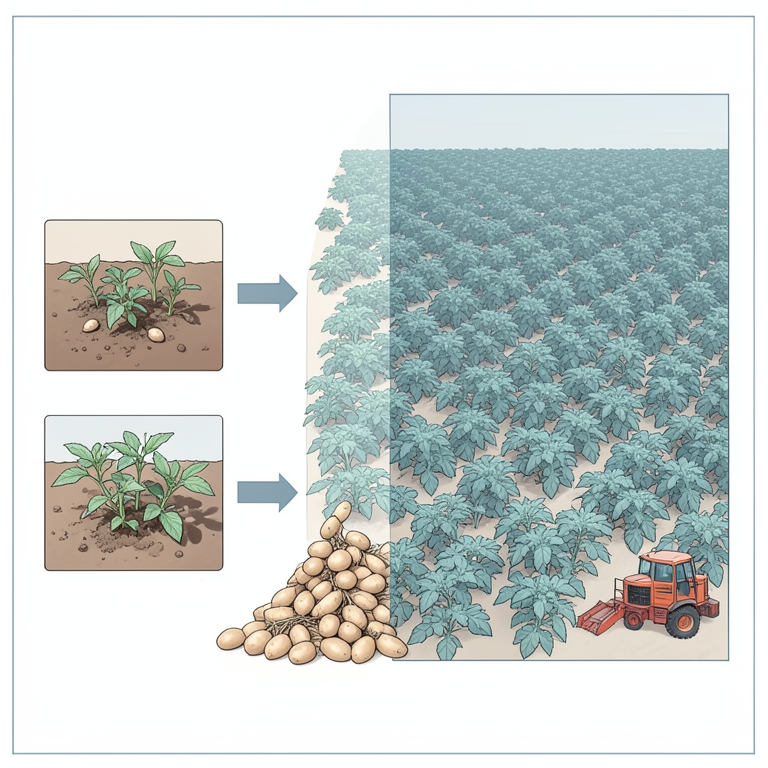
Farm Size vs. Economic Performance
AI-generated conceptual illustration (potato plants in agricultural fields). It explains the idea and does not show study data.
View source evidence ↗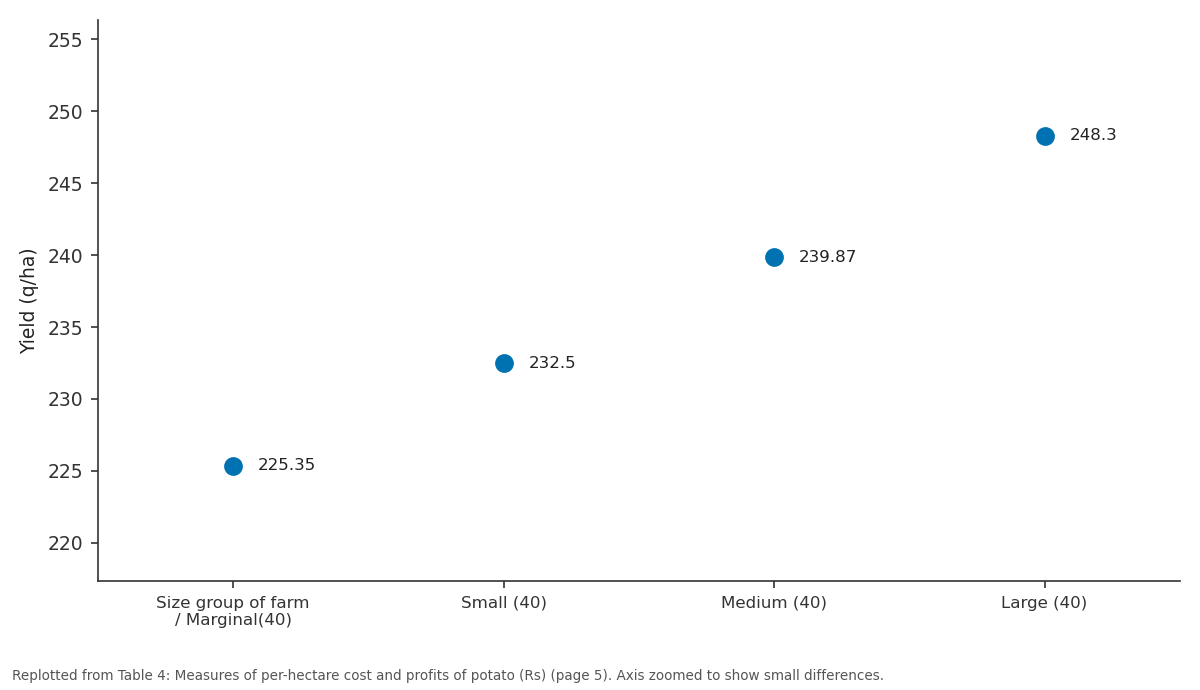
Yield (q/ha): Size group of farm /... vs Small (40) vs Medium (40) vs Large (40)
Replotted from Table 4 (page 5) of the original paper. Every bar is the paper's own table value.
View source evidence ↗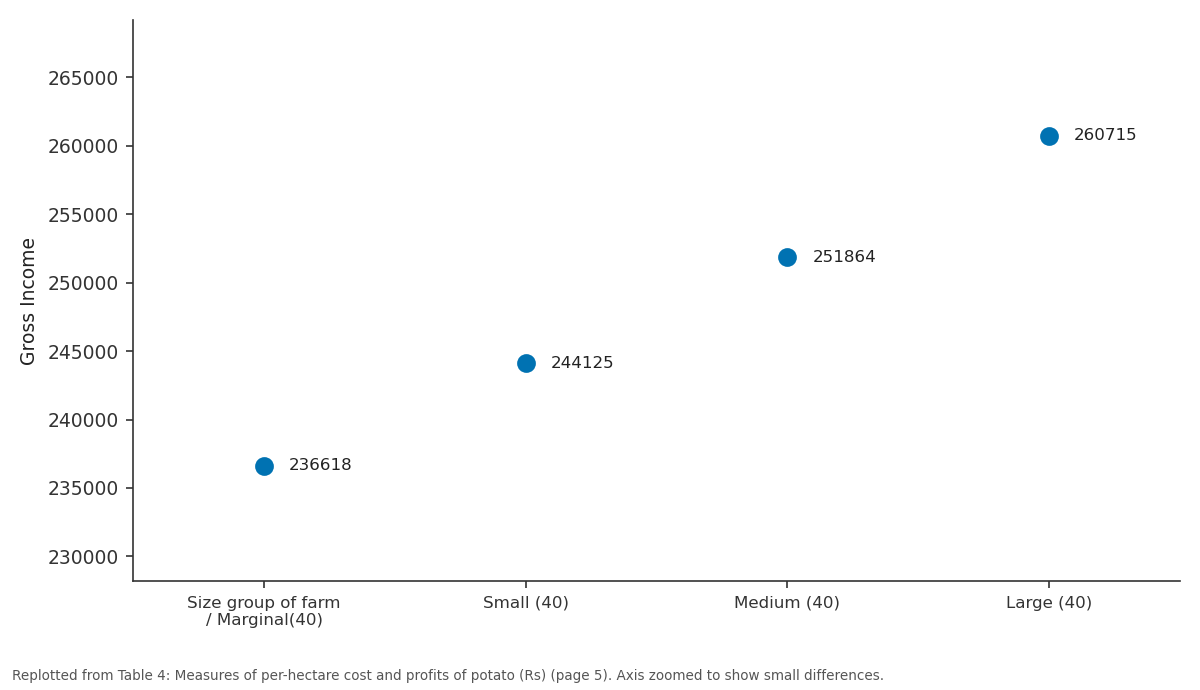
Gross Income: Size group of farm /... vs Small (40) vs Medium (40) vs Large (40)
Replotted from Table 4 (page 5) of the original paper. Every bar is the paper's own table value.
View source evidence ↗Figures & tables
From the original paper Table 1
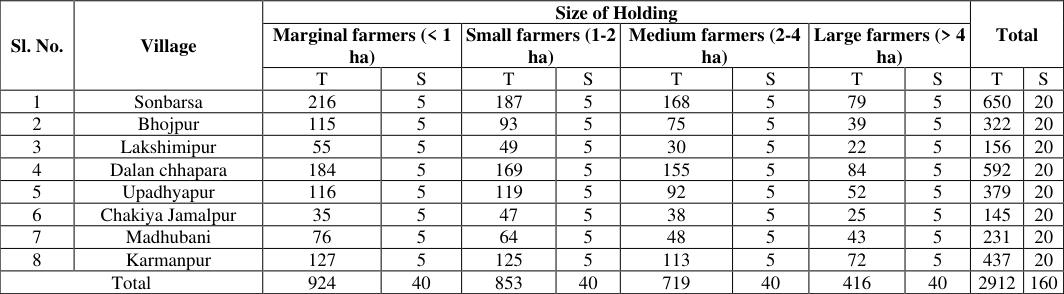 Table 2
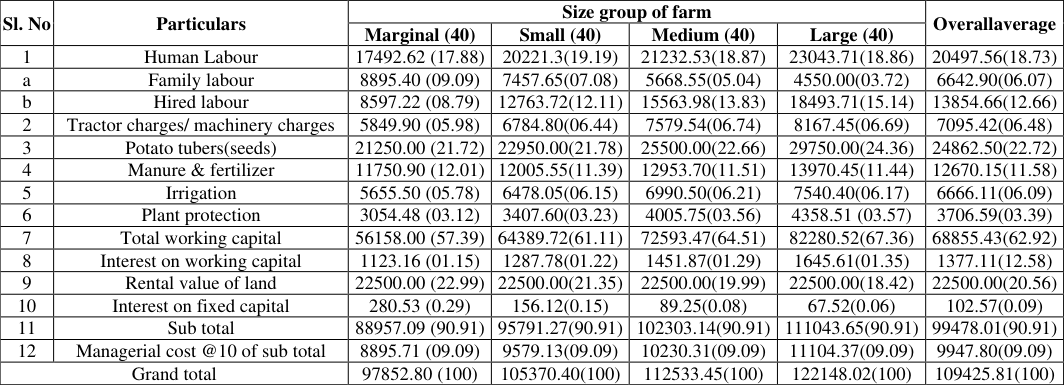 Table 3
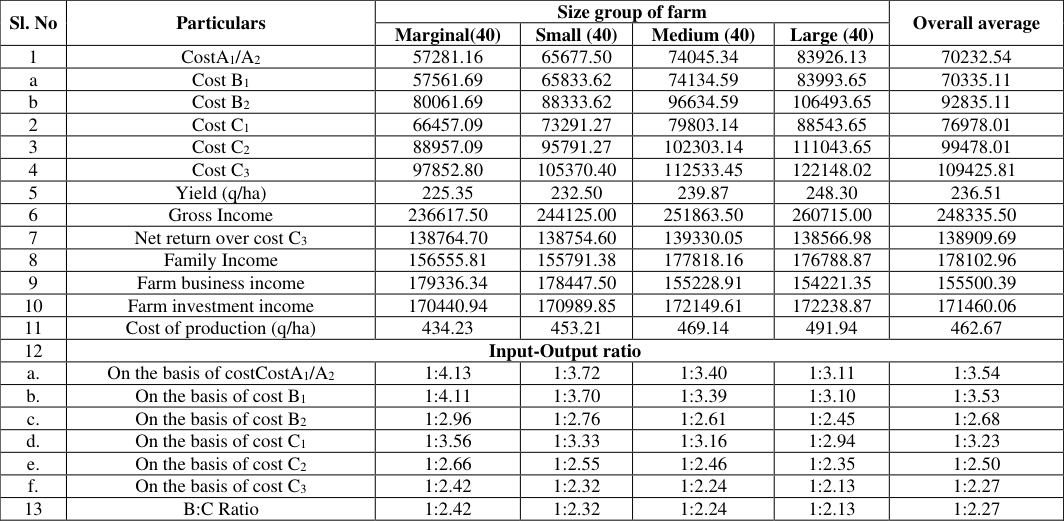 Table 4
Introduction
Potato (Solanum tuberosum L.) is one of the most important food and commercial crops cultivated in India. Besides contributing to food and nutritional security, potato provides cash income and employment opportunities to farm households because of its relatively intensive input use and short production cycle. The crop has an important place in the agricultural economy of northern and eastern India, where favourable agro-climatic conditions and established marketing systems support commercial production. The economics of potato cultivation is strongly influenced by the prices of seed, labour, fertilizers, irrigation, machinery and plant-protection inputs. Since potato production requires substantial expenditure on seed and other variable inputs, estimation of cost and returns is essential for assessing the economic performance of the crop. Recent studies have reported substantial variation in potato production costs and profitability across regions and farm-size groups. Kumar et al. (2022) [4,8] . reported an overall cost of cultivation of ₹82,560.79/ha and a net income of ₹88,993.96/ha in Sultanpur district of Uttar Pradesh, with an input-output ratio of 1:2.08. Similarly, Yadav et al. (2024) [15] . reported a Cost C3 of ₹78,154.62/ha and positive net income in Azamgarh district of eastern Uttar Pradesh. Studies from other potato-growing regions also demonstrate the economic importance of the crop. Raj Kumar et al. (2020) [1]. reported a total cost of ₹179,449/ha, gross return of ₹274,944/ha and net return of ₹95,495/ha in Kurukshetra, Haryana. Studies on potato production have further shown that seed, labour, fertilizers and land-related costs constitute major components of total cultivation expenditure (Yadav et al., 2020; Kumar et al., 2022; Shakya et al., 2024) [2,4,8,16] . Farm size can also influence input-use intensity, productivity and profitability. Recent research from Uttar Pradesh has reported increasing cultivation costs with farm size in some locations, while productivity and economic efficiency may vary according to input management and access to resources (Kumar et al., 2024; Kumar et al., 2025) [17,21] . Similarly, studies on potato production in other parts of India have demonstrated the importance of production technology, irrigation, planting geometry and nutrient management in determining yield and economic returns (Kumar et al., 2023; Singh et al., 2024) [10,19] . In view above facts in mind, the present study was conducted entitled, "Economic Analysis of Potato Cultivation in Ballia District of Uttar Pradesh, India".
Research Methodology Sampling procedure
A four-stage multistage sampling technique was employed for the selection of the study area and sample respondents. In the first stage, Ballia district of Uttar Pradesh was selected for the study. In the second stage, two blocks, namely Murlichhapra and Bairia, were selected. In the third stage, eight villages-Sonbarsa, Bhojpur, Lakshimipur, Dalan Chhapara, Upadhyapur, Chakiya Jamalpur, Madhubani and Karmanpur-were selected randomly from the selected blocks (table-1). In fourth stage, a comprehensive list of vegetable-growing farmers was prepared for each selected village. The farmers were classified into four groups according to operational landholding size: marginal farmers (<1 ha), small farmers (1-2 ha), medium farmers (2-4 ha) and large farmers (>4 ha). Five farmers from each farm-size category were selected randomly from each village, resulting in a total sample of 160 farmers, with 40 respondents in each farmsize category (table-2).
Data collection
Primary data were collected directly from the selected farmers through personal interviews using a pre-structured and pre-tested interview schedule. The data pertained to the agricultural year 2024-25. Secondary information was collected from government publications, agricultural reports, research journals, books, research papers and other relevant official sources.
Analytical tools
For estimating the cost and returns of potato cultivation, tabular analysis, simple averages and percentages were employed. The standard cost concepts used in agricultural economics were adopted for systematic estimation of different levels of cost. The Government of India's Directorate of Economics and Statistics conducts comprehensive cost-of-cultivation studies, and CACP uses such cost estimates in its agricultural price-policy framework. Simple Average (Arithmetic Mean)
CACP cost concepts
The following cost concepts were used: Cost A1/A2: Actual paid-out costs incurred in potato cultivation, including hired labour, machinery charges, seed, manure and fertilizers, irrigation, plant protection and interest on working capital. Where applicable, rent paid for leased-in land is incorporated in Cost A2. The CACP framework recognizes the importance of paidout costs, family labour, rental value of owned land and interest on fixed capital in comprehensive cost estimation.
Income measures
The following income measures were estimated: Gross income = Total value of potato output Net return over Cost C3 = Gross income -Cost C3 Farm business income = Gross income -Cost A1/A2 Family labour income = Gross income -Cost B2 Cost of production = Total cost ÷ total physical output Input-output ratio = Gross income ÷ corresponding cost
Results and Discussion Per-hectare cost of different inputs used in potato cultivation
The per-hectare cost structure of potato cultivation is presented in Table 1. The results show that the overall average Cost C3 was ₹109,425.81/ha. The cost increased progressively with farm size, from ₹97,852.80/ha on marginal farms to ₹105,370.40/ha on small farms, ₹112,533.45/ha on medium farms and ₹122,148.02/ha on large farms (table-3). The increasing total cost with farm size indicates greater expenditure on purchased inputs, labour, machinery and other production resources on larger farms. Similar increases in cultivation expenditure with farm size have been reported in recent potato studies from Uttar Pradesh (Kumar et al., 2024; Kumar et al., 2025) [17,21] . Among the individual cost components, potato seed constituted the largest expenditure, accounting for 22.72 per cent of the overall Cost C3. The average expenditure on seed was ₹24,862.50/ha. Seed expenditure increased from ₹21,250/ha on marginal farms to ₹29,750/ha on large farms (table-3). The importance of seed as a major cost component in potato cultivation has also been reported in other Indian studies (Raj Kumar et al., 2020; Kumar et al., 2022) [1,4,8] . The second major cost component was human labour, which accounted for 18.73 per cent of total Cost C3, with an overall expenditure of ₹20,497.56/ha. Human labour expenditure increased from ₹17,492.62/ha on marginal farms to ₹23,043.71/ha on large farms. Within human labour, family labour accounted for ₹6,642.90/ha, while hired labour accounted for ₹13,854.66/ha (table-3). The increasing share of hired labour with farm size indicates greater dependence of larger farms on purchased labour. The rental value of land constituted 20.56 per cent of the total cost, amounting to ₹22,500/ha across all farm-size groups. This indicates that land-related opportunity cost represented a substantial component of the comprehensive cost of potato cultivation. Manure and fertilizer expenditure accounted for 11.58 per cent of the total cost, with an overall average of ₹12,670.15/ha. The expenditure increased from ₹11,750.90/ha on marginal farms to ₹13,970.45/ha on large farms (table-3). Recent studies have also identified fertilizers and manures as important contributors to potato production cost and productivity (Yadav et al., 2020; Kumar et al., 2024) [2,17] . Machinery and tractor charges accounted for 6.48 per cent, while irrigation accounted for 6.09 per cent of total Cost C3. Plant-protection expenditure was comparatively smaller, accounting for 3.39 per cent. The pattern indicates that seed, land, labour and nutrient management together represented the major components of potato production expenditure. The total working capital averaged ₹68,855.43/ha, representing 62.92 per cent of total Cost C3. The proportion of working capital increased from 57.39 per cent on marginal farms to 67.36 per cent on large farms. Interest on working capital was ₹1,377.11/ha at the overall level. The findings broadly correspond with recent potato cost studies. For example, Kumar et al. (2022) [4,8] . reported seed and labour as major components of potato production expenditure in Sultanpur, while Shakya et al. (2024) [16] . observed that cultivation costs increased with farm size in Farrukhabad.
| S. No. | Particulars | Selection of study area | Technique |
|---|---|---|---|
| 1. | District | Ballia | Purposive |
| 2. | Blocks | Murlichhapra and Bairia | Purposive |
| 3. | Villages | Sonbarsa, Bhojpur, Lakshimipur, Dalan chhapara, Upadhyapur, Chakiya Jamalpur, Madhubani, and Karmanpur | Random |
Table text extracted from the original PDF; superscript letters are shown inline. The original table image is below.
View original table image
Cost concepts of potato cultivation
The different CACP cost concepts are presented in Table 2. The overall Cost A1/A2 was ₹70,232.54/ha, increasing from ₹57,281.16/ha on marginal farms to ₹83,926.13/ha on large farms. Cost B1 was ₹70,335.11/ha at the overall level, while Cost B2 increased to ₹92,835.11/ha due to the addition of rental value of owned land. Cost C1 was ₹76,978.01/ha and Cost C2 was ₹99,478.01/ha at the overall level. After adding 10 per cent managerial cost, Cost C3 increased to ₹109,425.81/ha (Table-4). The increase from Cost A1/A2 to Cost C3 demonstrates the effect of incorporating family labour, owned land and fixed-capital costs into the comprehensive economic cost of potato cultivation. This approach is consistent with the cost-estimation framework used in Indian agricultural economics and CACP cost studies. The increasing Cost C3 across farm-size groupsfrom ₹97,852.80/ha on marginal farms to ₹122,148.02/ha on large farms-suggests greater absolute expenditure on production resources on larger farms (table-4). However, the higher cost was accompanied by higher potato productivity, as discussed below.
| Sl. No. | Village | Size of Holding | — | — | — | — | — | — | — | Total | — |
|---|---|---|---|---|---|---|---|---|---|---|---|
| Marginal farmers (< 1 ha) | Small farmers (1-2 ha) | Medium farmers (2-4 ha) | Large farmers (> 4 ha) | ||||||||
| T | S | T | S | T | S | T | S | T | S | ||
| 1 | Sonbarsa | 216 | 5 | 187 | 5 | 168 | 5 | 79 | 5 | 650 | 20 |
| 2 | Bhojpur | 115 | 5 | 93 | 5 | 75 | 5 | 39 | 5 | 322 | 20 |
| 3 | Lakshimipur | 55 | 5 | 49 | 5 | 30 | 5 | 22 | 5 | 156 | 20 |
| 4 | Dalan chhapara | 184 | 5 | 169 | 5 | 155 | 5 | 84 | 5 | 592 | 20 |
| 5 | Upadhyapur | 116 | 5 | 119 | 5 | 92 | 5 | 52 | 5 | 379 | 20 |
| 6 | Chakiya Jamalpur | 35 | 5 | 47 | 5 | 38 | 5 | 25 | 5 | 145 | 20 |
| 7 | Madhubani | 76 | 5 | 64 | 5 | 48 | 5 | 43 | 5 | 231 | 20 |
| 8 | Karmanpur | 127 | 5 | 125 | 5 | 113 | 5 | 72 | 5 | 437 | 20 |
| Total | 924 | 40 | 853 | 40 | 719 | 40 | 416 | 40 | 2912 | 160 |
Table text extracted from the original PDF; superscript letters are shown inline. The original table image is below.
View original table image
Yield and gross income
The average potato yield was 236.51 q/ha. The yield increased consistently with farm size, from 225.35 q/ha on marginal farms to 232.50 q/ha on small farms, 239.87 q/ha on medium farms and 248.30 q/ha on large farms (table-4). The higher yield on larger farms may be associated with greater use of purchased inputs, machinery, hired labour and production resources. Similar relationships between input use and potato productivity have been reported in studies of potato production in Uttar Pradesh and other Indian regions (Yadav et al., 2020; Kumar et al., 2024) [17] . The overall gross income from potato cultivation was ₹248,335.50/ha. Gross income increased from ₹236,617.50/ha on marginal farms to ₹260,715.00/ha on large farms. The higher gross income on larger farms was primarily associated with higher physical productivity (table-4). Recent research has similarly reported positive gross returns from potato production under different production systems and regions (Raj Kumar et al., 2020; Kumar et al., 2025) [1,21] .
Net returns over Cost C3
The overall net return over Cost C3 was ₹138,909.69/ha. Farm-size-wise, net returns were ₹138,764.70/ha on marginal farms, ₹138,754.60/ha on small farms, ₹139,330.05/ha on medium farms and ₹138,566.98/ha on large farms (table-4). Although the large farms incurred the highest total cost, their higher yield and gross income largely compensated for the higher expenditure. As a result, net returns remained relatively close across the four farmsize categories. The medium farm group recorded the highest net return in the present dataset. The positive net returns over Cost C3 indicate that potato cultivation generated returns above the comprehensive cost, including imputed family labour, rental value of land, interest on fixed capital and managerial cost. Comparable positive profitability has been reported for potato cultivation (Kumar et al., 2022; Kumar et al., 2025) [4,8,21] .
Family income
The overall family income was ₹178,102.96/ha, based on the difference between gross income and Cost B2. The corresponding values were ₹156,555.81/ha for marginal farms, ₹155,791.38/ha for small farms, ₹177,818.16/ha for medium farms and ₹176,788.87/ha for large farms (table-4). The positive family income across all farm-size categories indicates that potato cultivation generated sufficient returns to cover paid-out costs, interest on owned fixed capital and rental value of land while also compensating family labour.
Farm business income
Farm business income represents the return available after deducting Cost A1/A2 from gross income. On the basis of the supplied Cost A1/A2 and gross-income figures, the farm business income was approximately ₹178,102.96/ha at the overall level (table-4). The positive farm business income indicates that potato cultivation generated substantial returns over the paid-out cost of production. This measure is particularly relevant for owner-operated farms because it reflects the return available to the farmer for management, family labour and owned resources after meeting actual cash and kind expenditure.
Farm investment income
Farm investment income represents the return remaining after accounting for Cost B1. Based on the supplied gross income and Cost B1 values, potato cultivation generated positive returns over Cost B1 in all farm-size categories (table-4). The positive investment return indicates that potato cultivation was capable of covering variable expenditure as well as interest on owned fixed capital. Similar positive economic performance has been reported in recent potato studies from Uttar Pradesh and other regions of India (Yadav et al., 2024; Raina et al., 2024) [15,18] .
Cost of production
The overall cost of production was ₹462.67/q. It increased from ₹434.23/q on marginal farms to ₹453.21/q on small farms, ₹469.14/q on medium farms and ₹491.94/q on large farms (table-4).
The increase in per-quintal cost with farm size indicates that the increase in production costs was proportionally greater than the increase in output. Therefore, although large farms recorded the highest yield, their per-unit production cost was also highest in the present study. The importance of controlling per-unit production cost has been highlighted in recent potato economic studies, where variations in seed, labour and input expenditure have influenced profitability across farm categories (Kumar et al., 2025; Darade et al., 2025) [22] .
Input-output ratio
The input-output ratio is an important indicator of the economic efficiency of potato cultivation. On the basis of Cost A1/A2, the overall input-output ratio was 1:3.54. It declined to 1:3.53 on Cost B1, 1:2.68 on Cost B2, 1:3.23 on Cost C1, 1:2.50 on Cost C2 and 1:2.27 on Cost C3. The Cost C3-based ratio of 1:2.27 means that an expenditure of ₹1 under the comprehensive cost of cultivation generated approximately ₹2.27 in gross income (table-4). The ratio remained above unity for all farm-size groups, indicating positive returns even after considering the comprehensive cost. The Cost C3-based input-output ratios were 1:2.42, 1:2.32, 1:2.24 and 1:2.13 for marginal, small, medium and large farms, respectively. Thus, the ratio declined with increasing farm size, despite the increase in yield. This suggests that larger farms achieved greater physical productivity but incurred proportionately greater costs (table-4). The overall profitability observed in the present study is comparable with recent findings from Uttar Pradesh. Kumar et al. (2022) [4] . reported an input-output ratio of 1:2.08 in Sultanpur, while Kumar et al. (2025) [21] . reported 1:1.96 in Kannauj. Positive economic returns have also been reported under improved potato production practices, nutrient management and planting configurations (Kumar et [10,14,19] .
Benefit-cost ratio
The B:C ratio under Cost C3 was 1:2.27 at the overall level. The corresponding ratios for marginal, small, medium and large farms were 1:2.42, 1:2.32, 1:2.24 and 1:2.13, respectively (table-4). The ratio above unity across all farm-size groups indicates that potato cultivation generated gross returns greater than the comprehensive cost of production. The relatively higher ratio on marginal farms may be associated with their lower absolute cost of cultivation and substantial contribution of family labour, whereas the lower ratio on large farms reflects higher expenditure on hired labour, seed, machinery and other purchased inputs. Comparable variations in profitability across farm sizes have been documented in potato studies. For example, Kumar et al. (2025) [21] . reported an overall B:C ratio of 1:1.96 in Kannauj, whereas Darade et al. (2025) [22] . reported a B:C ratio of 1.63 for chip-grade potato production in Pune.
Conclusion
The study concludes that potato cultivation was an economically important and profitable enterprise among the sampled farmers of Ballia district. The crop generated positive net returns over the comprehensive Cost C3 across all farm-size categories. The overall B:C ratio of 1:2.27 demonstrates that the gross value generated from potato cultivation was substantially higher than the comprehensive cost incurred. Seed emerged as the most important individual variable cost, followed by human labour and land rental value. Therefore, improvement in the availability and affordability of quality seed, efficient labour management and better utilization of land and machinery can contribute to reducing production costs. The increasing yield with farm size indicates the importance of adequate resource availability and timely input application. However, the decline in the Cost C3-based input-output ratio from marginal to large farms suggests that simply increasing expenditure does not necessarily result in proportional increases in economic returns. Greater emphasis should therefore be placed on efficient rather than merely increased input use. [10,11,19] . In addition, strengthening market linkages, collective marketing, storage and price-information systems can improve farmers' ability to obtain remunerative prices for potato. This is particularly important because price fluctuations and marketing constraints can influence the realized profitability of potato production (Sharma et al., 2023; Mavi and Arora, 2023) [12,13] .
Overall, the results suggest that potato cultivation has considerable potential to contribute to farm income in Ballia district, provided that production costs, productivity and market-related risks are managed efficiently.
Figures and tables from the paper
| Sl. No | Particulars | Size group of farm | — | — | — | Overallaverage |
|---|---|---|---|---|---|---|
| Marginal (40) | Small (40) | Medium (40) | Large (40) | |||
| 1 | Human Labour | 17492.62 (17.88) | 20221.3(19.19) | 21232.53(18.87) | 23043.71(18.86) | 20497.56(18.73) |
| a | Family labour | 8895.40 (09.09) | 7457.65(07.08) | 5668.55(05.04) | 4550.00(03.72) | 6642.90(06.07) |
| b | Hired labour | 8597.22 (08.79) | 12763.72(12.11) | 15563.98(13.83) | 18493.71(15.14) | 13854.66(12.66) |
| 2 | Tractor charges/ machinery charges | 5849.90 (05.98) | 6784.80(06.44) | 7579.54(06.74) | 8167.45(06.69) | 7095.42(06.48) |
| 3 | Potato tubers(seeds) | 21250.00 (21.72) | 22950.00(21.78) | 25500.00(22.66) | 29750.00(24.36) | 24862.50(22.72) |
| 4 | Manure & fertilizer | 11750.90 (12.01) | 12005.55(11.39) | 12953.70(11.51) | 13970.45(11.44) | 12670.15(11.58) |
| 5 | Irrigation | 5655.50 (05.78) | 6478.05(06.15) | 6990.50(06.21) | 7540.40(06.17) | 6666.11(06.09) |
| 6 | Plant protection | 3054.48 (03.12) | 3407.60(03.23) | 4005.75(03.56) | 4358.51 (03.57) | 3706.59(03.39) |
| 7 | Total working capital | 56158.00 (57.39) | 64389.72(61.11) | 72593.47(64.51) | 82280.52(67.36) | 68855.43(62.92) |
| 8 | Interest on working capital | 1123.16 (01.15) | 1287.78(01.22) | 1451.87(01.29) | 1645.61(01.35) | 1377.11(12.58) |
| 9 | Rental value of land | 22500.00 (22.99) | 22500.00(21.35) | 22500.00(19.99) | 22500.00(18.42) | 22500.00(20.56) |
| 10 | Interest on fixed capital | 280.53 (0.29) | 156.12(0.15) | 89.25(0.08) | 67.52(0.06) | 102.57(0.09) |
| 11 | Sub total | 88957.09 (90.91) | 95791.27(90.91) | 102303.14(90.91) | 111043.65(90.91) | 99478.01(90.91) |
| 12 | Managerial cost @10 of sub total | 8895.71 (09.09) | 9579.13(09.09) | 10230.31(09.09) | 11104.37(09.09) | 9947.80(09.09) |
| Grand total | 97852.80 (100) | 105370.40(100) | 112533.45(100) | 122148.02(100) | 109425.81(100) |
Table text extracted from the original PDF; superscript letters are shown inline. The original table image is below.
View original table image
| Sl. No | Particulars | Size group of farm | — | — | — | Overall average |
|---|---|---|---|---|---|---|
| Marginal(40) | Small (40) | Medium (40) | Large (40) | |||
| 1 | CostA1/A2 | 57281.16 | 65677.50 | 74045.34 | 83926.13 | 70232.54 |
| a | Cost B1 | 57561.69 | 65833.62 | 74134.59 | 83993.65 | 70335.11 |
| b | Cost B2 | 80061.69 | 88333.62 | 96634.59 | 106493.65 | 92835.11 |
| 2 | Cost C1 | 66457.09 | 73291.27 | 79803.14 | 88543.65 | 76978.01 |
| 3 | Cost C2 | 88957.09 | 95791.27 | 102303.14 | 111043.65 | 99478.01 |
| 4 | Cost C3 | 97852.80 | 105370.40 | 112533.45 | 122148.02 | 109425.81 |
| 5 | Yield (q/ha) | 225.35 | 232.50 | 239.87 | 248.30 | 236.51 |
| 6 | Gross Income | 236617.50 | 244125.00 | 251863.50 | 260715.00 | 248335.50 |
| 7 | Net return over cost C3 | 138764.70 | 138754.60 | 139330.05 | 138566.98 | 138909.69 |
| 8 | Family Income | 156555.81 | 155791.38 | 177818.16 | 176788.87 | 178102.96 |
| 9 | Farm business income | 179336.34 | 178447.50 | 155228.91 | 154221.35 | 155500.39 |
| 10 | Farm investment income | 170440.94 | 170989.85 | 172149.61 | 172238.87 | 171460.06 |
| 11 | Cost of production (q/ha) | 434.23 | 453.21 | 469.14 | 491.94 | 462.67 |
| 12 | Input-Output ratio | |||||
| a. | On the basis of costCostA1/A2 | 1:4.13 | 1:3.72 | 1:3.40 | 1:3.11 | 1:3.54 |
| b. | On the basis of cost B1 | 1:4.11 | 1:3.70 | 1:3.39 | 1:3.10 | 1:3.53 |
| c. | On the basis of cost B2 | 1:2.96 | 1:2.76 | 1:2.61 | 1:2.45 | 1:2.68 |
| d. | On the basis of cost C1 | 1:3.56 | 1:3.33 | 1:3.16 | 1:2.94 | 1:3.23 |
| e. | On the basis of cost C2 | 1:2.66 | 1:2.55 | 1:2.46 | 1:2.35 | 1:2.50 |
| f. | On the basis of cost C3 | 1:2.42 | 1:2.32 | 1:2.24 | 1:2.13 | 1:2.27 |
| 13 | B:C Ratio | 1:2.42 | 1:2.32 | 1:2.24 | 1:2.13 | 1:2.27 |
Table text extracted from the original PDF; superscript letters are shown inline. The original table image is below.
View original table image
References
24 in the original paper- Kumar R, Kumar N, Bishnoi DK, Malik AK, Kumar P. A study of production and marketing of potato in Kurukshetra District of Haryana. Indian J Econ Dev. 2020;16(2):307-312. doi:10.35716/IJED/19121.
- Bordoloi R, Lama M. Productivity and profitability in potato cultivation: a study in Brahmaputra Valley of Assam, India. Int J Agric Sci. 2020;12(4):9573-9577.
- Kumar A, Singh R, Singh PK, Yadav B, Singh HP, Choudhri. Economic aspects of potato cultivation in Sultanpur District of Uttar Pradesh. Econ Aff. 2022;67(1 Special Issue):15-18. doi:10.46852/04242513.1.2022.3.
- Hussain I, Baruah A, Das R. A comparative economic analysis of Farmer Producer Company's member farmers vis-à-vis non-member farmers. Indian J Econ Dev. 2021;17(3):562-568. doi:10.35716/IJED/21107.
- Singh SP, Sharma SK, Dua VK, Sharma J, Sadawarti MJ, Roy S, et al. Potato productivity and nutrient use efficiency as influenced by NPK fertilizer omissions in Central India. Potato J. 2021;47(2).
- Nivethitha AS, Prahadeeswaran M, Padma Rani S, Patil SG. A study on cultivation and marketing of organic and conventional vegetables in the Nilgiris District, Tamil Nadu. Asian J Agric Ext Econ Sociol. 2022;40(10):573-583. doi:10.9734/ajaees/2022/v40i1031115.
- Kumar S, Kumar NR, Immanuelraj K, Pandey NK. Growth, instability and profitability of potato production in Eastern India. Potato J. 2022;48(2):93-98.
- Das S, Datta K. Some problems related to production and marketing of potato crop in Jalpaiguri district of West Bengal, India. Indian J Agric Mark. 2022;36(1 Special):214.
- Kumar R, Kumar P, Shah MA, Singh RK, Sharma AK, Sharma J. Influence of planting geometries on tuber yield and profitability of seed potatoes (Solanum tuberosum) in north-western plains of India. Indian J Agric Sci. 2023;93(6):596-601. doi:10.56093/ijas. v93i6.130504.
- Singh SP. Evaluation of conventional and zero tillage for potato cultivation in rice-potato sequence. Potato J. 2023;50(1).
- Mavi HK, Arora K. Marketing problems faced by potato growers and intermediaries in Punjab State. J Agric Dev Policy. 2023;33(1):103-108. doi:10.63066/23220457.33.1.014.
- Sharma I, Singh L, Guleria A. Price behaviour and market integration amongst the major potato markets in India. Indian J Econ Dev. 2023;19(4):831-838. doi:10.35716/IJED-22510.
- Chaurasiya R, Singh SK, Bhati D, Tyagi DB, Pathak SK, Sharma A, et al. Economic indicators of potato cultivation after application of potassium and zinc in combination with biofertilizers. Ann Biol. 2023;39(2):277-281.
- Yadav RS, Kushwaha RR, Maurya K, Singh AK, Singh RK, Verma AK. A study on costs and returns of potato in Azamgarh District of Eastern Uttar Pradesh, India. J Exp Agric Int. 2024;46(5):825-831. doi:10.9734/jeai/2024/v46i52437.
- Shakya AK, Supriya, Kushwaha RR, Kumar M, Pratap A. Estimation of the cost and returns of potato cultivation in Farrukhabad District of Uttar Pradesh. Int J Res Agron. 2024;7(3):531-536. doi: 10.33545/2618060X.2024.v7.i3g.828.
- Kumar K, Kushwaha RR, Kushwaha S, Singh SN, Singh VK, Gautam S, et al. Resource use efficiency and constraints faced by potato growers in Kannauj District of Uttar Pradesh, India. J Exp Agric Int. 2024;46(10):618-624. doi:10.9734/jeai/2024/v46i102985.
- Raina A, Sharma P, Gupta G, Kumari S. An economics of potato production in Kangra District of Himachal Pradesh. Potato J. 2024;51(1). doi:10.56093/potatoj. v51i1.152422.
- Singh SP, Sadaworti M, Sharma S, Singh R, Rawal S, Kumar M, et al. Effect of irrigation methods and nutrient management practices on production and economics of potato under different preceding crop sequences in Central India. Potato J. 2024;51(1). doi:10.56093/potatoj.v51i1.142833.
- Bhardwaj SB, Bala BB. Economic analysis of potato cultivation in Trans-Giri region of Himachal Pradesh. Potato J. 2025;52(1). doi:10.56093/potatoj.v52i1.170158.
- Kumar K, Kushwaha RR, Singh VK, Mourya KK, Verma S, Yadav B, et al. Costs and returns of potato cultivation in Kannauj District of Uttar Pradesh, India. J Exp Agric Int. 2025;47(1):94-104. doi:10.9734/jeai/2025/v47i13207.
- Darade AA, Yadav JP, Patil RA, Madane VD. Economics and profitability analysis of chip grade potato in Pune District of Maharashtra, India. J Exp Agric Int. 2025;47(9):199-205. doi:10.9734/jeai/2025/v47i93741.
- Das A, Munshi SA, Barman B. Technological impact on potato farmers' income: insights from a bibliometric analysis. Potato J. 2025;51(2). doi:10.56093/potatoj.v51i2.157964.
- Das A, Richard A, Das D. A comparative study of potato farmers' earnings in contract farming and open market operation. Potato J. 2025;52(2):213-220. doi:10.56093/potatoj.v52i2.165595.
- Directorate of Economics and Statistics, Ministry of Agriculture and Farmers Welfare, Government of India. Cost studies under the Comprehensive Scheme for Studying the Cost of Cultivation of Principal Crops in India. New Delhi: Government of India; 2020.