
Research article · 2026 · Full text
International Journal of Advanced Chemistry ResearchGrowth response of geranium aralia (Polyscias guilfoylei) to different potting media
Volume 8(9) · Pages 40–43 · DOI: 10.33545/26646781.2026.v8.i9a.747 ↗
Research areasGrowth and nutrition in plantsPlant Growth and Agriculture TechniquesFlowering Plant Growth and Cultivation
Abstract
Author-writtenAn experiment was conducted to evaluate the effect of different potting media on the growth and development of Geranium Aralia (Polyscias guilfoylei), an important ornamental foliage plant widely used in landscaping and indoor decoration. The study was carried out under nursery conditions using various combinations of potting media comprising soil, cocopeat, Farmyard Manure (FYM), vermicompost, sand, and other organic amendments. Growth parameters such as plant height, number of leaves, leaf length, leaf width, plant spread were recorded. An experiment entitled “Growth Response of Geranium Aralia (Polyscias guilfoylei) to Different Potting Media” ornamental foliage plant. This study aims to discover the optimal media combination for Polyscias guilfoylei plant growth. The site of experiment is situated at 230N latitude and 890E longitudes at an elevation of 9.75 meters from mean sea level. The experiment comprised seven potting media treatments (media combinations). T1: Soil + sand + FYM (2:1:1), T2: Soil + sand + vermicompost (2:1:1), T3: Soil + sand + FYM + vermicompost (2:1:1.0:0.5), T4: Cocopeat only, T5 Cocopeat + sand + FYM (2:1:1), T6: Cocopeat + sand + vermicompost (2:1:1) and T7: Cocopeat + sand + FYM + vermicompost (2:1:1.0:0.5).
Summary
Source-checkedPlain-language reading of the full paper, prepared with AI and checked against the text. Each point links to the authors' own words.
Why it matters
- Geranium Aralia (Polyscias guilfoylei) is a significant ornamental foliage plant used for indoor decoration and landscaping. View evidence ↗
- Potting media are critical because they provide physical support and manage water, air, and nutrients for root growth. View evidence ↗
- Standard soil-based media can negatively impact plant quality due to issues like compaction and soil-borne diseases. View evidence ↗
The question
- The study aimed to identify the best potting media combination to optimize the growth of Polyscias guilfoylei. View evidence ↗
What they did
- Growth was measured using five parameters: plant height, number of leaves, leaf length, leaf width, and plant spread. View evidence ↗
- The seven treatments tested various combinations of soil, sand, cocopeat, Farmyard Manure (FYM), and vermicompost. View evidence ↗
What they found
- The highest plant height was 62 cm in T1 (Soil + sand + FYM), while the lowest was 32 cm in T6 (Cocopeat + sand + vermicompost). View evidence ↗
- T3 (Soil + sand + FYM + vermicompost) produced the most leaves (1418 per plant), whereas T6 produced the fewest (143 per plant). View evidence ↗
- The longest leaves (5.0 cm) were found in T6, while the shortest (2.5 cm) occurred in T4 and T7. View evidence ↗
- T2 (Soil + sand + vermicompost) resulted in the widest leaves (4.5 cm), while T7 had the narrowest (2.0 cm). View evidence ↗
- The largest plant spread (38 x 42 cm) was achieved in T5, while the smallest (19 x 18 cm) was in T4 (Cocopeat alone). View evidence ↗
Visual summary
3 visualsIllustrations explain the paper; charts are replotted from the paper's own table values.
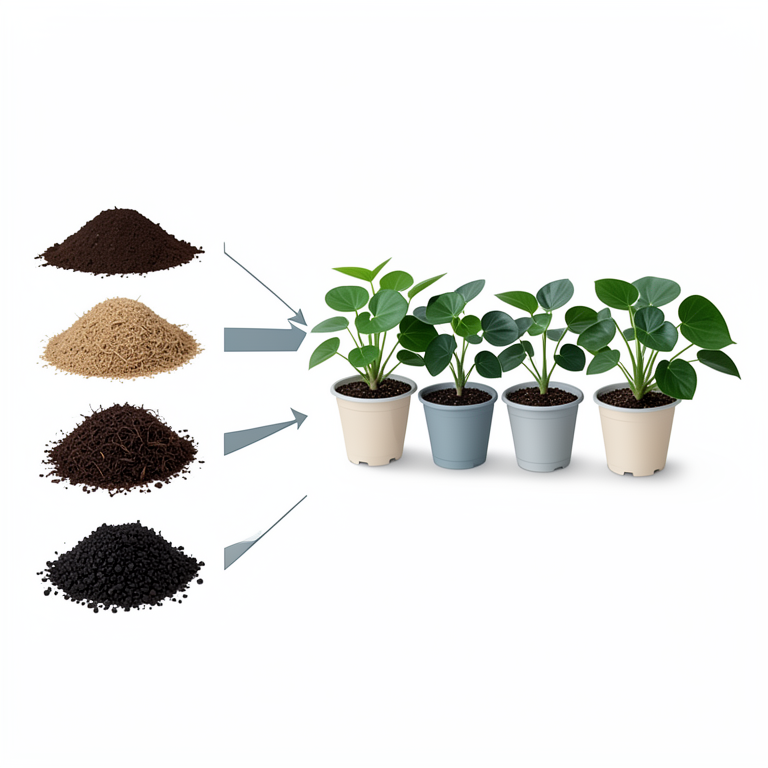
Potting Media Components
AI-generated conceptual illustration (Geranium aralia (Polyscias guilfoylei) plants in pots). It explains the idea and does not show study data.
View source evidence ↗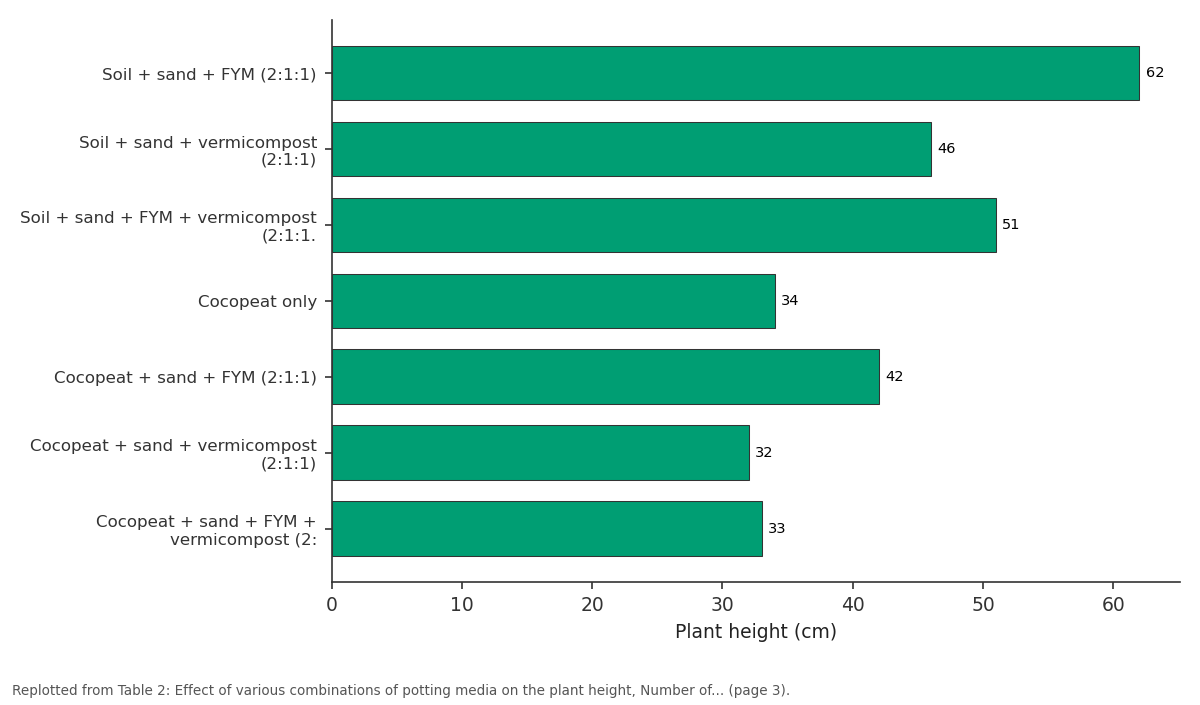
Plant height (cm): Soil + sand + FYM... vs Soil + sand +... vs Soil + sand + FYM +... vs Cocopeat only vs Cocopeat + sand + FYM...
Replotted from Table 2 (page 3) of the original paper. Every bar is the paper's own table value.
View source evidence ↗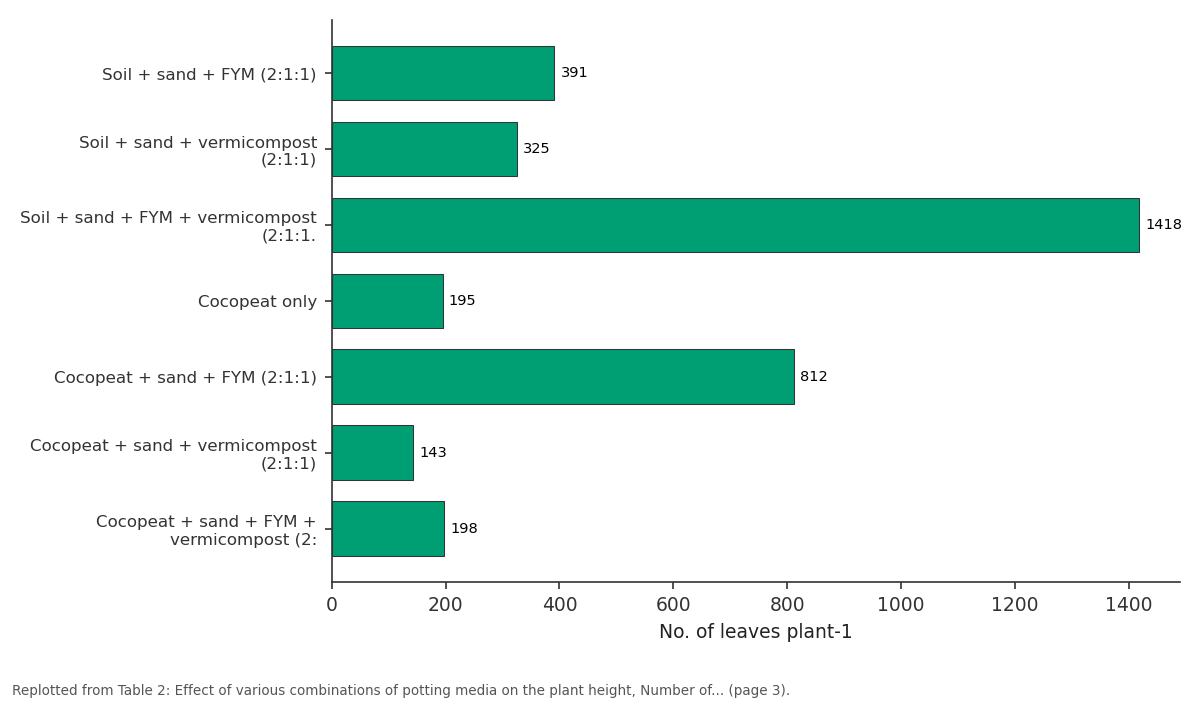
No. of leaves plant-1: Soil + sand + FYM... vs Soil + sand +... vs Soil + sand + FYM +... vs Cocopeat only vs Cocopeat + sand + FYM...
Replotted from Table 2 (page 3) of the original paper. Every bar is the paper's own table value.
View source evidence ↗Figures & tables
From the original paper Table 1
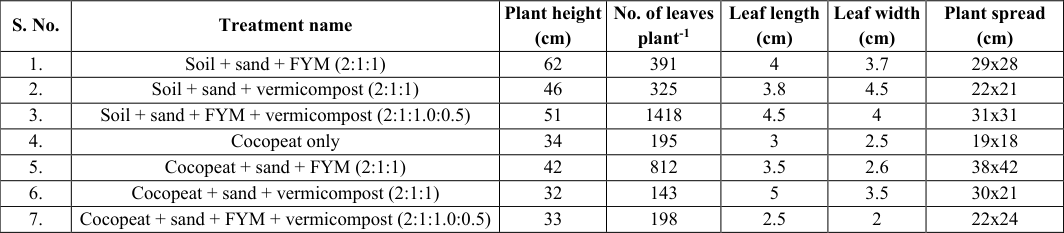 Table 2
Introduction
Ornamental foliage plants play a vital role in enhancing the aesthetic value of landscapes, gardens, offices, and indoor environments. Their diverse forms, attractive foliage, and adaptability to different growing conditions have contributed significantly to the expanding ornamental horticulture industry. Among the various foliage plants, Geranium Aralia (Polyscias guilfoylei), a member of the family Araliaceae, is highly valued for its attractive, deeply lobed, glossy green leaves and compact growth habit. The plant is extensively used as a hedge, border plant, specimen plant, and container-grown ornamental in both tropical and subtropical regions. Owing to its year-round foliage appeal and ease of maintenance, P. guilfoylei has gained considerable popularity among landscapers, nursery growers, and home gardeners. The successful cultivation of ornamental foliage plants largely depends on the quality of the growing medium. Potting media serve as the physical support system for plant roots and provide favourable conditions for water retention, aeration, nutrient availability, and root the medium with organic matter and essential nutrients while improving its physical properties. Vermicompost serves as a rich source of readily available nutrients, beneficial microorganisms, and plant growth-promoting substances that enhance plant growth and development. Sand improves drainage and aeration, thereby facilitating healthy root growth. The combined use of these components can create an optimal growing environment that promotes vigorous vegetative growth and improves the overall quality of ornamental plants. Although several studies have demonstrated the beneficial effects of different potting media on the growth and quality of ornamental crops, information regarding the response of Geranium Aralia (Polyscias guilfoylei) to various media compositions is limited. Identifying an appropriate potting medium is essential for producing healthy, vigorous, and marketable plants under nursery conditions. Therefore, the present investigation was undertaken to evaluate the growth response of Geranium Aralia to different potting media combinations and to determine the most suitable growing medium for its commercial cultivation and nursery production.
Materials and Methods
The present investigation entitled "Growth Response of Geranium Aralia (Polyscias guilfoylei) to Different Potting Media" was conducted under a shade-net house at the All India Coordinated Research Project on Floriculture (AICRP on Floriculture), Mohanpur, Bidhan Chandra Krishi Viswavidyalaya (BCKV). The experiment was laid out in a Completely Randomized Design (CRD) comprising seven treatments with three replications. Ten pots were maintained under each treatment. Healthy and uniform plants of Geranium Aralia were transplanted into pots containing the respective potting media combinations. Seven different potting media treatments were evaluated, viz., T₁: Soil + sand + FYM (2:1:1); T₂: Soil + sand + vermicompost (2:1:1); T₃: Soil + sand + FYM + vermicompost (2:1:1:0.5); T₄: Cocopeat alone; T₅: Cocopeat + sand + FYM (2:1:1); T₆: Cocopeat + sand + vermicompost (2:1:1); and T₇: Cocopeat + sand + FYM + vermicompost (2:1:1:0.5). The components of each growing medium were thoroughly mixed according to the specified proportions before filling the pots. All the experimental plants were maintained under uniform environmental and cultural conditions. Irrigation was provided uniformly to all treatments as and when required. Regular intercultural operations, including removal of weeds, dried and damaged leaves, and necessary plant protection measures, were carried out throughout the experimental period to ensure healthy plant growth. The response of Geranium Aralia to different potting media was evaluated based on various vegetative growth parameters. Observations were recorded at appropriate intervals after transplanting for plant height (cm), number of leaves per plant, leaf length (cm), leaf width (cm), and plant spread (cm). The recorded observations were used to assess the influence of different potting media on the vegetative growth and overall performance of Polyscias guilfoylei. The data obtained were subjected to statistical analysis appropriate for a Completely Randomized Design to determine the significance of differences among the treatments.
Results and Discussion
Results and Discussion
Plant height
The data presented in Table 2 revealed considerable variation in plant height of Geranium Aralia (Polyscias guilfoylei) under different potting media. The maximum plant height (62 cm) was recorded in T₁ (Soil + sand + FYM, 2:1:1), followed by T₃ (Soil + sand + FYM + vermicompost, 2:1:1:0.5) with a plant height of 51 cm. The lowest plant height (32 cm) was recorded in T₆ (Cocopeat + sand + vermicompost, 2:1:1), followed by T₇ (33 cm) and T₄ (34 cm).
The superior plant height observed in T₁ may be attributed to the combined effect of soil, sand and FYM, which might have provided a favourable root-zone environment with adequate aeration, drainage, moisture retention and nutrient availability. FYM is an important source of organic matter and nutrients, while soil provides mineral nutrients and physical support and sand improves drainage and aeration. The comparatively lower plant height in cocopeat-based treatments may be associated with differences in nutrient availability and the physical characteristics of the medium when compared with soil-based mixtures.
Number of leaves per plant
Marked differences were observed in the number of leaves produced by plants grown in different potting media. The highest number of leaves (1418 leaves plant⁻¹) was recorded in T₃ (Soil + sand + FYM + vermicompost, 2:1:1:0.5), followed by T₅ (Cocopeat + sand + FYM, 2:1:1) with 812 leaves plant⁻¹ and T₁ (Soil + sand + FYM, 2:1:1) with 391 leaves plant⁻¹. The minimum number of leaves (143 leaves plant⁻¹) was recorded in T₆ (Cocopeat + sand + vermicompost, 2:1:1). The higher leaf production in T₃ could be attributed to the complementary effects of FYM and vermicompost in the growing medium. The combination of these organic amendments may have improved the nutrient status of the medium and promoted root growth, nutrient uptake and vegetative development. Vermicompost provides readily available nutrients and organic matter, while FYM contributes to improved soil structure and sustained nutrient release. The combined presence of these components with soil and sand may therefore have created a more favorable environment for continuous leaf initiation and expansion.
Leaf length
Leaf length varied among the different potting media treatments. The maximum leaf length (5.0 cm) was recorded in T₆ (Cocopeat + sand + vermicompost, 2:1:1), followed by T₃ (4.5 cm). T₁ recorded a leaf length of 4.0 cm, while T₂ and T₅ recorded 3.8 and 3.5 cm, respectively. The minimum leaf length (2.5 cm) was observed in both T₄ (Cocopeat alone) and T₇ (Cocopeat + sand + FYM + vermicompost, 2:1:1:0.5).
The greater leaf length in T₆ may be due to the favorable physical properties of cocopeat and the nutrient-supplying capacity of vermicompost. Cocopeat provides good porosity, aeration and moisture retention, which can facilitate healthy root activity, whereas vermicompost may enhance nutrient availability and support leaf expansion. These favorable root-zone conditions could have contributed to improved leaf development.
Leaf width
The highest leaf width (4.5 cm) was recorded in T₂ (Soil + sand + vermicompost, 2:1:1), followed by T₁ (3.7 cm) and T₆ (3.5 cm). The lowest leaf width (2.0 cm) was recorded in T₇ (Cocopeat + sand + FYM + vermicompost, 2:1:1:0.5), followed by T₄ (2.5 cm) and T₅ (2.6 cm). The greater leaf width observed in T₂ may be associated with the combined influence of soil, sand and vermicompost, which might have provided an appropriate balance between nutrient availability, moisture retention and aeration. Adequate availability of nutrients, particularly nitrogen and other essential elements, is important for the development and expansion of foliage. The relatively narrow leaves under T₇ may indicate that the particular combination and proportion of substrate components was less favorable for leaf expansion under the prevailing experimental conditions.
Plant spread
Plant spread also showed considerable variation among the potting media treatments. The maximum plant spread in the two measured directions was recorded in T₅ (Cocopeat + sand + FYM, 2:1:1), with 38 × 42 cm, followed by T₃ (31 × 31 cm), T₆ (30 × 21 cm), and T₁ (29 × 28 cm). The minimum plant spread was observed in T₄ (Cocopeat alone), with 19 × 18 cm. The greater plant spread in T₅ may be attributed to the favorable combination of cocopeat, sand and FYM.
Cocopeat may have improved water-holding capacity and aeration, while sand enhanced drainage and FYM supplied organic matter and nutrients. The interaction of these components may have promoted vigorous shoot growth and lateral branching, resulting in greater canopy development.
In contrast, the restricted spread observed under cocopeat alone may be due to comparatively lower nutrient availability, as cocopeat primarily functions as a physical growing substrate and may require supplementation with nutrient sources for sustained plant growth. The variation in growth attributes may be explained by differences in the physical and chemical properties of the respective potting media, including bulk density, porosity, aeration, water-holding capacity, drainage and nutrient availability. Organic amendments such as FYM and vermicompost can improve the nutrient-supplying capacity and biological activity of the growing medium, while cocopeat and sand can modify the air-water relationship within the root zone. Thus, an appropriate combination of growing-media components is essential for achieving balanced vegetative growth and improved plant quality in Geranium Aralia.
Conclusion
The present investigation demonstrated that different potting media significantly influenced the vegetative growth and overall performance of Geranium Aralia (Polyscias guilfoylei). The superior performance of these treatments may be attributed to the beneficial effects of FYM, vermicompost, cocopeat, and sand in improving the physical and chemical properties of the growing medium, such as aeration, porosity, water-holding capacity, drainage, nutrient availability, and root-zone environment. These favorable conditions enhanced nutrient uptake and vegetative growth, resulting in improved plant quality.
Based on the overall growth performance, the treatment T₃ (Soil + Sand + FYM + Vermicompost, 2:1:1:0.5) can be considered the most suitable potting medium for producing healthy, vigorous, and marketable plants of Geranium Aralia under nursery conditions, as it provided a balanced combination of growth attributes and superior foliage development.
Figures and tables from the paper
| S. No. | Treatments | Composition/details |
|---|---|---|
| 1 | T1 | Soil + sand + FYM (2:1:1) |
| 2 | T2 | Soil + sand + vermicompost (2:1:1) |
| 3 | T3 | Soil + sand + FYM + vermicompost (2:1:1.0:0.5) |
| 4 | T4 | Cocopeat only |
| 5 | T5 | Cocopeat + sand + FYM (2:1:1) |
| 6 | T6 | Cocopeat + sand + vermicompost (2:1:1) |
| 7 | T7 | Cocopeat + sand + FYM + vermicompost (2:1:1.0:0.5) |
Table text extracted from the original PDF; superscript letters are shown inline. The original table image is below.
View original table image
References
15 in the original paper- Argo WR, Biernbaum JA. The effect of root medium physical properties on root growth and nutrient uptake. Acta Hortic. 1996;450:103-110.
- Ayuso M, Hernández T, Garcia C, Pascual JA. Stimulation of barley growth and nutrient absorption by humic substances originating from various organic materials. Bioresour Technol. 1996;57(3):251-257. International Journal of Advanced Chemistry Research https://www.chemistryjournals.net
- Gaikwad AM, Patil SS, Jadhav PB. Effect of different growing media on growth and flowering of tuberose (Polianthes tuberosa L.). Int J Chem Stud. 2020;8(4):1864-1868.
- Gruda N. Sustainable peat alternative growing media. J Appl Bot Food Qual. 2012;85:107-121.
- Hartmann HT, Kester DE, Davies FT, Geneve RL. Hartmann and Kester's plant propagation: principles and practices. 9th ed. New York: Pearson Education; 2018.
- Kavana GB, Patil VS, Hegde NK. Influence of growing media on growth and development of Nephrolepis undulata. J Pharmacogn Phytochem. 2019;8(4):21482151.
- Makinde EA, Ayoola OT, Ojeniyi SO. Effect of organic and inorganic fertilizers on growth and yield of maize in a tropical soil. World J Agric Sci. 2007;3(5):573-578.
- Muraleedharan A, Rema J, Nair SA. Effect of different potting media on growth and quality of Anthurium (Anthurium andreanum Lind.). Int J Curr Microbiol Appl Sci. 2020;9(6):2603-2609.
- Nazari F, Farahmand H, Khosh-Khui M. Effects of different growing media on growth and flowering of ornamental plants under greenhouse conditions. J Ornamental Hortic Plants. 2011;1(2):75-82.
- Nichols MA, Savidov NA. Soilless culture: principles and applications in protected horticulture. Acta Hortic. 2009;843:205-212.
- Panj S, Kumari S, Kumar R. Evaluation of different growing media for containerized ornamental plant production. Indian J Hortic. 2014;71(3):405-409.
- Raviv M, Lieth JH. Soilless culture: Theory and practice. Amsterdam: Elsevier; 2008.
- Succop CE, Newman SE. Organic fertilization of greenhouse container production crops. HortTechnology. 2004;14(1):50-54.
- Wazir MG, Amin NU, Ishtiaq M, Khan I. Effects of different soil media on the growth of Dracaena deremensis var. Janet Craige cuttings. Sarhad J Agric. 2003;19(1):31-34.
- Yadav LP, Bose US, Singh AK. Effect of different growing media on growth and quality of foliage plants under protected conditions. Int J Curr Microbiol Appl Sci. 2018;7(10):1500-1507.