
Research article · 2026 · Full text
International Journal of Agriculture and NutritionGrowth and survival of Pangasius hypophthalmus in biofloc technology: effects of carbon:nitrogen ratios
Volume 8(9) · Pages 25–28 · DOI: 10.33545/26646064.2026.v8.i9.746 ↗
Research areasAquaculture Nutrition and GrowthInnovations in Aquaponics and Hydroponics SystemsAquaculture disease management and microbiota
Abstract
Author-writtenWe conducted a 90-day experiment to evaluate the effects of different carbon:nitrogen (C:N) ratios on the growth and survival of Pangasius hypophthalmus juveniles in biofloc technology (BFT) systems. Four treatments were tested: control (conventional system, 5% feeding rate, 30% daily water exchange), T1 (C:N 15:1, 8% feeding rate, no water exchange), T2 (C:N 20:1, 8% feeding rate, no water exchange), and T3 (C:N 25:1, 8% feeding rate, no water exchange). Each treatment had three replicates. T3 (C:N 25:1) produced the highest final weight (110.56 ± 1.65 g), which was 46.1% higher than control (75.67 ± 1.45 g). Specific growth rate (SGR) was highest in T3 (2.54 ± 0.08 %/day) and lowest in control (2.04 ± 0.06 %/day). Survival reached 98.0 ± 1.2% in T3, while control had only 92.0 ± 2.1%. A clear dose-response relationship was observed: higher C:N ratios produced better growth and higher survival. We conclude that a C:N ratio of 25:1 in biofloc systems significantly improves growth performance and survival of Pangasius hypophthalmus under zero-water exchange conditions.
Summary
Source-checkedPlain-language reading of the full paper, prepared with AI and checked against the text. Each point links to the authors' own words.
Why it matters
- Biofloc technology (BFT) is used in aquaculture to maintain water quality and offer fish additional nutrition. View evidence ↗
- Bioflocs provide a protein-rich food source (30-50% crude protein) that supplements regular fish feeding. View evidence ↗
What they did
- Treatments included a conventional control (5% feed, 30% daily water exchange) and three BFT systems (8% feed, no water exchange) with C:N ratios of 15:1, 20:1, and 25:1. View evidence ↗
What they found
- Fish in the T3 group showed a 55.3% improvement in weight gain (98.15 g) over 90 days compared to the control (63.22 g). View evidence ↗
What it means
- The authors recommend a C:N ratio of 25:1 for maximum growth and survival, or 20:1 as a balanced alternative for less intensive management. View evidence ↗
Visual summary
1 visualsIllustrations explain the paper; they do not show study data.
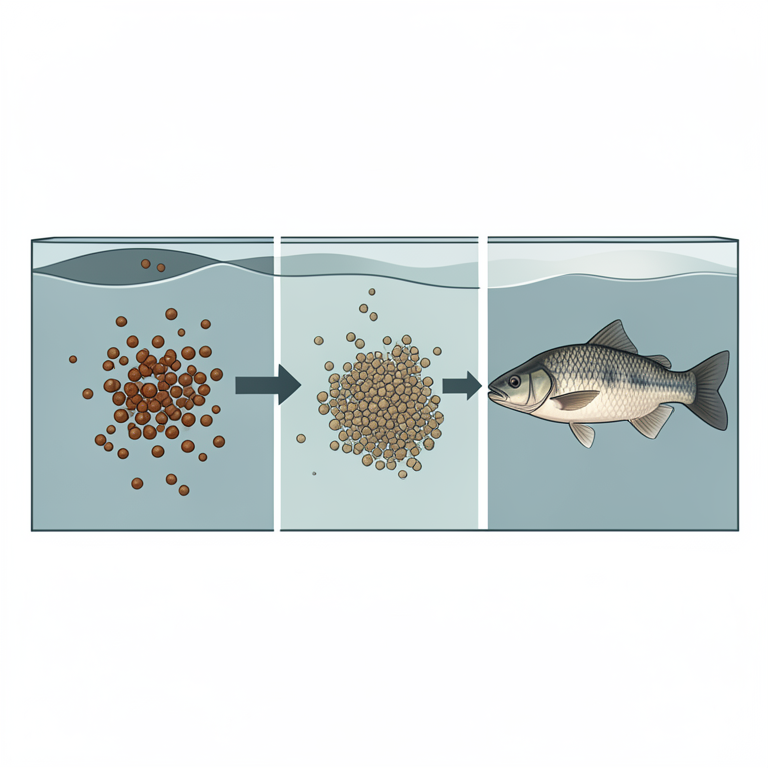
BFT Mechanism
AI-generated conceptual illustration (Pangasius hypophthalmus (striped catfish) in a biofloc aquaculture tank). It explains the idea and does not show study data.
View source evidence ↗Figures & tables
From the original paper Table 1
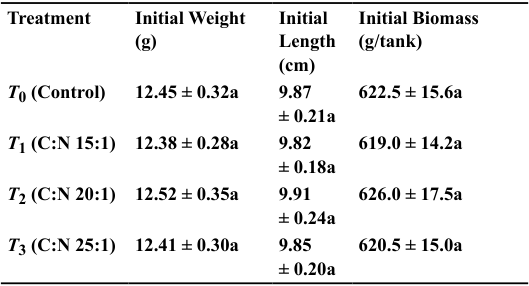 Table 2
 Table 3
 Table 4
Introduction
Biofloc technology (BFT) is a modern aquaculture system designed to manage water quality and provide supplemental nutrition to cultured fish. The concept was developed by Avnimelech and his team in the 1980s and 1990s (Avnimelech et al., 1986; Avnimelech, 1999) [1,2] . BFT works by manipulating the carbon-to-nitrogen (C:N) ratio in the culture water. When we add an organic carbon source to the water, heterotrophic bacteria begin to grow. These bacteria consume ammonia the toxic waste produced by fish and convert it into microbial biomass. This microbial biomass forms clumps called "bioflocs" (Crab et al., 2012) [3] . The bioflocs serve two important functions. First, they keep the water clean by removing ammonia. This means farmers do not need to exchange water frequently. Second, the fish eat these bioflocs. Bioflocs are rich in protein, typically containing 30-50% crude protein depending on the carbon source and management. So the fish get extra nutrition between their regular feedings (Emerenciano et al., 2022) [4] . The key to making BFT work is the C:N ratio. When the C:N ratio is low (below 10:1), autotrophic nitrifying bacteria dominate. These bacteria convert ammonia to nitrite and then to nitrate. This process consumes alkalinity and produces acid. When the C:N ratio is high (above 15:1), heterotrophic bacteria take over. These bacteria directly assimilate ammonia into their cells. This process does not produce nitrite as an intermediate, so it is faster and safer for the fish (Hargreaves, 2013) [5] . Most BFT systems target a C:N ratio between 15:1 and 20:1. But researchers have tested higher ratios. Sasry and colleagues (2020) [6] studied C:N ratios of 15:1, 20:1, and 25:1 for Pangasius hypophthalmus culture. They found that the 25:1 ratio produced the best weight gain and growth rate. Higher C:N ratios increase heterotrophic bacterial populations, which enhances ammonia removal and biofloc formation. The carbon source also matters. Different organic carbon materials have different degradation rates and nutritional values for bacteria (Emerenciano et al., 2022) [4] . Molasses, tapioca, rice bran, and cornstarch have all been tested. Studies on Pangasius biofloc ponds found that molasses produced the highest fish weight, though all carbon sources gave similar growth performance (Garuda Kemdikbud, n.d.). Research on common carp has also shown that biofloc systems with different carbon sources can maintain water quality parameters within normal ranges (Ratnakar et al., 2024) [7] . Probiotics are often added to BFT systems to help establish beneficial microbial communities. A study of probiotic doses (5, 10, and 15 mL/m³) in Pangasius culture found that the highest dose (15 mL/m³) produced the best results for growth and feed efficiency (Neliti, 2017) [8] . Fish growth in BFT is influenced by several factors. The biofloc provides high-quality microbial protein. Consumption of biofloc stimulates digestive enzyme activity. The gut microbiome composition improves, which helps nutrient assimilation. And the stable water quality reduces metabolic stress (Banu et [9,10,11] .
Survival is another critical parameter in BFT. Better water quality means less stress on the fish. Lower ammonia and nitrite levels reduce gill damage and osmoregulatory stress. Some studies have also found that biofloc contains immunostimulatory compounds.
Promthale and colleagues (2019) [12] reported that biofloc-fed shrimp showed better immune responses and disease resistance. Khanjani and colleagues (2023b) [13] found higher antioxidant enzyme activity in BFT-reared animals. Floc volume typically stabilizes about three weeks after system initiation. This stabilization signals the formation of mature microbial populations capable of efficient nitrogen transformation (Pérez et al., 2014) [14] . Proper management during this establishment phase is essential for success.
Given this background, we designed the present study with two specific objectives: (1) to evaluate the growth performance of Pangasius hypophthalmus juveniles in biofloc systems with different C:N ratios (15:1, 20:1, and 25:1), and (2) to assess survival rates under zero-water exchange conditions.
Materials and Methods
Materials and Methods
Experimental design
We used a completely randomized design with four treatments and three replicates each (12 tanks total). Tank volume was 500 L (working volume 400 L). Stocking density was 50 fish per tank (125 fish/m³). Initial fish weight ranged from 12.38 to 12.52 g, and we confirmed no significant differences among treatments at the start (p > 0.05).
Biofloc development
We used molasses as the carbon source based on Garuda Kemdikbud (n.d.). Commercial probiotic was added at 10 mL/m³ following Neliti (2017) [8] . Biofloc was allowed to mature for two weeks before fish were stocked. Carbon requirement was calculated using Avnimelech's (1999) [1] formula:
Carbon required (g) = ( Feed input × 0.30 × 0.16 × 0.75 ) × target C:N ratio
Where: 30% protein in feed, 16% nitrogen in protein, 75% nitrogen excretion rate.
Feeding and sampling
Fish were fed commercial pelleted feed (30% crude protein, 2-3 mm pellet size) three times daily (08:00, 12:00, 16:00). BFT treatments received 8% of biomass per day; control received 5% per day (Meritha et al., 2018) [15] . Feeding rates were adjusted weekly based on biomass sampling. Growth was measured biweekly (every 15 days). Survival was recorded daily.
Growth and survival calculations
We calculated the following parameters:
Statistical analysis
We analyzed data using one-way ANOVA followed by Tukey's HSD test. Significance was set at p < 0.05. Values are presented as mean ± standard deviation.
Results
Results
Initial stocking
All treatments started with similar fish size. No significant differences were found (p > 0.05). The superscript "a" confirms that all treatments were statistically identical at the start. Any differences at the end are due to the treat-ments themselves.
Growth performance
Final weight increased progressively with higher C:N ratios. T 3 produced the heaviest fish, and control produced the lightest. Final Weight: T 3 fish reached 110.56 g, which is 46.1% more than control fish (75.67 g). The different superscript letters (a, b, c, d) indicate that every treatment was significantly different from every other treatment (p < 0.05). This is a clear dose-response relationship: higher C:N ratio = heavier fish.
Survival rate
Survival improved with higher C:N ratios. T 3 had the highest survival, and control had the lowest. Survival increased stepwise with higher C:N ratios. T 3 saved 3 more fish than T 2 , 6 more than T 1 , and 9 more than control. T 3 (98.0%) was significantly better than control (92.0%). T 2 (96.0%) was also significantly better than control. T 1 (94.0%) was not significantly different from either control or T 2 (shared superscripts "ab"), meaning a C:N ratio of at least 20:1 is needed to achieve statistically significant improvement in survival.
In practical terms, for every 1000 fish stocked, T 3 would save 60 more fish than control. Over multiple production cycles, this is a substantial economic benefit.
Discussion
Our results clearly show that BFT improves both growth and survival of Pangasius hypophthalmus. The effect is dose-dependent: higher C:N ratios produce better outcomes. T 3 (C:N 25:1) gave the best growth and highest survival. Two mechanisms explain this. First, water quality in BFT systems remained excellent. Heterotrophic bacteria assimilated ammonia efficiently. Second, fish consumed biofloc as supplemental food. The floc in T 3 contained 38.6% crude protein, providing extra nutrition between feedings (Crab et al., 2012) [3] . Our finding that SGR increased by 24.5% in T 3 matches Meritha et al. (2018) [15] and Sasry et al. (2020) [6] , who also reported better growth in biofloc-reared Pangasius. The role of stable environmental conditions in supporting aquatic life has been emphasized in studies of river ecosystems, where macrozoobenthic diversity is directly linked to water quality (Dar et al., 2022) [16] . Better water quality means less stress. Ammonia and nitrite were lower in BFT treatments, especially T 3 . Lower stress leads to stronger immune systems. Promthale et al. (2019) [12] found that biofloc contains immunostimulatory compounds. Khanjani et al. (2023b) [13] reported higher antioxidant enzyme activity in BFT-reared animals. Our survival data (98% in T 3 vs. 92% in control) support these findings. A C:N ratio of 15:1 is likely too low to promote sufficient heterotrophic bacterial growth. At this ratio, autotrophic nitrifying bacteria may still dominate. These bacteria do not produce edible floc. As a result, T 1 fish received the same 8% feeding rate as T 2 and T 3 but did not get supplemental nutrition from biofloc. This explains why T 1 's growth was better than control but worse than T 2 and T 3 . Sasry et al. (2020) [6] similarly found that C:N 15:1 gave intermediate results. That depends on their goals. If maximum growth and survival are the priority, and the farmer is willing to monitor alkalinity and add buffers, C:N 25:1 is the best choice. If the farmer wants good results with less intensive management, C:N 20:1 is a balanced alternative. C:N 15:1 is not recommended because it does not provide enough benefit to justify the extra feeding.
Conclusion
This study demonstrates that biofloc technology significantly improves the growth and survival of Pangasius hypophthalmus under zero-water exchange conditions. The effects are dose-dependent: higher C:N ratios produce better results.
Figures and tables from the paper
References
15 in the original paper- Avnimelech Y, Weber B, Hepher B, Milstein A, Zorn MJ. Studies in circulated fish ponds: Organic matter recycling and nitrogen transformation. Aquaculture Research. 1986;17(4):231-242.
- Crab R, Defoirdt T, Bossier P, Verstraete W. Biofloc technology in aquaculture: Beneficial effects and future challenges. Aquaculture. 2012;356-357:351-356.
- Emerenciano MGC, Artur NR, Felipe DN, Vieira MA, Martins GJC, Truong HH, Tansyn HN, Cedric JS. Review intensification of penaeid shrimp culture: An applied review of advances in production systems, nutrition and breeding. Animals. 2022;12(3):236.
- Hargreaves JA. Biofloc production systems for aquaculture. Southern Regional Aquaculture Center Publication. 2013;450:112.
- Sasry MA, Supono, Wardiyanto. Analysis of different C:N ratios in the biofloc system on the growth of Pangasius hypophthalmus (Sauvage, 1878). E Jurnal Rekayasa dan Teknologi Budidaya Perairan. 2020;9(1):1075-1084.
- Ratnakar M, Mishra R, Tamot P, Vyas V. Effects of different carbon sources on water quality and growth performance of common carp fry in biofloc technology. Journal of Advanced Zoology. 2024;44(S1):194-199.
- Banu H. Comparative microbial community occurrence pattern, growth attributes, and digestive enzyme indices of Pangasianodon hypophthalmus under freshwater biofloc based polyculture system. BMC Microbiology. 2024;24(1):432.
- Zhang N, Luo G, Tan H, Liu W, Hou Z. Growth, digestive enzyme activity and welfare of tilapia reared in a biofloc-based system with poly-β-hydroxybutyric as a carbon source. Aquaculture. 2016;464:710-717.
- Xu WJ, Pan LQ. Enhancement of immune response and antioxidant status of Litopenaeus vannamei juvenile in biofloc-based culture tanks manipulating high C/N ratio of feed input. Aquaculture. 2013;412-413:117-124.
- Promthale P, Pongtippatee P, Withyachumnamkul B, Wongprasert K. Bioflocs substituted fishmeal feed stimulates immune response and protects shrimp from Vibrio parahaemolyticus infection. Fish and Shellfish Immunology. 2019;93:1067-1075.
- Khanjani MH, Sharifinia M, Emerenciano MGC. A detailed look at the impacts of biofloc on immunological and hematological parameters and improving resistance to diseases. Fish and Shellfish Immunology. 2023;137:108796.
- Pérez RCI, Pérez FJA, Hernández VMP. Biofloc, a technical alternative for culturing Malaysian prawn Macrobrachium rosenbergii. InTech. 2014;57501:87-104.
- Meritha WW, Suprayudi MA, Ekasari J. The growth performance and resistance to salinity stress of striped catfish Pangasius sp. juvenile in biofloc system with different feeding rates. Jurnal Akuakultur Indonesia. 2018;17(2):113-119.
- Dar RA, Dave K, Vyas V, Bhavsar A. Assessment of macrozoobenthic diversity in Parbati River, Madhya Pradesh, India. International Journal of Fauna and Biological Studies. 2022;9(3):35-40.
- Zoology. 2024;44(S1):194-199. How to cite this article: Narzary S, Mishra R, Saxena S, Tiwari S. Growth and survival of Pangasius hypophthalmus in biofloc technology: effects of carbon:nitrogen ratios. International Journal of Agriculture and Nutrition. 2026;8(9):25-28. doi: http s://www.doi.org/10.33545/26646064.2026.v8.i9.746 International Journal of Agriculture and Nutrition https://www.agriculturejournal.net 26646072, 2026, 8(9), Downloaded from https://www.doi.org/10.33545/26646064.2026.v8.i9.746 by International Journal of Agriculture and Nutrition on [23/09/2026]. See the Terms and Conditions (https://www.agriculturejournal.net) for rules of use; OA articles are governed by the applicable Creative Commons License