
Research article · 2026 · Full text
International Journal of Advanced Chemistry ResearchStudies on Physico-chemical properties of flavoured cow milk blended with annatto (Bixa orellana) seed extract as a colouring agent
Volume 8(9) · Pages 36–39 · DOI: 10.33545/26646781.2026.v8.i9a.746 ↗
Research areasFood and Agricultural SciencesDye analysis and toxicityAgricultural and Biological Research
Abstract
Author-writtenThe present study evaluated the physico-chemical properties of flavoured cow milk prepared with different levels of annatto (Bixa orellana) seed extract. The study was conducted during 2025-26 at the Department of Animal Husbandry and Dairy Science, Dr. Panjabrao Deshmukh Krishi Vidyapeeth, Akola. Five treatments were used: T₁ (0%), T₂ (3%), T₃ (5%), T₄ (7%) and T₅ (9%) annatto seed extract, with 8 per cent sugar constant. The experiment was conducted in Completely Randomized Design with four replications. Fat, protein, total solids, moisture, total sugar and ash were analysed. Fat, protein, total solids and total sugar decreased gradually with increasing extract level, while moisture and ash increased. Treatment T₄ (7%) showed a desirable physico-chemical composition and was considered the most suitable level under the conditions of the study.
Summary
Source-checkedPlain-language reading of the full paper, prepared with AI and checked against the text. Each point links to the authors' own words.
Why it matters
- Flavoured milk is a common value-added dairy product that combines the nutritional value of milk with improved taste and variety through the addition of sugar and flavouring agents. View evidence ↗
- Annatto, derived from Bixa orellana seeds, serves as a significant natural colouring agent for various food products. View evidence ↗
- Adding plant-based extracts to milk can alter its chemical composition, specifically affecting levels of fat, protein, total solids, moisture, sugar, and ash. View evidence ↗
The question
- The study aimed to evaluate how different concentrations of annatto seed extract affect the physico-chemical properties of flavoured cow milk. View evidence ↗
What they did
- The experiment utilized five treatments with varying levels of annatto seed extract: 0% (control), 3%, 5%, 7%, and 9%, while maintaining a constant sugar level of 8%. View evidence ↗
- A Completely Randomized Design (CRD) was employed for the experiment, with four replications for each treatment. View evidence ↗
- Physico-chemical analysis included the Gerber method for fat, the gravimetric method for total solids, the Micro-Kjeldahl method for protein, and A.O.A.C. standards for ash content. View evidence ↗
What they found
- Fat content decreased as the annatto seed extract level increased, dropping from 3.68% in the control (T₁) to 3.32% in the 9% extract treatment (T₅). View evidence ↗
What it means
- The authors concluded that the 7% annatto seed extract level (T₄) was the most suitable because it provided a desirable physico-chemical composition and the best overall sensory acceptance. View evidence ↗
- The study recommends the use of annatto seed extract as an effective method for creating naturally coloured, value-added flavoured cow milk. View evidence ↗
Visual summary
1 visualsIllustrations explain the paper; they do not show study data.
Effect of Annatto Extract on Milk Composition
AI-generated conceptual illustration (cow milk and annatto seeds). It explains the idea and does not show study data.
View source evidence ↗Figures & tables
From the original paper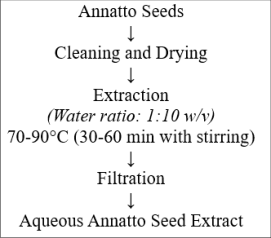 Figure 1
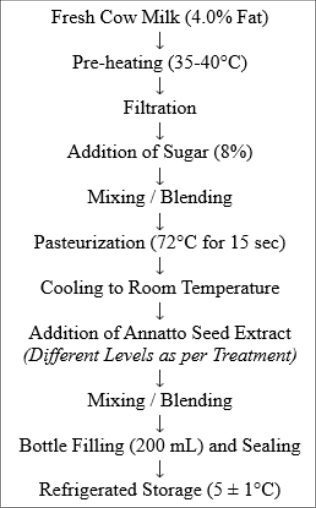 Figure 2
 Table 1
Introduction
Milk is a nutritious food and is widely consumed. Flavoured milk is a popular value-added dairy product prepared by adding sugar and suitable flavouring ingredients to milk. It provides the nutritional benefits of milk along with better taste and variety. Aneja et al. (2002) [1] reported the importance of flavoured milk as a value-added dairy product. There is increasing interest in the use of natural ingredients in food products. Annatto obtained from the seeds of Bixa orellana is an important natural colouring material used in food products. Levy and Rivadeneira (2000) [2] reported the use of annatto as a natural food colour in different food applications. Hirko and Getu (2022) [3] also described annatto as a useful source of natural colouring material. The addition of plant-based extracts may affect the chemical composition of milk products. The level of extract added can influence the amounts of fat, protein, total solids, moisture, total sugar and ash in the final product. De Souza et al. (2019) [4] reported the use of waterbased extraction for obtaining colouring material from Bixa orellana seeds. Several studies have reported changes in the physico-chemical properties of flavoured milk after adding natural ingredients. Repate et al. (2010) [5] studied flavoured milk prepared from cow milk and safflower milk, while Dhande et al. (2016) [6] studied lemongrass flavoured milk. Therefore, the present study was undertaken to evaluate the effect of different levels of annatto seed extract on the physico-chemical properties of flavoured cow milk.
Materials and Methods
The investigation was conducted during 2025-26 at the Department of Animal Husbandry and Dairy Science, Dr. Panjabrao Deshmukh Krishi Vidyapeeth, Akola, Maharashtra. Fresh and clean cow milk was collected from the Livestock Instructional Farm of the department. Annatto seeds were procured from the local market at Akola. Cane sugar was used at 8 per cent in all treatments and cardamom was kept constant. The experiment consisted of five treatments and four replications in Completely Randomized Design (CRD). Preliminary trials were conducted to select suitable levels of annatto seed extract for preparation of flavoured cow milk.
Preparation of Annatto Seed Extract
Annatto seeds were cleaned and dried before extraction. The cleaned seeds were mixed with distilled water at a ratio of 1:10 (w/v). The mixture was heated at 70-90 °C for 30-60 minutes with stirring. After extraction, the mixture was cooled and filtered to remove the seed residues. The filtered aqueous annatto seed extract was collected and used as a natural colouring agent in the preparation of flavoured cow milk.
Flow Chart for Preparation of Annatto Seed Extract
Flow Chart for Preparation of Annatto Seed Extract
Treatment Details
Five treatments were used in the experiment.
Treatment
Treatment details T₁ Sweet milk (Control) T₂ T₁ + annatto seed extract @ 3% T₃ T₁ + annatto seed extract @ 5% T₄ T₁ + annatto seed extract @ 7% T₅ T₁ + annatto seed extract @ 9%
Sugar was added at 8 per cent in all treatments was kept constant.
Preparation of Flavoured Cow Milk
Fresh cow milk containing approximately 4.0 per cent fat was pre-heated to 35-40 °C and filtered. Sugar was added at 8 per cent and mixed thoroughly until completely dissolved.
The milk was then blended properly and pasteurized at 72 °C for 15 seconds. After pasteurization, the milk was cooled to room temperature. Annatto seed extract was then added according to the respective treatment level and mixed thoroughly for uniform distribution. The prepared flavoured milk was filled into 200 ml bottles, sealed and stored under refrigerated conditions for further analysis.
Flow Chart for Preparation of Flavoured Cow Milk
Flow Chart for Preparation of Flavoured Cow Milk
Chemical Analysis
The prepared flavoured cow milk samples were analysed for fat, protein, total solids, moisture, total sugar and ash. Fat content was determined by the Gerber method as described in IS:1224 (Part I), 1977 [7] . Total solids were determined by the gravimetric method according to IS:1479 (Part II), 1961 [8] . Protein was estimated by determining nitrogen using the Micro-Kjeldahl method. Ash content was determined according to the standard method described by A.O.A.C. (1995) [9] . Total sugar was determined according to the standard procedure used for milk products. Moisture content was determined from the total solids values.
Statistical Analysis
The experiment was conducted in Completely Randomized Design (CRD) with five treatments and four replications.
The data obtained for different physico-chemical parameters were subjected to analysis of variance (ANOVA). Statistical analysis was carried out according to the procedure described by Panse and Sukhatme (1978) [10] . Treatment means were compared at the 5 per cent level of significance.
Results and Discussion
Results and Discussion
Physico-Chemical Properties of Flavoured Cow Milk
The mean values of fat, protein, total solids, moisture, total sugar and ash of flavoured cow milk prepared with different levels of annatto seed extract are presented in Table 1. The results indicated that incorporation of annatto seed extract influenced the physico-chemical composition of flavoured cow milk. Fat, protein, total solids and total sugar showed a decreasing trend, whereas moisture and ash showed an increasing trend with increasing level of annatto seed extract.
| Treatment | Fat (%) | Protein (%) | Total solids (%) | Moisture (%) | Total sugar (%) | Ash (%) |
|---|---|---|---|---|---|---|
| T₁ (Control) | 3.68 | 3.24 | 20.02 | 79.98 | 12.48 | 0.61 |
| T₂ (3% A.S.E.) | 3.56 | 3.14 | 19.92 | 80.08 | 12.39 | 0.67 |
| T₃ (5% A.S.E.) | 3.48 | 3.08 | 19.85 | 80.15 | 12.33 | 0.73 |
| T₄ (7% A.S.E.) | 3.40 | 3.02 | 19.79 | 80.21 | 12.26 | 0.78 |
| T₅ (9% A.S.E.) | 3.32 | 2.96 | 19.71 | 80.29 | 12.21 | 0.82 |
Table text extracted from the original PDF; superscript letters are shown inline. The original table image is below.
View original table image
Fat
The fat content decreased gradually with increasing level of annatto seed extract. The highest fat content was recorded in T₁ (3.68%), followed by T₂ (3.56%), T₃ (3.48%), T₄ (3.40%) and T₅ (3.32%). Thus, the lowest fat content was recorded in T₅ containing 9 per cent annatto seed extract. The decrease in fat content may be mainly due to the dilution effect caused by the addition of aqueous annatto seed extract and the corresponding reduction in the proportion of milk in the final product. Similar changes in the chemical composition of flavoured milk with the incorporation of plant-based ingredients have been reported by Dhande et al. (2016) [6] .
Protein
Protein content also showed a gradual decreasing trend with increasing level of annatto seed extract. Protein content decreased from 3.24 per cent in T₁ to 3.14, 3.08, 3.02 and 2.96 per cent in T₂, T₃, T₄ and T₅ respectively. The decrease may be associated with the replacement of a portion of milk with aqueous annatto seed extract, which resulted in a lower proportion of milk protein in the final product. The change was gradual as the level of extract increased.
Total Solids
Total solids showed a gradual decreasing trend with increasing levels of annatto seed extract. The highest total solids content was recorded in T₁ (20.02%), followed by T₂ (19.92%), T₃ (19.85%), T₄ (19.79%) and T₅ (19.71%). The reduction in total solids may be due to the higher moisture content of the aqueous annatto seed extract. As the quantity of extract increased, a greater amount of water was incorporated into the product, resulting in a slight reduction in total solids.
Moisture
Moisture content increased gradually with increasing levels of annatto seed extract. The moisture content increased from 79.98 per cent in T₁ to 80.08, 80.15, 80.21 and 80.29 per cent in T₂, T₃, T₄ and T₅ respectively. The increase in moisture may be attributed to the aqueous nature of the annatto seed extract. Higher levels of extract resulted in the incorporation of more water into the flavoured milk. The highest moisture content was observed in T₅ containing 9 per cent extract.
Total Sugar
Total sugar content showed a slight decreasing trend with increasing level of annatto seed extract. The total sugar content was highest in T₁ (12.48%) and decreased to 12.39, 12.33, 12.26 and 12.21 per cent in T₂, T₃, T₄ and T₅ respectively. Although sugar was added at a constant level of 8 per cent in all treatments, the slight variation in total sugar may be associated with the replacement of a portion of milk by aqueous annatto seed extract. The decrease was small across the treatments.
Ash
Ash content showed an increasing trend with increasing level of annatto seed extract. The ash content increased from 0.61 per cent in T₁ to 0.67, 0.73, 0.78 and 0.82 per cent in T₂, T₃, T₄ and T₅ respectively. The increase in ash content may be associated with the mineral constituents contributed by the annatto seed extract. The gradual increase observed with increasing extract level indicates that the incorporation of annatto seed extract influenced the mineral fraction of the flavoured milk.
Overall Physico-Chemical Performance
The incorporation of annatto seed extract resulted in gradual changes in the physico-chemical composition of flavoured cow milk. Fat, protein, total solids and total sugar decreased gradually, whereas moisture and ash increased with increasing levels of extract. Among the treatments, T₄ containing 7 per cent annatto seed extract showed a desirable physico-chemical composition. It also corresponded with the treatment that showed the best overall sensory acceptance in the present investigation. Therefore, T₄ was considered the most suitable treatment under the conditions of the study.
Conclusion
The present study showed that annatto seed extract can be used as a natural colouring agent in the preparation of flavoured cow milk. Increasing the level of annatto seed extract resulted in a gradual decrease in fat, protein, total solids and total sugar, while moisture and ash increased. Among the treatments, T₄ containing 7 per cent annatto seed extract was considered the most suitable level based on its desirable physico-chemical composition and overall product performance. The use of annatto seed extract therefore provides a suitable approach for developing a naturally coloured value-added flavoured cow milk.
Figures and tables from the paper
References
10 in the original paper- Aneja RP, Mathur BN, Chandan RC, Banerjee AK. Technology of Indian milk products. New Delhi: Dairy India Publications; 2002.
- Levy LW, Rivadeneira DM. Annatto. In: Natural food colorants: science and technology. New York: Marcel Dekker; 2000. p.115-152.
- Hirko B, Getu A. Bixa orellana (Annatto Bixa): a review on use, structure, extraction methods and analysis. Journal of Agronomy, Technology and Engineering Management. 2022;5(1):687-696.
- De Souza AC, et al. Extraction of natural dyes from Bixa orellana L. seeds using water and their application in textile dyeing. Journal of Natural Fibers. 2019;16(7):1004-1015.
- Repate KC, Kamble VJ, Hassan BA, Thombre BM. Studies on preparation of flavoured milk from cow milk blended with safflower milk. Dairying, Foods & Home Sciences. 2010;29(2):92-96.
- Dhande SV, Chavan SD, Kumar H. Evaluation of physico-chemical properties of lemongrass flavoured milk. International Journal of Chemical Studies. 2016.
- Bureau of Indian Standards. IS 1224 Part I: Determination of fat by Gerber method. New Delhi: Bureau of Indian Standards; 1977.
- Bureau of Indian Standards. IS 1479 Part II: Methods of test for dairy industry: chemical analysis of milk. New Delhi: Bureau of Indian Standards; 1961.
- Association of Official Analytical Chemists. Official methods of analysis. 12th ed. Washington, DC: Association of Official Analytical Chemists; 1995.
- Panse VG, Sukhatme PV. Statistical methods for agricultural workers. 3rd ed. New Delhi: Indian Council of Agricultural Research; 1978.