
Research article · 2026 · Full text
International Journal of Biology SciencesGreen pea, Production constraints, Marketing constraints, Garrett’s Ranking Technique, Labour cost, Market access
Volume 8(9) · Pages 41–44 · DOI: 10.33545/26649926.2026.v8.i9a.989 ↗
Research areasAgricultural Economics and PracticesAgricultural Development and ManagementAgricultural economics and policies
Abstract
Author-writtenGreen pea (Pisum sativum L.) is an important cool-season vegetable crop with considerable nutritional and economic significance. The present study was undertaken to examine the major production and marketing constraints faced by green pea growers in Ahilyanagar district of Maharashtra. The study was conducted in Parner and Sangamner tehsils, where six villages were selected purposively. Primary data were collected through personal interviews using a pre-tested questionnaire from 90 farmers comprising 30 each from small, medium and large farm-size groups. Garrett’s Ranking Technique was employed to identify and prioritize the major production and marketing constraints. The results revealed that high cost of labour was the most serious production constraint, with a mean Garrett score of 65.19 per cent, followed by non-availability of labour during peak periods (59.17%), high cost of fertilizers and insecticides (57.83%), and uneven rainfall (55.39%). Pest and disease incidence, lack of electricity and lack of irrigation ranked fifth, sixth and seventh, respectively. In marketing, poor market access emerged as the major constraint with a Garrett score of 59.71, followed by perishability and lack of storage facilities (54.90), heavy price fluctuation (48.64), high transportation cost (48.07) and delay in payment (37.68). The study highlights that labour availability and cost were the major production-related concerns, while inadequate market access and post-harvest limitations were the principal marketing problems. Strengthening village-level market and cold-storage facilities, improving transportation and market information systems, ensuring timely availability of labour and agricultural inputs, and extending suitable crop insurance coverage can help reduce production and marketing risks. These measures would contribute to better price realization, reduced post-harvest losses and improved profitability of green pea cultivation in the study area.
Summary
Source-checkedPlain-language reading of the full paper, prepared with AI and checked against the text. Each point links to the authors' own words.
Why it matters
- Green pea is a significant cool-season vegetable crop valued for both its nutritional content and economic importance. View evidence ↗
- Ahilyanagar district is a critical hub for green pea production in Maharashtra, contributing 73.90% of the state's area and 67.11% of its production in 2022–23. View evidence ↗
- Despite its importance, farmers in Ahilyanagar face production and marketing constraints that can negatively impact their profitability and productivity. View evidence ↗
The question
- The study aimed to identify and prioritize the primary production and marketing challenges experienced by green pea growers in the Ahilyanagar district. View evidence ↗
What they did
- The research was conducted in the Parner and Sangamner tehsils, which were chosen because they have the largest green pea cultivation areas in the district. View evidence ↗
- Data were gathered via personal interviews with 90 farmers, equally divided into small, medium, and large farm-size groups (30 farmers each). View evidence ↗
- The researchers used Garrett’s Ranking Technique to prioritize the severity of the identified production and marketing constraints. View evidence ↗
What they found
- The most severe production constraint was the high cost of labour, which ranked first with a mean Garrett score of 65.19%. View evidence ↗
- The second most significant production issue was the lack of available labour during peak periods, with a mean Garrett score of 59.17%. View evidence ↗
- High costs for insecticides and fertilizers were ranked as the third most serious production constraint (57.83% mean Garrett score). View evidence ↗
- Irregular rainfall was the fourth most severe production constraint, scoring 55.39%. View evidence ↗
- Poor market access was identified as the primary marketing constraint, ranking first with a mean Garrett score of 59.71. View evidence ↗
- The second most critical marketing challenge was the perishability of the crop combined with a lack of storage facilities (54.90% mean Garrett score). View evidence ↗
- Significant fluctuations in market prices were ranked as the third most serious marketing constraint, with a score of 48.64%. View evidence ↗
What it means
- The authors recommend improving village-level cold storage, transportation, and market information, while ensuring timely access to labour, inputs, and crop insurance to mitigate risks. View evidence ↗
- The authors conclude that enhancing market infrastructure and linkages between farmers and markets is essential to reduce marketing difficulties and increase returns. View evidence ↗
Visual summary
3 visualsIllustrations explain the paper; charts are replotted from the paper's own table values.
Primary Constraints Overview
AI-generated conceptual illustration (Green pea plants and a rural marketplace). It explains the idea and does not show study data.
View source evidence ↗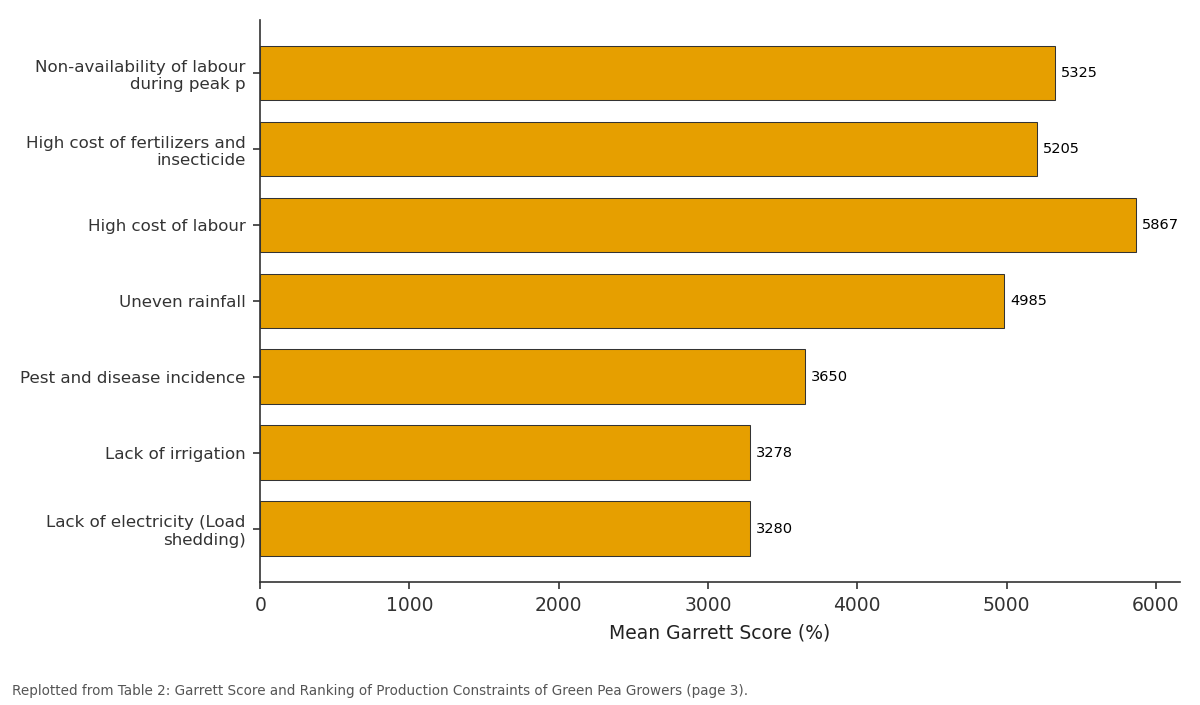
Total Garrett Score: Non-availability of... vs High cost of... vs High cost of labour vs Uneven rainfall vs Pest and disease...
Replotted from Table 2 (page 3) of the original paper. Every bar is the paper's own table value.
View source evidence ↗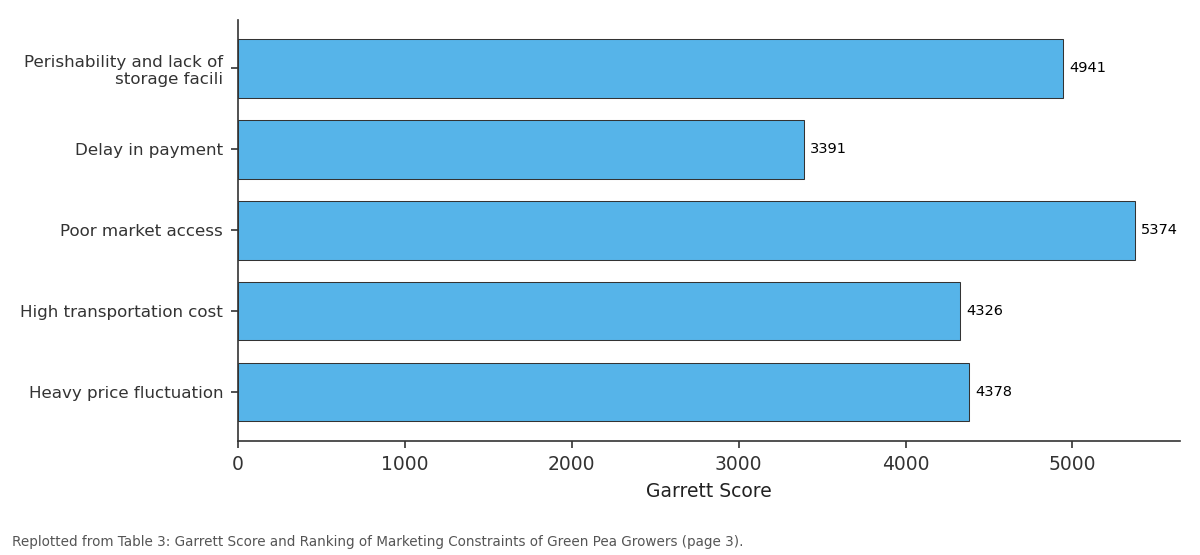
Total Garrett Score: Perishability and lack... vs Delay in payment vs Poor market access vs High transportation cost vs Heavy price fluctuation
Replotted from Table 3 (page 3) of the original paper. Every bar is the paper's own table value.
View source evidence ↗Figures & tables
From the original paper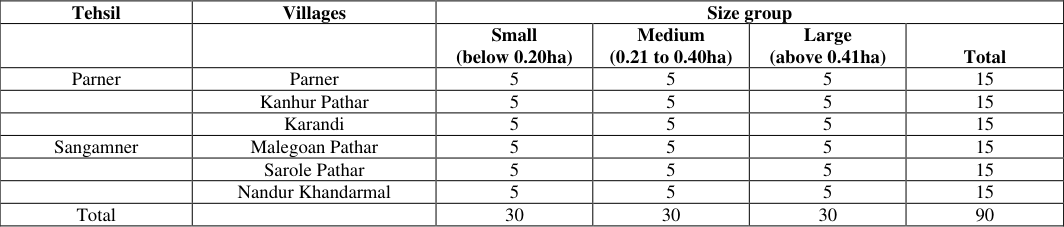 Table 1
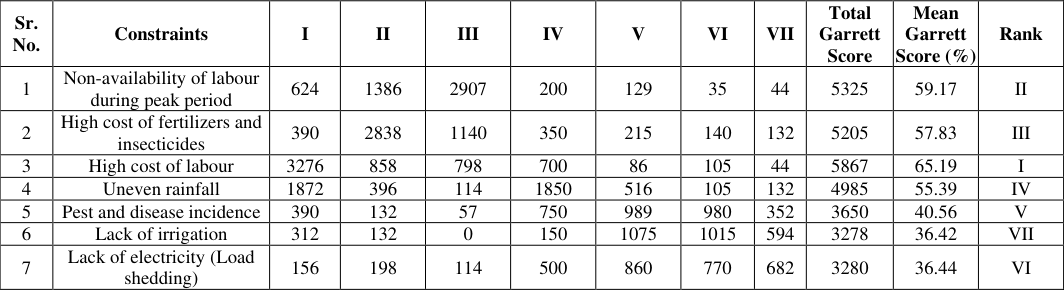 Table 2
 Table 3
Introduction
Green pea (Pisum sativum L.) is an important cool-season leguminous vegetable crop belonging to the family Fabaceae. It has a short crop duration and is valued for its tender green seeds and pods. Being a legume, it also has the ability to fix atmospheric nitrogen through symbiotic association with soil bacteria. Green pea roots establish a symbiotic relationship with beneficial soil bacteria, particularly Rhizobium leguminosarum, resulting in the formation of root nodules. These nodules facilitate biological nitrogen fixation by converting atmospheric nitrogen into a form usable by plants, thereby promoting plant growth and improving soil fertility. For effective nodulation, pea seeds are generally treated with Rhizobium inoculants before sowing or the inoculant is applied to the soil. Root nodules generally develop within two weeks after plant establishment, while poor nodulation may result in pale green or yellow leaves and stunted plant growth (Sharma et al., 2025) [7] . Green pea is an important vegetable crop with considerable nutritional and economic significance. Its increasing demand for fresh consumption and food processing, along with its short crop duration, good yield potential and favourable market prices, makes it an attractive and remunerative crop for farmers. In addition to providing nutritional benefits, pea cultivation contributes to farm income, livelihood security and sustainable agricultural production. Thus, green pea has significant potential as an income-generating vegetable crop under suitable production conditions (Dahl et al., 2012) [2] . Green peas possess several important healthpromoting properties due to their nutritional composition and bioactive compounds. They have a relatively low glycemic index and are rich in dietary fibre, proteins, vitamins, minerals and antioxidants.
The fibre content supports digestion and gut health, while vitamins and minerals such as iron, calcium, zinc and folic acid contribute to overall health and well-being. Peas are also naturally gluten-free and contain bioactive proteins, peptides and polyphenolic compounds that exhibit antioxidant, anti-inflammatory and other beneficial properties. These characteristics support the potential of green pea as a nutritious and functional food (Kumari and Deka, 2021) [4] . The production scenario of green pea indicates its growing importance in India and Maharashtra. During 2023-24, Uttar Pradesh ranked first in green pea area and production, while Maharashtra recorded 8.86 thousand hectares of area, 54.10 thousand MT of production and 6.11 MT/ha productivity against the national average of 10.91 MT/ha. In Maharashtra, area and production fluctuated during 2019-20 to 2023-24, while productivity declined initially and improved to 6.11 MT/ha in 2023-24.
At the district level, Ahilyanagar was the major green peaproducing district during 2022-23, accounting for 73.90 per cent of the state area and 67.11 per cent of production, followed by Pune. This highlights the importance of Ahilyanagar in green pea production and provides a strong basis for studying its production economics (Department of Agriculture and Farmer Welfare, 2023). Despite the economic importance of green pea cultivation in Ahilyanagar district, farmers face several production and marketing constraints that may affect productivity, profitability and price realization. Therefore, the present study was undertaken to identify and prioritize the major production and marketing constraints faced by green pea growers in Ahilyanagar district of Maharashtra.
Methodolgy Data Collection
Primary data were collected from the selected green pea growers through personal interviews using a pre-tested questionnaire. The data specifically covered the major constraints faced by farmers in the production and marketing of green pea. The respondents were asked to provide information on the severity of various constraints experienced during cultivation and marketing.
Selection of District
Ahilyanagar district was selected purposively due to its major contribution to green pea cultivation in Maharashtra, accounting for 73.90 per cent of the state area and 67.11 per cent of production, with a productivity of 4.53 MT/ha. (Department of Agriculture and Farmer Welfare, 2023).
Selection of Tehsil
Parner and Sangamner tehsils were selected purposively as they had the largest area under green pea cultivation in Ahilyanagar district.
Selection of Villages
Based on green pea cultivation area obtained from the Tehsil Agriculture Offices, three villages from each selected tehsil were chosen purposively. From Sangamner, Malegaon Pathar, Sarole Pathar and Nandur Khandarmal, and from Parner, Parner, Kanhur Pathar and Karandi were selected.
Selection of Sample Farmers
The farmers were classified into three farm-size groups, namely small (below 0.20 ha), medium (0.21-0.40 ha) and large (above 0.41 ha). Five farmers from each farm-size group were selected randomly from each village. Thus, 15 farmers were selected from each village, comprising 30 farmers from each farm-size group and 90 farmers in total.
Constraints in the Production and Marketing of Green Pea
The Garrett ranking technique is used to assess the constraints faced by farmers in Green Pea production and marketing. As per this method, respondents have been asked to assign the rank for all factors and the result such as ranking have been converted into score value with the help of following formula, (by Garrett in 1969) [3] .
Per cent position = 100(𝑅𝑖𝑗-0.5)
𝑁𝑗
Where, Rij = Rank given for i th factor by j th individual Nj = Number of factors ranked by j th individual
Results and Discussion
The identification of constraints faced by green pea cultivators formed an important component of the present study. To analyse the major production and marketing problems experienced by the sample farmers, Garrett's Ranking Technique was employed. The respondents were asked to rank the identified production and marketing constraints according to their perceived severity. The assigned ranks were converted into Garrett scores using the standard Garrett conversion table, and the mean Garrett score for each constraint was calculated. The constraints were then arranged in descending order of their mean scores, with the highest score indicating the most serious constraint.
Constraints in Production of Green Pea
The results of the production constraints are presented in Table 2. Seven major production constraints were identified and ranked according to their severity. The results indicated that high cost of labour was the most serious production constraint, securing first rank with a mean Garrett score of 65.19 per cent. This was followed by non-availability of labour during the peak period, which ranked second with a mean Garrett score of 59.17 per cent. The high cost of fertilizers and insecticides ranked third with a mean Garrett score of 57.83 per cent, indicating that rising input prices added considerably to the cost of cultivation. Uneven rainfall occupied the fourth rank with a mean Garrett score of 55.39 per cent, suggesting that irregular rainfall adversely affected crop growth, particularly where irrigation facilities were inadequate. Pest and disease incidence ranked fifth with a mean Garrett score of 40.56 per cent, reflecting the additional expenditure required for plant protection measures. Lack of electricity (load shedding) ranked sixth with a mean Garrett score of 36.44 per cent, while lack of irrigation ranked seventh with 36.42 per cent. Overall, the findings showed that labour-related constraints were the most prominent problems, particularly the high cost and non-availability of labour during peak periods. These were followed by high input costs and uneven rainfall. Ensuring timely labour availability, improving irrigation infrastructure, providing reliable electricity and facilitating access to agricultural inputs could help reduce the major production constraints faced by green pea growers in the study area.
| Sr. No. | Constraints | I | II | III | IV | V | VI | VII | Total Garrett Score | Mean Garrett Score (%) | Rank |
|---|---|---|---|---|---|---|---|---|---|---|---|
| 1 | Non-availability of labour during peak period | 624 | 1386 | 2907 | 200 | 129 | 35 | 44 | 5325 | 59.17 | II |
| 2 | High cost of fertilizers and insecticides | 390 | 2838 | 1140 | 350 | 215 | 140 | 132 | 5205 | 57.83 | III |
| 3 | High cost of labour | 3276 | 858 | 798 | 700 | 86 | 105 | 44 | 5867 | 65.19 | I |
| 4 | Uneven rainfall | 1872 | 396 | 114 | 1850 | 516 | 105 | 132 | 4985 | 55.39 | IV |
| 5 | Pest and disease incidence | 390 | 132 | 57 | 750 | 989 | 980 | 352 | 3650 | 40.56 | V |
| 6 | Lack of irrigation | 312 | 132 | 0 | 150 | 1075 | 1015 | 594 | 3278 | 36.42 | VII |
| 7 | Lack of electricity (Load shedding) | 156 | 198 | 114 | 500 | 860 | 770 | 682 | 3280 | 36.44 | VI |
Table text extracted from the original PDF; superscript letters are shown inline. The original table image is below.
View original table image
Constraints in Marketing of Green Pea
The major marketing constraints faced by green pea growers are presented in Table 3. The results revealed that poor market access was the most serious marketing constraint, securing first rank with a mean Garrett score of 59.71. Limited access to suitable markets made it difficult for farmers to dispose of their highly perishable produce in a timely manner and obtain remunerative prices. Perishability and lack of storage facilities ranked second with a mean Garrett score of 54.90, indicating that the short shelf life of green pea and inadequate storage facilities compelled farmers to sell their produce quickly. Heavy price fluctuation ranked third with a mean Garrett score of 48.64, reflecting uncertainty in returns due to variations in market prices during the harvesting period. High transportation cost ranked fourth with a mean Garrett score of 48.07, indicating that higher transportation expenses increased the cost of marketing and reduced farmers' net returns. Delay in payment ranked fifth with a mean Garrett score of 37.68, making it comparatively less severe than the other constraints. Overall, the findings indicated that poor market access, perishability and lack of storage facilities, and heavy price fluctuation were the major marketing constraints faced by green pea growers. Improving market access, strengthening storage facilities, providing timely market information and reducing transportation costs could help improve the efficiency of green pea marketing and enhance farmers' returns.
| Sr. No. | Constraints | I | II | III | IV | V | Total Garrett Score | Garrett Score | Rank |
|---|---|---|---|---|---|---|---|---|---|
| 1 | Perishability and lack of storage facilities | 525 | 3360 | 600 | 240 | 216 | 4941 | 54.90 | II |
| 2 | Delay in payment | 825 | 660 | 250 | 360 | 1296 | 3391 | 37.68 | V |
| 3 | Poor market access | 3300 | 900 | 550 | 360 | 264 | 5374 | 59.71 | I |
| 4 | High transportation cost | 1350 | 360 | 600 | 1800 | 216 | 4326 | 48.07 | IV |
| 5 | Heavy price fluctuation | 750 | 120 | 2500 | 840 | 168 | 4378 | 48.64 | III |
Table text extracted from the original PDF; superscript letters are shown inline. The original table image is below.
View original table image
The findings of the present study are in close conformity with those reported by Pandey (2018) [5] , Rajpoot et al.
(2023) [6] and Thakur et al. (2023) [8] . These studies also identified labour-related problems, inadequate storage facilities, transportation difficulties, poor market access and price fluctuations as the major constraints affecting pea cultivation and marketing, which are broadly consistent with the findings of the present study.
Conclusion
The study indicated that green pea growers encountered various challenges during production, with high labour cost emerging as the most critical constraint. This was followed by the shortage of labour during peak periods, increasing prices of fertilizers and insecticides, and irregular rainfall. The findings emphasize the importance of ensuring timely labour availability, improving input accessibility and adopting efficient water management practices. Better irrigation facilities and a dependable power supply would also contribute to the smooth and timely completion of important farm operations. In marketing, inadequate market access was identified as the leading constraint, followed by perishability and insufficient storage facilities, price fluctuations, high transportation expenses and delayed payments. The highly perishable nature of green pea makes timely marketing and proper post-harvest management particularly important. Strengthening market infrastructure, improving storage and transportation facilities, ensuring timely market information and developing better linkages between farmers and markets can help minimize marketing difficulties and improve the returns from green pea cultivation.
Policy Suggestions 1. Cold Storage and Rural Market Facilities:
Cold storage facilities should be established at the village or cluster level, along with better local market facilities, to enable farmers to store green pea for a short period and sell their produce at favourable prices. 2. Crop Insurance and Market Accessibility: Effective crop insurance coverage should be extended to green pea growers to protect them against production risks such as uneven rainfall and pest and disease incidence. Easy access to nearby markets and improved transportation facilities should also be promoted in rural areas.
Figures and tables from the paper
| Tehsil | Villages | Size group | — | — | — |
|---|---|---|---|---|---|
| Small (below 0.20ha) | Medium (0.21 to 0.40ha) | Large (above 0.41ha) | Total | ||
| Parner | Parner | 5 | 5 | 5 | 15 |
| Kanhur Pathar | 5 | 5 | 5 | 15 | |
| Karandi | 5 | 5 | 5 | 15 | |
| Sangamner | Malegoan Pathar | 5 | 5 | 5 | 15 |
| Sarole Pathar | 5 | 5 | 5 | 15 | |
| Nandur Khandarmal | 5 | 5 | 5 | 15 | |
| Total | 30 | 30 | 30 | 90 |
Table text extracted from the original PDF; superscript letters are shown inline. The original table image is below.
View original table image
References
8 in the original paper- Department of Agriculture and Farmer Welfare. District-wise production of green pea in Maharashtra. New Delhi: Department of Agriculture and Farmer Welfare; 2023. Available from: https://agriwelfare.gov.in/
- Dahl WJ, Foster LM, Tyler RT. Review of the health benefits of peas (Pisum sativum L.). Br J Nutr. 2012;108(S3).
- Garrett HE, Woodworth RS. Statistics in psychology and education. 1969.
- Kumari T, Deka SC. Potential health benefits of garden pea seeds and pods: a review. Legume Sci. 2021;3(1). doi:10.1002/leg3.82.
- Faizabad, Uttar Pradesh: Narendra Deva University of Agriculture and Technology; 2018.
- Meerut, Uttar Pradesh: Sardar Vallabhbhai Patel University of Agriculture and Technology; 2023.
- Sharma A, Rani M, Thakur H, Lata H, Kour M, Thakur A, et al. Garden pea (Pisum sativum L.). In: Kalia P, editor. Vegetable crops: handbooks of crop diversity: conservation and use of plant genetic resources. Singapore: Springer; 2025. doi:10.1007/978-981-978949-8_28.
- Thakur P, Mehta P, Devi C, Sharma P, Singh KK, Yadav S, et al. Marketing performance and factors influencing farmers' choice for agricultural output marketing channels: the case of garden pea (Pisum sativum) in India. Front Sustain Food Syst. 2023;7:1270121. doi:10.3389/fsufs.2023.1270121.