
Research article · 2026 · Full text
International Journal of Advanced Chemistry ResearchEffect of supplementation of fodder cactus (Opuntia ficus indica) on dry matter intake and water intake of growing calves
Volume 8(9) · Pages 33–35 · DOI: 10.33545/26646781.2026.v8.i9a.745 ↗
Research areasRuminant Nutrition and Digestive PhysiologyAnimal Nutrition and PhysiologyAnimal health and immunology
Abstract
Author-writtenThe present study was conducted to determine the effect of fodder cactus (Opuntia ficus indica) supplementation on dry matter intake and water intake of growing calves. Twenty growing calves were selected and randomly distributed into four treatment groups, comprising five calves in each group. The feeding trial was conducted for 90 days. The basal ration consisted of dry roughage, green fodder comprising Hybrid Napier and Berseem in equal proportion, and concentrate mixture. Fodder cactus was supplemented at 0, 200, 300 and 400 g/calf/day in T₁, T₂, T₃ and T₄, respectively. Dry matter intake increased with fodder cactus supplementation and was highest in T₃ (2.125 kg/day/calf), followed by T₄ (2.100 kg), T₂ (1.871 kg) and T₁ (1.700 kg). Dry matter intake expressed per 100 kg body weight was also higher in the supplemented groups, with the highest value recorded in T₃ (3.15 kg/100 kg BW). Water intake was highest in T₃ (8.14 L/day/calf), followed by T₄ (7.98 L), T₂ (7.55 L) and T₁ (7.25 L). The corresponding water intake per 100 kg body weight was 11.22, 11.46, 12.06 and 11.81 L in T₁, T₂, T₃ and T₄, respectively. The findings indicated that supplementation of fodder cactus influenced dry matter and water intake of growing calves. Among the tested levels, 300 g fodder cactus/calf/day resulted in the highest dry matter and water intake.
Summary
Source-checkedPlain-language reading of the full paper, prepared with AI and checked against the text. Each point links to the authors' own words.
Why it matters
- Livestock production in India is hindered by a lack of quality feed and fodder, especially in dry and semi-arid regions where water is limited and green fodder is seasonally scarce. View evidence ↗
- Fodder cactus (Opuntia ficus indica) is a viable alternative forage because it thrives in water-limited environments and provides moisture, minerals, and carbohydrates. View evidence ↗
- Due to its relatively low protein content, fodder cactus is best used as a supplement rather than a primary feed source. View evidence ↗
The question
- The study aimed to determine how supplementing the diet of growing calves with fodder cactus affects their dry matter and water intake. View evidence ↗
What they did
- The research was conducted at the Livestock Instructional Farm in Akola, Maharashtra, within the Vidarbha region. View evidence ↗
- Twenty growing calves were used, randomly divided into four groups of five calves each. View evidence ↗
- The feeding trial lasted 90 days, running from December 5, 2025, to March 5, 2026. View evidence ↗
- Four treatment levels of fodder cactus supplementation were tested: 0 g (T1), 200 g (T2), 300 g (T3), and 400 g (T4) per calf per day. View evidence ↗
What they found
- When expressed per 100 kg of body weight, DMI was highest in the T3 group (3.15 kg) and lowest in the T1 group (2.63 kg). View evidence ↗
- Daily water intake was highest in the T3 group (8.14 L/day/calf) and lowest in the T1 group (7.25 L/day/calf). View evidence ↗
- Water intake per 100 kg of body weight was highest in the T3 group (12.06 L) and lowest in the T1 group (11.22 L). View evidence ↗
- Chemical analysis revealed that fodder cactus has significantly higher moisture and lower dry matter compared to conventional dry feed ingredients. View evidence ↗
What it means
- The authors concluded that supplementing growing calves with 300 g of fodder cactus per day results in the highest dry matter and water intake. View evidence ↗
Visual summary
3 visualsIllustrations explain the paper; charts are replotted from the paper's own table values.
Supplementation Effect Trend
AI-generated conceptual illustration (growing calves and fodder cactus (Opuntia ficus indica)). It explains the idea and does not show study data.
View source evidence ↗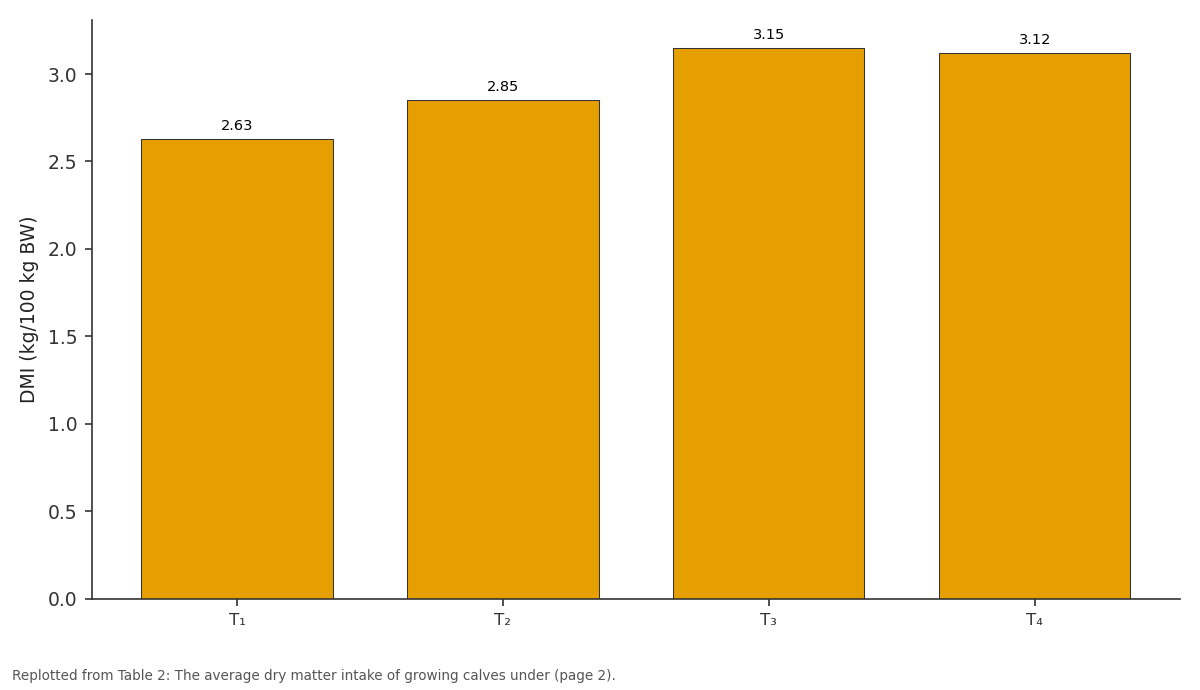
DMI (kg/100 kg BW): T₁ vs T₂ vs T₃ vs T₄
Replotted from Table 2 (page 2) of the original paper. Every bar is the paper's own table value.
View source evidence ↗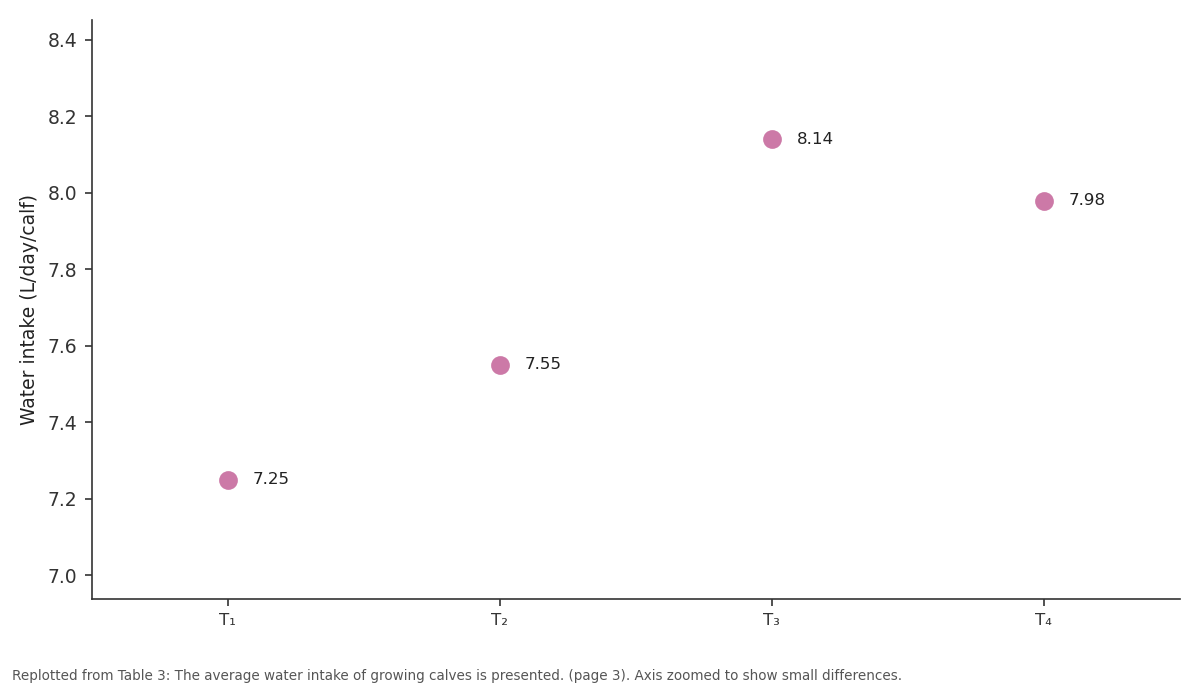
Water intake (L/day/calf): T₁ vs T₂ vs T₃ vs T₄
Replotted from Table 3 (page 3) of the original paper. Every bar is the paper's own table value.
View source evidence ↗Figures & tables
From the original paper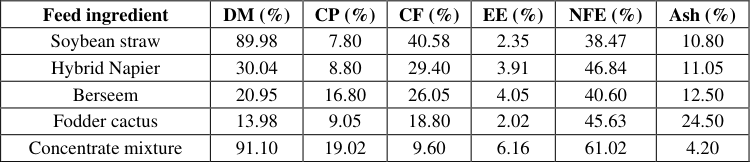 Table 1
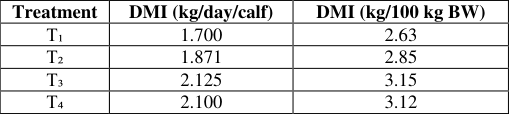 Table 2
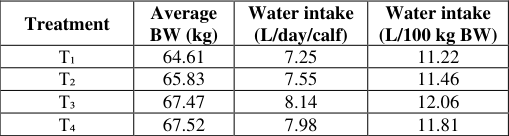 Table 3
Introduction
Livestock production plays an important role in the agricultural economy of India by providing milk, employment, income and nutritional security to rural households. However, inadequate availability of quality feed and fodder remains one of the major constraints to livestock production. The problem becomes more serious in dry and semi-arid regions, where seasonal shortages of green fodder and limited water availability restrict the use of conventional fodder crops. Therefore, identifying alternative fodder resources that can withstand adverse climatic conditions is important for maintaining adequate feed availability. Fodder cactus (Opuntia ficus indica) is considered a promising alternative forage because of its ability to grow under dry and water-limited conditions. It contains a high proportion of moisture and provides readily available carbohydrates and minerals. Its high water-use efficiency and ability to produce biomass under drought conditions make it particularly useful in regions where conventional green fodder production is difficult. However, its comparatively low protein concentration makes its use as a supplementary feed along with other feed resources more appropriate (Thakuria et al., 2020; Pastorelli et al., 2022) [12,7] . The nutritional composition of fodder cactus can vary according to cultivar, growing conditions and stage of harvest. Jadhav et al. (2022) [6] reported variation in the nutritional quality of different fodder cactus germplasm. Recent studies have also indicated that inclusion of alternative forage resources can influence feed utilization and voluntary water consumption in livestock. Therefore, the present study was undertaken with the objective of determining the effect of fodder cactus supplementation on dry matter intake and water intake of growing calves.
Materials and Methods
Materials and Methods
Experimental site
The experiment was conducted at the Livestock Instructional Farm, Akola, Maharashtra, under the agroclimatic conditions of the Vidarbha region.
Experimental animals and design
Twenty growing calves were selected for the study. The animals were randomly distributed into four treatment groups consisting of five calves in each group. The experiment was conducted using a Randomized Block Design (RBD). The feeding trial was carried out for 90 days from 05 December 2025 to 05 March 2026, excluding the adaptation period.
Experimental treatments
The dietary treatments were as follows:
Treatment
Treatment Details T₁ Dry roughages (ad lib) + 2 Kg green roughages (50% hybrid napier + 50% Berseem/lucerne) concentrate T₂ Basal ration + 200 g fodder T₃ Basal ration + 300 g fodder T₄ Basal ration + 400 g fodder
The basal ration consisted of dry roughage offered ad libitum, 2 kg green fodder comprising Hybrid Napier and Berseem in equal proportion, and concentrate mixture.
Feeding management
Feed was offered twice daily at 9:00 a.m. and 5:00 p.m. Fodder cactus was supplied to the respective treatment groups according to the specified supplementation level.
Water was offered twice daily at 9:30 a.m. and 3:30 p.m. using measured buckets. The quantity of water offered and the quantity remaining were recorded to determine daily water intake.
General management
The growing calves were groomed every morning and washed on alternate days. The animals were allowed access to the paddock for a short period. Deworming was carried out 15 days before the commencement of the experiment. The health condition of the calves was monitored throughout the experimental period and the animal shed was cleaned regularly.
Chemical analysis of feed ingredients
Representative samples of the feed ingredients were collected and analysed for proximate constituents. Dry matter (DM), crude protein (CP), crude fibre (CF), ether extract (EE), nitrogen-free extract (NFE) and total ash were determined according to AOAC (1990) [2] . Crude protein was estimated using the Kjeldahl method, with nitrogen multiplied by 6.25, following BIS IS 7874 Part 1:1975.
Determination of dry matter intake
Daily dry matter intake was calculated from the quantity of individual feed ingredients consumed and their respective dry matter contents. The total dry matter intake was expressed as kg/day/calf and kg per 100 kg body weight.
Determination of water intake
Water intake was determined daily by recording the quantity of water offered and the quantity remaining after the specified feeding period. The difference between water offered and water refused was considered the actual water intake. Water intake was expressed as litres/day/calf and litres per 100 kg body weight.
Statistical analysis
The observations obtained for dry matter intake and water intake were subjected to statistical analysis using the appropriate procedure for Randomized Block Design. Treatment means were compared for significance at the 5 percent level. The chemical composition showed that fodder cactus contained considerably higher moisture and lower dry matter than the conventional dry feed ingredients. Its high moisture content is an important characteristic of cactus forage and may contribute to its usefulness as a succulent fodder source. The observed composition was within the general range reported for Opuntia forage by Thakuria et al.
Results and Discussion
Results and Discussion
Proximate composition of feed ingredients
(2020) [12] , Pastorelli et al. (2022) [7] and Jadhav et al. (2022) [6] . Dry matter intake increased with supplementation of fodder cactus. The highest dry matter intake was recorded in T₃ (2.125 kg/day/calf), followed by T₄ (2.100 kg), T₂ (1.871 kg) and T₁ (1.700 kg). Similarly, dry matter intake per 100 kg body weight was highest in T₃ (3.15 kg), followed by T₄ (3.12 kg), T₂ (2.85 kg) and T₁ (2.63 kg). The increased dry matter intake in the supplemented groups may be associated with improved acceptability of the ration and the contribution of cactus to the overall nutrient supply. The succulent nature and readily fermentable carbohydrates present in cactus may also support voluntary consumption of the complete ration. Telgote Madhu (2022) [11] reported variation in dry matter intake among calves receiving different dietary treatments. Rajput et al. (2025) [8] also observed differences in dry matter intake of growing calves fed different forage resources.
Dry matter intake
The present results indicate that supplementation of fodder cactus at 300 g/calf/day resulted in the highest dry matter intake among the tested levels. Although DMI in T₄ was also higher than the control, it was slightly lower than T₃. Water intake differed among the treatment groups. The highest water intake was recorded in T₃ (8.14 L/day/calf), followed by T₄ (7.98 L), T₂ (7.55 L) and T₁ (7.25 L). Water intake per 100 kg body weight followed a similar trend, with the highest value in T₃ (12.06 L), followed by T₄ (11.81 L), T₂ (11.46 L) and T₁ (11.22 L).
Water intake
The variation in water intake may be related to differences in dry matter consumption and nutrient intake among the treatment groups. Water requirement of growing calves is influenced by feed composition, dry matter intake, environmental temperature and physiological requirements. The higher water intake observed in T₃ may therefore be associated with its greater dry matter intake. Shelar (2004) [9] reported variation in water intake among calves receiving different dietary treatments, although the differences were not statistically significant in that study. Sonone et al. (2018) [10] also reported differences in water intake among crossbred calves fed soybean straw-based diets. The present findings indicate that supplementation of fodder cactus influenced voluntary water intake, with the highest intake observed at 300 g/calf/day.
Conclusion
Based on the findings of the present study, supplementation of fodder cactus (Opuntia ficus indica) influenced dry matter intake and water intake of growing calves. Dry matter intake increased from 1.700 kg/day/calf in the control group to 2.125 kg/day/calf at 300 g cactus supplementation.
Similarly, water intake increased from 7.25 to 8.14 L/day/calf. Among the supplementation levels evaluated, 300 g fodder cactus/calf/day (T₃) recorded the highest dry matter intake and water intake. Therefore, fodder cactus can be considered a useful supplementary fodder resource for improving feed and water intake of growing calves, particularly under conditions of seasonal fodder scarcity.
Figures and tables from the paper
| Feed ingredient | DM (%) | CP (%) | CF (%) | EE (%) | NFE (%) | Ash (%) |
|---|---|---|---|---|---|---|
| Soybean straw | 89.98 | 7.80 | 40.58 | 2.35 | 38.47 | 10.80 |
| Hybrid Napier | 30.04 | 8.80 | 29.40 | 3.91 | 46.84 | 11.05 |
| Berseem | 20.95 | 16.80 | 26.05 | 4.05 | 40.60 | 12.50 |
| Fodder cactus | 13.98 | 9.05 | 18.80 | 2.02 | 45.63 | 24.50 |
| Concentrate mixture | 91.10 | 19.02 | 9.60 | 6.16 | 61.02 | 4.20 |
Table text extracted from the original PDF; superscript letters are shown inline. The original table image is below.
View original table image
| Treatment | DMI (kg/day/calf) | DMI (kg/100 kg BW) |
|---|---|---|
| T₁ | 1.700 | 2.63 |
| T₂ | 1.871 | 2.85 |
| T₃ | 2.125 | 3.15 |
| T₄ | 2.100 | 3.12 |
Table text extracted from the original PDF; superscript letters are shown inline. The original table image is below.
View original table image
| Treatment | Average BW (kg) | Water intake (L/day/calf) | Water intake (L/100 kg BW) |
|---|---|---|---|
| T₁ | 64.61 | 7.25 | 11.22 |
| T₂ | 65.83 | 7.55 | 11.46 |
| T₃ | 67.47 | 8.14 | 12.06 |
| T₄ | 67.52 | 7.98 | 11.81 |
Table text extracted from the original PDF; superscript letters are shown inline. The original table image is below.
View original table image
References
12 in the original paper- Ahmed S, et al. Effect of complete feed block on growth performance of crossbred calves under farm condition. The Pharma Innovation Journal. 2023;12(5):3695-3702.
- Association of Official Analytical Chemists (AOAC). Official Methods of Analysis of the Association of Official Analytical Chemists. 15th ed. Arlington, Virginia, USA: Association of Official Analytical Chemists; 1990.
- Bureau of Indian Standards (BIS). Methods of Tests for Animal Feeds and Feeding Stuffs: Part 1-General Methods (IS 7874 Part 1:1975). New Delhi: Bureau of Indian Standards; 1975.
- Department of Animal Husbandry and Dairying. Basic Animal Husbandry Statistics 2025. New Delhi: Ministry of Fisheries, Animal Husbandry and Dairying, Government of India; 2025.
- Government of India. Annual Report 2023-24. New Delhi: Department of Animal Husbandry and Dairying, Ministry of Fisheries, Animal Husbandry and Dairying, Government of India; 2024.
- Jadhav RB, Damame SV, Landge SA, Vanjare DC. Nutritional quality of fodder cactus (Opuntia ficusindica (L.) Mill.) germplasm. Forage Research. 2022;48(3):362-366.
- Pastorelli G, Serra V, Vannuccini C, Attard E. Opuntia spp. as alternative fodder for sustainable livestock production. Animals. 2022;12(13):1597. doi:10.3390/ani12131597.
- Rajput AG, Shelke RR, Chavan SD, Shegokar SR, Nage SP. Effect of subabul (Leucaena leucocephala) tree leaves feeding on dry matter intake and body weight gain in growing crossbred calves. International Journal of Veterinary Sciences and Animal Husbandry. 2025;10(8):230-233.
- Akola, Maharashtra, India: Dr. Panjabrao Deshmukh Krishi Vidyapeeth; 2004.
- Sonone NR, Tanpure MU, Dahatonde KN, Chavan SD. Effect of feeding soybean (Glycine max) straw on feed and water intake of crossbred calves. Journal of Pharmacognosy and Phytochemistry. 2018;7(6):938940.
- Telgote M, Chavan SD, Shelke RR, Nage SP, Bidwe KU. Effect of hydroponically and conventionally grown maize fodder feeding on dry matter intake and growth performance of calves. The Pharma Innovation Journal. 2022;11(6S):2801-2804.
- Thakuria A, Datt C, Shambhvi, Dudi K, Gajender, Thamizhan P, Yadav RK. Edible spineless cactus (Opuntia ficus-indica): a promising alternative forage source for livestock. Indian Journal of Dairy Science. 2020;73(3):185-191.