
Research article · 2026 · Full text
International Journal of Advanced Chemistry ResearchSustainable oxidation of glass wool–supported ru Photocatalysts and pca-functionalized fe₃o₄ nanocatalysts for heterocycle synthesis
Volume 8(9) · Pages 14–18 · DOI: 10.33545/26646781.2026.v8.i9a.742 ↗
Research areasRadical Photochemical ReactionsAdvanced Photocatalysis TechniquesOxidative Organic Chemistry Reactions
Abstract
Author-writtenThis analysis reveals sustainable heterogeneous catalytic frameworks based on ruthenium photoredox catalysts immobilised on biodegradable glass wool and pyrrole-2-carboxylic acid–enhanced Fe₃O₄ (PCA–Fe₃O₄) nanoparticles. The Ru/glass wool catalysts successfully accelerated aerobic photooxidation reactions when exposed to blue LED light, yielding impressive results (>95%) in just 6 hours. The PCA–Fe₃O₄ nanocatalyst, which is recoverable by magnetism, promoted the formation of isoxazole[4,3-e]indazole derivatives under mild alkaline conditions, with fast reaction durations and notable recyclability. The synthesised agents revealed considerable antibacterial action, notably against Bacillus subtilis. These recyclable heterogeneous systems indicate substantial promise for greener and sustainable organic synthesis.
Summary
Source-checkedPlain-language reading of the full paper, prepared with AI and checked against the text. Each point links to the authors' own words.
Why it matters
- Catalytic processes are essential to industrial chemistry, as they are used in over 95% of all chemicals produced by volume. View evidence ↗
- Green chemistry seeks to prevent pollution at the source rather than managing waste after it has been produced. View evidence ↗
- Unprotected magnetite nanoparticles often suffer from surface oxidation and irreversible aggregation. View evidence ↗
The question
- The study aims to address gaps in catalyst design and industrial transition by developing innovative nanocatalyst systems and eco-friendly pathways. View evidence ↗
What they did
- PCA-functionalized Fe₃O₄ nanoparticles were synthesized using a co-precipitation technique with pyrrole-2-carboxylic acid. View evidence ↗
- The synthesis of PCA-Fe₃O₄ was conducted at 80 °C for 6 hours under a nitrogen atmosphere to prevent oxidation. View evidence ↗
- The antibacterial activity of isoxazole [4,3-e] indazole derivatives was evaluated against Gram-positive (including Bacillus subtilis) and Gram-negative bacteria. View evidence ↗
What they found
- Ru/glass wool catalysts achieved yields exceeding 95% in aerobic photooxidation reactions within 6 hours under blue LED light. View evidence ↗
- Both catalysts demonstrated structural resilience, retaining 88% of their yield after five repeated reaction cycles. View evidence ↗
What it means
- The authors conclude that these two catalytic platforms are efficient, affordable, and sustainable options for drug discovery and organic synthesis. View evidence ↗
Visual summary
2 visualsIllustrations explain the paper; charts are replotted from the paper's own table values.
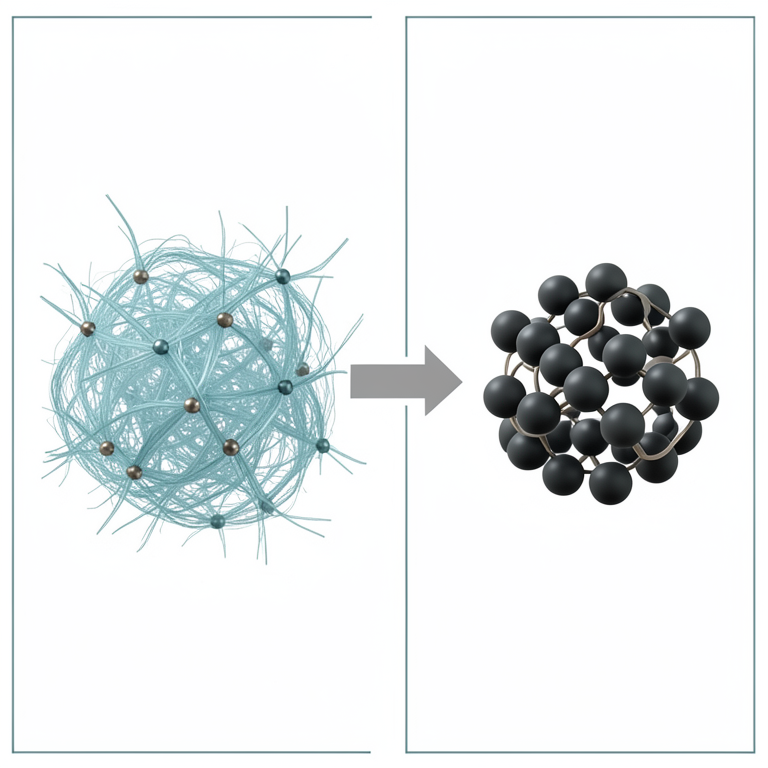
Catalyst Support Comparison
AI-generated conceptual illustration (glass wool fibers and iron oxide nanoparticles). It explains the idea and does not show study data.
View source evidence ↗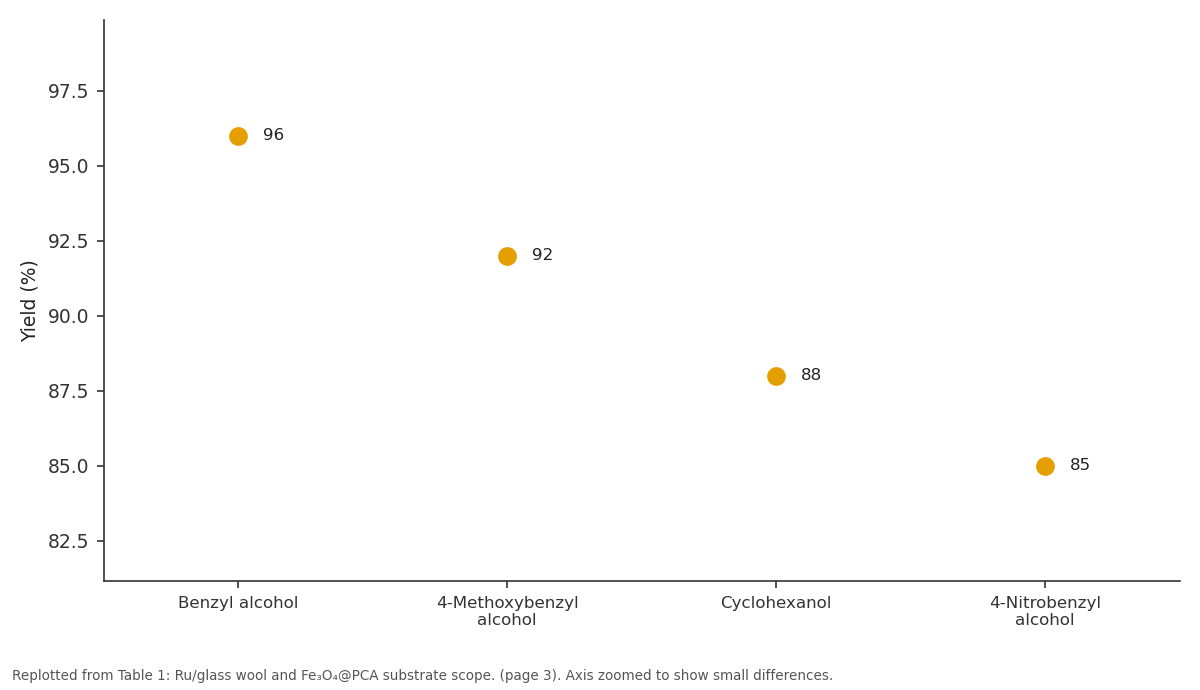
Yield (%): Benzyl alcohol vs 4-Methoxybenzyl alcohol vs Cyclohexanol vs 4-Nitrobenzyl alcohol
Replotted from Table 1 (page 3) of the original paper. Every bar is the paper's own table value.
View source evidence ↗Figures & tables
From the original paper Table 1
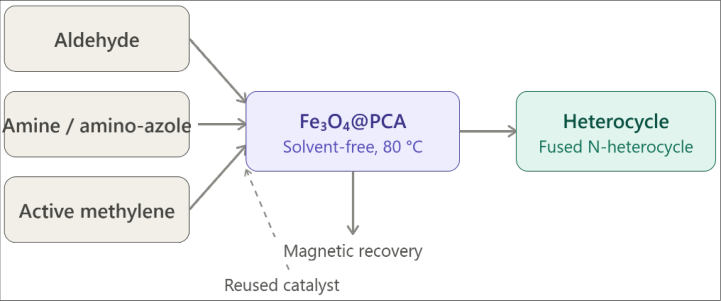 Figure 1
Introduction
Catalysis is an area of research whose impact on everyday life is significantly under estimated. In contemporary chemistry, catalytic systems are primarily categorised into homogeneous, heterogeneous, and nanostructured types, with the latter gaining prominence in the twenty-first century as a notably dynamic research domain, presenting a wealth of options for exploration and innovation [1] . Catalytic processes facilitate elevated regio-and stereoselectivity in chemical conversions, as well as enhanced yields and gentler reaction conditions. Over 95% (by volume) of all chemicals produced industrially currently depend on catalytic processes, rendering the quest for more efficient catalytic materials a dynamic and perpetually advancing field of research [2] . Catalysis is fundamentally central to chemistry, acting as a crucial instrument for the cleavage and formation of chemical bonds and for the synthesis of valuable chemicals in physical chemistry, electrochemistry, organic and inorganic chemistry, industrial chemistry, and biochemistry [3,4] . The economic importance of catalytic technologies is considerable: the worldwide catalyst market is anticipated to attain around US $22 billion, highlighting the magnitude of persistent industrial and scholarly engagement [5][6] . The phrase "catalysis" was initially introduced by Berzelius in 1836 [7] . Since that time, the domain has evolved into a multidisciplinary research sector that is pivotal in chemical, biological, nanotechnological, polymer, energy, medicinal, and agricultural sciences. [8,11] . A catalyst enhances the pace of a reaction by reducing its activation energy while maintaining the overall thermodynamic properties of the process [12] . This often facilitates the attainment of elevated yields of the target product in reduced reaction durations and with diminished energy consumption relative to traditional stoichiometric processes. The quest for more effective and sustainable catalytic substances has historically been a prominent research objective, and this initiative has acquired increased significance in recent times due to escalating worries regarding the sustainability of economic expansion [13] . Fundamental to this transition is the tenet of green chemistry, which aims to avert pollution at its origin instead of regarding waste production and disposal as inevitable outcomes of chemical production. Catalysis directly facilitates multiple fundamental aims of green chemistry, such as diminished energy usage, the application of catalytic instead of stoichiometric amounts of reactants, enhanced selectivity, reduced necessity for processing and separation agents, and decreased dependence on hazardous substances. These advantages establish catalysis as an essential instrument for tackling environmental contamination, climate change, and excessive raw material consumption facilitating chemical processes that need reduced resources, diminished energy, and produce less physical and chemical waste. [14] . Magnetic Fe₃O₄ nanoparticles have become essential materials in the biomedical, environmental, and engineering fields owing to their distinctive soft ferromagnetic properties, half-metallic characteristics, and compatibility with biological systems [15,16] . In the realm of environmental remediation, these nanoparticles function as exceptionally effective, magnetically separable substrates that avoid the secondary contamination commonly linked to conventional chemical treatment techniques [17] . In spite of its practicality, securing long-lasting colloidal stability is a notable difficulty, given that unprotected magnetite nanoparticles are inclined to irreversible aggregation and surface oxidation [18,19] . In order to mitigate these shortcomings, the utilisation of ruthenium-based photocatalytic systems provides a viable method for surface stabilisation, allowing for controlled crystal formation and increased resilience to environmental deterioration [20-21. This strategy employs Rubased photocatalytic precursors to generate a protective interfacial layer that influences surface reactivity and lessens magnetic core photo-dissolution [22] . This technique leverages the redox-active properties of ruthenium complexes to govern the nucleation and growth processes, efficiently securing a stabilised shell to the magnetite surface [23] . This intentional alteration not only reduces the quick deterioration of magnetic susceptibility resulting from particle clustering but also boosts the material's overall photocatalytic efficacy [24] . In addition, the covalent bonding of ruthenium-phenanthroline complexes onto iron oxide substrates has shown improved precision in nanoparticle size as compared to standard synthetic approaches [25] . This strategy develops a strong synthetic framework that meets the vital demand for monodisperse magnetic nanoparticles that retain structural stability in complicated reaction settings. Nanocatalysis has surfaced as a notably dynamic subdiscipline, utilising the elevated surface-area-to-volume ratio and adjustable electrical characteristics of nanostructured materials to attain improved activity and selectivity compared to traditional catalysts [26] . Simultaneous progress in photocatalysis and electrocatalysis has placed catalytic science at the forefront of renewable energy research, which includes solar-powered water splitting and electrochemical CO₂ reduction [27] . Biocatalysis, utilising enzymes and modified biological systems, has broadened catalytic uses in pharmaceutical production and environmentally friendly manufacturing, providing exceptional selectivity under gentle circumstances [28] . Computational methodologies, especially density functional theory (DFT), have emerged as essential instruments for forecasting catalytic mechanisms, evaluating potential materials, and elucidating experimental findings at the electronic scale, hence expediting catalyst development [29] . At the core of this current research is the concept of green chemistry, which has shifted catalytic studies toward decreasing waste, lowering energy usage, and substituting harmful stoichiometric reagents with catalytic options [30] . Throughout these eras, catalytic theory has transitioned from a predominantly descriptive, empirical model to a progressively predictive, mechanistically based field. Initial adsorption-centric models (Langmuir-Hinshelwood, Eley-Rideal) and the theory of intermediate compound formation laid the foundational terminology for surface and molecular catalysis, whereas transition state theory and the Sabatier principle offered the thermodynamic and kinetic justification for catalytic efficacy. Modern computational and nanotechnology methodologies have enhanced, although not supplanted, these fundamental notionsinstead, they have facilitated their utilisation with unparalleled accuracy. Notwithstanding this advancement, significant deficiencies persist: the systematic design of catalysts exhibiting predictable selectivity under practical (rather than theoretical) reaction conditions is still constrained; the transition of numerous nanocatalytic and photocatalytic systems from the lab to industrial use continues to pose a formidable challenge; and the amalgamation of computational forecasting with experimental corroboration remains inconsistent across various subdisciplines [31] . These deficiencies inspire ongoing research into innovative nanocatalyst systems, ecofriendly catalytic pathways, or mechanistic analyses under industrially pertinent settings, which this study aims to tackle. [32] .
Materials and Methods:
All reagents and solvents were acquired from [supplier name(s), e.g., Sigma-Aldrich] and utilised in their received form unless specified differently. The glass wool support was procured from [source]. The ruthenium precursor [specify, e.g., RuCl₃•6H₂O or Ru(bpy)₃Cl₂] and ligands employed for the production of complexes were of analytical quality. FeCl₃•6H₂O, FeCl₂•4H₂O, pyrrole-2carboxylic acid, and ammonium hydroxide (NH₄OH) were employed in the synthesis of nanoparticles. Acetonitrile and methanol employed in photooxidation processes were of HPLC quality.
Results and Discussion:
The PCA-functionalized Lewis-acidic Fe₃O₄ surface facilitates the three-component condensation (aldehyde, amine/amino-azole, and an active-methylene partner) under solvent-free conditions, resulting in the formation of a fused N-heterocycle; subsequently, the catalyst is extracted magnetically and reused, thereby completing the recyclability loop, which should be supported by a bar chart of yields across successive cycles as illustrated in Figure 1.
Preparation of Ru-Immobilized Glass Wool
The pretreatment of glass wool fibres included a washing technique with acetone and deionised water, succeeded by drying at 80 °C, to provide surface silanol groups appropriate for complex adhesion. The ruthenium complex was later secured onto the glass wool support using [method of surface coordination/impregnation], by submerging the pretreatment fibres in a (Benzyl alcohol) solution of the Ru complex at 80 °C for 1-3 hr. The reusability of the Ru/glass wool and Fe₃O₄@PCA catalysts throughout five repeated reaction cycles. The catalyst was obtained by simple filtration (Ru/glass wool) or magnetic decantation (Fe₃O₄@PCA), then washed, dried, and reused without any subsequent activation. An 88% yield retention after five cycles reflects limited metal leaching and commendable structural resilience. The substrate applicability for Ru/glass wool-catalyzed alcohol oxidation (entry 1-4) and Fe₃O₄@PCA-catalyzed heterocycle formation (entries 5-7) is depicted in Table 1. The yields are defined as isolated yields achieved following column chromatography or recrystallization; the reactions were executed under the optimized conditions detailed in the Experimental section.
| Entry | Catalyst | Substrate | Product | Yield (%) | Time (h) |
|---|---|---|---|---|---|
| 1 | Ru/glass wool | Benzyl alcohol | Benzaldehyde | 96 | 2 |
| 2 | Ru/glass wool | 4-Methoxybenzyl alcohol | 4-Methoxybenzaldehyde | 92 | 2.5 |
| 3 | Ru/glass wool | Cyclohexanol | Cyclohexanone | 88 | 3 |
| 4 | Ru/glass wool | 4-Nitrobenzyl alcohol | 4-Nitrobenzaldehyde | 85 | 3.5 |
| 5 | Fe₃O₄@PCA | 2-Aminobenzaldehyde + malononitrile | 2-Aminoquinoline-3-carbonitrile | 94 | 1 |
| 6 | Fe₃O₄@PCA | 4-Chlorobenzaldehyde + aminopyrazole | Pyrazolo-pyrimidine derivative | 90 | 1.5 |
| 7 | Fe₃O₄@PCA | Furfural + aminouracil | Pyrimido-fused furan | 87 | 2 |
Table text extracted from the original PDF; superscript letters are shown inline. The original table image is below.
View original table image
Characterization.
The synthesised PCA-Fe₃O₄ nanoparticles and Ru-glass wool materials were analysed employing with FT-IR, XRD, TEM/SEM, VSM, TGA, and UV-Vis DRS to verify their structure, morphology, magnetic characteristics, and effective functionalization/immobilization.
Conclusion:
This analysis outlines two complementary heterogeneous catalytic platforms aimed at sustainable synthesis. Immobilised on glass wool, ruthenium-based photoredox catalysts effectively mediated aerobic photooxidations, such as those of 9,10-dimethylanthracene and 2-ethylfuran, achieving excellent yields exceeding 95% under mild visible-light conditions, resulting in a system that is readily recoverable and appropriate for flow photochemistry.
Separately, nanoparticles of Fe₃O₄ functionalised with pyrrole-2-carboxylic acid (PCA-Fe₃O₄) were synthesised as a magnetically recoverable nanocatalyst for the synthesis of isoxazole[4,3-e]indazole derivatives, which showed considerable antibacterial activity, notably against Bacillus subtilis. Both systems shown notable reusability, quick reaction intervals, and clean product synthesis, accentuating their promise as proficient, affordable, and ecologically sustainable platforms for organic synthesis and drug discovery.
References
31 in the original paper- Chughtai AH, Ahmad N, Younus HA, Laypkov A, Verpoort F. Metal-organic frameworks: versatile heterogeneous catalysts for efficient catalytic organic transformations. Chem Soc Rev. 2015;44:6804-6849.
- Lindström B, Pettersson LJ. A brief history of catalysis. CATTECH. 2003;7:130-138.
- Rothenberg G. Catalysis: concepts and green applications. Weinheim: Wiley-VCH; 2008.
- Leeuwen PWN. Homogeneous catalysis. Springer Nature; 2004. doi:10.1007/1-4020-2000-7.
- Anastas PT, Bartlett LB, Kirchhoff MM, Williamson TC. The role of catalysis in the design, development, and implementation of green chemistry. Catal Today. 2000;55:11-22.
- Collis AEC, Horváth IT. Heterogenization of homogeneous catalytic systems. Catal Sci Technol. 2011;1:912-919.
- Ross JRH. Heterogeneous catalysis: fundamentals and applications. Amsterdam: Elsevier; 2012. ISBN:9780444533630.
- Smith GV, Notheisz F. Heterogeneous catalysis in organic chemistry. Academic Press; 1999. ISBN:0-12651645.
- Dhakshinamoorthy A, Asiri AM, Alvaro M, Garcia H. Metal organic frameworks as catalysts in solvent-free or ionic liquid assisted conditions. Green Chem. 2018;20:86-107.
- Freire C, Pereira C, Rebelo S. Green oxidation catalysis with metal complexes: from bulk to nano recyclable hybrid. Catalysis. 2012;24:116-203.
- Vedrine JC. Heterogeneous catalysis on metal oxides. Catalysts. 2017;7:341.
- Climent MJ, Corma A, Iborra S. Homogeneous and heterogeneous catalysts for multicomponent reactions. RSC Adv. 2012;2:16-58.
- Bhaskaruni SVHS, Maddila S, Gangu KK, Jonnalagadda SB. A review on multi-component green synthesis of N-containing heterocycles using mixed oxides as heterogeneous catalysts. Arab J Chem. 2017;13(1).
- Nguyen QT, Rousset E, Nguyen VTH, Colliere V, Lemercier G, Tran PD, et al. Covalent grafting of ruthenium complexes on iron oxide nanoparticles: hybrid materials for photocatalytic water oxidation. ACS Appl Mater Interfaces. 2021;13(45):53829-53840.
- Theerthagiri J, et al. Electrocatalytic conversion of nitrate waste into ammonia: a review. Environ Chem Lett. 2022;20:2929-2949.
- Ngulube NK, Tatano H, Samaddar S. Factors impacting participatory post-disaster relocation and housing reconstruction: the case of Tsholotsho District, Zimbabwe. Int J Disaster Risk Sci. 2024;15:58-72.
- Diksha, Kumari M, Kumari R. Spatiotemporal characterization of land surface temperature in relation to landuse/cover: a spatial autocorrelation approach. J Landsc Ecol. 2023;16(1):1-18.
- Abdel Maksoud MIA, Fahim RA, Bedir AG, Osman AI, Abouelela MM, El-Sayyad GS, et al. Engineered magnetic oxides nanoparticles as efficient sorbents for wastewater remediation: a review. Environ Chem Lett. 2021;20:519-562.
- Ba-Abbad MM, Mohammad AW, Mahmoudi E. Synthesis of Fe3O4 nanoparticles with different shapes through a co-precipitation method and their application. Springer Nature Link. 2022;74:3531-3539.
- Bazrafshan E, Mosafer J, Muhammad NZ, Dargahi A. Optimization of the photocatalytic degradation of phenol using superparamagnetic iron oxide (Fe3O4) nanoparticles in aqueous solutions. RSC Adv. 2023;13(36):25408-25424.
- Shoneye A, Sen CJ, Chong MN, Tang J. Recent progress in photocatalytic degradation of chlorinated phenols and reduction of heavy metal ions in water by TiO2-based catalysts. Int Mater Rev. 2021;67(1):47-64.
- Zheng H, Xu Y, Wang M, Qi L, Lian Z, Hu L, et al. The role of fertilization on soil carbon sequestration in bibliometric analysis. Agriculture. 2024;14(10):1850.
- Azarshab K, Hashemi M, Nasiri A, Khodabakhshi A. Synthesis and characterization of CuCoFe2O4@GA/AC as a bio-based matrix magnetic nano-heterogeneous photocatalyst for ceftriaxone degradation from aqueous media. Appl Water Sci. 2024;14:197.
- Keshta BE, Gemeay AH, Sinha DK, Elsharkawy S, Arora C. State of the art on the magnetic iron oxide nanoparticles: synthesis, functionalization, and applications in wastewater treatment. Results Chem. 2024;7:101388.
- Ruhul AM, Kalam MA, Masjuki HH, Fattah IMR, Reham SS, Rashed MM. State of the art of biodiesel production process: a review on heterogeneous, homogeneous, biocatalytic and non-catalytic process. RSC Adv. 2015;5:101023-101044.
- Latchubugata CS, Kondapaneni RV, Atluri KK, Virendra U, Vedantam S. Kinetics and optimization studies using response surface methodology in biodiesel production using heterogeneous catalyst. Chem Eng Res Des. 2018;135:129-139.
- Sharma S, Saxena V, Baranwal A, Chandra P, Pandey LM. Engineered nanoporous materials mediated heterogeneous catalysts and their implications in biodiesel production. Mater Sci Energy Technol. 2018;1:11-21.
- Abdullah SHYS, Hanapi NHM, Azid A, Umar R, Juahir H, Khatoon H, et al. A review of biomassderived heterogeneous catalyst for a sustainable biodiesel production. Renew Sust Energ Rev. 2017;70:1040-1051.
- Qian C, Yao C, Yang L, Yang B, Liu S, Liu Z. Preparation and application of silica films supported imidazolium-based ionic liquid as efficient and recyclable catalysts for benzoin condensations. Catal Lett. 2020;150:1389-1396.
- Pourjavadi A, Hosseini SH, Doulabi M, Fakoorpoor SM, Seidi F. Multi-layer functionalized poly(ionic liquid) coated magnetic nanoparticles: highly recoverable and magnetically separable Brønsted acid catalyst. ACS Catal. 2012;2:1259-1266.
- Gholinejad M, Zareh F, Sheibani H, Náje C, Yus M. Magnetic ionic liquids as catalysts in organic reactions. J Mol Liq. 2022;367:120395.