
Research article · 2026 · Full text
International Journal of Advanced Chemistry ResearchBaker’s Yeast Promoted Synthesis of β Aminoketones by Nucleophilic Addition of Acetophenones to Imines
Volume 8(8) · Pages 121–126 · DOI: 10.33545/26646781.2026.v8.i8b.739 ↗
Research areasEnzyme Catalysis and ImmobilizationChemical Synthesis and ReactionsAsymmetric Hydrogenation and Catalysis
Abstract
Author-writtenAn environmentally compatible and operationally simple approach has been established for the synthesis of β-aminoketones through the addition of acetophenones to preformed imines using Baker’s yeast as a biocatalyst. The transformation proceeds under mild reaction conditions with ethanol serving as the reaction medium. Baker’s yeast, an inexpensive and easily accessible biological catalyst, efficiently promotes the carbon-carbon bond-forming step between the acetophenone and imine components. The optimized reaction employs a preformed Schiff base, acetophenone, Baker’s yeast, and ethanol at room temperature for 36 h. Under these conditions, the model β-aminoketone was isolated in 90% yield. A series of β-aminocarbonyl compounds 3a-k was subsequently prepared in 88-93% yields. The products were identified and characterized by melting-point determination, 1H-NMR spectroscopy, and mass spectrometry. Compared with several conventional approaches for the preparation of β-aminoketones, the present method avoids the requirement for metal-supported catalysts and provides a straightforward work-up. The study demonstrates the usefulness of Baker’s yeast for promoting nucleophilic addition of acetophenones to imines and provides an attractive green route to Mannich-type β-aminoketones.
Summary
Source-checkedPlain-language reading of the full paper, prepared with AI and checked against the text. Each point links to the authors' own words.
Why it matters
- The Mannich reaction is a critical tool for creating carbon-carbon bonds, specifically providing access to β-aminocarbonyl compounds used in medicinal chemistry and organic synthesis. View evidence ↗
- Existing methods for synthesizing β-aminoketones often rely on complex catalysts, toxic solvents, or difficult recovery processes, creating a need for simpler, greener alternatives. View evidence ↗
- Baker's yeast is a promising biocatalyst due to its low cost, accessibility, and proven ability to facilitate various organic chemical transformations. View evidence ↗
The question
- The researchers aimed to investigate whether Baker's yeast could be used as a biological catalyst for the nucleophilic addition of acetophenones to preformed imines. View evidence ↗
What they did
- The synthesis involved reacting 1 mmol of a preformed Schiff base and 1 mmol of acetophenone in 10 mL of ethanol with 500 mg of Baker's yeast. View evidence ↗
- The reaction mixture was maintained at room temperature and stirred using an orbital shaker for a period of three days. View evidence ↗
- The resulting compounds were characterized using mass spectrometry, 1H-NMR spectroscopy, and the determination of their melting points. View evidence ↗
What they found
- Initial one-pot reactions produced only trace amounts of the desired β-aminoketone, as the formation of the Schiff base occurred more readily than the subsequent carbon-carbon bond formation. View evidence ↗
- The reaction failed to produce any product when using solvents such as benzene, toluene, dichloromethane, ethyl acetate, or tetrahydrofuran for 12 hours. View evidence ↗
- Using a sequential approach in ethanol, the yield of the model product 3a increased from 35% at 12 hours to 60% at 24 hours, reaching 90% after 36 hours. View evidence ↗
- The method was successfully applied to eleven different substrates (3a-k), producing high isolated yields between 88% and 93%. View evidence ↗
- Among the synthesized compounds, 3b and 3f achieved the highest yield at 93%, while 3c had the lowest yield at 88%. View evidence ↗
What it means
- The authors conclude that they have developed a convenient biocatalytic method for preparing β-aminoketones by adding acetophenones to preformed imines using Baker's yeast. View evidence ↗
- The authors state that this protocol is an environmentally attractive alternative because it uses an inexpensive catalyst, a mild solvent (ethanol), and a simple isolation process. View evidence ↗
Visual summary
2 visualsIllustrations explain the paper; charts are replotted from the paper's own table values.
Sequential vs One-Pot Synthesis
AI-generated conceptual illustration (Saccharomyces cerevisiae (Baker's yeast) cells and chemical molecular structures). It explains the idea and does not show study data.
View source evidence ↗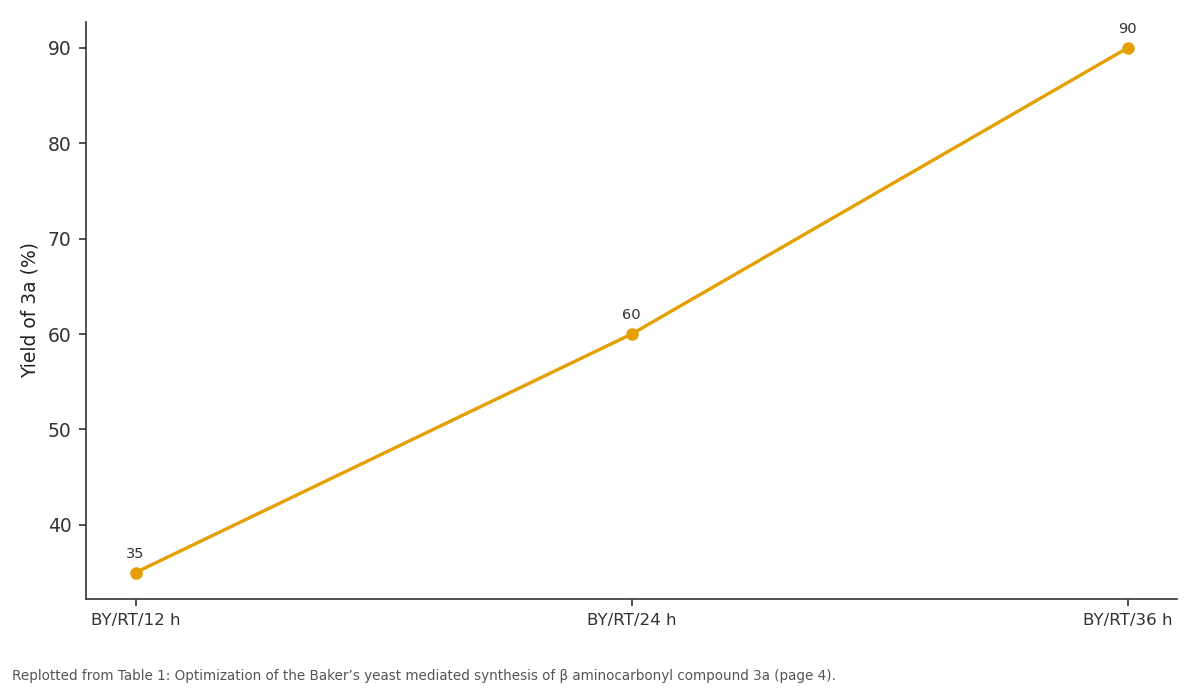
Yield of 3a / NR: BY/RT/12 h vs BY/RT/24 h vs BY/RT/36 h
Replotted from Table 1 (page 4) of the original paper. Every bar is the paper's own table value.
View source evidence ↗Figures & tables
From the original paper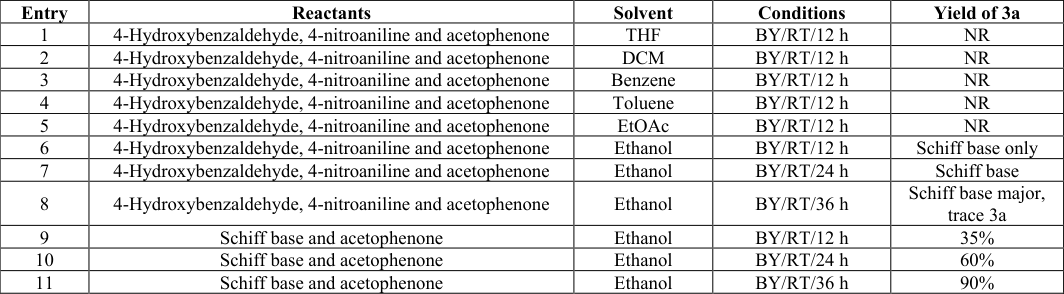 Table 1
Introduction
Multicomponent reactions have become valuable synthetic tools because they allow several molecular building blocks to be incorporated into a single product in a relatively concise sequence. Such reactions can reduce the number of individual synthetic operations and are particularly useful for generating structurally diverse compound libraries for medicinal and pharmaceutical research [1][2][3][4][5][6][7][8] . The Mannich reaction represents one of the most useful carboncarbon bond-forming reactions among multicomponent transformations. It provides direct access to β-aminocarbonyl compounds, which are important intermediates in organic synthesis and possess considerable relevance in medicinal chemistry. β-Aminoketone frameworks are found in or related to a number of biologically important molecules, and consequently considerable effort has been directed toward developing efficient procedures for their preparation [9] . An effective synthesis of β-aminoketones should ideally provide high conversion and good product yield while minimizing reaction time, solvent toxicity, catalyst cost, and purification requirements. Several approaches have therefore been developed for constructing the βaminoketone framework. The classical Mannich reaction constitutes one major strategy. In this process, an amine, carbonyl compound, and aldehyde participate in the formation of the β-aminocarbonyl skeleton [10][11][12] . Another route involves nucleophilic addition of enolate species to imines, resulting in formation of a new carbon-carbon bond [13] . β-Aminoketones can also be accessed through aza-Michael reactions involving addition of amines to α, βunsaturated carbonyl compounds [14][15][16][17][18] . Aza-Michael reactions have been performed under a variety of catalytic and non-catalytic conditions. Bismuth nitrate has been employed as a catalyst for Michael-type transformations another approach to Michael additions under aqueous and comparatively mild conditions [18] . Other routes to βaminoketones include transformations involving enaminones and hydroamination reactions. Alternative approaches have employed catalytic hydroamination of alkynes and related functionalization strategies [19][20][21][22][23] . Microwave-assisted Mannich chemistry and solvent-free procedures have also been reported as approaches toward βaminoketone synthesis [24,25] . Zinc tetrafluoroboratecatalyzed Mannich-type reactions of aldimines with silyl enol ethers represent another example of catalytic carboncarbon bond formation leading to amino carbonyl products [26] . Although these methodologies have significantly expanded the synthetic chemistry of β-aminoketones, several reported protocols involve relatively complex catalysts, specialized reaction conditions, prolonged reaction times, toxic solvents, ionic liquids, or difficult catalyst-recovery procedures.
The development of simple and environmentally acceptable alternatives therefore remains desirable. Recent reviews of β-aminoketone chemistry emphasize the continuing importance of improving synthetic efficiency and sustainability [9] . Biocatalysis offers an attractive alternative to many conventional catalytic approaches. Biological catalysts can operate under mild conditions and can often be obtained inexpensively from readily available biological sources. Baker's yeast is particularly interesting in this regard because of its availability, ease of handling, and well-established catalytic activity in organic transformations. Baker's yeast contains Saccharomyces cerevisiae and has traditionally been used in fermentation and food processing. Its enzymatic machinery is also capable of promoting several useful transformations in organic chemistry. Microbial asymmetric catalysis using Baker's yeast has long been recognized, particularly for the reduction of carbonyl compounds [27] . Baker's yeast has also been applied to reductions and other useful biotransformations [28,29] . The application of Baker's yeast has subsequently been extended to multicomponent organic reactions. Its use in multicomponent synthesis has been reviewed, and examples include the preparation of dihydropyrimidinones and other multicomponent products [30,31] . These applications demonstrate the potential of Baker's yeast as an inexpensive and environmentally attractive biocatalyst. Despite the broad application of Baker's yeast in organic transformations, the nucleophilic addition of acetophenones to preformed imines using Baker's yeast had not been explored in the manner investigated in the present work. Previous studies involving acetophenone Mannich bases have employed other catalytic systems, including ionicliquid-based methodologies [32] . Such observations encouraged us to investigate Baker's yeast as an alternative biological catalyst. Our initial attempt involved a conventional one-pot three-component reaction between an aldehyde, an aromatic amine, and acetophenone in the presence of Baker's yeast. The expected β-aminoketone was produced only in trace quantities, while the corresponding Schiff base was the major product. This observation suggested that formation of the imine and subsequent reaction with acetophenone should be considered as separate steps.
Experimental 2.1 Materials and Analytical Methods
All solvents used during the investigation were distilled and dried before application. The chemicals were purchased commercially and used without additional purification. The progress of the reactions was examined by thin-layer chromatography using silica gel 60 plates. Petroleum ether and ethyl acetate in an 8:2 ratio were used as the usual mobile phase. For product monitoring during the representative reaction, ethyl acetate and hexane containing 20% ethyl acetate were used as the eluent. The 1H-NMR spectra were recorded on a Varian-400MR spectrometer operating at 400 MHz. CDCl₃ was used as solvent and tetramethylsilane was employed as the internal standard. Mass spectral analysis was carried out using an Agilent G6160A InfinityLab LC/MSD/IQ mass spectrometer.
General Method for the Synthesis of β Aminocarbonyl Compounds 3a-k
The synthesis was carried out by reacting preformed Schiff bases with acetophenones in the presence of Baker's yeast. For the representative synthesis of compound 3a, the Schiff base obtained from 4-nitroaniline and 4hydroxybenzaldehyde was used in an amount corresponding to 1 mmol. Acetophenone was also employed in a quantity of 1 mmol. The two reactants were dissolved in 10 mL ethanol, followed by addition of 500 mg Baker's yeast. The reaction suspension was stirred on an orbital shaker for three days at room temperature. Completion of the transformation was determined by TLC. After completion, the Baker's yeast was separated by filtration through Celite. The retained yeast was washed with ethanol and the resulting filtrate was collected. Water (20 mL) was added to the filtrate and the aqueous mixture was extracted with ethyl acetate (2 × 30 mL). The organic portions were combined and dried over anhydrous sodium sulfate. The solvent was subsequently removed to obtain the crude material. Recrystallization of the crude product from ethanol provided the purified β-aminocarbonyl compound. Using this procedure, compound 3a was obtained in 90% yield. The remaining products 3b-k were prepared by applying the same general protocol. Their identities were established from melting-point, ^1H-NMR, and mass spectral data. The compounds prepared in the investigation are known compounds and their characterization was consistent with reported information.
Characterization of Synthesized Compounds 2.3.1 3-(4-Hydroxyphenyl)-3-((4-nitrophenyl)amino)-1phenylpropan-1-one 3a
Characterization of Synthesized Compounds 2.3.1 3-(4-Hydroxyphenyl)-3-((4-nitrophenyl)amino)-1phenylpropan-1-one 3a
3-(4-Chlorophenyl)-3-((4-nitrophenyl)amino)-1phenylpropan-1-one 3d
Yield: 90%; m.p.: 113-115 °C; ^1H-NMR: (400 MHz) δ 8.12 (dd, J = 8.6, 1.4 Hz, 2H), 7.39-7.31 (m, 2H), 6.81 (dd, J = 8.4, 1.1 Hz, 2H), 6.71 (ddd, J = 8.4, 7.0, 1.2 Hz, 2H), 6.05 (s, 6H), 3.67 (s, 1H), 1.25 (s, 2H). Mass: 380.2.
3-(4-Hydroxyphenyl)-3-((2-nitrophenyl)amino)-1phenylpropan-1-one 3i
Yield: 88%; m.p.: 283-285 °C; 1H-NMR: (400 MHz) δ 9.87 (s, 1H), 8.12 (dd, J = 8.6, 1.4 Hz, 1H), 7.82-7.80 (m, 3H), 7.36 (ddd, J = 8.4, 7.0, 1.5 Hz, 1H), 7.26 (s, 4H), 6.97-6.93 (m, 4H), 6.81 (dd, J = 8.4, 1.1 Hz, 1H), 6.71 (ddd, J = 8.4, 7.0, 1.2 Hz, 1H), 5.89 (s, 1H), 3.50 (s, 2H). Mass: 363.3.
1-Phenyl-3-(phenylamino)-3-(3, 4, 5trimethoxyphenyl)propan-1-one 3j
Yield: 92%; m.p.: 148-150 °C; 1H-NMR: (400 MHz) δ 8.36 (s, 1H), 7.40 (t, J = 7.7 Hz, 2H), 7.32-6.97 (m, 8H), 6.85 (s, 1H), 3.95 (d, J = 2.6 Hz, 6H), 3.94 (s, 2H), 3.91 (d, J = 6.4 Hz, 4H), 3.49 (s, 1H). Mass: 392.5.
2.3.11
3-(4-Chlorophenyl)-1-phenyl-3-(phenylamino)propan-1-one 3k Yield: 90%; m.p.: 113-115 °C; 1H-NMR: (400 MHz) δ 7.74 (d, J = 8.8 Hz, 3H), 7.48-7.40 (m, 4H), 7.32 (dd, J = 5.0, 3.6 Hz, 1H), 6.71 (dd, J = 8.9, 3.9 Hz, 3H), 3.10 (d, J = 3.3 Hz, 4H), 3.02 (s, 1H), 2.46 (s, 2H). Mass: 335.2.
Results and Discussion
Results and Discussion
Initial Investigation
The investigation began with a one-pot reaction involving 4hydroxybenzaldehyde, 4-nitroaniline, and acetophenone in ethanol in the presence of Baker's yeast. The expected Mannich product 3a was obtained only in a trace quantity. In contrast, the Schiff base generated from 4hydroxybenzaldehyde and 4-nitroaniline constituted the major product. This result demonstrated that the formation of the imine occurred more readily than the subsequent carbon-carbon bond-forming reaction involving acetophenone. Therefore, rather than forcing the transformation through a single three-component operation, a sequential approach was investigated. In the revised strategy, the Schiff base was prepared first and then treated with acetophenone in the presence of Baker's yeast. This modification produced a substantial increase in the formation of β-aminoketone 3a.
Optimization of Reaction Conditions
The model reaction involving 4-hydroxybenzaldehyde, 4nitroaniline, and acetophenone was used for optimization. Different solvents and reaction periods were examined at room temperature in the presence of Baker's yeast. The optimization results are presented in Table 1. The reaction failed to produce the desired β-aminoketone when tetrahydrofuran, dichloromethane, benzene, toluene, or ethyl acetate was used for 12 h. In each case, no reaction product was detected. Ethanol produced a different outcome. When all three starting materials were combined in ethanol with Baker's yeast and maintained at room temperature for 12 h, formation of the Schiff base was observed. Increasing the reaction time to 24 h again resulted predominantly in Schiff base formation. After 36 h, only a trace amount of the desired Mannich product appeared, while the Schiff base continued to be the principal product. These observations indicated that the onepot reaction was not an efficient route to the desired compound. The reaction sequence was consequently modified by first generating the Schiff base and subsequently adding acetophenone. The sequential procedure produced 35% of 3a after 12 h. Extension of the reaction time to 24 h increased the yield to 60%. A further extension to 36 h resulted in a substantial improvement, giving 3a in 90% yield. Therefore, the optimum conditions were identified as follows: preformed Schiff base, acetophenone, Baker's yeast as biocatalyst, ethanol as solvent, room temperature, and 36 h reaction time. The original optimization study reports these same values across entries 1-11 of Table 1. NR = no reaction. For entries 9-11, the Schiff base was first prepared by reaction of 4-hydroxybenzaldehyde and 4-nitroaniline for 12 h before acetophenone was introduced.
| Entry | Reactants | Solvent | Conditions | Yield of 3a |
|---|---|---|---|---|
| 1 | 4-Hydroxybenzaldehyde, 4-nitroaniline and acetophenone | THF | BY/RT/12 h | NR |
| 2 | 4-Hydroxybenzaldehyde, 4-nitroaniline and acetophenone | DCM | BY/RT/12 h | NR |
| 3 | 4-Hydroxybenzaldehyde, 4-nitroaniline and acetophenone | Benzene | BY/RT/12 h | NR |
| 4 | 4-Hydroxybenzaldehyde, 4-nitroaniline and acetophenone | Toluene | BY/RT/12 h | NR |
| 5 | 4-Hydroxybenzaldehyde, 4-nitroaniline and acetophenone | EtOAc | BY/RT/12 h | NR |
| 6 | 4-Hydroxybenzaldehyde, 4-nitroaniline and acetophenone | Ethanol | BY/RT/12 h | Schiff base only |
| 7 | 4-Hydroxybenzaldehyde, 4-nitroaniline and acetophenone | Ethanol | BY/RT/24 h | Schiff base |
| 8 | 4-Hydroxybenzaldehyde, 4-nitroaniline and acetophenone | Ethanol | BY/RT/36 h | Schiff base major, trace 3a |
| 9 | Schiff base and acetophenone | Ethanol | BY/RT/12 h | 35% |
| 10 | Schiff base and acetophenone | Ethanol | BY/RT/24 h | 60% |
| 11 | Schiff base and acetophenone | Ethanol | BY/RT/36 h | 90% |
Table text extracted from the original PDF; superscript letters are shown inline. The original table image is below.
View original table image
Substrate Scope
Once the optimized reaction conditions had been established, the method was applied to a range of imines and acetophenone-derived substrates. The objective was to determine whether structural variation in the aromatic substituents could be accommodated under the optimized conditions. The reaction furnished eleven β-aminocarbonyl compounds, designated 3a-k. The isolated yields were consistently high, ranging from 88% to 93%. Compound 3c was obtained in 88%, whereas compounds 3b and 3f gave the highest isolated yield of 93%. Compound 3h and compound 3j were obtained in 92%, while the remaining products generally afforded 90% yield. The synthesized compounds contained different functional groups, including hydroxyl, nitro, chloro, methoxy, dimethylamino, and trimethoxy substituents. This range of products demonstrates the applicability of the reaction to structurally different aromatic substrates. The characterization of the products was performed using melting-point analysis, ^1H-NMR spectroscopy, and mass spectrometry. The experimental section of the source article reports the complete characterization of compounds 3a-k.
Spectroscopic Features
The 1H-NMR spectra provided characteristic signals corresponding to the newly formed β-aminoketone framework. The methylene protons associated with the C2 position generally appeared in the region of approximately 3-4 ppm and were observed as doublets of doublets or multiplets. The proton attached to the carbon bearing the amino functionality was generally detected in the 4-5 ppm region, commonly appearing as a triplet or multiplet. Aromatic protons arising from the different aromatic rings occurred predominantly in the 6-9 ppm range as doublets or multiplets. The mass spectral measurements were consistent with the molecular masses reported for the synthesized compounds. Collectively, the physical and spectroscopic data supported the formation of the desired β-aminocarbonyl structures. Subsequent proton transfer leads to formation of the final Mannich product. The proposed sequence is therefore consistent with a two-stage process involving initial Schiffbase formation followed by activation of acetophenone and nucleophilic addition to the imine. The proposed pathway also agrees with the general mechanistic description of acetophenone-derived Mannich reactions reported in the literature [32] .
Proposed Mechanism
Proposed Mechanism
conclusion
A convenient biocatalytic route has been developed for the preparation of β-aminoketones through nucleophilic addition of acetophenones to preformed imines using Baker's yeast. The study established that direct one-pot reaction of an aldehyde, amine, and acetophenone was inefficient because the corresponding Schiff base was formed preferentially. In contrast, preformation of the imine followed by reaction with acetophenone provided the desired Mannich product efficiently. Optimization experiments demonstrated that ethanol was the most suitable solvent among the solvents examined. The best result was obtained when the preformed Schiff base and acetophenone were treated with Baker's yeast in ethanol at room temperature for 36 h. Under these conditions, the model product 3a was obtained in 90% yield. Application of the optimized procedure to a series of substrates afforded βaminoketones 3a-k in 88-93% yields. The products were The developed protocol offers several practical advantages, including the use of Baker's yeast as an inexpensive biological catalyst, ethanol as the reaction medium, mild temperature conditions, and a straightforward isolation procedure. The method therefore provides an environmentally attractive alternative for the synthesis of βaminoketones through nucleophilic addition of acetophenones to imines. The study further demonstrates the potential of Baker's yeast for promoting carbon-carbon bond-forming reactions and contributes to the expanding application of biocatalytic methods in synthetic organic chemistry.
References
28 in the original paper- John SE, Gulati S, Shankaraiah N. Recent advances in multi-component reactions and their mechanistic insights: A triennium review. Organic Chemistry Frontiers. 2021;8:4237-4287.
- multicomponent Mannich reaction: Synthesis of anti1,3-diamines using enecarbamates as nucleophiles. Organic Letters. 2009;11:5546-5549.
- Ayats C, Henseler AH, Dibello E, Pericas MA. Continuous flow enantioselective three-component antiMannich reactions catalyzed by a polymer-supported threonine derivative. ACS Catalysis. 2014;4:3027-3033.
- Luan Y, Yu J, Zhang X, Schaus SE, Wang G. Diastereoselective three-component synthesis of βamino carbonyl compounds using diazo compounds, boranes and acyl imines under catalyst-free conditions. The Journal of Organic Chemistry. 2014;79:4694-4698.
- Isambert N, Duque MMS, Plaquevent JC, Genisson Y, Rodriguez J, Constantieux T. Multicomponent reactions and ionic liquids: A perfect synergy for eco-compatible heterocyclic synthesis. Chemical Society Reviews. 2011;40:1347-1357.
- Domling A, Wang W, Wang K. Chemistry and biology of multicomponent reactions. Chemical Reviews. 2012;112:3083-3135.
- Gu Y. Multicomponent reactions in unconventional solvents: State of the art. Green Chemistry. 2012;14:2091-2128.
- Rotstein BH, Zaretsky S, Rai V, Yudin AK. Small heterocycles in multicomponent reactions. Chemical Reviews. 2014;114:8323-8359.
- Mohamed MH, Khaled ME. Recent progress in the chemistry of β-aminoketones. RSC Advances. 2022;12:24681-24712.
- Robinson RL. LXIII-A synthesis of tropinone. Journal of the Chemical Society, Transactions. 1917;111:762768.
- Sun K, Lv Y, Zhu Z, Xiao B, Wang X. Oxidative C-S bond cleavage reaction of DMSO for C-N and C-C bond formation: New Mannich-type reaction for βamino ketones. RSC Advances. 2015;5:3094-3097.
- Matsumoto K, Hashimoto S, Otani S, Atnita F, Osugi J. Mannich reaction under high pressure. Dimethylaminomethylation of ketones with bis(diethylamino)methane under mild conditions. Synthetic Communications. 1984;14:585-590.
- Kobayashi S, Ishitani H. Catalytic enantioselective addition to imines. Chemical Reviews. 1999;99:10691094.
- Tang XJ, Yan ZL, Chen WL, Zhang YL, Wang YQ. Aza-Michael reaction promoted by aqueous sodium carbonate solution. Tetrahedron Letters. 2013;54:26692673.
- Srivastava N, Banik BK. Bismuth nitrate-catalyzed versatile Michael reactions. The Journal of Organic Chemistry. 2003;68:2109-2114.
- Bartoli G, Bosco M, Marcantoni E, Petrini M, Sambri L, Torregiani E. Conjugate addition of amines to α,βenones promoted by CeCl₃•7H₂O-NaI system supported in silica gel. The Journal of Organic Chemistry. 2001;66:9052-9055.
- Reboule I, Gil R, Colli J. Aza-Michael reactions catalyzed by samarium diiodide. Tetrahedron Letters. 2005;46:7761-7764.
- Firouzabadi H, Iranpoor N, Jafari AA. Micellar solution of sodium dodecyl sulfate catalyzes facile Michael addition of amines and thiols to α,β-unsaturated ketones in water under neutral conditions. Advanced Synthesis and Catalysis. 2005;347:655-661.
- SanMardín R, Marigorta E, Domínguez E. A convenient alternative route to β-aminoketones. Tetrahedron. 1994;50:2255-2264.
- Fukumoto Y, Asai H, Shimizu M, Chatan N. AntiMarkovnikov addition of both primary and secondary amines to terminal alkynes catalyzed by the TpRh(C₂H₄)₂/PPh₃ system. Journal of the American Chemical Society. 2007;129:13792-13793.
- Hesp K, Stradiotto M. Stereo-and regioselective goldcatalyzed hydroamination of internal alkynes with dialkylamines. Journal of the American Chemical Society. 2010;132:18026-18029.
- Leitch D, Payne P, Dunbar C, Schafer L. Broadening the scope of group 4 hydroamination catalysis using a tethered ureate ligand. Journal of the American Chemical Society. 2009;131:18246-18247.
- Bahri J, Blieck R, Jamoussi B, Taillefer F, Monnier F. Hydroamination of terminal alkynes with secondary amines catalyzed by copper: Regioselective access to amines. Chemical Communications. 2015;51:1121011212.
- Hao WJ, Jiang B, Tu SJ, Han ZG, Shi F. A new mild base-catalyzed Mannich reaction of hetero-arylamines in water: Highly efficient stereoselective synthesis of βaminoketones under microwave heating. Organic and Biomolecular Chemistry. 2009;7:1410-1414.
- Demirkol O, Akbaşlar D, Giray S, Anıl B. One-pot synthesis of Mannich bases under solvent-free conditions. Synthetic Communications. 2014;44:12791285.
- Ranu BC, Samanta S, Sankar KG. Zinc tetrafluoroborate catalyzed Mannich-type reaction of aldimines and silyl enol ethers in aqueous medium. Tetrahedron. 2002;58:983-988.
- Sih CJ, Chen CS. Microbial asymmetric catalysisenantioselective reduction of ketones. Angewandte Chemie International Edition. 1984;23:570-578.
- Ohta H, Kobayashi N, Ozaki K. Asymmetric reduction of nitro olefins by fermenting baker's yeast. The Journal of Organic Chemistry. 1989;54:1802-1804.