
Research article · 2026 · Full text
International Journal of Geography Geology and EnvironmentEffect of anionic Mishran feed supplementation during the transition period on calving performance, postpartum health and milk production in Pluriparous dairy cows
Volume 8(8) · Pages 60–63 · DOI: 10.22271/27067483.2026.v8.i8a.850 ↗
Research areasReproductive Physiology in LivestockRuminant Nutrition and Digestive PhysiologyAnimal health and immunology
Abstract
Author-writtenThe transition period is a critical phase in dairy cows, characterized by substantial changes in nutrient intake, mineral metabolism and endocrine function, with increased calcium demand at calving predisposing animals to hypocalcaemia and associated postpartum disorders. This study evaluated the effects of Anionic Mishran supplementation during the prepartum transition period on placental expulsion, calf performance, postpartum health, milk fever incidence and milk yield in Pluriparous dairy cows. Twelve cows were randomly allocated to treatment and control groups (n=6 each). The treatment group received Anionic Mishran during the prepartum period, while controls received the basal diet. Placental expulsion time, calf birth and weaning weights, metritis/pyometra, downer cow/milk fever incidence and daily milk yield were recorded. Anionic Mishran supplementation significantly reduced placental expulsion time from 6.93±0.22 to 4.63±0.33 h (P< 0.001) and increased daily milk yield from 8.64±0.11 to 9.64±0.16 L/day (P< 0.001). Calf birth and weaning weights did not differ significantly between groups. Metritis/pyometra and downer cow/milk fever incidence were numerically lower in the supplemented group, although differences were not statistically significant. Overall, prepartum Anionic Mishran supplementation showed beneficial effects on placental expulsion and early lactation yield, indicating its potential as a nutritional strategy for improving transition-period management in Pluriparous dairy cows. Larger studies are warranted to validate its effects on postpartum health and reproductive performance.
Summary
Source-checkedPlain-language reading of the full paper, prepared with AI and checked against the text. Each point links to the authors' own words.
Why it matters
- The transition period in dairy cows is a critical phase where changes in nutrient intake and mineral metabolism, specifically increased calcium demand, can lead to hypocalcaemia and other postpartum disorders. View evidence ↗
- Reducing the dietary cation-anion difference (DCAD) is a nutritional strategy that creates a mild metabolic acidosis to improve calcium homeostasis. View evidence ↗
- Prior meta-analysis of 1,803 cows across 42 experiments indicates that reducing prepartum DCAD can lower the risk of metritis, retained placenta, and milk fever while improving blood calcium. View evidence ↗
The question
- The study aimed to evaluate how supplementing pluriparous dairy cows with Anionic Mishran during the prepartum transition period affects milk yield, milk fever incidence, postpartum health, calf performance, and placental expulsion. View evidence ↗
What they did
- The treatment group was supplemented with Anionic Mishran during the prepartum period, whereas the control group received only the basal diet. View evidence ↗
- Researchers measured daily milk yield, the incidence of milk fever/downer cow and metritis/pyometra, placental expulsion time, and the birth and weaning weights of the calves. View evidence ↗
What they found
- Supplementation with Anionic Mishran significantly reduced the time for placental expulsion from 6.93±0.22 hours in the control group to 4.63±0.33 hours (P < 0.001). View evidence ↗
- Daily milk yield significantly increased from 8.64±0.11 L/day in the control group to 9.64±0.16 L/day in the supplemented group (P < 0.001). View evidence ↗
- There was no significant difference in calf birth weight between the treatment group (24.48±0.32 kg) and the control group (24.67±0.38 kg) (P = 0.705). View evidence ↗
- Calf weaning weights did not differ significantly between the treatment group (56.08±0.78 kg) and the control group (56.82±0.58 kg) (P = 0.474). View evidence ↗
- The incidence of metritis/pyometra was numerically lower in the treatment group (0%) compared to the control group (33.3%), but this was not statistically significant (P = 0.211). View evidence ↗
- The incidence of milk fever or downer cow syndrome was numerically lower in the supplemented group (0%) than in the control group (33.3%), though the result was not statistically significant (P = 0.211). View evidence ↗
What it means
- The authors conclude that prepartum Anionic Mishran supplementation is a potential nutritional strategy to improve early lactation yield and placental expulsion in pluriparous dairy cows. View evidence ↗
- The study's primary limitation was the small sample size (n=6 per group), which may have reduced the statistical power to detect differences in low-frequency postpartum disorders. View evidence ↗
Visual summary
1 visualsIllustrations explain the paper; they do not show study data.
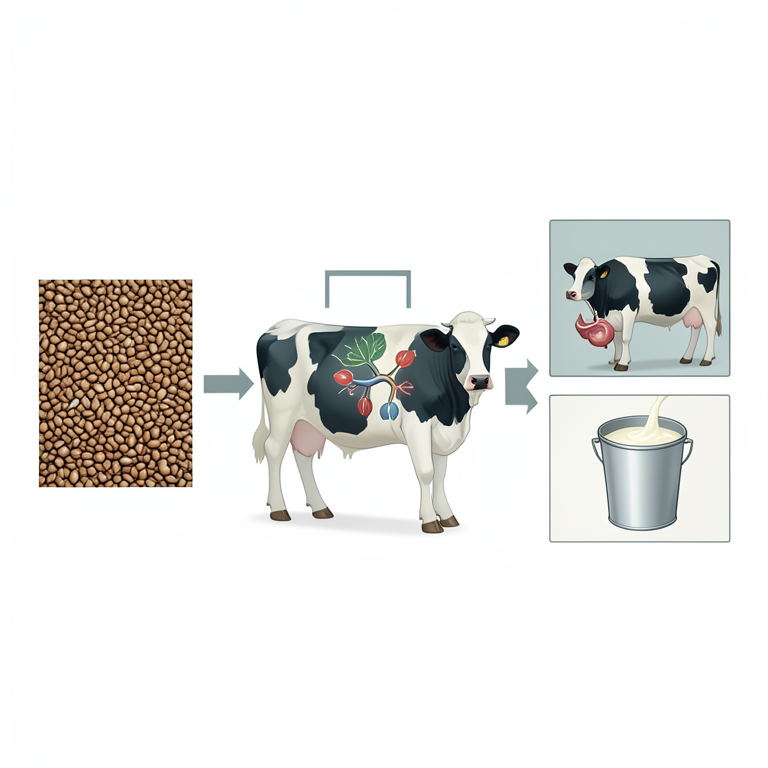
Mechanism of Anionic Supplementation
AI-generated conceptual illustration (Pluriparous dairy cows). It explains the idea and does not show study data.
View source evidence ↗Introduction
The transition period, extending from late gestation through the early postpartum period, is one of the most metabolically demanding phases of the dairy cow's production cycle. During this period, cows undergo marked changes in feed intake, energy balance, mineral metabolism and physiological adaptation to lactation. Among the minerals, calcium is particularly important at parturition because the initiation of colostrum and milk secretion results in a sudden incr in calcium requirement. Failure to maintain calcium homeostasis can result in clinical or subclinical hypocalcaemia. This condition can compromise muscular function and is associated with several postpartum health problems. Manipulation of prepartum dietary cation-anion difference has therefore become an important nutritional approach for transition-cow management. Lowering dietary DCAD produces a mild metabolic acidosis that enhances the physiological mechanisms involved in calcium homeostasis. A large meta-analysis involving 42 experiments and 1,803 cows reported that reducing prepartum DCAD improved blood calcium around calving and reduced the risk of milk fever, retained placenta and metritis. Importantly, the response in milk production was more favourable in parous cows, which directly supports the rationale for evaluating this strategy in pluriparous animals (Santos et al., 2019). [7] More recent experimental evidence continues to support the physiological effect of negative-DCAD diets. Connelly et al. (2024) [1] demonstrated in multiparous cows that prepartum DCAD manipulation altered calcium dynamics around parturition. Similarly, Frizzarini et al.
(2024a) [3] reported that a negative-DCAD diet influenced peripartal mineral and hormonal responses, while Frizzarini et al. (2024b) [2] evaluated effects on feed intake, energy metabolism and milk performance. Recent work comparing anionic supplements also showed that negative-DCAD diets significantly lowered urinary pH, demonstrating their acidogenic effect, although effects on feed intake and production varied according to the formulation and dietary conditions (Rajaeerad et al., 2023) [6] . Therefore, the present study was undertaken to evaluate the effect of Anionic Mishran, an anionic feed supplement, during the transition period on calving performance, calf growth, postpartum reproductive health, milk fever incidence and milk production in pluriparous dairy cows.
Objectives Primary objective
To evaluate the effect of Anionic Mishran supplementation during the transition period on calving performance and early lactation yield in pluriparous dairy cows.
Secondary objectives 1. To assess the effect on placental expulsion time. 2. To assess calf birth weight. 3. To evaluate calf weaning weight. 4. To determine the incidence of metritis/pyometra. 5. To determine the incidence of downer cow/milk fever. 6. To assess daily lactation yield. 7. To evaluate the practical applicability of Anionic Mishran as a transition-cow nutritional intervention.
Experimental Design Animals
Experimental Design Animals
Study period
The intervention should be described precisely according to your actual protocol. Based on your previous study description, you can write: Anionic Mishran supplementation was initiated during the prepartum transition period and continued according to the prescribed feeding schedule until calving. [7,1] . However, the present study did not directly measure blood calcium or urinary pH, so this proposed mechanism should be regarded as biologically plausible rather than directly demonstrated. [7] . More recent work in multiparous Holstein cows has continued to evaluate the relationship between prepartum DCAD strategy, calcium status and milk production (Graef et al., 2025; Frizzarini et al., 2024b) [4,2] . Recent experimental work also demonstrates that the response to prepartum anionic diets can involve changes in mineral metabolism and physiological adaptation around the onset of lactation.
Results Interpretation
Results Interpretation
Calf Birth Weight
Calf Birth Weight
Metritis/Pyometra
Treatment:0/6 = 0% Control:2/6 = 33.3% Reported P = 0.211 Metritis/pyometra incidence was numerically lower in the treatment group (0%) than in the control group (33.3%), although the difference was not statistically significant (P = 0.211)
Downer Cow/Milk Fever
Treatment: 0/6 = 0% Control: 2/6 = 33.3% Reported P = 0.211 The incidence of downer cow/milk fever was numerically lower in the Anionic Mishran group (0%) compared with the control group (33.3%), but the difference was not statistically significant (P = 0.211).
Biological significance
Although statistically non-significant, the complete absence of observed cases in the treatment group is potentially interesting. The finding is directionally consistent with evidence that reducing prepartum DCAD improves calcium status and reduces milk-fever risk, particularly in parous cows (Santos et al., 2019) [7] . Recent research also confirms that periparturient calcium dynamics are associated with postpartum health and inflammatory status in multiparous cows (Graef et al., 2025b) [5] .
Effect on placental expulsion
Anionic Mishran → altered DCAD → acid-base adaptation → improved Ca homeostasis → improved uterine contractility → faster placental expulsion Your result should then be compared with studies reporting reduced retained placenta with lower prepartum DCAD. The meta-analysis by Santos et al. (2019) [7] reported a reduction in retained placenta and metritis with decreasing prepartum DCAD, supporting the biological plausibility of the present observation. Nevertheless, because the present study did not directly measure calcium status, uterine contractility or retained placenta incidence, the proposed mechanism should be discussed cautiously.
Effect on calf growth
Explain that the supplement was targeted primarily at the dam's mineral and acid-base adaptation, and the absence of differences in birth and weaning weights suggests no adverse effect on calf growth.
Effect on milk yield 9.64 vs 8.64 L/day can be discussed alongside the meta-analysis showing improved milk production in parous cows receiving lower prepartum DCAD diets (Santos et al., 2019) [7] . Recent experimental studies in multiparous cows also indicate that prepartum DCAD strategy can influence calcium status and milk production, although responses may depend on the degree of acidification and dietary calcium supply (Frizzarini et al., 2024b; Graef et al., 2025a) [2,4] . Recent work also emphasizes that the effects of anionic diets are not simply attributable to one factor; changes in mineral metabolism, acid-base status, feed intake and metabolic adaptation may collectively influence postpartum performance (Frizzarini et al., 2024a, 2024b; Graef et al., 2025a) [3,2,4] .
Effect on metritis/pyometra
Discuss the 0 vs 33.3% numerical difference cautiously. The literature supports a possible connection between improved calcium homeostasis and reduced postpartum disease risk, but your sample size prevents a strong statistical conclusion.
Effect on milk fever/downer cow 0% vs 33.3% but statistically non-significant. A larger study is needed.
Key Limitation
The major limitation of the present study was the small sample size (n = 6 per group), which may have limited the statistical power to detect differences in low-frequency postpartum disorders."
References
7 in the original paper- Connelly MK, Rodney Harris RM, Kuehnl J. Influence of prepartum dietary cation-anion difference and the magnitude of calcium decline at the onset of lactation on mineral metabolism and physiological responses. J Dairy Sci. 2024;107(2):1228-1243. https://doi.org/10.3168/jds.2023-23588
- Frizzarini WS, Campolina JP, Vang AL, Lewandowski LR, Teixeira NN, Connelly MK, et al. Mechanisms by which feeding synthetic zeolite A and dietary cationanion difference diets affect feed intake, energy metabolism, and milk performance: Part II. J Dairy Sci. 2024;107(7):5222-5234. https://doi.org/10.3168/jds.2024-24057
- Frizzarini WS, Monteiro PLJ, Campolina JP, Vang AL, Soudah O, Lewandowski LR, et al. Mechanisms by which feeding synthetic zeolite A and dietary cationanion difference diets affect mineral metabolism in multiparous Holstein cows: Part I. J Dairy Sci. 2024;107(7):5204-5221. https://doi.org/10.3168/jds.2024-24056
- Graef GM, Kerwin AL, Ferro LN, Ordaz-Puga S, Ryan CM, Westhoff TA, et al. Effect of prepartum dietary cation-anion difference strategy and level of dietary calcium on postpartum blood calcium status and milk production of multiparous Holstein cows. J Dairy Sci. 2025;108(8):8332-8349. https://doi.org/10.3168/jds.2024-25783
- Graef GM, Sipka A, Tompkins S, Seely CR, McArt JAA, Overton TR. Associations between periparturient calcium dynamics of multiparous Holstein cows and inflammation markers during the transition period. J Dairy Sci. 2025;108(10):11389-11402. https://doi.org/10.3168/jds.2024-25979
- Rajaeerad A, Ghorbani GR, Khorvash M, SadeghiSefidmasgi A, Mahdavi AH, Boroumand Jazi M, et al. Comparison of two different anionic supplements and a low calcium diet fed to transition cows prepartum on DM intake, mineral homoeostasis and performance. Animal. 2023;17(10):100961. https://doi.org/10.1016/j.animal.2023.100961
- Santos JEP, Lean IJ, Golder H, Block E. Meta-analysis of the effects of prepartum dietary cation-anion difference on performance and health of dairy cows. J Dairy Sci. 2019;102(3):2134-2154. https://doi.org/10.3168/jds.2018-14628