
Research article · 2026 · Full text
International Journal of Horticulture and Food ScienceEffect of Pusa hydrogel and plant growth regulators on water use efficiency in strawberry (Fragaria × ananassa duch.) cv. Chandler
Volume 8(8) · Pages 59–62 · DOI: 10.33545/26631067.2026.v8.i8a.839 ↗
Research areasBerry genetics and cultivation researchPolymer-Based Agricultural EnhancementsIrrigation Practices and Water Management
Abstract
Author-writtenIntroduction: Hydrogels are water-absorbing polymers capable of retaining and gradually releasing large quantities of water, making them particularly useful in drought-prone and sandy soils. Pusa Hydrogel, developed by ICAR-IARI, helps conserve soil moisture, reduce nutrient leaching, and improve crop performance under water-limited conditions. Its integration with plant growth regulators (PGRs) may further enhance growth, yield, and water use efficiency in strawberry cultivation. Aim and Objectives: The study aimed to evaluate the effects of Pusa Hydrogel on vegetative growth, flowering, fruiting, yield, fruit quality, water use efficiency, and economic returns of strawberry cv. Chandler. Methods: A field experiment was conducted during 2021-22 and 2022-23 at the Central Research Farm, Department of Horticulture, Shri Durga Ji Post Graduate College, Azamgarh, Uttar Pradesh. The experiment was laid out in a Randomized Block Design with 27 treatment combinations involving Pusa Hydrogel, Cycocel, Triacontanol, their combinations, and a control, replicated three times. Results: Significant differences in water use efficiency (WUE) were observed among treatments. The highest WUE was recorded in T20 (Triacontanol 170 ppm + Pusa Hydrogel 60 g), with values of 0.496, 0.503, and 0.500 t ha⁻¹ cm⁻¹ during 2021-22, 2022-23, and pooled analysis, respectively. T12 (Triacontanol 120 ppm + Pusa Hydrogel 60 g) ranked second. The lowest WUE was observed in T4 (Cycocel 1200 ppm). Enhanced moisture retention and efficient water utilization contributed to superior performance under hydrogel-based treatments. Conclusion: The combined application of Triacontanol (170 ppm) and Pusa Hydrogel (60 g plant⁻¹) significantly improved water use efficiency, growth, yield, fruit quality, and profitability in strawberry cv. Chandler and is recommended for commercial cultivation under Eastern Uttar Pradesh conditions.
Summary
Source-checkedPlain-language reading of the full paper, prepared with AI and checked against the text. Each point links to the authors' own words.
Why it matters
- Hydrogels are polymers that can absorb and slowly release large amounts of water, which is beneficial for sandy soils or areas prone to drought. View evidence ↗
- Pusa Hydrogel, created by ICAR-IARI, is used to maintain soil moisture, prevent nutrients from leaching, and boost crop performance when water is scarce. View evidence ↗
- Plant Growth Regulators (PGRs), including triacontanol and cycocel, are used to manage various physiological functions in plants. View evidence ↗
The question
- The research aimed to determine how Pusa Hydrogel affects the growth, yield, fruit quality, water use efficiency, and economic returns of the strawberry cultivar 'Chandler'. View evidence ↗
What they did
- The field experiment took place in Azamgarh, Uttar Pradesh, over two periods: 2021-22 and 2022-23. View evidence ↗
- The study used a Randomized Block Design with three replicates and 27 different treatment combinations of Pusa Hydrogel, Cycocel, Triacontanol, and a control group. View evidence ↗
- Water use efficiency (WUE) was measured as the ratio of fruit yield (t ha⁻¹) to the total depth of water applied (cm). View evidence ↗
What they found
- The highest water use efficiency was achieved by treatment T20 (Triacontanol 170 ppm + Pusa Hydrogel 60 g), with values of 0.496 t ha⁻¹ cm⁻¹ (2021-22), 0.503 t ha⁻¹ cm⁻¹ (2022-23), and 0.500 t ha⁻¹ cm⁻¹ (pooled). View evidence ↗
- The lowest water use efficiency was observed in treatment T4 (Cycocel 1200 ppm), with values of 0.269, 0.239, and 0.254 t ha⁻¹ cm⁻¹. View evidence ↗
- There were statistically significant differences in water use efficiency across the various treatment combinations. View evidence ↗
What it means
- The authors recommend using a combination of 170 ppm Triacontanol and 60 g Pusa Hydrogel per plant for commercial strawberry cultivation in Eastern Uttar Pradesh to maximize productivity and profit. View evidence ↗
- The authors conclude that Triacontanol and Pusa Hydrogel work synergistically to improve crop performance by enhancing nutrient uptake and moisture availability. View evidence ↗
Visual summary
2 visualsIllustrations explain the paper; charts are replotted from the paper's own table values.
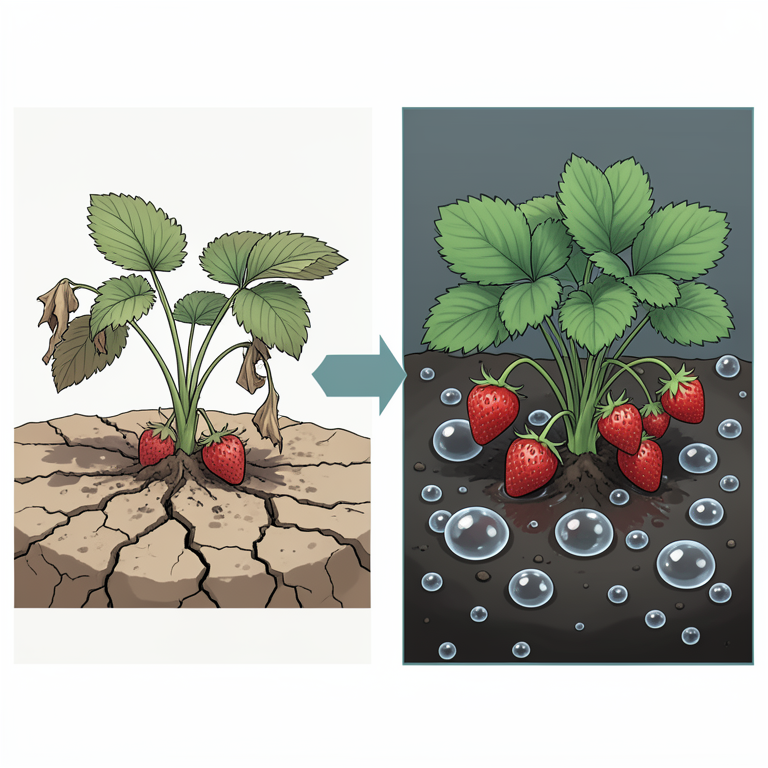
Synergistic Effect Concept
AI-generated conceptual illustration (strawberry plants (Fragaria x ananassa cv. Chandler)). It explains the idea and does not show study data.
View source evidence ↗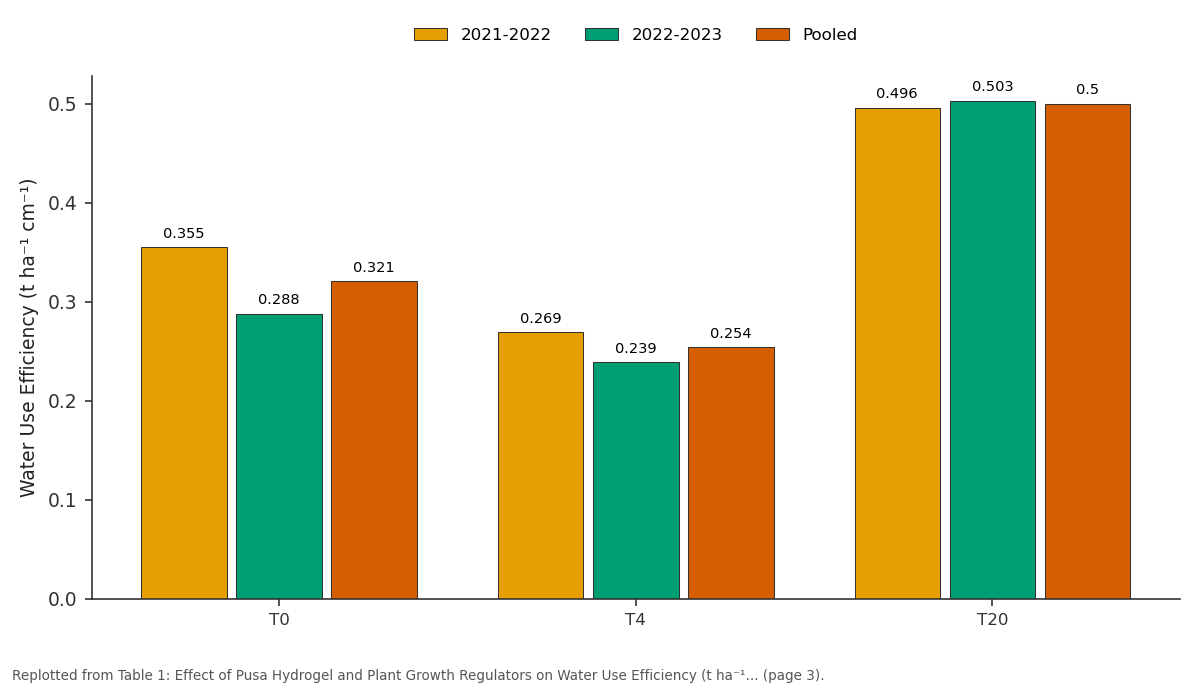
2021-2022 and 2022-2023 and more: T0 vs T4 vs T20
Replotted from Table 1 (page 3) of the original paper. Every bar is the paper's own table value.
View source evidence ↗Figures & tables
From the original paper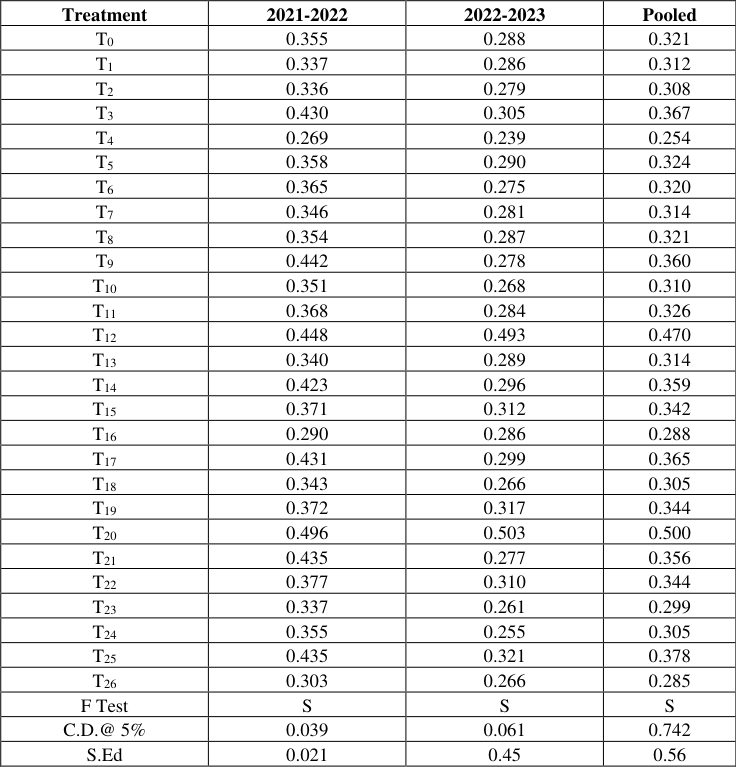 Table 1
Introduction
Hydrogels are water-absorbing polymers capable of retaining and gradually releasing large quantities of water, making them particularly useful in drought-prone and sandy soils. Pusa Hydrogel, developed by ICAR-IARI, helps conserve soil moisture, reduce nutrient leaching, and improve crop performance under water-limited conditions. Its integration with plant growth regulators (PGRs) may further enhance growth, yield, and water use efficiency in strawberry cultivation. Aim and Objectives: The study aimed to evaluate the effects of Pusa Hydrogel on vegetative growth, flowering, fruiting, yield, fruit quality, water use efficiency, and economic returns of strawberry cv.
Chandler.
Methods
A field experiment was conducted during 2021-22 and 2022-23 at the Central Research Farm, Department of Horticulture, Shri Durga Ji Post Graduate College, Azamgarh, Uttar Pradesh. The experiment was laid out in a Randomized Block Design with 27 treatment combinations involving Pusa Hydrogel, Cycocel, Triacontanol, their combinations, and a control, replicated three times.
Results
Significant differences in water use efficiency (WUE) were observed among treatments. The highest WUE was recorded in T20 (Triacontanol 170 ppm + Pusa Hydrogel 60 g), with values of 0.496, 0.503, and 0.500 t ha⁻¹ cm⁻¹ during 2021-22, 2022-23, and pooled analysis, respectively. T12 (Triacontanol 120 ppm + Pusa Hydrogel 60 g) ranked second. The lowest WUE was observed in T4 (Cycocel 1200 ppm).
Enhanced moisture retention and efficient water utilization contributed to superior performance under hydrogel-based treatments.
Conclusion
The combined application of Triacontanol (170 ppm) and Pusa Hydrogel (60 g plant⁻¹) significantly improved water use efficiency, growth, yield, fruit quality, and profitability in strawberry cv. Chandler and is recommended for commercial cultivation under Eastern Uttar Pradesh conditions. Keywords: Strawberry, pusa hydrogel, triacontanol, water use efficiency, plant growth regulators, chandler
Introduction
One promising approach involves the application of Pusa Hydrogel, a superabsorbent polymer innovated by the Indian Agricultural Research Institute (IARI). This biodegradable hydrogel can retain up to 300 times its weight in water, providing a sustained moisture supply to the root zone, even under limited irrigation conditions. By improving the soil’s water-holding capacity and minimizing evaporation losses, Pusa Hydrogel helps alleviate moisture stress and enhances overall plant performance. Likewise, the application of Plant Growth Regulators (PGRs) such as gibberellic acid, cycocel (chlormequat chloride), and triacontanol plays a significant role in regulating plant physiological functions.
These regulators influence flowering, fruit formation, cell elongation, and nutrient uptake, thereby leading to higher yields and better fruit quality. Although both Pusa Hydrogel and PGRs have shown individual efficacy in strawberry cultivation, there is a lack of comprehensive studies examining their combined effects. Exploring the synergistic interaction between these two inputs offers a novel opportunity to optimize strawberry production through improved plant vigor, higher yield potential, and superior fruit quality. This study is therefore timely and relevant, as it addresses two major constraints - water scarcity and low productivity - faced by strawberry growers.
The anticipated outcomes aim to guide sustainable and resource-efficient cultivation practices, leading to better economic returns for farmers and contributing to environmentally sound horticultural development. Furthermore, the findings have broader implications for advancing climate-resilient and eco-friendly fruit production systems in India and beyond. NAAS Rating (2026): 4.74 IJHFS 2026; 8(8): 59-62 Abhay Kumar Bhardwaj PhD Scholar, Department of Horticulture, Shri Durga Ji Post Graduate College, Chandeshwar, Azamgarh, Uttar Pradesh, India Shailandra Vikram Singh Associate Professor, Department of Horticulture, Shri Durga Ji Post Graduate College, Chandeshwar, Azamgarh, Uttar Pradesh, India Abhay Kumar Bhardwaj PhD Scholar, Department of Horticulture, Shri Durga Ji Post Graduate College, Chandeshwar, Azamgarh, Uttar Pradesh, India https://www.hortijournal.com hydrogel and plant growth regulators on strawberry cultivation under Eastern U.P.'s agro-climatic conditions. Observations to be recorded Water use efficiency Treatment detail
Materials And Methods
The present investigation titled “Effect of Pusa Hydrogel and Plant Growth Regulators on Growth, Yield and Quality Parameters of Strawberry (Fragaria × ananassa Duch.) cv. Chandler” was conducted during 2021-22 and 2022-23 at the Research Field of the Department of Horticulture, Shri Durga Ji Post Graduate College, Chandeshwar, Azamgarh, Uttar Pradesh. The study aimed to evaluate the impact of Duch.) cv. Chandler.
The experimental details are given below. Effect of pusa hydrogel and plant growth regulators on water use efficiency The effect of different treatments (Pusa Hydrogel, Cycocel, and Triacontanol) was assessed in terms of water use efficiency, calculated as the ratio of yield obtained in a particular treatment to the total depth of water applied. As shown in Table 1, significant differences among treatments were observed in the first year, second year, and pooled data. The maximum water use efficiency - 0.496, 0.503, and 0.500 t ha⁻¹ cm⁻¹ in 2021-22, 2022-23, and pooled data, respectively - was recorded in T20 (Triacontanol 170 ppm + Pusa Hydrogel 60 g), followed by T12 (Triacontanol 120 ppm + Pusa Hydrogel 60 g) with values of 0.448, 0.493, and 0.470 t ha⁻¹ cm⁻¹, respectively, which was statistically at par with T20.
| Treatment | 2021-2022 | 2022-2023 | Pooled |
|---|---|---|---|
| T0 | 0.355 | 0.288 | 0.321 |
| T1 | 0.337 | 0.286 | 0.312 |
| T2 | 0.336 | 0.279 | 0.308 |
| T3 | 0.430 | 0.305 | 0.367 |
| T4 | 0.269 | 0.239 | 0.254 |
| T5 | 0.358 | 0.290 | 0.324 |
| T6 | 0.365 | 0.275 | 0.320 |
| T7 | 0.346 | 0.281 | 0.314 |
| T8 | 0.354 | 0.287 | 0.321 |
| T9 | 0.442 | 0.278 | 0.360 |
| T10 | 0.351 | 0.268 | 0.310 |
| T11 | 0.368 | 0.284 | 0.326 |
| T12 | 0.448 | 0.493 | 0.470 |
| T13 | 0.340 | 0.289 | 0.314 |
| T14 | 0.423 | 0.296 | 0.359 |
| T15 | 0.371 | 0.312 | 0.342 |
| T16 | 0.290 | 0.286 | 0.288 |
| T17 | 0.431 | 0.299 | 0.365 |
| T18 | 0.343 | 0.266 | 0.305 |
| T19 | 0.372 | 0.317 | 0.344 |
| T20 | 0.496 | 0.503 | 0.500 |
| T21 | 0.435 | 0.277 | 0.356 |
| T22 | 0.377 | 0.310 | 0.344 |
| T23 | 0.337 | 0.261 | 0.299 |
| T24 | 0.355 | 0.255 | 0.305 |
| T25 | 0.435 | 0.321 | 0.378 |
| T26 | 0.303 | 0.266 | 0.285 |
| F Test | S | S | S |
| C.D.@ 5% | 0.039 | 0.061 | 0.742 |
| S.Ed | 0.021 | 0.45 | 0.56 |
Table text extracted from the original PDF; superscript letters are shown inline. The original table image is below.
View original table image
The minimum water use efficiency - 0.269, 0.239, and 0.254 t ha⁻¹ cm⁻¹, respectively - was recorded in T4 (Cycocel 1200 ppm). Notation Treatment Details T0 Control T1 Pusa Hydrogel - 30 g T2 Pusa Hydrogel - 60 g T3 Cycocel (600 ppm) T4 Cycocel (1200 ppm) T5 Triacontanol (120 ppm) T6 Triacontanol (170 ppm) T7 Cycocel (600 ppm) + Pusa Hydrogel 30 g T8 Cycocel (600 ppm) + Pusa Hydrogel 60 g T9 Cycocel (1200 ppm) + Pusa Hydrogel 30 g T10 Cycocel (1200 ppm) + Pusa Hydrogel 60 g T11 Triacontanol (120 ppm) + Pusa Hydrogel 30 g T12 Triacontanol (120 ppm) + Pusa Hydrogel 60 g T13 Triacontanol (120 ppm) + Cycocel (600 ppm) T14 Triacontanol (120 ppm) + Cycocel (600 ppm) + Pusa Hydrogel 30 g T15 Triacontanol (120 ppm) + Cycocel (600 ppm) + Pusa Hydrogel 60 g T16 Triacontanol (120 ppm) + Cycocel (1200 ppm) T17 Triacontanol (120 ppm) + Cycocel (1200 ppm) + Pusa Hydrogel 30 g T18 Triacontanol (120 ppm) + Cycocel (1200 ppm) + Pusa Hydrogel 60 g T19 Triacontanol (170 ppm) + Pusa Hydrogel 30 g T20 Triacontanol (170 ppm) + Pusa Hydrogel 60 g T21 Triacontanol (170 ppm) + Cycocel (600 ppm) T22 Triacontanol (170 ppm) + Cycocel (600 ppm) + Pusa Hydrogel 30 g T23 Triacontanol (170 ppm) + Cycocel (600 ppm) + Pusa Hydrogel 60 g T24 Triacontanol (170 ppm) + Cycocel (1200 ppm) T25 Triacontanol (170 ppm) + Cycocel (1200 ppm) + Pusa Hydrogel 30 g T26 Triacontanol (170 ppm) + Cycocel (1200 ppm) + Pusa Hydrogel 60 g Calculation of water use efficiency Water use efficiency (WUE) was calculated as the ratio of fruit yield to the total quantity of water applied, using the formula: WUE (t ha⁻¹ cm⁻¹) = Fruit yield (t ha⁻¹) ÷ Total water applied (cm)
Results And Discussion
The results of the studies on the “Effect of Pusa Hydrogel and Plant Growth Regulators on Vegetative Growth, Fruit Yield and Quality of Strawberry (Fragaria × ananassa Duch.) cv. Chandler” are briefly described hereunder. Two field experiments were carried out during 2021-22 and 2022-23 at the Research Field, Department of Horticulture, Shri Durga Ji Post Graduate College, Chandeshwar, Azamgarh (U.P.). This study was undertaken to examine the influence of Pusa Hydrogel and plant growth regulators on water use efficiency of strawberry (Fragaria × ananassa https://www.hortijournal.com Table 1: Effect of Pusa Hydrogel and Plant Growth Regulators on Water Use Efficiency (t ha⁻¹ cm⁻¹) of Strawberry (Fragaria × ananassa Duch.) cv.
Chandler Indian Horticulture. 2013;58(4):18-21. 3. Dorraji SS, Golchin A, Ahmadi S. The effects of hydrophilic polymer and soil salinity on corn growth in sandy and loamy soils. Clean - Soil, Air, Water. 2010;38(7):584-591. 4.
Kumar R, Kumar A, Meena RL. Effect of hydrogel on growth and survival of aonla (Emblica officinalis) under arid conditions. Progressive Horticulture. 2014;46(1):91-95. 5. Vyas SP, Patel BM, Sharma HG.
Influence of super absorbent polymer on growth and yield of guava (Psidium guajava L.). International Journal of Chemical Studies. 2017;5(5):1223-1226. 6. Rao KVR, Reddy KMC, Reddy PS. Effect of hydrogel on growth, yield and water use efficiency in mango orchards.
Journal of Horticultural Sciences. 2016;11(2):137-142. 7. Saxena A, Singh D, Singh RK. Impact of Pusa Hydrogel on soil moisture conservation and growth of citrus under semi-arid conditions. Journal of Applied and Natural Science. 2018;10(2):613-618. 8.
ICAR-Indian Agricultural Research Institute. Pusa Treatment 2021-2022 2022-2023 Pooled T0 0.355 0.288 0.321 T1 0.337 0.286 0.312 T2 0.336 0.279 0.308 T3 0.430 0.305 0.367 T4 0.269 0.239 0.254 T5 0.358 0.290 0.324 T6 0.365 0.275 0.320 T7 0.346 0.281 0.314 T8 0.354 0.287 0.321 T9 0.442 0.278 0.360 T10 0.351 0.268 0.310 T11 0.368 0.284 0.326 T12 0.448 0.493 0.470 T13 0.340 0.289 0.314 T14 0.423 0.296 0.359 T15 0.371 0.312 0.342 T16 0.290 0.286 0.288 T17 0.431 0.299 0.365 T18 0.343 0.266 0.305 T19 0.372 0.317 0.344 T20 0.496 0.503 0.500 T21 0.435 0.277 0.356 T22 0.377 0.310 0.344 T23 0.337 0.261 0.299 T24 0.355 0.255 0.305 T25 0.435 0.321 0.378 T26 0.303 0.266 0.285 F Test S S S C.D.@ 5% 0.039 0.061 0.742 S.Ed 0.021 0.45 0.56
Conclusion
The present investigation clearly demonstrated that the application of Pusa Hydrogel and Plant Growth Regulators significantly influenced the growth, flowering, fruiting, yield, quality, and economics of strawberry cv. Chandler. Among all treatment combinations, T20 (Triacontanol 170 ppm + Pusa Hydrogel 60 g) proved to be the most effective, producing the maximum water use efficiency in strawberry. The synergistic effect of Triacontanol and Pusa Hydrogel enhanced moisture availability, nutrient uptake, and physiological activities, resulting in improved crop performance.
Therefore, the combined application of Triacontanol at 170 ppm and Pusa Hydrogel at 60 g per plant is recommended for commercial cultivation of strawberry cv. Chandler to achieve higher productivity, better fruit quality, and maximum profitability under the agro-climatic conditions of Eastern Uttar Pradesh. Competing interests Authors have declared that no competing interests exist.
References
9 in the original paper- Choudhary M, Mali SS, Yadav RL. Effect of hydrogel Hydrogel: A new technology for enhancing water use efficiency. New Delhi: Division of Agricultural Physics, ICAR-Indian Agricultural Research Institute; 2011.
- Bhardwaj AK, Shainberg I, Goldstein D, Warrington on growth and yield of fruit crops under water stress conditions. Indian Journal of Horticulture. 2015;72(3):456-460.
- Singh AK, Singh S, Sharma RR. Water management DN, Levy GJ. Water retention and hydraulic through hydrogel application in horticultural crops. https://www.hortijournal.com conductivity of cross-linked polyacrylamides in sandy soils. Soil Science Society of America Journal. 2007;71(2):406-412.
- Meena HR, Sharma SK, Sharma KC. Effect of hydrogel on growth and nutrient uptake of pomegranate (Punica granatum L.). Annals of Agricultural Research. 2015;36(4):421-425.
- Kumar P, Yadav RK, Singh V. Effect of super absorbent polymers on growth, yield and quality of strawberry under water deficit conditions. International Journal of Current Microbiology and Applied Sciences. 2019;8(7):2412-2419.
- Patel N, Patel P, Patel R. Influence of hydrogel application on growth and yield of papaya (Carica papaya L.). International Journal of Agricultural Sciences. 2017;13(2):253-256.
- Narjary B, Aggarwal P, Singh AK, Chakraborty D, Singh R. Water availability in different soils in relation to hydrogel application. Geoderma. 2012;187-188:94- 101.
- Rana G, Kumar S, Sharma N. Evaluation of Pusa Hydrogel for improving water productivity and fruit yield in ber (Ziziphus mauritiana). Indian Journal of Agricultural Sciences. 2020;90(8):1482-1487.
- ICAR-Indian Agricultural Research Institute. Pusa Hydrogel: Technology bulletin for moisture conservation in agriculture and horticulture. New Delhi: ICAR-Indian Agricultural Research Institute; 2018.
Cited by 1
From OpenAlex, OpenCitations and reference lists read by Scinovex
- Effect of Pusa Hydrogel and Plant Growth Regulators on Fruiting, Yield, Fruit Quality and Economics of Strawberry (Fragaria × ananassa Duch.) cv. Chandler ↗
Abhay Kumar Bhardwaj, Shailandra Vikram Singh · International Journal of Science and Engineering Science Research · 2026
A treatment that produces vigorous plants and conserves irrigation water is not automatically the treatment a grower should adopt; that decision ultimately rests on how many fruits reach the crate, how good they taste, and whether the extra input pays for itself. These are the questions the present study addresses. Building on a two-season field trial that has already established…
❝ 0PDF