
Research article · 2026 · Full text
International Journal of Agriculture and NutritionMarket share analysis and farmers’ perception of BPG-100 (BGMH-9101) maize hybrid of booster plant genetics Pvt. Ltd. in Nagpur district
Volume 8(8) · Pages 115–118 · DOI: 10.33545/26646064.2026.v8.i8b.741 ↗
Research areasAgricultural Economics and PracticesGenetically Modified Organisms ResearchAgricultural Innovations and Practices
Abstract
Author-writtenThe present investigation, entitled “Market Share Analysis and Farmers’ Perception of BPG-100 (BGMH-9101) Maize Hybrid of Booster Plant Genetics Pvt. Ltd. in Nagpur District,” was undertaken during 2025-26 to determine the market share of the BPG-100 (BGMH-9101) maize hybrid and evaluate farmers’ perceptions of its performance. The study was conducted in Kuhi and Umred talukas of Nagpur district, Maharashtra, involving fifty randomly selected maize-growing farmers interviewed using a structured schedule. Secondary information regarding maize seed sales of Booster Plant Genetics Pvt. Ltd. and competing companies was obtained from company records and local dealers, whereas primary information concerning farmers’ perceptions was gathered directly from the selected respondents. Market share was calculated using the percentage method, while farmers’ perceptions were measured through a five-point Likert scale and evaluated using the Weighted Mean Score (WMS) technique. The findings indicated that BPG-100 (BGMH-9101) accounted for a market share of 4.94 per cent, representing 123 bags or 492 kg, out of the total maize seed market of 2,492 bags (9,968 kg) in the study area. This was the lowest share among the major branded companies considered, following others/Local Brands (22.51%), Other Companies (20.63%), Advanta (16.85%), Bayer (15.85%), Pioneer (9.95%) and Syngenta (9.27%). Within the company's overall seed sales, maize contributed only 0.90 per cent, while soybean accounted for 96.02 per cent. Regarding farmers’ perceptions, Shelling Percentage (85%) emerged as the most positively evaluated performance attribute, with a WMS of 3.16 and Rank I, followed by Higher Yield (WMS = 3.00) and Grain Quality/High Test Weight (WMS = 2.92), whereas Uniform Cob Size received the lowest score (WMS = 2.88). Among agronomic and adaptability characteristics, Suitability for Nagpur Climate obtained the highest WMS of 3.42 (Rank I), followed by Disease Tolerance (WMS = 2.90) and Drought Tolerance (WMS = 2.84), while Early Vigour recorded the lowest score (WMS = 2.58). The study concludes that although BPG-100 (BGMH-9101) currently commands a relatively small market share, it has a moderately favourable perception among farmers, especially with respect to climatic adaptability and grain characteristics. This indicates considerable potential for expanding its market presence through a stronger dealer network, focused field demonstrations and enhanced farmer awareness.
Summary
Source-checkedPlain-language reading of the full paper, prepared with AI and checked against the text. Each point links to the authors' own words.
Why it matters
- Maize is a critical cereal crop in India due to its high productivity and diverse uses in food, animal feed, and industrial sectors. View evidence ↗
- Maharashtra is a leading producer of maize in India, accounting for approximately 11% of the national output. View evidence ↗
- Private seed companies are essential for increasing maize productivity by developing hybrids tailored to specific local climates. View evidence ↗
What they did
- Market share data was derived from secondary sources, including company records and local seed dealer reports. View evidence ↗
- Farmer perceptions were measured using a five-point Likert scale and analyzed using the Weighted Mean Score (WMS) technique. View evidence ↗
What they found
- BPG-100 held a 4.94% market share (492 kg) of the total 9,968 kg maize seed market in the study area. View evidence ↗
- BPG-100 had the lowest market share among the major brands, with Local Brands (22.51%) and Other Companies (20.63%) leading the market. View evidence ↗
- Within Booster Plant Genetics' own portfolio, maize (BPG-100) represented only 0.90% of sales, while soybean dominated at 96.02%. View evidence ↗
- Among variety performance, farmers rated Shelling Percentage (85%) highest (WMS 3.16), while Uniform Cob Size was rated lowest (WMS 2.88). View evidence ↗
- For agronomic traits, Suitability for Nagpur Climate was the most valued (WMS 3.42), whereas Early Vigour was the least favorable (WMS 2.58). View evidence ↗
What it means
- The authors conclude that there is untapped potential for BPG-100 because farmers perceive it favorably despite its current low market share. View evidence ↗
- The authors recommend expanding market presence through enhanced farmer awareness, focused field demonstrations, and a stronger dealer network. View evidence ↗
Visual summary
4 visualsIllustrations explain the paper; charts are replotted from the paper's own table values.
Market Share Distribution
AI-generated conceptual illustration (maize plants). It explains the idea and does not show study data.
View source evidence ↗
Farmer Perception Ranking
AI-generated conceptual illustration (maize plants (Zea mays)). It explains the idea and does not show study data.
View source evidence ↗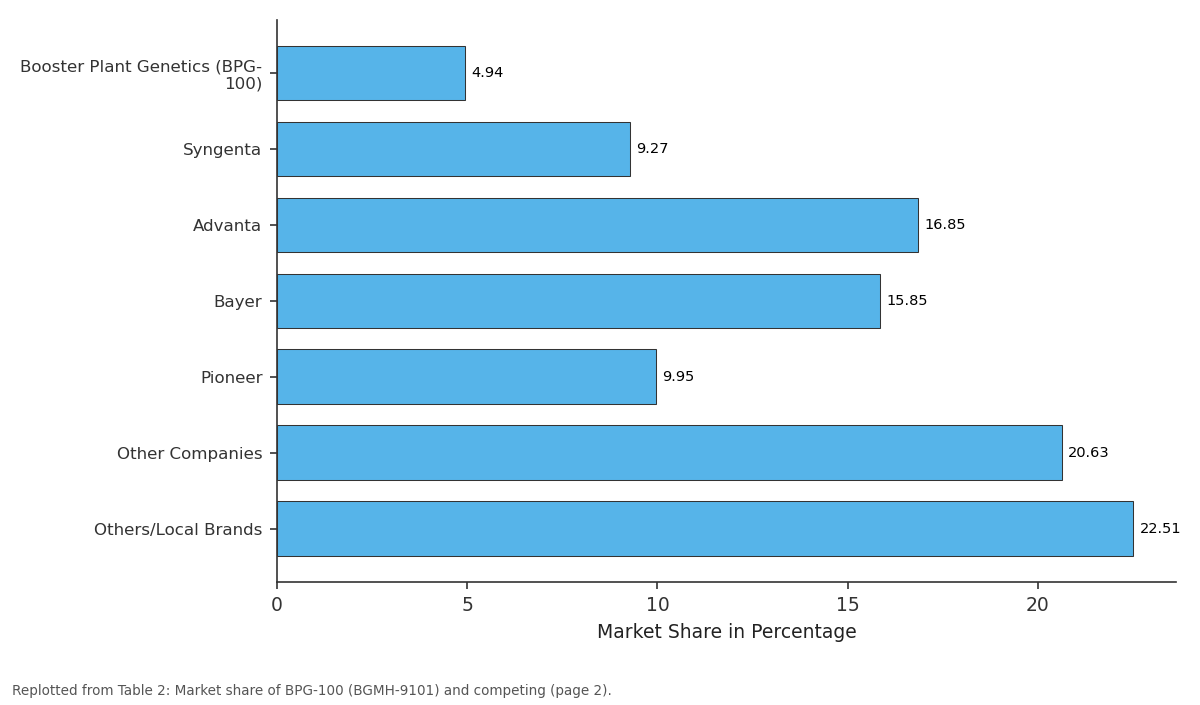
Market Share of Competitive Brands in Maize...: Booster Plant Genetics... vs Syngenta vs Advanta vs Bayer vs Pioneer
Replotted from Table 2 (page 2) of the original paper. Every bar is the paper's own table value.
View source evidence ↗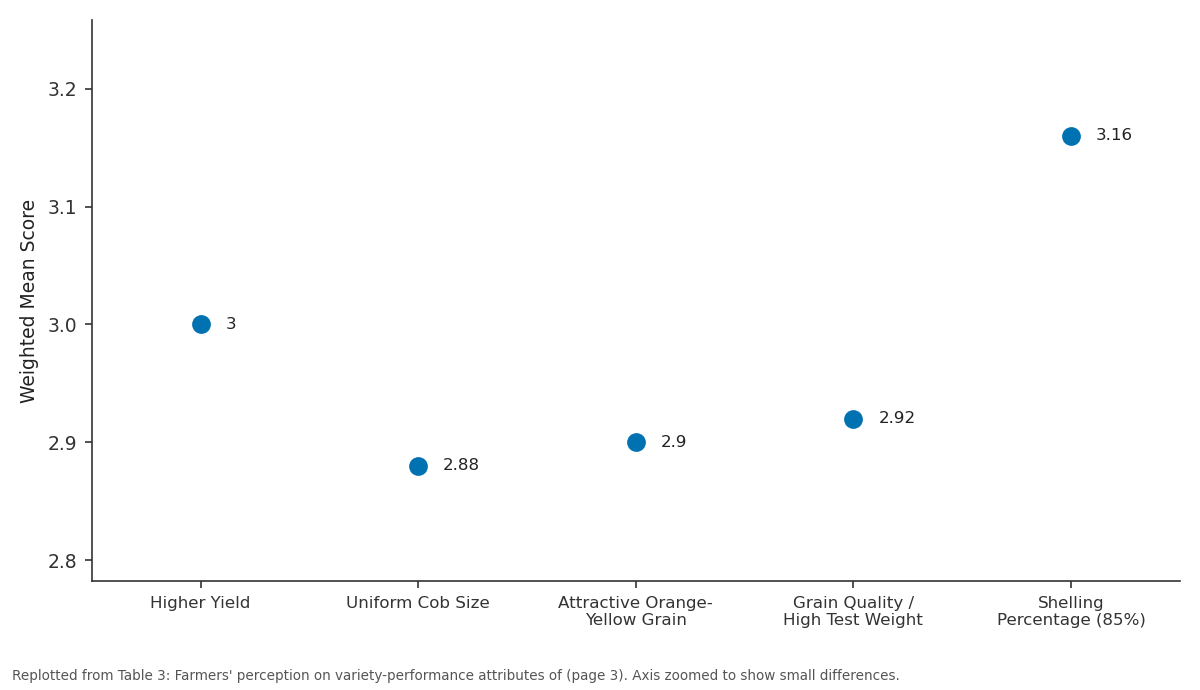
Weighted Mean Score: Higher Yield vs Uniform Cob Size vs Attractive... vs Grain Quality / High... vs Shelling Percentage...
Replotted from Table 3 (page 3) of the original paper. Every bar is the paper's own table value.
View source evidence ↗Figures & tables
From the original paper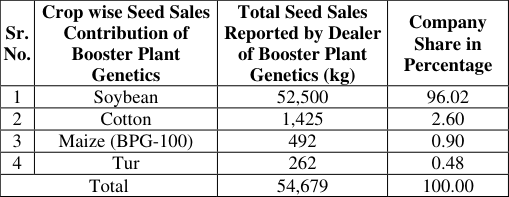 Table 1
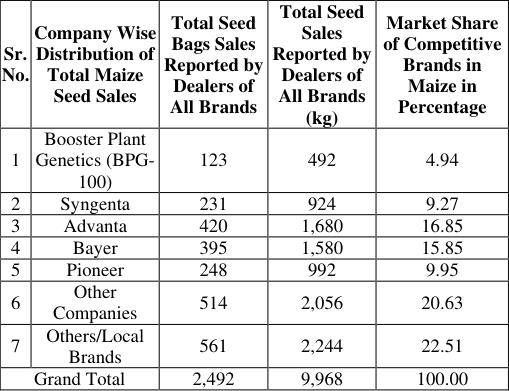 Table 2
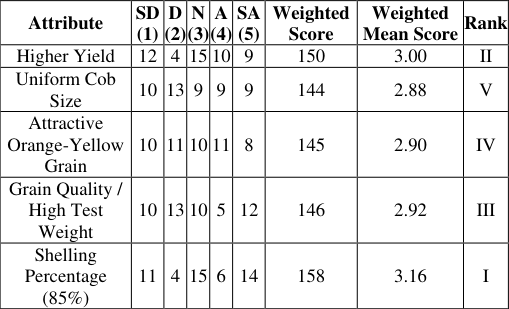 Table 3
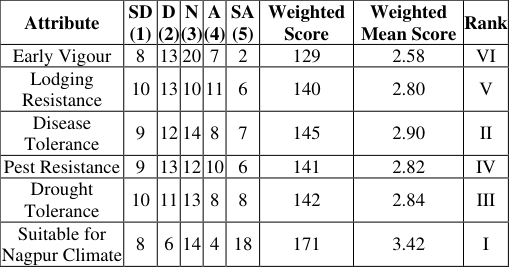 Table 4
Introduction
Maize (Zea mays L.) is one of the most important cereal crops in India, valued for its wide adaptability, high productivity and multiple end-uses spanning human food, poultry and animal feed, starch and ethanol industries. Maharashtra ranks among the top three maizeproducing states in the country, contributing nearly 11 per cent of national maize production, with Vidarbha, Marathwada, Western Maharashtra and Khandesh being the major growing regions. Within Vidarbha, Nagpur district has increasingly witnessed the adoption of singlecross hybrid maize, supported by rising demand from the poultry, feed and ethanol sectors and a favourable minimum support price. The private hybrid seed sector plays a central role in improving maize productivity by continuously introducing improved hybrids suited to local agro-climatic conditions. Booster Plant Genetics Pvt. Ltd., operating under the Paris Group of Companies, is one such research-driven seed company that has introduced the maize hybrid BPG-100 (BGMH-9101) for cultivation in the Nagpur region, alongside its existing portfolio of soybean, cotton and pigeon pea seeds. In a market crowded with several established multinational and domestic
Methodology Study area and sampling design
The present study was conducted in Nagpur district of the Vidarbha region of Maharashtra, purposively selected on the basis of the concentration of maize growers cultivating the BPG-100 (BGMH-9101) hybrid. Out of the district, two maize-growing talukas, viz., Kuhi and Umred, were selected. From these two talukas, thirteen villages (six from Kuhi and seven from Umred) were selected, and fifty maizegrowing farmers were selected through simple random sampling -twenty-five each from Kuhi and Umredconstituting the total sample for the study. The study pertains to the agricultural year 2025-26. Secondary data relating to the total maize seed sales of all companies operating in the study area, as well as the sales of BPG-100 (BGMH-9101), were collected from seed dealers and company records. Primary data on farmers' perception of the hybrid's performance were collected from the fifty selected farmers through personal interviews using a specially designed structured interview schedule.
Farmers' perception of BPG-100 (BGMH-9101) hybrid
Farmers' perception regarding the performance of BPG-100 (BGMH-9101) was assessed using a five-point Likert scale (Strongly Agree = 5, Agree = 4, Neutral = 3, Disagree = 2, Strongly Disagree = 1) across a set of variety-performance and crop-performance statements. The perception was quantified using the Weighted Mean Score (WMS), computed as:
Where, f = frequency of farmers selecting a particular response; w = weight assigned to the response (1-5); and N = total number of respondents. Statements were ranked in descending order of their WMS, with the highest score assigned Rank I, indicating the most favourable perception.
Results and Discussion 1. Market Share of BPG-100 (BGMH-9101) Maize Hybrid
Market share reflects the proportion of total sales in a market accounted for by a particular company, brand or product, and is an important indicator of competitive position. The market share of BPG-100 (BGMH-9101) was assessed both in relation to the company's own product portfolio and in relation to competing maize seed brands operating in the study area. Table 1 shows that within the company's own seed portfolio, soybean was overwhelmingly dominant, accounting for 96.02 per cent (52,500 kg) of total sales, followed by cotton (2.60%). The maize hybrid BPG-100 (BGMH-9101) contributed only 0.90 per cent (492 kg) to total company sales, while tur varieties together contributed the lowest share (0.48%). This indicates that maize currently occupies a comparatively small, though strategically important, segment within the company's overall business, with considerable room for expansion relative to its established soybean business. Table 3 shows that farmers held a moderately favorable perception of BPG-100 (BGMH-9101) with respect to its variety-performance attributes. Shelling Percentage (85%) received the highest Weighted Mean Score (3.16) and was ranked first, followed by Higher Yield (WMS = 3.00, Rank II) and Grain Quality/High Test Weight (WMS = 2.92, Rank III). Attractive Orange-Yellow Grain (WMS = 2.90) was ranked fourth, while Uniform Cob Size recorded the lowest score (WMS = 2.88, Rank V). These results indicate that farmers valued the grain-processing and yield-related qualities of the hybrid most highly, whereas cob uniformity was the comparatively weaker attribute in farmers' perception.
| Attribute | SD (1) | D (2) | N (3) | A (4) | SA (5) | Weighted Score | Weighted Mean Score | Rank |
|---|---|---|---|---|---|---|---|---|
| Higher Yield | 12 | 4 | 15 | 10 | 9 | 150 | 3.00 | II |
| Uniform Cob Size | 10 | 13 | 9 | 9 | 9 | 144 | 2.88 | V |
| Attractive Orange-Yellow Grain | 10 | 11 | 10 | 11 | 8 | 145 | 2.90 | IV |
| Grain Quality / High Test Weight | 10 | 13 | 10 | 5 | 12 | 146 | 2.92 | III |
| Shelling Percentage (85%) | 11 | 4 | 15 | 6 | 14 | 158 | 3.16 | I |
Table text extracted from the original PDF; superscript letters are shown inline. The original table image is below.
View original table image
Conclusion
The study revealed that the maize hybrid BPG-100 (BGMH-9101) produced by Booster Plant Genetics Pvt. Ltd. currently holds a modest market share of 4.94 per cent in the maize seed market of Nagpur district, the lowest among the major branded companies compared, and contributes only 0.90 per cent to the company's own overall seed sales, which remain dominated by soybean. Despite this limited market presence, farmers' perception of the hybrid was found to be moderately favorable, with shelling percentage, yield and grain quality rated highly among variety-performance attributes, and suitability to the Nagpur climate and disease tolerance rated highly among agronomic attributes. The gap between the hybrid's favorable perception and its limited market share points to untapped potential that could be realized through strengthened dealer networks, wider farmer awareness programmes and targeted field demonstrations highlighting the attributes that farmers value most, particularly climatic adaptability and grain quality.
Figures and tables from the paper
| Attribute | SD (1) | D (2) | N (3) | A (4) | SA (5) | Weighted Score | Weighted Mean Score | Rank |
|---|---|---|---|---|---|---|---|---|
| Early Vigour | 8 | 13 | 20 | 7 | 2 | 129 | 2.58 | VI |
| Lodging Resistance | 10 | 13 | 10 | 11 | 6 | 140 | 2.80 | V |
| Disease Tolerance | 9 | 12 | 14 | 8 | 7 | 145 | 2.90 | II |
| Pest Resistance | 9 | 13 | 12 | 10 | 6 | 141 | 2.82 | IV |
| Drought Tolerance | 10 | 11 | 13 | 8 | 8 | 142 | 2.84 | III |
| Suitable for Nagpur Climate | 8 | 6 | 14 | 4 | 18 | 171 | 3.42 | I |
Table text extracted from the original PDF; superscript letters are shown inline. The original table image is below.
View original table image
References
7 in the original paper- Fisher M, Abate T, Lunduka RW, Asnake W, Yirga C, Wayessa P. Drought tolerant maize for farmer adaptation to drought in sub-Saharan Africa: Determinants of adoption in eastern Africa. Weather Clim Extremes. 2015;9:7-14.
- Kolady DE, Spielman DJ, Cavalieri A. The impact of seed policy reforms and intellectual property rights on crop productivity in India. J Agric Econ. 2012;63(2):361-384.
- Kulkarni AP, Kuchanur PH, Satihal DG, Zaidi PH, Rahut DB. Stress-resilient maize hybrid adoption factors and impact: Evidence from rain-fed International Journal of Agriculture and Nutrition https://www.agriculturejournal.net agroecologies of Karnataka state, India. Front Sustain Food Syst. 2022;6:909588.
- Maibangsa S, Singh R, Das B. Farmers' preferences and adoption of rice varieties in the hill region of Assam, India. Econ Aff. 2022;67(4):519-525.
- Pray CE, Ramaswami B. Liberalization's impact on the Indian seed industry: Competition, research, and impact on farmers. Int Food Agribus Manag Rev. 1999;2(34):407-420.
- Sekhon MK, Kaur M, Kumar S, Kingra HS. An economic analysis of maize production and adoption behaviour in Punjab. Agric Econ Res Rev. 2012;25(Conf):397-404.
- Tripathi A, Sardar S, Shyam HS. Hybrid crops, income, and food security of smallholder families: Empirical evidence from poor states of India. Technol Forecast Soc Change. 2023;191:122532.