
Research article · 2026 · Full text
International Journal of Biology SciencesInfluence of aquatic vegetation on the diversity of freshwater fauna
Volume 8(8) · Pages 56–59 · DOI: 10.33545/26649926.2026.v8.i8a.978 ↗
Research areasFreshwater macroinvertebrate diversity and ecologyAquatic Ecosystems and Phytoplankton DynamicsEcology and Vegetation Dynamics Studies
Abstract
Author-writtenAquatic vegetation constitutes a fundamental structural component of freshwater ecosystems, profoundly influencing the diversity, abundance, and distribution of freshwater fauna. This research paper investigates the multifaceted relationships between macrophyte communities and faunal diversity across various freshwater habitats including lakes, rivers, ponds, and wetlands. Through a comprehensive synthesis of field-based ecological studies, experimental data, and existing literature, this paper examines how submerged, emergent, and floating aquatic plants shape physical microhabitats, regulate water chemistry, and mediate trophic interactions. Results indicate that areas with high macrophyte diversity consistently demonstrate significantly elevated species richness among invertebrates, fish, amphibians, and waterbirds. The mechanisms underlying these relationships include provision of refuge from predation, spawning and nesting substrates, food resources, and oxygenated microhabitats. Furthermore, the paper explores how anthropogenic degradation of aquatic vegetation adversely affects faunal communities and discusses implications for freshwater biodiversity conservation and ecosystem management.
Summary
Source-checkedPlain-language reading of the full paper, prepared with AI and checked against the text. Each point links to the authors' own words.
Why it matters
- Freshwater ecosystems are critical biodiversity hotspots, containing about 10% of all known species and one-third of all vertebrates despite covering less than 1% of the Earth's surface. View evidence ↗
- Freshwater biodiversity is declining at rates that far exceed those seen in marine or terrestrial systems due to threats like pollution, climate change, and habitat destruction. View evidence ↗
- Aquatic plants, or macrophytes, act as ecosystem engineers that physically alter their environment, which in turn affects entire food webs. View evidence ↗
The question
- The study aims to synthesize how aquatic vegetation influences faunal diversity across different taxa, the impact of human-driven vegetation loss, and potential conservation strategies. View evidence ↗
What they did
- The authors conducted a comprehensive synthesis of existing literature, experimental data, and field-based ecological studies to analyze the role of various aquatic plant types. View evidence ↗
What they found
- High diversity of aquatic plants is consistently linked to significantly higher species richness across invertebrates, fish, amphibians, and waterbirds. View evidence ↗
- For invertebrates, the physical architectural complexity of the plant beds is a more critical driver of diversity than the specific species of plant present. View evidence ↗
- Vegetated littoral zones provide a refuge for large-bodied zooplankton, protecting them from visual predators and helping maintain water clarity. View evidence ↗
- Aquatic plants increase fish reproductive success by offering substrates for egg attachment and protecting eggs from currents and predators. View evidence ↗
- In European ponds, the diversity of frogs and toads (anurans) is positively correlated with the amount and variety of aquatic vegetation. View evidence ↗
- The density and species richness of nesting waterbirds are highest in extensive and structurally complex reedbeds. View evidence ↗
- A global loss of over 35% of wetland area since 1970 is strongly linked to declines in freshwater fauna, driven largely by the loss of aquatic plant habitats. View evidence ↗
- Invasive plants like water hyacinth can suppress native diversity by forming dense mats that block light and deplete dissolved oxygen. View evidence ↗
What it means
- The authors conclude that the most effective way to maintain and improve freshwater faunal diversity is through the conservation and restoration of aquatic vegetation. View evidence ↗
- The authors state that future research needs to identify the specific threshold levels of plant cover required to support faunal diversity for better management targets. View evidence ↗
Visual summary
1 visualsIllustrations explain the paper; they do not show study data.
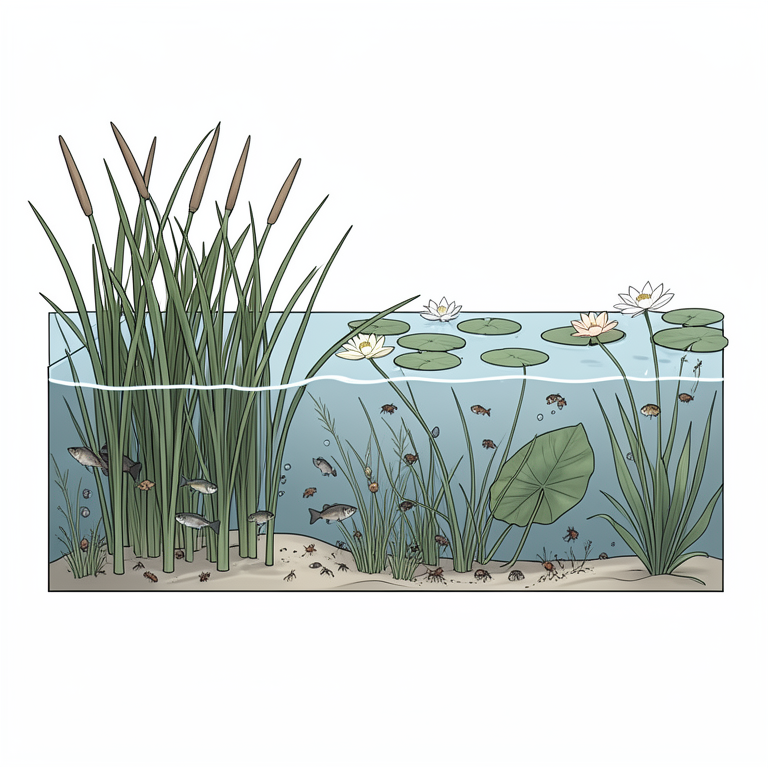
The Role of Macrophytes as Habitat Engineers
AI-generated conceptual illustration (Freshwater ecosystem with macrophytes, small fish, invertebrates, and amphibians). It explains the idea and does not show study data.
View source evidence ↗Introduction
Freshwater ecosystems, though covering less than 1% of Earth's surface, harbor approximately 10% of all known species and about one-third of all vertebrate species (Dudgeon et al., 2006) [3] . These ecosystems face unprecedented threats from habitat destruction, pollution, over-exploitation, invasive species, and climate change, driving freshwater biodiversity loss at rates far exceeding those observed in terrestrial or marine systems. Understanding the ecological processes that underpin freshwater biodiversity is therefore of critical importance for conservation efforts. Among the many biotic and abiotic factors governing species diversity in freshwater habitats, aquatic vegetation broadly defined here as macrophytes including submerged, emergent, floating-leaved, and free-floating plants plays a disproportionately important ecological role. Macrophytes are recognized as ecosystem engineers, physically modifying their environment in ways that cascade through entire food webs (Jones et al., 1994) [4] . By providing structural complexity, stabilizing sediments, cycling nutrients, and moderating light and temperature regimes, aquatic plants create conditions conducive to high levels of faunal diversity. Despite the acknowledged importance of macrophytes, a comprehensive synthesis of their influence across multiple faunal groups from microinvertebrates to vertebrates remains incomplete. This paper aims to address this gap by: (i) reviewing the key mechanisms through which aquatic vegetation influences faunal diversity; (ii) synthesizing evidence across taxonomic groups; (iii) examining how vegetation loss due to anthropogenic stressors impacts fauna; and (iv) proposing management recommendations for biodiversity conservation in freshwater systems.
Types of Aquatic
Types of Aquatic
Key Ecological Functions
Aquatic vegetation performs numerous ecological functions critical to freshwater ecosystem integrity. Nutrient cycling is a primary function, as macrophytes uptake excess nitrogen and phosphorus from the water column and sediments, reducing eutrophication and maintaining water clarity. Oxygen production by photosynthetically active submerged macrophytes supports aerobic faunal communities, particularly during daylight hours. Sediment stabilization by root systems reduces turbidity and maintains the clear-water conditions preferred by many invertebrate and fish species.
The physical structure of macrophyte beds reduces water velocity, creating low-turbulence refuges where fauna can conserve energy, avoid predators, and reproduce. Epiphytic algae growing on macrophyte surfaces represent an important food source for grazing invertebrates, which in turn support fish and waterbird communities. The detrital decomposition of macrophyte biomass releases nutrients and organic matter that fuel microbial food webs, further amplifying biodiversity support functions.
Influence on Invertebrate Diversity 3.1 Macroinvertebrate Communities
Aquatic macroinvertebrates including insects, crustaceans, mollusks, oligochaetes, and other taxa represent the most species-rich faunal group in freshwater systems and are closely associated with macrophyte communities. Numerous studies have demonstrated a strong positive correlation between macrophyte structural complexity and macroinvertebrate species richness. The complex threedimensional architecture of macrophyte beds creates a diversity of microhabitats including leaf surfaces, stem bases, rhizome mats, and interstitial spaces that are colonized by different invertebrate guilds. Research by Warfe and Barmuta (2004) [10] demonstrated that architectural complexity of macrophyte beds is more important than plant species identity in determining invertebrate diversity. Dense beds of structurally complex plants such as Myriophyllum or Ceratophyllum support higher invertebrate biomass and diversity than structurally simpler species. Grazer invertebrates such as Physella snails and Gammarus amphipods directly consume epiphytic algae and macrophyte tissues, while collectors and shredders process macrophyte detritus. Predatory invertebrates such as odonates (dragonfly and damselfly larvae) and water beetles in turn rely on macrophyte structure for ambush hunting and larval development.
Zooplankton and Meiofauna
Macrophyte beds provide critical refuge for zooplankton communities particularly cladocerans such as Daphnia from fish predation. The 'littoral refuge hypothesis' postulates that vegetated littoral zones permit the persistence of largerbodied zooplankton species that would otherwise be eliminated by visual fish predators in open water. This has significant ecological consequences, as large-bodied cladocerans are more effective grazers of phytoplankton and thereby contribute to maintaining water clarity in lakes with well-developed macrophyte communities. Meiofaunal communities, including nematodes, copepods, and ostracodes, are likewise highly diverse in vegetated sediments where organic matter and microbial food sources are concentrated.
Influence on Fish Diversity 4.1 Habitat Provision and Spawning
The relationship between aquatic macrophytes and fish is particularly well-documented. Macrophyte beds are critical spawning and nursery habitats for many fish species. Phytophilic fish species those depositing adhesive eggs on macrophytes include ecologically and economically important species such as common carp (Cyprinus carpio), pike (Esox lucius), perch (Perca fluviatilis), and numerous cyprinids. The presence of macrophytes significantly increases reproductive success by providing suitable attachment substrates, protecting eggs from scouring currents, and reducing egg predation through the physical complexity of the vegetation. Juvenile fish of many species depend heavily on macrophyte beds for refuge from piscivorous predators. The spatial complexity of dense vegetation disrupts predator search efficiency and provides escape routes for juvenile fish. Studies in European lakes have shown that fish species richness is consistently higher in lakes with well-developed littoral macrophyte zones compared to those with degraded or absent vegetation. The food base provided by invertebrate communities associated with macrophytes also supports higher densities and biomass of planktivorous and benthivorous fish species.
Trophic Diversity and Feeding Guilds
Macrophyte-rich habitats support a greater diversity of fish feeding guilds than structurally simple or unvegetated areas. Herbivorous fish species such as grass carp (Ctenopharyngodon idella) and rudd (Scardinius erythrophthalmus) directly consume macrophyte tissue. Insectivorous species exploit the abundant epiphytic invertebrate fauna. Piscivorous predators such as pike and largemouth bass (Micropterus salmoides) use macrophyte stands as ambush cover. This multi-guild fish community structure is a hallmark of productive, macrophyte-rich littoral zones and represents a key component of aquatic food web complexity.
Influence on Amphibians and Reptiles
Amphibians are among the most threatened vertebrate groups globally, and freshwater macrophytes play a central role in their reproductive ecology. Most anuran amphibians (frogs and toads) deposit eggs in or around aquatic vegetation, which provides physical support for egg masses, reduces desiccation risk, and offers some degree of temperature buffering. Tadpoles of many species are closely associated with macrophyte beds, grazing on periphyton attached to plant surfaces and using the vegetation as refuge from predatory fish and wading birds. Salamanders and newts similarly depend on aquatic vegetation for egg attachment and larval habitat. Studies conducted in European ponds have demonstrated that the diversity of anuran species is positively correlated with macrophyte species richness and cover. Emergent vegetation such as Phragmites and Typha also provides terrestrial-aquatic interface habitat critical for adult amphibian thermoregulation and overwintering. Freshwater reptiles, including water snakes and aquatic turtles, use macrophyte mats and emergent vegetation for basking, nesting, and hunting, with macrophyte-rich wetlands supporting higher reptile diversity than open-water habitats.
Influence on Waterbirds and Wetland Avifauna
Wetland bird communities are profoundly shaped by the composition and extent of aquatic vegetation. Emergent macrophyte beds particularly dense reedbeds of Phragmites australis and bulrush stands of Typha spp. provide nesting habitat for a diverse assemblage of birds including rails, bitterns, herons, grebes, ducks, and passerines such as warblers and buntings. The structural complexity of reedbeds determines carrying capacity for reed-nesting species, with extensive and structurally diverse beds supporting the highest bird densities and species richness. Submerged and floating-leaved macrophytes indirectly support waterbirds through their food provision function. Diving ducks such as pochards (Aythya ferina) and tufted ducks (Aythya fuligula) consume submerged macrophytes directly, while also exploiting the rich invertebrate fauna associated with vegetation. Swans, geese, and coots are significant herbivores of submerged and emergent vegetation in productive lakes and rivers. The presence of floating macrophytes such as water lilies provides platform habitat for jacanas, grebes, and other water surface-nesting species in tropical and subtropical freshwater systems.
Anthropogenic Threats to Aquatic Vegetation and Faunal Consequences 7.1 Eutrophication
Nutrient enrichment of freshwater bodies from agricultural runoff, urban wastewater, and industrial effluents is the most pervasive threat to aquatic macrophyte communities globally. Elevated phosphorus and nitrogen loadings stimulate phytoplankton and epiphytic algal blooms that reduce water transparency, shading out submerged macrophytes and triggering a regime shift from a clearwater, macrophyte-dominated state to a turbid, phytoplankton-dominated state. This state shift can be abrupt and highly resistant to reversal, with profound consequences for associated faunal communities. Loss of macrophyte beds leads to cascading declines in invertebrate diversity, fish recruitment failure, and abandonment of breeding sites by waterbirds.
Physical Habitat Modification
Channelization of rivers, dredging of lakes and ponds, drainage of wetlands, and shoreline development destroy or fragment aquatic macrophyte habitats. Riparian buffer removal increases wave action and bank erosion, reducing the shallow-water littoral zones where macrophytes establish and disrupting the terrestrial-aquatic connectivity critical for many amphibians and waterbirds. The global loss of wetland area estimated at over 35% since 1970 has been accompanied by alarming declines in freshwater faunal diversity, with strong circumstantial evidence pointing to macrophyte habitat loss as a key mechanistic driver.
Invasive Species
Both invasive macrophytes and invasive fauna can fundamentally alter the relationship between vegetation and faunal diversity. Invasive aquatic plants such as water hyacinth (Eichhornia crassipes) and water fern (Salvinia molesta) can form dense surface mats that deplete dissolved oxygen, alter pH, reduce light penetration, and homogenize habitat structure, suppressing native macrophyte and faunal diversity. Conversely, invasive herbivorous fish such as grass carp and common carp can overgraze and disturb native macrophyte communities, collapsing the structural complexity that supports invertebrate and fish diversity. Invasive predatory fish such as Nile perch (Lates niloticus) have driven catastrophic biodiversity collapses in macrophyte-rich lakes, as documented in Lake Victoria.
Conservation and Management Implications
The evidence reviewed in this paper strongly supports the conclusion that conserving and restoring aquatic vegetation is among the most effective strategies for maintaining and enhancing freshwater faunal diversity. Practical management recommendations arising from this synthesis include nutrient load reduction to reverse eutrophication and facilitate natural macrophyte recovery, re-establishment of riparian buffer zones to reduce direct inputs of nutrients and sediment, and restoration of wetland hydrological connectivity to restore macrophyte community development. Active macrophyte restoration through transplanting of native species has shown success in numerous case studies, with rapid recovery of associated invertebrate and fish communities following restoration of vegetation cover. Biomanipulation the removal of benthivorous and planktivorous fish can enhance water clarity and facilitate macrophyte re-establishment in eutrophied lakes. Management of invasive aquatic plants through biological, mechanical, and chemical control is necessary to prevent displacement of native macrophyte communities. Long-term monitoring programs that track both macrophyte community composition and associated faunal diversity are essential for evaluating management effectiveness and detecting early warning signals of ecosystem degradation.
Conclusion
This paper has reviewed the extensive evidence linking aquatic vegetation to the diversity of freshwater fauna across invertebrates, fish, amphibians, reptiles, and waterbirds. The mechanisms are multiple and interacting: macrophytes engineer physical habitat structure, regulate water chemistry, support complex food webs through epiphytic algal production and detrital pathways, and provide critical sites for reproduction and predator refuge. The loss of aquatic vegetation through eutrophication, physical disturbance, and invasive species results in the simplification of freshwater communities and the loss of species diversity. Future research should prioritize the elucidation of threshold relationships between macrophyte cover and faunal diversity to support evidence-based management targets, the investigation of how climate change-driven shifts in macrophyte phenology and distribution will alter faunal communities, and the development of cost-effective macrophyte restoration techniques applicable across different freshwater ecosystem types. The conservation of freshwater biodiversity in the face of global change ultimately depends on our ability to protect and restore the aquatic vegetation that forms the structural and functional foundation of these irreplaceable ecosystems.
References
12 in the original paper- Carpenter SR, Lodge DM. Effects of submersed macrophytes on ecosystem processes. Aquat Bot. 1986;26:341-370.
- Chambers PA, Lacoul P, Murphy KJ, Thomaz SM. Global diversity of aquatic macrophytes in freshwater. Hydrobiologia. 2008;595(1):9-26.
- Dudgeon D, Arthington AH, Gessner MO, Kawabata ZI, Knowler DJ, Lévêque C, et al. Freshwater biodiversity: importance, threats, status and conservation challenges. Biol Rev. 2006;81(2):163-182.
- Jones CG, Lawton JH, Shachak M. Organisms as ecosystem engineers. Oikos. 1994;69(3):373-386.
- Jeppesen E, Søndergaard M, Christoffersen K, editors. The structuring role of submerged macrophytes in lakes. New York: Springer; 1997.
- Kloskowski J. Differential effects of age-structured common carp (Cyprinus carpio) stocks on pond invertebrate communities: implications for recreational and wildlife use of angling ponds. Aquat Ecol. 2011;45(1):5-15.
- Murphy KJ. Plant communities and plant diversity in softwater lakes of northern Europe. Aquat Bot. 2002;73(4):287-324.
- Paillisson JM, Marion L. Can small water level fluctuations affect the biomass of Nymphaea alba in large lakes? Aquat Bot. 2006;84(3):259-266.
- Thomaz SM, Cunha ERD. The role of macrophytes in habitat structuring in aquatic ecosystems: methods of measurement, causes and consequences on animal assemblages composition and biodiversity. Acta Limnol Bras. 2010;22(2):218-236.
- Warfe DM, Barmuta LA. Habitat structural complexity mediates the foraging success of multiple predator species. Oecologia. 2004;141(1):171-178.
- Wetzel RG. Limnology: Lake and River Ecosystems. 3rd ed. San Diego: Academic Press; 2001.
- Willby NJ, Abernethy VJ, Demars BOL. Attributebased classification of European hydrophytes and its relationship to habitat utilization. Freshw Biol. 2000;43(1):43-74.