
Research article · 2026 · Full text
International Journal of Horticulture and Food ScienceCorrelation and path analysis in okra genotypes for yield and yield attributing traits
Volume 8(8) · Pages 39–42 · DOI: 10.33545/26631067.2026.v8.i8a.833 ↗
Research areasAgricultural Practices and Plant GeneticsGenetics and Plant BreedingAgricultural pest management studies
Abstract
Author-writtenThe present investigation was carried out at the Instructional-cum-Research Farm, Horticulture Section, Rajarshee Chhatrapati Shahu Maharaj College of Agriculture, Kolhapur, during the summer season of 2025–26. The experiment was laid out in a Randomized Block Design (RBD) comprising 22 okra genotypes with two replications. The experimental data were subjected to genotypic and phenotypic correlation coefficient analyses and path coefficient analysis to determine the association among yield and its contributing traits. Correlation analysis revealed that yield per hectare exhibited highly significant and positive association with yield per plot, number of fruits per plant, average fruit weight, number of pods per plant, plant height and number of branches per plant at both genotypic and phenotypic levels. Fruit length and fruit girth also showed significant positive association with yield per hectare, whereas days to first flower initiation and node at first flower appearance exhibited negative association. Path coefficient analysis indicated that number of fruits per plant exerted the highest positive direct effect on yield per hectare, followed by average fruit weight, number of pods per plant, plant height, fruit length, number of branches per plant, fruit girth and internodal length. In contrast, days to first flower initiation and node at first flower appearance recorded negative direct effects on yield per hectare. Therefore, these positively associated traits may be considered as reliable selection criteria for improving fruit yield in okra breeding programmes.
Summary
Source-checkedPlain-language reading of the full paper, prepared with AI and checked against the text. Each point links to the authors' own words.
Why it matters
- Okra is a significant vegetable crop valued for its economic importance and the nutritional quality of its edible green fruits. View evidence ↗
- Improving okra yield is challenging because it is a complex trait influenced by many interconnected morphological characteristics. View evidence ↗
- Understanding how different traits relate to one another is necessary to create effective breeding strategies for identifying high-yielding genotypes. View evidence ↗
The question
- The study aimed to identify the most important selection criteria for improving okra yield by analyzing the correlation and the direct and indirect effects of various traits on yield per hectare. View evidence ↗
What they did
- The research was conducted during the summer of 2025–26 at the Rajarshee Chhatrapati Shahu Maharaj College of Agriculture in Kolhapur. View evidence ↗
- The experiment used 22 different okra genotypes arranged in a Randomized Block Design with two replications. View evidence ↗
- Researchers recorded data on twelve quantitative characters from five randomly selected plants per treatment in each replication. View evidence ↗
- Path coefficient analysis, based on methods by Wright, Dewey, and Lu, was used to determine the direct and indirect effects of traits on yield per hectare. View evidence ↗
What they found
- Yield per hectare showed highly significant positive correlations with yield per plot, number of fruits per plant, number of nodes per plant, average fruit weight, and plant height. View evidence ↗
- The days to first flower initiation and the node at first flower appearance had a negative, though non-significant, association with yield per hectare. View evidence ↗
- Genotypic correlations were generally higher than phenotypic ones, suggesting that genetic factors played a larger role than environmental factors in the observed trait associations. View evidence ↗
- Days to first flower initiation (-0.162) and the node at first flower appearance (-0.144) both had negative direct effects on yield per hectare. View evidence ↗
What it means
- The authors conclude that the number of fruits per plant, average fruit weight, and number of nodes per plant are the most reliable selection criteria for improving okra yield. View evidence ↗
Visual summary
3 visualsIllustrations explain the paper; charts are replotted from the paper's own table values.
Direct Effects on Okra Yield
AI-generated conceptual illustration (okra plants (Abelmoschus esculentus)). It explains the idea and does not show study data.
View source evidence ↗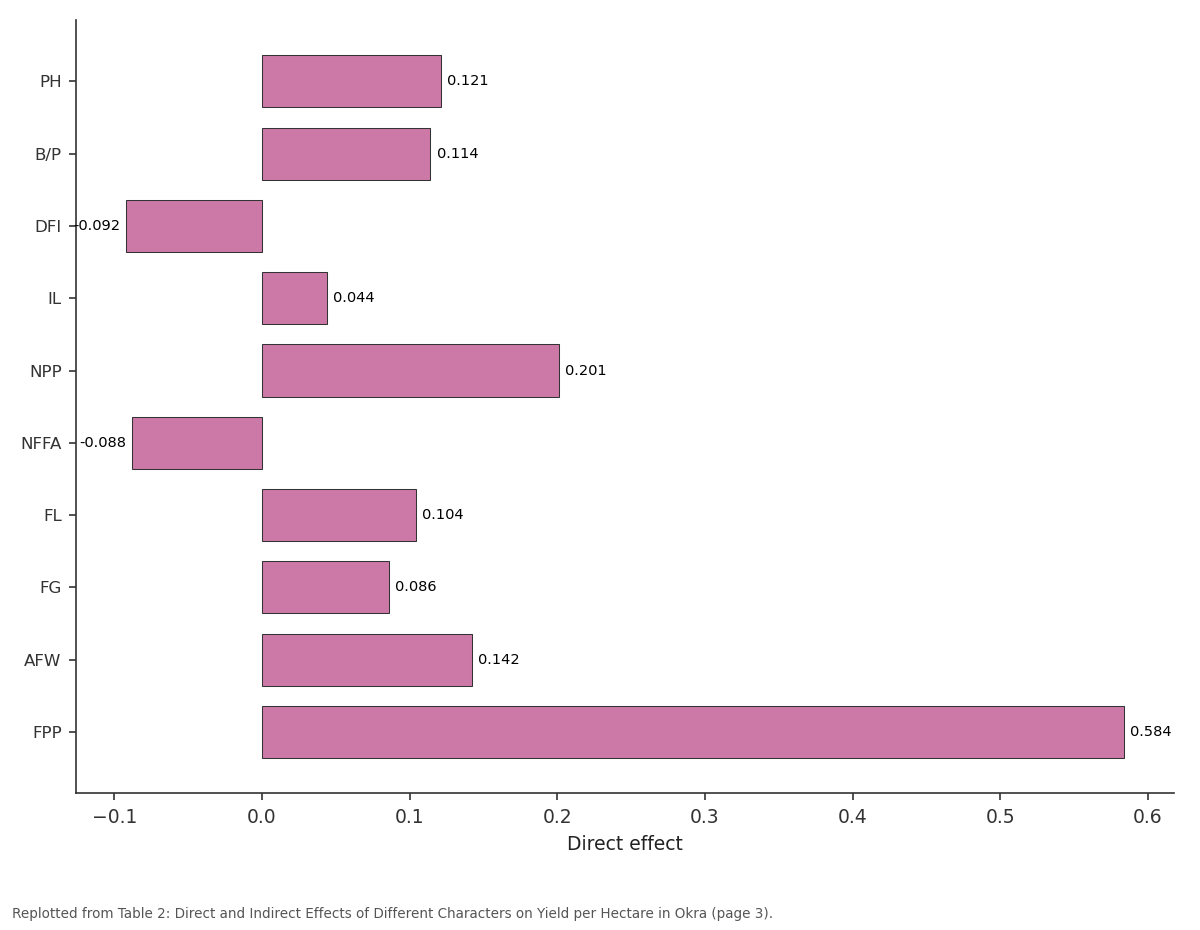
FPP: PH vs B/P vs DFI vs IL vs NPP
Replotted from Table 2 (page 3) of the original paper. Every bar is the paper's own table value.
View source evidence ↗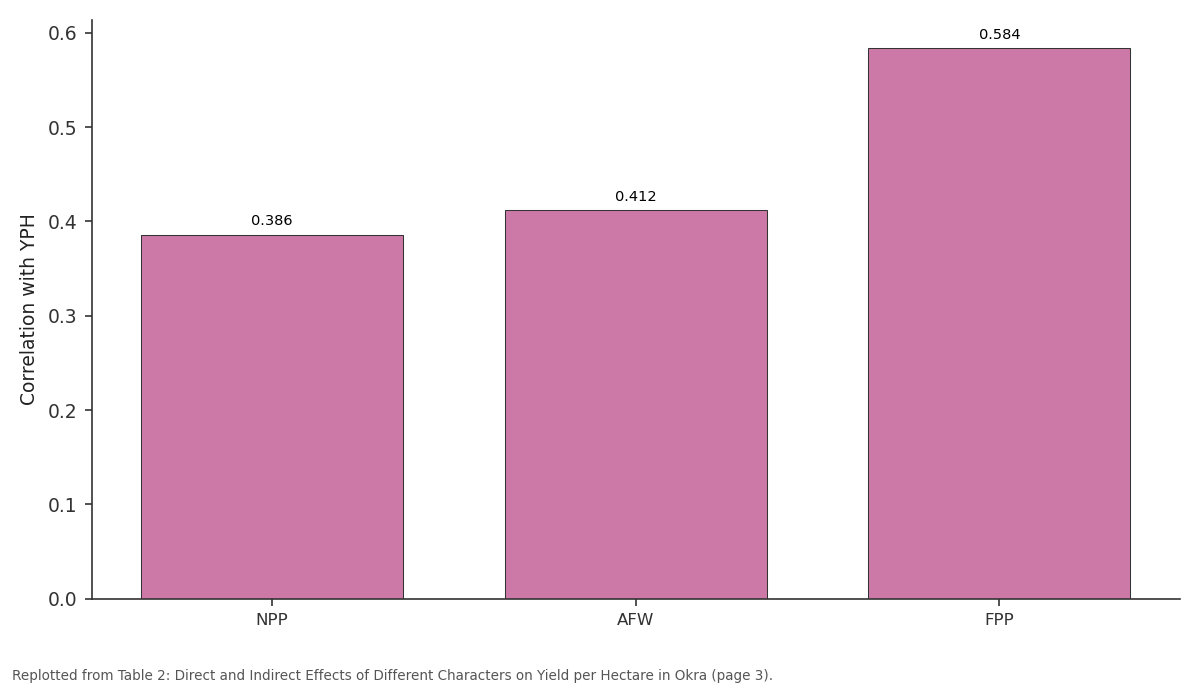
Direct effect: NPP vs AFW vs FPP
Replotted from Table 2 (page 3) of the original paper. Every bar is the paper's own table value.
View source evidence ↗Figures & tables
From the original paper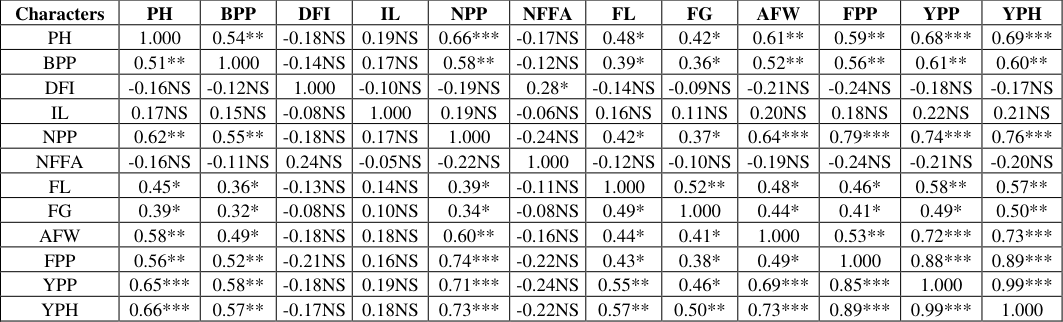 Table 1
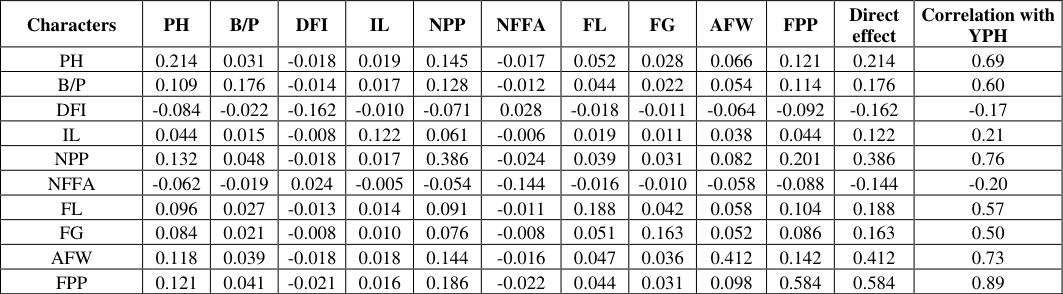 Table 2
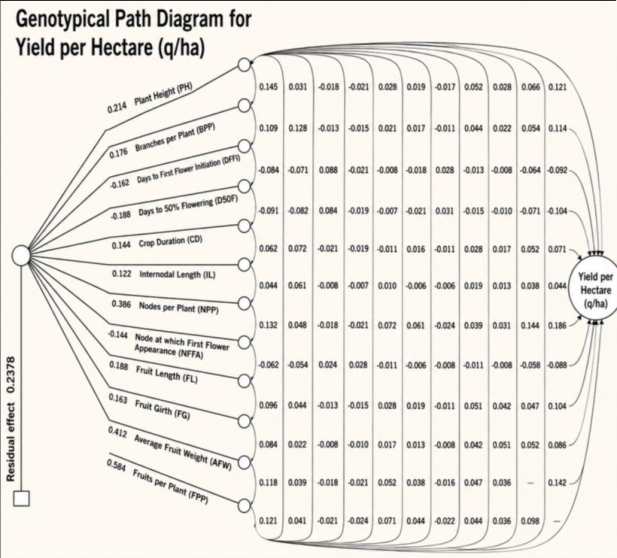 Figure 1
Introduction
Okra (Abelmoschus esculentus (L.) Moench) is an important vegetable crop belonging to the family Malvaceae. It is believed to have originated in Ethiopia and is widely cultivated in tropical and subtropical regions of the world. In India, okra is popularly known as Bhindi and is grown throughout the year under suitable agro-climatic conditions. The crop is primarily cultivated for its tender, edible green fruits, which are valued for their nutritional quality, consumer preference and economic importance Okra is a diploid species with a chromosome number of 2n = 130 and exhibits considerable genetic variability for growth, yield and quality traits. The fruits are rich in dietary fibre, carbohydrates, vitamins A, B and C, calcium, potassium and other essential minerals. In addition to its nutritional value, okra contains mucilage and several bioactive compounds that possess antioxidant and healthpromoting properties, making it an important vegetable crop for both nutritional security and commercial cultivation. Fruit yield in okra is a complex quantitative trait governed by several interrelated morphological and yield-contributing characters. Therefore, improvement in yield through direct selection alone may not always be effective. Knowledge of the association among different traits is essential for formulating efficient breeding strategies and identifying superior genotypes with desirable yield attributes. Correlation analysis provides information on the nature and magnitude of the relationship between yield and its component traits, thereby assisting breeders in selecting characters that contribute significantly to yield improvement. Therefore, the present investigation was undertaken to study the association among yield and its component characters through correlation analysis and to estimate the direct and indirect effects of different yield-contributing traits on yield per hectare in okra, with the objective of identifying the most important selection criteria for genetic improvement of the crop.
Materials and Methods
During the summer season of 2025-26, a field experiment was conducted at the Instructional-cum-Research Farm, Horticulture Section, Rajarshee Chhatrapati Shahu Maharaj College of Agriculture, Kolhapur. The experiment comprised 22 okra genotypes and was laid out in a Randomized Block Design (RBD) with two replications. Five plants were randomly selected from each treatment in each replication for recording observations on twelve quantitative characters. Path coefficient analysis was carried out following the method proposed by Wright (1921) [18] and later elaborated by Dewey and Lu (1959) [6] to determine the direct and indirect effects of different component characters on yield per hectare in okra.
Result and Discussion Correlation Coefficient analysis
Correlation coefficient analysis is an important statistical tool used to determine the degree and direction of association among different characters and their contribution towards yield. The genotypic (above diagonal) and phenotypic (below diagonal) correlation coefficients among yield per hectare and its component characters are presented in Table 1. Correlation analysis revealed that yield per hectare exhibited highly significant and positive association with yield per plot (rg = 0.99, rp = 0.99), number of fruits per plant (rg = 0.89, rp = 0.89), number of nodes per plant (rg = 0.76, rp = 0.73), average fruit weight (rg = 0.73, rp = 0.73) and plant height (rg = 0.69, rp = 0.66) at both genotypic and phenotypic levels. Significant positive correlations were also observed with branches per plant, fruit length and fruit girth, whereas days to first flower initiation and node at first flower appearance exhibited negative but non-significant association with yield per hectare. These results indicate that improvement in these positively associated characters would be effective for enhancing fruit yield in okra. Similar findings were reported by Ahamed et (2022) [1,4,10,11] . Among the yield-contributing traits, number of fruits per plant exhibited a strong positive association with number of nodes per plant (rg = 0.79, rp = 0.74), average fruit weight (rg = 0.53, rp = 0.49), plant height (rg = 0.59, rp = 0.56) and branches per plant (rg = 0.56, rp = 0.52). Likewise, average fruit weight showed positive association with plant height, fruit length, fruit girth and number of nodes per plant, suggesting that simultaneous improvement of these characters would contribute to increased fruit yield. Similar observations were also reported by Bagadiya et [2,12,14] . The genotypic correlation coefficients were generally higher than the corresponding phenotypic correlation coefficients, indicating that the associations among the studied characters were predominantly governed by genetic factors with comparatively lower environmental influence. Therefore, yield per plot, number of fruits per plant, average fruit weight and number of nodes per plant may be considered as reliable selection criteria for the improvement of fruit yield in okra. [8,15,17] .
| Characters | PH | BPP | DFI | IL | NPP | NFFA | FL | FG | AFW | FPP | YPP | YPH |
|---|---|---|---|---|---|---|---|---|---|---|---|---|
| PH | 1.000 | 0.54** | -0.18NS | 0.19NS | 0.66*** | -0.17NS | 0.48* | 0.42* | 0.61** | 0.59** | 0.68*** | 0.69*** |
| BPP | 0.51** | 1.000 | -0.14NS | 0.17NS | 0.58** | -0.12NS | 0.39* | 0.36* | 0.52** | 0.56** | 0.61** | 0.60** |
| DFI | -0.16NS | -0.12NS | 1.000 | -0.10NS | -0.19NS | 0.28* | -0.14NS | -0.09NS | -0.21NS | -0.24NS | -0.18NS | -0.17NS |
| IL | 0.17NS | 0.15NS | -0.08NS | 1.000 | 0.19NS | -0.06NS | 0.16NS | 0.11NS | 0.20NS | 0.18NS | 0.22NS | 0.21NS |
| NPP | 0.62** | 0.55** | -0.18NS | 0.17NS | 1.000 | -0.24NS | 0.42* | 0.37* | 0.64*** | 0.79*** | 0.74*** | 0.76*** |
| NFFA | -0.16NS | -0.11NS | 0.24NS | -0.05NS | -0.22NS | 1.000 | -0.12NS | -0.10NS | -0.19NS | -0.24NS | -0.21NS | -0.20NS |
| FL | 0.45* | 0.36* | -0.13NS | 0.14NS | 0.39* | -0.11NS | 1.000 | 0.52** | 0.48* | 0.46* | 0.58** | 0.57** |
| FG | 0.39* | 0.32* | -0.08NS | 0.10NS | 0.34* | -0.08NS | 0.49* | 1.000 | 0.44* | 0.41* | 0.49* | 0.50** |
| AFW | 0.58** | 0.49* | -0.18NS | 0.18NS | 0.60** | -0.16NS | 0.44* | 0.41* | 1.000 | 0.53** | 0.72*** | 0.73*** |
| FPP | 0.56** | 0.52** | -0.21NS | 0.16NS | 0.74*** | -0.22NS | 0.43* | 0.38* | 0.49* | 1.000 | 0.88*** | 0.89*** |
| YPP | 0.65*** | 0.58** | -0.18NS | 0.19NS | 0.71*** | -0.24NS | 0.55** | 0.46* | 0.69*** | 0.85*** | 1.000 | 0.99*** |
| YPH | 0.66*** | 0.57** | -0.17NS | 0.18NS | 0.73*** | -0.22NS | 0.57** | 0.50** | 0.73*** | 0.89*** | 0.99*** | 1.000 |
Table text extracted from the original PDF; superscript letters are shown inline. The original table image is below.
View original table image
Path Analysis
Path coefficient analysis provides a better understanding of the direct and indirect contribution of different characters towards yield by partitioning the correlation coefficients into their respective direct and indirect effects. The direct and indirect effects of different characters on yield per hectare are presented in Table 2. The present investigation revealed that number of fruits per plant exerted the highest positive direct effect (0.584) on yield per hectare, followed by average fruit weight (0.412), number of nodes per plant (0.386), plant height (0.214), fruit length (0.188), branches per plant (0.176), fruit girth (0.163) and internodal length (0.122). These results indicate that direct selection based on these characters would be effective for improving fruit yield in okra. Similar findings were reported by Chhatrola and Monpara (2005) [5,9,11,13] . On the contrary, days to first flower initiation (-0.162) and node at first flower appearance (-0.144) exhibited negative direct effects on yield per hectare, indicating that delayed flowering and higher node position of first flowering may adversely influence fruit yield. However, several characters expressed positive indirect effects through number of fruits per plant, average fruit weight and number of nodes per plant, further emphasizing the importance of these traits in determining fruit yield. Similar observations have also been reported by Bagadiya et [2,8,14] . The positive direct effects observed for number of fruits per plant, average fruit weight and number of nodes per plant were also accompanied by significant positive correlation with yield per hectare, indicating that these characters play a major role in determining fruit yield. The coincidence of high direct effects with strong positive association suggests the predominance of additive gene action and emphasizes the usefulness of these traits as effective selection criteria in okra improvement programmes. [1,4,7,12] . The present findings further indicated that some characters contributed to fruit yield mainly through their indirect effects via number of fruits per plant and average fruit weight, highlighting the complex interrelationship among yield-contributing traits. Therefore, simultaneous selection based on these component characters rather than on yield alone would improve the efficiency of selection and facilitate the development of superior high-yielding okra genotypes. Comparable observations were also reported by Rathava et al. [8,15,17,16] . Overall, the results of path coefficient analysis indicated that number of fruits per plant, average fruit weight and number of nodes per plant were the major contributors to fruit yield due to their high positive direct effects coupled with significant positive association with yield per hectare. Hence, these traits may be considered as reliable selection criteria for the genetic improvement and development of high-yielding okra genotypes.
| Characters | PH | B/P | DFI | IL | NPP | NFFA | FL | FG | AFW | FPP | Direct effect | Correlation with YPH |
|---|---|---|---|---|---|---|---|---|---|---|---|---|
| PH | 0.214 | 0.031 | -0.018 | 0.019 | 0.145 | -0.017 | 0.052 | 0.028 | 0.066 | 0.121 | 0.214 | 0.69 |
| B/P | 0.109 | 0.176 | -0.014 | 0.017 | 0.128 | -0.012 | 0.044 | 0.022 | 0.054 | 0.114 | 0.176 | 0.60 |
| DFI | -0.084 | -0.022 | -0.162 | -0.010 | -0.071 | 0.028 | -0.018 | -0.011 | -0.064 | -0.092 | -0.162 | -0.17 |
| IL | 0.044 | 0.015 | -0.008 | 0.122 | 0.061 | -0.006 | 0.019 | 0.011 | 0.038 | 0.044 | 0.122 | 0.21 |
| NPP | 0.132 | 0.048 | -0.018 | 0.017 | 0.386 | -0.024 | 0.039 | 0.031 | 0.082 | 0.201 | 0.386 | 0.76 |
| NFFA | -0.062 | -0.019 | 0.024 | -0.005 | -0.054 | -0.144 | -0.016 | -0.010 | -0.058 | -0.088 | -0.144 | -0.20 |
| FL | 0.096 | 0.027 | -0.013 | 0.014 | 0.091 | -0.011 | 0.188 | 0.042 | 0.058 | 0.104 | 0.188 | 0.57 |
| FG | 0.084 | 0.021 | -0.008 | 0.010 | 0.076 | -0.008 | 0.051 | 0.163 | 0.052 | 0.086 | 0.163 | 0.50 |
| AFW | 0.118 | 0.039 | -0.018 | 0.018 | 0.144 | -0.016 | 0.047 | 0.036 | 0.412 | 0.142 | 0.412 | 0.73 |
| FPP | 0.121 | 0.041 | -0.021 | 0.016 | 0.186 | -0.022 | 0.044 | 0.031 | 0.098 | 0.584 | 0.584 | 0.89 |
Table text extracted from the original PDF; superscript letters are shown inline. The original table image is below.
View original table image
Summery and conclusion
The present investigation was undertaken to study the association among yield and its component characters through correlation and path coefficient analyses in 22 okra genotypes. Correlation analysis revealed that yield per hectare had highly significant and positive association with yield per plot, number of fruits per plant, average fruit weight, number of nodes per plant and plant height at both genotypic and phenotypic levels. Significant positive associations were also observed with branches per plant, fruit length and fruit girth, whereas days to first flower initiation and node at first flower appearance exhibited negative association with yield per hectare. Path coefficient analysis indicated that number of fruits per plant exerted the highest positive direct effect on yield per hectare, followed by average fruit weight, number of nodes per plant, plant height, fruit length, branches per plant, fruit girth and internodal length. In contrast, days to first flower initiation and node at first flower appearance showed negative direct effects on yield. The combined results of correlation and path coefficient analyses indicated that number of fruits per plant, average fruit weight and number of nodes per plant are the most important yield-contributing characters and may be considered as reliable selection criteria for the improvement of fruit yield in okra breeding programmes.
Acknowledgement
AcknowledgementsI gratefully acknowledge the Department of Horticulture, Rajarshee Chhatrapati Shahu Maharaj Government College of Agriculture, Kolhapur, for providing the facilities to conduct this research and thank all teachers, technical staff and colleagues for their support and cooperation. I also thankful to Dr. M. D. Mali for his valuable guidance, constant encouragement and constructive suggestions throughout the course of the study.
Figures and tables from the paper
References
17 in the original paper- Ahamed KU, Akter B, Ara N, Hossain MF, Moniruzzaman M. Heritability, correlation and path coefficient analysis in fifty seven okra genotypes. Int J Appl Sci Biotechnol. 2015;3(1):127-133.
- Bagadiya PG, Intwala CG, Patel P, Usadad JS. Assessment of the correlation and path analysis with association of growth and yield characteristics in okra [Abelmoschus esculentus (L.) Moench]. Pharma Innov J. 2022;11(4):769-774.
- Bose TK, Soman MG, Kabir T. Vegetables crops in India. Calcutta: Naya Prakash; 1993.
- Chavan J, Seenivasan N, Saidaiah P, Sivaraj N. Estimation of correlation coefficient and path coefficient analysis for yield and yield components in okra [Abelmoschus esculentus (L.) Moench]. Int J Chem Stud. 2019;7(4):1254-1260.
- Chhatrola MD, Monpara BA. Correlation and path analysis and their implications in okra [Abelmoschus esculentus (L.) Moench] improvement. Natl J Plant Improv. 2005;7(2):127-130.
- Dewey DR, Lu KH. Correlation and path coefficient analysis of components of crested wheatgrass seed production. Agron J. 1959;51:515-518.
- Maurya A, Singh S, Singh A. Studies on correlation and path coefficient analysis in okra [Abelmoschus esculentus (L.) Moench]. Plant Arch. 2025;25(1).
- Mehta DR, Dhaduk LK, Patel KD. Genetic variability, correlation and path analysis studies in okra [Abelmoschus esculentus (L.) Moench]. Agric Sci Dig. 2006;26(1):15-18.
- Mohammed J, Mohammed W, Shiferaw E. Correlation and path coefficient analysis among agromorphological and biochemical traits of okra [Abelmoschus esculentus (L.) Moench] genotypes in Ethiopia. Acta Agric Slov. 2020;115(2):329-339.
- Neeraja S, Srinivas J, Joshi V, Nikhil BSK, Sathish G. Correlation and path analysis studies in okra [Abelmoschus esculentus (L.)] genotypes. Biol Forum Int J. 2022;14(4):1097-1106.
- Patel AI, Vrunda R, Vashi JM, Chaudhari BN. Correlation and path analysis studies in okra [Abelmoschus esculentus (L.) Moench]. Acta Sci Agric. 2019;3(2):65-70.
- Prasath G, Reddy KR, Saidaiah P. Correlation and path coefficient analysis of fruit yield and yield attributes in okra [Abelmoschus esculentus (L.) Moench]. Int J Curr Microbiol Appl Sci. 2017;6(3):463-472.
- Pundir S, Singh MK, Kumar M, Lodhi SK, Singh A, Alam K. Studies on correlation and path coefficient for direct selection between pair of traits using green fruit yield as dependent character in okra. Int J Environ Clim Change. 2022;12(4):90-96.
- Rathava D, Patel AI, Chaudhari BN, Vashi JM. Correlation and path coefficient studies in okra [Abelmoschus esculentus (L.) Moench]. Int J Curr Microbiol Appl Sci. 2019;8(10):1710-1719.
- Samiksha RS, Verma SK, Prakash S, Kumar S, Maurya SK. Studies on correlation and path coefficient analysis in okra [Abelmoschus esculentus (L.) Moench]. Int J Curr Microbiol Appl Sci. 2021;10(3):277-284.
- Temam N. Correlation and path coefficient analysis of pod yield and related traits of okra [Abelmoschus esculentus (L.) Moench] genotypes evaluated at Melkassa, Central Ethiopia. Int J Eng Res Technol. 2020;9(8):792-801.
- Wright S. Correlation and causation. J Agric Res. 1921;20(7):557-585.