
Research article · 2026 · Full text
International Journal of Horticulture and Food ScienceIntercropping in guava orchards: A sustainable approach for enhancing productivity, soil health and farm income
Volume 8(8S) · Pages 09–12 · DOI: 10.33545/26631067.2026.v8.i8sa.832 ↗
Research areasAgronomic Practices and Intercropping SystemsAgroforestry and silvopastoral systemsPlant Physiology and Cultivation Studies
Abstract
Author-writtenGuava (Psidium guajava L.) is an important tropical and subtropical fruit crop recognized for its nutritional value, adaptability and commercial significance. During the early stages of orchard establishment, a considerable proportion of the land between guava trees remains unused because the tree canopy has not yet expanded sufficiently. This vacant area can be productively utilized through intercropping with suitable short-duration crops. Guava-based intercropping can improve land productivity, provide supplementary income, support soil fertility, reduce weed pressure and contribute to better conservation and utilization of soil moisture and nutrients. The suitability of an intercrop is influenced by orchard age, climatic conditions, soil characteristics, availability of irrigation, crop duration and market opportunities. Legumes, vegetables, spices, cereals, medicinal crops and cover crops may be integrated into young guava orchards depending on local conditions. This review discusses the concept and objectives of guava intercropping, suitable intercrops, effects on tree growth and soil properties, water-use efficiency, biological and economic benefits, land-use efficiency and research needs.
Summary
Source-checkedPlain-language reading of the full paper, prepared with AI and checked against the text. Each point links to the authors' own words.
Why it matters
- Guava is a commercially significant fruit crop grown in tropical and subtropical regions due to its adaptability and nutritional value. View evidence ↗
- In newly established guava orchards, significant land between trees remains unused because the canopies have not yet fully expanded. View evidence ↗
- The unused space in young orchards can be utilized by planting compatible, short-duration intercrops. View evidence ↗
The question
- The authors aim to review the objectives, suitable crop choices, and the biological and economic impacts of intercropping in guava orchards. View evidence ↗
What they did
- Intercropping is most effective during the first three to five years of orchard establishment. View evidence ↗
- Selecting intercrops requires evaluating their growth habit, rooting pattern, resource demands, and market value to ensure compatibility with guava. View evidence ↗
- The Land Equivalent Ratio (LER) is used to assess land-use efficiency, where a value over 1.0 indicates an advantage over sole cropping. View evidence ↗
What they found
- Legumes such as cowpea, French bean, chickpea, and pea are suitable intercrops that improve soil fertility. View evidence ↗
- Vegetables like onion, garlic, carrot, radish, chilli, and okra provide additional income and maximize the use of inter-row space. View evidence ↗
- Previous reports on a guava and cowpea intercropping system showed improvements in pH, bulk density, organic carbon, and water-holding capacity. View evidence ↗
- Intercrops help manage weeds by providing ground cover and intercepting light, which limits weed emergence. View evidence ↗
- Intercropping can improve water-use efficiency by reducing soil evaporation through increased ground cover. View evidence ↗
- Increasing plant diversity through intercropping may enhance soil biological activity, including microbial biomass and nutrient mineralization. View evidence ↗
- Intercropping with marketable short-duration crops provides supplementary income that can help offset the costs of establishing the orchard. View evidence ↗
What it means
- The authors conclude that well-planned intercropping creates a more sustainable and resource-efficient production model for guava orchards. View evidence ↗
- A primary constraint is the increasing competition for resources between the intercrop and the guava tree as the tree canopy grows. View evidence ↗
Visual summary
1 visualsIllustrations explain the paper; they do not show study data.
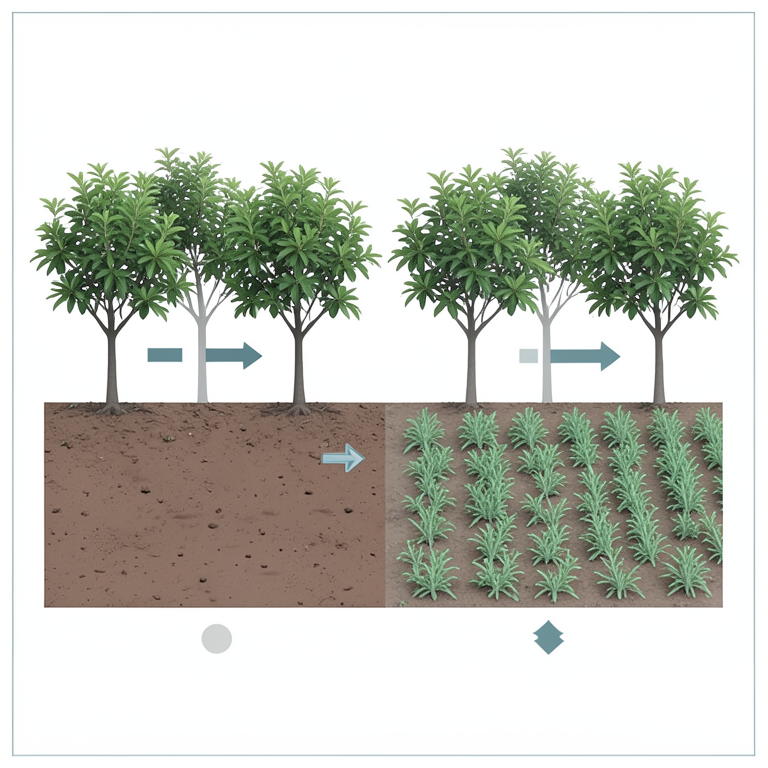
Orchard Space Utilization
AI-generated conceptual illustration (young guava trees and seasonal legume intercrops). It explains the idea and does not show study data.
View source evidence ↗Introduction
Guava (Psidium guajava L.) is widely cultivated in tropical and subtropical regions because of its adaptability, nutritional importance and economic value. In newly established orchards, the tree canopy is relatively small and the space between rows remains largely unoccupied. This provides an opportunity to introduce compatible annual or seasonal crops without converting additional land to agricultural production. Intercropping can increase the productive use of orchard space and provide an additional source of farm income during the period when guava trees have not yet attained full production. Depending on the choice of crop and management practices, intercrops may also contribute to soil fertility, weed suppression, moisture conservation and improved utilization of water and nutrients. The performance of a guava-based intercropping system is strongly influenced by crop compatibility, orchard age, planting arrangement, soil conditions, irrigation facilities and the degree of competition for light, moisture and nutrients. Legumes, vegetables, cereals and spices are among the crop groups that can be considered for integration with young guava orchards. Earlier studies have also indicated that suitable intercrop combinations can improve soil characteristics and nutrient availability while maintaining favorable guava performance. For example, guava combined with cowpea has been reported to improve several soil properties and guava productivity under eastern Indian conditions. Thus, appropriate planning and management of intercrops can convert a young guava orchard into a diversified production system capable of generating both biological and economic benefits.
Concept of Intercropping in Guava Orchards
Guava intercropping involves the cultivation of one or more compatible crops in the space available between guava trees. Rather than focusing only on the performance of the individual crops, the system aims to increase the productivity and efficiency of the orchard as a whole.
The practice is particularly relevant during approximately the first three to five years after orchard establishment, when the guava canopy is comparatively small and substantial inter-row space is available. The basic principle is to combine crops with complementary requirements so that available land, sunlight, soil moisture and nutrients are utilized more effectively. At the same time, intercrops should have limited competitive effects on the guava trees. Appropriate spatial arrangement, irrigation management and fertilizer application are therefore essential components of successful guava intercropping.
Objectives of Intercropping in Guava
1. Utilizing otherwise unused inter-row space during the early stages of orchard development. 2. Increasing productivity from the same unit of land by combining fruit and seasonal crops. 3. Providing additional income before the guava orchard reaches full bearing. 4. Improving the efficiency with which water, nutrients, solar radiation and land are utilized.
5. Supporting soil fertility through the incorporation of crop residues and the inclusion of legumes. 6. Reducing weed establishment by maintaining greater ground cover. 7. Conserving soil moisture through crop cover and incorporation of residues. 8. Diversifying farm production and reducing dependence on a single crop. 9. Improving nutrient cycling through the use of crops capable of biological nitrogen fixation. 10. Developing a more sustainable and economically viable orchard production system.
Suitable Intercrops in Guava Orchards
The choice of intercrop should be based on its growth habit, duration, rooting pattern, water and nutrient demand, market value and compatibility with guava. During the early orchard phase, crops having relatively short duration and limited competition with guava are generally more appropriate.
Crop
Crop
Effect of Intercropping on Guava Growth
The influence of intercropping on guava growth depends primarily on the degree of competition between the component crops. Properly selected intercrops may have indirect positive effects by reducing weeds, improving soil conditions and enhancing nutrient availability. Improved soil moisture conservation and organic matter addition may also create a favourable root-zone environment for guava. However, crops with extensive root systems or high water and nutrient requirements may compete strongly with guava, particularly during periods of moisture stress. Therefore, intercrop selection and spatial management should be designed to maintain the balance between additional crop production and the requirements of the guava trees.
Influence on Soil Health
One of the important advantages of guava intercropping is its potential contribution to soil quality. Intercrop residues, roots and rhizosphere activity can influence the physical, chemical and biological characteristics of the soil.
Soil Organic Carbon
Addition of intercrop residues and root biomass increases the return of organic material to the soil. Leguminous crops are particularly useful because their biomass can contribute biologically active organic matter and support nutrient cycling.
Soil Nitrogen
Leguminous intercrops have the ability to fix atmospheric nitrogen through biological association with suitable microorganisms. Part of this nitrogen may subsequently become available following decomposition of plant residues, thereby contributing to nutrient cycling within the production system.
Available Phosphorus and Potassium
Intercropping can modify nutrient availability through changes in root activity, microbial processes, root exudation and decomposition of crop residues.
Soil Physical Properties
Intercropping and residue addition can influence soil physical characteristics such as water-holding capacity, porosity, bulk density, infiltration and organic carbon. The reported guava + cowpea system showed improvement in several soil attributes, including water-holding capacity, organic carbon, bulk density and pH.
Weed Management
Weed infestation can be considerable in young guava orchards because much of the soil surface receives direct sunlight. Intercrops can reduce weed establishment by occupying available space, intercepting light and providing ground cover. This reduces the amount of exposed soil available for weed emergence. Nevertheless, intercrops may themselves create management problems when they are allowed to persist beyond their intended production period. Timely harvesting, appropriate crop selection and proper residue management are therefore necessary to obtain the weed-suppressive advantages of intercropping without creating additional weed problems.
Water-Use Efficiency
Water management is particularly important in guava-based intercropping systems established under semi-arid or water-limited conditions. A suitable intercrop can make productive use of otherwise unused inter-row space and may increase the amount of total produce obtained per unit of water consumed. Short-duration and relatively shallow-rooted crops are generally more appropriate because they are less likely to compete strongly with guava for soil moisture. Conversely, crops with extensive root systems or high water requirements may reduce the availability of moisture to guava, particularly during dry periods. Ground cover produced by intercrops can reduce the direct exposure of soil to solar radiation and thereby limit evaporative water loss. Drip irrigation, appropriate emitter placement and irrigation scheduling can further improve the efficiency with which water is supplied to both components of the system.
Microbial and Biological Benefits
Increasing plant diversity within an orchard may create a more active and diverse rhizosphere. Intercropping can potentially promote microbial biomass, nutrient mineralization, decomposition processes, phosphatase activity and beneficial mycorrhizal associations. These biological processes can influence nutrient availability and soil functioning. Such benefits may be especially relevant in soils with low organic carbon, where increasing biological activity can contribute to improved nutrient cycling and soil quality. Recent synthesis of fruit-based intercropping systems has also indicated beneficial changes in microbial activity and arbuscular mycorrhizal associations under appropriate cropping combinations.
Economic Benefits
Intercropping provides an opportunity to obtain additional production and income from the same area of land. This advantage is especially important during the early years of guava orchard establishment, when tree production may be comparatively low but establishment and maintenance expenses continue to be incurred. Cultivation of shortduration vegetables, legumes, spices, medicinal crops and other marketable crops can provide supplementary returns from inter-row areas. Such income may partially compensate for orchard establishment costs and improve the financial viability of the production system. The economic performance of an intercropping system depends on crop yield, cultivation cost, market price, crop duration, labour requirements, irrigation needs and input use. Legume-based systems may additionally reduce the need for external nitrogen inputs through biological nitrogen fixation. Although intercropping may enhance economic returns, possible increased labour but can be fulfill through agriculture mechanization. Overall, carefully selected intercrops can provide regular supplementary income and improve the economic efficiency of young guava orchards.
Land Equivalent Ratio
Land Equivalent Ratio (LER) is an important indicator for assessing the land-use advantage of an intercropping system. It compares the land required under sole cropping with the land required under intercropping to produce an equivalent amount of yield. The LER can be expressed as:
LER = YGI/YGS + YIG/YIS
• YGI = yield of guava under intercropping • YGS = yield of guava under sole cropping • YIG = yield of intercrop under intercropping • YIS = yield of intercrop under sole cropping An LER value above 1.0 indicates that the intercropping system has a land-use advantage over growing the component crops separately.
Constraints and Considerations
Despite its potential advantages, guava intercropping requires careful management. Competition for water, nutrients, light and root-zone space can become important as the guava canopy develops. Increased labour requirements, pest and disease interactions, variable market prices and inappropriate selection of intercrops may reduce the expected benefits. For this reason, the choice of intercrop should be based on orchard age, tree spacing, soil characteristics, irrigation availability, crop duration and local market conditions. Intercropping intensity should also be reduced as the guava canopy expands and the available inter-row space becomes limited.
Conclusion
Guava-based intercropping provides an effective means of utilizing vacant orchard space and improving the overall productivity and profitability of young orchards. Appropriate intercrops can provide additional income while contributing to better utilization of land, water and nutrients. The incorporation of legumes and crop residues may support soil fertility and biological activity, whereas adequate ground cover can assist in weed suppression and moisture conservation. The benefits of intercropping, however, depend on maintaining compatibility between the guava trees and associated crops. Appropriate selection of intercrops, spacing, irrigation scheduling and nutrient management are essential to minimize competition and sustain guava performance. Overall, a carefully designed guava intercropping system can contribute to a more diversified, resource-efficient and economically sustainable orchard production model.
References
3 in the original paper- Kasal YG, Khan S, Singh S. Hybrid power in farm machinery: a review of solar, biofuel and hydrogen assisted agricultural mechanization. International Journal of Agriculture and Food Science. 2025;7(11):14-17.
- Kasal YG, Singh S, Khan S. Innovation in farm machinery for sustainable horticultural production: an innovation perspective. International Journal of Horticulture and Food Science. 2025;7(10):86-89.
- Maurya R, Kumar N, Ram A, Debnath S, Dev I, Newaj R, et al. Maximizing the productivity, economic gain, and soil fertility of guava (Psidium guajava L.)-based agroforestry system through intercropping interventions. Indian Journal of Agronomy. 2026;70.