
Research article · 2026 · Full text
International Journal of Advanced Chemistry ResearchSynthesis of trimetallic nanoparticles and photocatalytic degradation of methylene blue
Volume 8(8) · Pages 53–57 · DOI: 10.33545/26646781.2026.v8.i8a.732 ↗
Research areasAdvanced Photocatalysis TechniquesAdvanced oxidation water treatmentNanomaterials for catalytic reactions
Abstract
Author-writtenTrimetallic copper-manganese-zinc (Cu-Mn-Zn) nanoparticles have emerged as highly efficient multifunctional nanomaterials owing to their enhanced physicochemical stability, superior catalytic activity, and synergistic interactions among the three constituent metals. In this study, Cu-Mn-Zn trimetallic nanoparticles were synthesized and comprehensively characterized using standard analytical technique. The enhanced catalytic performance of the nanoparticles is attributed to the synergistic effects of the three metals, which facilitate efficient electron transfer and increase the density of active catalytic sites. The catalytic activity of the synthesized nanoparticles was investigated through the degradation of methylene blue, a widely used model organic dye and representative water pollutant. Under optimized reaction conditions, the trimetallic nanoparticles exhibited rapid dye degradation and high removal efficiency, demonstrating excellent catalytic performance. These findings highlight the significant potential of Cu-Mn-Zn trimetallic nanoparticles as cost-effective, environmentally sustainable, and high-performance catalyst for wastewater treatment and the efficient removal of dye contaminants from polluted aquatic environments.
Summary
Source-checkedPlain-language reading of the full paper, prepared with AI and checked against the text. Each point links to the authors' own words.
Why it matters
- Methylene Blue is a common water pollutant used in the textile dyeing and printing industries. View evidence ↗
- Multi-metallic nanostructures are preferred over monometallic ones because combining metals often creates synergistic effects that improve chemical and physical properties. View evidence ↗
- Trimetallic nanoparticles can enhance catalytic reactions by increasing the number of active sites and modifying the surface electronic density. View evidence ↗
The question
- The study aims to report on the use of trimetallic nanoparticles as a photocatalyst for the degradation of methylene blue in aqueous solutions. View evidence ↗
What they did
- The trimetallic nanoparticles were synthesized using 1 gram each of copper sulphate pentahydrate, manganese chloride tetrahydrate, and zinc sulphate monohydrate, each dissolved in 100 mL of water. View evidence ↗
- A pH of 12 was maintained during synthesis by adding 15 mL of aqueous ammonia solution. View evidence ↗
- For the degradation test, 40 mg of the catalyst was added to 100 mL of a 10 mg/L methylene blue solution. View evidence ↗
- The photocatalytic process was monitored by collecting 5 mL samples every 10 minutes for a total of 50 minutes under visible light. View evidence ↗
What they found
- UV-Visible analysis confirmed the synthesis of the nanoparticles, showing an absorption band between 300 and 345 nm. View evidence ↗
- The trimetallic nanoparticles achieved a methylene blue degradation efficiency of 47.72% after 50 minutes of irradiation. View evidence ↗
- Initial degradation was observed at 10 minutes, with a removal efficiency of 16.818%. View evidence ↗
- The degradation process followed pseudo-first-order kinetics with an apparent rate constant of 0.0132 min⁻¹. View evidence ↗
- The catalytic activity is attributed to synergistic interactions between Cu, Mn, and Zn, which reduce electron-hole recombination and promote charge separation. View evidence ↗
What it means
- The authors conclude that the synthesized trimetallic nanoparticles are efficient photocatalysts for removing organic dye pollutants from wastewater. View evidence ↗
- The particles are recommended for future use in environmental remediation, antimicrobial research, and biomedical applications. View evidence ↗
Visual summary
2 visualsIllustrations explain the paper; charts are replotted from the paper's own table values.
Synergistic Charge Separation
AI-generated conceptual illustration (trimetallic nanoparticles of copper, manganese, and zinc in an aqueous solution of methylene blue dye). It explains the idea and does not show study data.
View source evidence ↗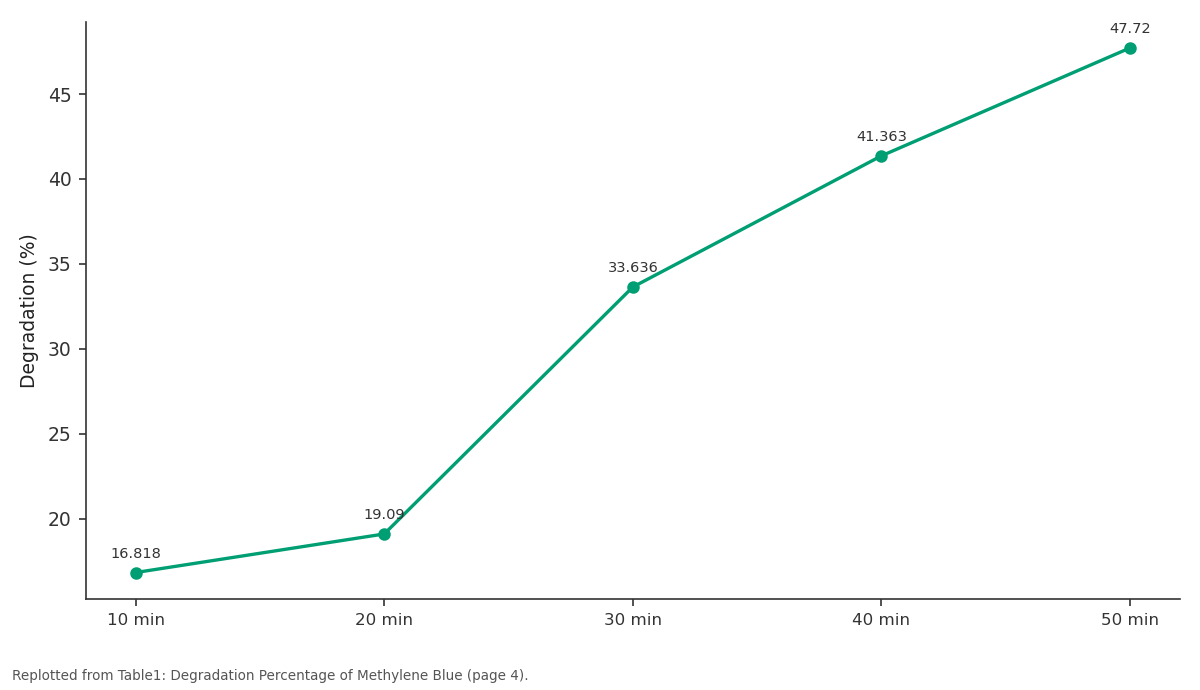
Degradation: 10 min vs 20 min vs 30 min vs 40 min vs 50 min
Replotted from Table1 (page 4) of the original paper. Every bar is the paper's own table value.
View source evidence ↗Figures & tables
From the original paper Table1
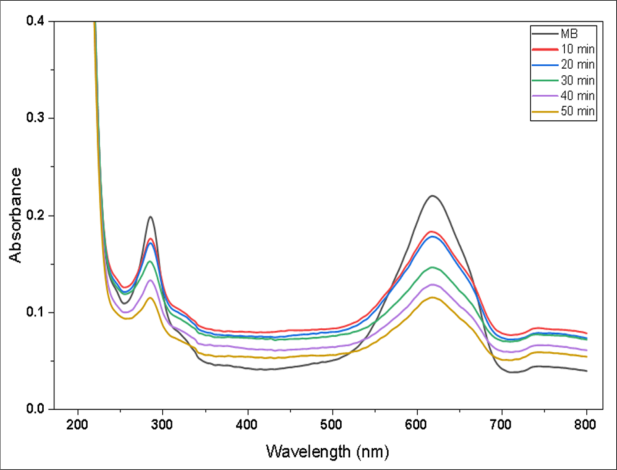 Figure 1
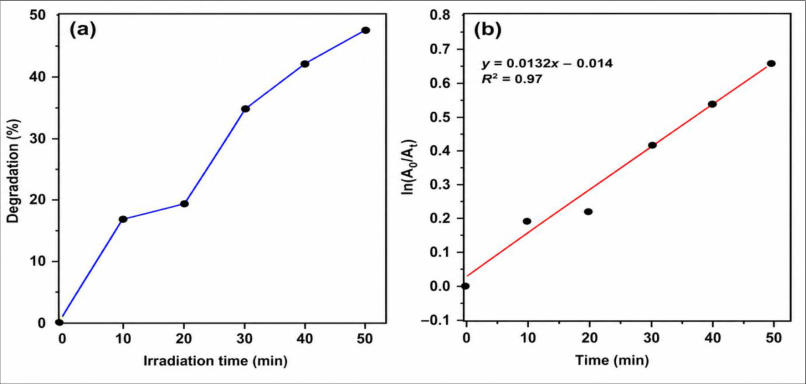 Figure 2
Introduction
In the present scenario nanoscience has the potential to make a healthy, safe and valuable life where the surroundings must be chemical and toxic free. This is possible by using the relative nanotechnologies [1,2] . Generally the nanoparticles may be defined where all the three Cartesian dimensions are less than 100 nm. These are larger than atoms or molecules individually but smaller than bulk solids. The physical properties of nano scaled particles and bulk material are different [3,4] . The trimetallic nanoparticles had recently gained appealing applications in the field of catalysis and are significantly manifested in various catalytic processes [5,6] . Methylene Blue (MB) is an intensely colored compound which is used in dyeing and printing textiles and is a common water pollutant. The present work reports the photocatalytic degradation of methylene blue (MB) in aqueous solution using Trimetallic nanoparticles as photocatalyst. At the nanoscale, metals exhibit unique optical, electronic, magnetic, catalytic, and mechanical properties that differ significantly from those of their bulk counterparts due to their high surface-to-volume ratio, quantum confinement effects, and increased surface energy. Among various metallic nanomaterials, Zn, Cu and Mn have attracted considerable attention owing to their stability, excellent biocompatibility, Localised Surface Plasmon Resonance (LSPR) as well as outstanding catalytic and antimicrobial properties. In recent years, researchers have shifted their focus from monometallic nanoparticles to multi-metallic nanostructures because combining two or more metals in a single nanoparticle often yields synergistic effects that enhance its physical, chemical, and biological properties. Bimetallic and trimetallic nanoparticles exhibit improved catalytic efficiency, higher thermal and chemical stability, tunable optical characteristics, and superior mechanical properties Trimetallic nanoparticles represent the next generation of multifunctional nanomaterials due to their ability to integrate the desirable characteristics of three different metallic elements within a single nanostructure. Compared to monometallic and bimetallic nanoparticles, trimetallic systems provide greater flexibility in controlling particle morphology, size distribution, electronic structure, catalytic activity, and chemical stability. The incorporation of three metals creates additional active sites and modifies the electronic density of the nanoparticle surface, leading to enhanced catalytic reactions and improved functional performance. Trimetallic nanoparticles have a greater catalytic activity [7,8] , increased anti microbial action [9] , diverse morphologies [10] , highly selective detection and sensitivity [11,12,13] . These nanoparticles have demonstrated excellent potential in photocatalysis, electrocatalysis, biosensing, antimicrobial treatment, drug delivery, cancer therapy, environmental remediation, and energy conversion technologies [11,12,13] . In biomedical applications, Cu-Zn-Mn trimetallic nanoparticles exhibit enhanced antibacterial, antifungal, antiviral, antioxidant, and anticancer activities compared to monometallic nanoparticles. The introduction of Trimetals narrows the bandgap of Cu-Zn-Mn which are highly useful for photocatalytic activity [14] . Their high surface area facilitates efficient interaction with microbial cell membranes, leading to membrane disruption, reactive oxygen species generation, and inhibition of cellular metabolism [15] . Additionally, the excellent biocompatibility of gold improves the safety profile of these nanoparticles for drug delivery and diagnostic applications. Surface functionalization with biomolecules, polymers, antibodies, or therapeutic agents further expands their potential in targeted medicine and biosensing technologies. Despite these remarkable advantages, several challenges remain in the synthesis and application of trimetallic nanoparticles. Achieving uniform particle size distribution, precise elemental composition, controlled morphology, and long-term colloidal stability requires careful optimisation of synthesis conditions. Furthermore, large-scale production, reproducibility, environmental safety, and toxicity assessment remain important considerations before these nanomaterials can be widely commercialised. Continued research is therefore focused on developing reliable, scalable, and environmentally sustainable synthetic strategies while improving the functional performance of trimetallic nanoparticles. Overall, the chemical synthesis of, Cu-Zn-Mn based trimetallic nanoparticles represents a rapidly expanding field of nanotechnology with immense scientific and technological significance. The combination of silver and gold within a multi-metallic architecture offers unique synergistic properties that cannot be achieved using individual metals alone. Chemical reduction techniques provide a versatile and efficient approach for fabricating these nanomaterials with controlled structural and functional characteristics [16] . Owing to their exceptional optical, catalytic, antimicrobial, and biomedical properties, chemically synthesised, Cu-Zn-Mn trimetallic nanoparticles have emerged as promising materials for applications in environmental remediation, healthcare, sensing, catalysis, and energy technologies. Further advances in synthesis methodologies and a deeper understanding of structureproperty relationships are expected to accelerate the development of highly efficient and application-specific trimetallic nanomaterials in the near future.
Materials and Methods
Materials and Methods
Materials
For the preparation of solution the precursor includes Copper sulfate pentahyradrate (1gm) in 100 mL double distilled water, Zinc sulphate monohydrate (1gm) in 100 mL double distilled water, Manganese chloride (1gm) in 100 mL double distilled water. An aqueous ammonia solution was used as the precipitating agent. Methylene blue was chosen as a pollutant for the degradation process. Doubledistilled water was used as a solvent throughout the experiment.
Methods
Methods
Synthesis of Cu-Zn-Mn Mixed Trimetal Oxide
In a standard reaction procedure, add 1 gram of copper sulphate pentahydrate in 100 mL water and mix it for 15 minutes using a magnetic stirrer. Followed by this, add 1 gm of manganese chloride tetrahydrate in 100 mL water and continue the stirring for further 15 minutes using a magnetic stirrer. Next, add 1 gram of Zinc sulphate monohydrate in 100 ml water and the mixture was stirred again for 60 minutes using a magnetic stirrer. The pH was kept at 12 by adding 15 mL of an aqueous ammonia solution to the precursor solutions mentioned above of all trimetals. The black trimetallic nanoparticles were centrifuged for about 15 minutes at 3000 rpm. Then the nanoparticles were washed with methanol and dried at 80°C for 5 to 10 minutes [17] . The resulting black nanoparticles, representing the final product, were collected and stored in an airtight container for further characterization and applications.
Photocatalytic Degradation of Methylene Blue Dye Solution
The photocatalytic performance of the synthesized Trimetallic nanoparticles (NPs) was investigated using a method adapted from previously reported literature [18] . Methylene blue (MB) dye was selected as the model organic pollutant to evaluate the photocatalytic degradation efficiency under visible light irradiation [19] . For the experiment, 40 mg of the synthesized catalyst was dispersed in 100 mL of an aqueous MB solution with a concentration of 10 mg/L. The suspension was stirred in the dark for 30 minutes to establish adsorption-desorption equilibrium between the dye molecules and the catalyst surface [20] . After this equilibration period, the reaction mixture was exposed to visible light to initiate photocatalytic degradation. During the irradiation process, 5 mL aliquots were collected every 10 minutes over a total reaction period of 50 minutes. Each collected sample was centrifuged for 10 minutes to separate the catalyst particles from the solution. The absorbance of the clear supernatant was then recorded using a UV-Visible spectrophotometer.
A 0 = Initial concentration (or absorbance) of the dye before photocatalytic irradiation.
A t = Concentration (or absorbance) of the dye at irradiation time t.
Result and Discussion
Result and Discussion
Trimetallic Nanoparticles (Cu-Zn-Mn): UV-Visible Analysis
The UV-Visible spectrum of the trimetallic nanoparticles (Cu-Zn-Mn) showed an absorption band between 300 and 345 nm. This peak is broader and more defined indicating the successful integration of the nanoparticle framework. The shift in the absorption profile suggests interactions between the three metal components, which alter the optical properties. This confirms the formation of a trimetallic alloy rather than a physical mixture of individual metal particles. It has been observed that UV-visible analysis confirmed the synthesis of nanoparticles, which has a strong UV absorption. Trimetallic nanoparticles peak ranges 300-345 nm band which represents a more complex, stable structure. This confirms that trimetals act as reducing agent and capping agent of the successful synthesis of trimetallic nanoparticles.
Application of Trimetallic NPs: Photocatalytic activity Test
Methylene blue (MB) dye was used as the model organic pollutant under neutral pH conditions to assess the photocatalytic degradation efficiency of the synthesized Cu-Zn-Mn trimetal oxide nanocomposite. The nanocomposite's outstanding photocatalytic efficiency and suitability for the removal of organic pollutants from wastewater under mild operating conditions can be seen by its 47.72% degradation in 50 minutes. The UV-Visible spectra of the trimetallic nanoparticles and methylene blue (MB) demonstrated two characteristic absorption regions. A distinct absorption peak in the UV region (approximately 290 nm) corresponds to the synthesized trimetallic nanoparticles, while the characteristic absorption peak of methylene blue was observed in the visible region (approximately 620-625 nm). Upon visible light irradiation, the intensity of the methylene blue absorption peak decreased progressively with increasing reaction time, indicating the effective photocatalytic degradation of the dye by the synthesized nanoparticles. Methylene blue dye was used as a pollutant to test the photocatalytic degradation efficiency of the synthesized Cu-Zn-Mn trimetal oxide nanocomposite at neutral pH as described in Table 1 and Fig 1 . A UV-Vis spectrophotometer was used to test the deteriorated solution, which was collected at varying intervals. Upon visible light irradiation, the intensity of the methylene blue absorption peak decreased progressively with increasing reaction time, indicating the effective photocatalytic degradation of the dye by the synthesized nanoparticles. The gradual reduction in absorbance confirms the excellent visible-light photocatalytic performance of the biosynthesized trimetallic nanoparticles, highlighting their potential application as efficient photocatalysts for the removal of organic dye pollutants from water.
| S. No. | MB (Time) | λmax | Absorbance | Degradation |
|---|---|---|---|---|
| 01. | 0 min (Stock MB solution) | 621nm | 0.220 | 0% |
| 02. | 10 min | 621nm | 0.183 | 16.818% |
| 03. | 20 min | 621nm | 0.178 | 19.090% |
| 04. | 30 min | 621nm | 0.146 | 33.636% |
| 05. | 40 min | 621nm | 0.129 | 41.363% |
| 06. | 50 min | 621nm | 0.115 | 47.72% |
Table text extracted from the original PDF; superscript letters are shown inline. The original table image is below.
View original table image
Photocatalytic degradation kinetics of methylene blue
The photocatalytic degradation of methylene blue (MB) using Cu-Mn-Zn trimetallic nanoparticles under visible-light irradiation showed a gradual increase in degradation efficiency with increasing irradiation time. The degradation efficiency reached 47.72% after 50 min, indicating the effective photocatalytic activity of the synthesized nanoparticles. The decrease in MB absorbance at 621 nm confirmed the progressive degradation of the dye.
The degradation kinetics followed a pseudo-first-order model according to the Langmuir-Hinshelwood equation, ln(A₀/Aₜ) = kt. The kinetic plot exhibited good linearity with the regression equation y = 0.0132x -0.014 and a correlation coefficient of R ² = 0.97, indicating that the degradation process obeyed pseudo-first-order kinetics represented in Fig 2 . The apparent rate constant was calculated to be 0.0132 min⁻¹, demonstrating efficient visible-light-induced photocatalytic performance. The enhanced activity can be attributed to the synergistic interaction among Cu, Mn, and Zn, which promotes charge separation and suppresses electron-hole recombination, thereby increasing the generation of reactive oxygen species responsible for MB degradation.
Conclusion
This study reports the successful synthesis of trimetallic nanoparticles acts as both a natural reducing and stabilizing agent. This plant-based approach offers a sustainable, costeffective, and environmentally friendly alternative to traditional chemical synthesis techniques. It displayed significant absorption in the ultraviolet range attributed to its bioactive phytochemicals in the synthesis of trimetallic nanoparticles exhibited characteristic absorption peaks between 300 -340 nm, verifying their successful synthesis.
The trimetallic nanoparticles displayed a broader absorption profile, indicating the successful integration of the third metal and a potential improvement in optical properties. The gradual reduction in absorbance confirms the excellent visible-light photocatalytic performance of the biosynthesized trimetallic nanoparticles, highlighting their potential application as efficient photocatalysts for the removal of organic dye pollutants from wastewater. This study demonstrates that trimetallic nanoparticle is a highly effective biological agent for synthesizing metallic nanoparticles. These synthesized particles show significant promise for future applications in photocatalysis, environmental remediation, antimicrobial research, and various other biomedical fields.
References
20 in the original paper- Mohammadinejad R, Karimi S, Iravani S, Varma RS. Plant-derived nanostructures: Types and applications. Green Chem. 2016;18:20-52.
- Mohammadinejad R, Shavandi A, Raie DS, Sangeetha J, Soleimani M, Hajibehzad SS, et al. Plant molecular farming: Production of metallic nanoparticles and therapeutic proteins using green factories. Green Chem. 2019;21:1845-1865.
- Bonnemann H, Richards RM. Nanoscopic metal particles synthetic methods and potential applications. Eur J Inorg Chem. 2001;2001(10):2455-2480.
- Venkatesan P, Santhanalakshmi J. Synthesis of chiral imidazolium salts from a carbohydrate and their application in Pd-catalyzed suzuki-miyaura reaction. J Mol Catal A Chem. 2010;326(1-2):99-106.
- Jiang HL, Xu Q. Recent progress in synergistic catalysis over heterometallic nanoparticles. J Mater Chem. 2011;21:13705-13725.
- Aranishi K, Jiang HL, Akita T, Haruta M, Xu Q. Onestep synthesis of magnetically recyclable Au/Co/Fe triple-layered core-shell nanoparticles as highly efficient catalysts for the hydrolytic dehydrogenation of ammonia borane. Nano Res. 2011;4:1233-1241.
- Pandey P, Pandey G. One-pot two-step rapid synthesis of 3-aminopropyltrimethoxysilane-mediated highly catalytic Ag@(PdAu) trimetallic nanoparticles. Catal Sci Technol. 2016;6:3911-3917.
- Feng Y, Zhang J, Ye H, Li L, Wang H, Li X, et al. Ni0.5Cu0.5Co2O4 Nanocomposites, Morphology, Controlled Synthesis, and Catalytic Performance in the Hydrolysis of Ammonia Borane for Hydrogen Production. Nanomaterials. 2019;9:1334.
- Yadav N, Jaiswal AK, Dey KK, Yadav VB, Nath G, Srivastava AK, et al. Trimetallic Au/Pt/Ag based nanofluid for enhanced antibacterial response. Mater Chem Phys. 2018;218:10-17.
- Akbarzadeh H, Abbaspour M, Mehrjouei E, Kamrani M. AgPd@ Pt nanoparticles with different morphologies of cuboctahedron, icosahedron, decahedron, octahedron, and Marks-decahedron: Insights from atomistic simulations. Inorg Chem Front. 2018;5:870-878.
- Ge S, Zhang Y, Zhang L, Liang L, Liu H, Yan M, et al. Ultrasensitive electrochemical cancer cells sensor based on trimetallic dendritic Au@ PtPd nanoparticles for signal amplification on lab-on-paper device. Sens Actuators B Chem. 2015;220:665-672.
- Wu P, Ding P, Ye X, Li L, He X, Wang K. One-pot synthesized Cu/Au/Pt trimetallic nanoparticles as a novel enzyme mimic for biosensing applications. RSC Adv. 2019;9:14982-14989.
- Nie F, Ga L, Ai J, Wang Y. Trimetallic PdCuAu Nanoparticles for Temperature Sensing and Fluorescence Detection of H2O2 and Glucose. Front Chem. 2020;8:244.
- Alam MW, Al Qahtani HS, Souayeh B, Ahmed W, Albalawi H, Farhan M, et al. Novel copper-zincmanganese ternary metal oxide nanocomposite as heterogeneous catalyst for glucose sensor and antibacterial activity. Antioxidants. 2022;11(6):1064.
- Thakur Y, Choudhary A, Tripathi M, Sarojinee R, Sharma AK, Sharma R. Protein and Lipid Nanomaterial Based Functional Construct. In: Sharma B, Chaudhary V, Shekhar S, Kumar A, editors. Nanostructured Polymers. Singapore: Springer; 2026. p. 235-258.
- Singh S, Vyas G, Jain B, Verma DK, Kanungo S. Fundamentals of multifunctional magnetic nanoparticles. In: Berdimurodov E, Hussain CM, Tüzün B, editors. Multifunctional Magnetic Nanoparticles in Therapy, Biology, and Pharmacy: Synthesis, Fundamentals and Applications. Elsevier; 2025. p. 3458.
- Alam MW, Al Qahtani HS, Souayeh B, Ahmed W, Albalawi H, Farhan M, et al. Novel copper-zincmanganese ternary metal oxide nanocomposite as heterogeneous catalyst for glucose sensor and antibacterial activity. Antioxidants. 2022;11(6):1064.
- Behnajady M, Modirshahla N, Hamzavi R. Kinetic study on photocatalytic degradation of C.I. Acid Yellow 23 by ZnO photocatalyst. J Hazard Mater. 2006;133(13):226-232.
- Fujishima A, Zhang X, Tryk DA. TiO2 photocatalysis and related surface phenomena. Surf Sci Rep. 2008;63:515-582.
- Ibhadon U, Fitzpatrick P. Heterogeneous Photocatalysis: Recent Advances and Applications. Catalysts. 2013;3:189-218.