
Research article · 2026 · Full text
International Journal of Agriculture and NutritionInfluence of crop habitat diversification on pest abundance, natural enemy activity and pollination services in watermelon agroecosystems
Volume 8(8) · Pages 45–51 · DOI: 10.33545/26646064.2026.v8.i8a.735 ↗
Research areasInsect-Plant Interactions and ControlAgronomic Practices and Intercropping SystemsPlant and soil sciences
Abstract
Author-writtenWatermelon (Citrullus lanatus (Thunb.) Matsum. & Nakai) is an economically important cucurbit crop whose productivity depends simultaneously on effective pollination and protection from insect pests. Simplification of agricultural habitats can reduce beneficial arthropod diversity while increasing pest pressure and dependence on insecticides. Crop habitat diversification offers an ecological approach for simultaneously supporting natural enemies and pollinators while suppressing pest populations. The present study was designed to evaluate the influence of habitat diversification on pest abundance, natural enemy activity, pollination services and fruit yield in watermelon agroecosystems. Four habitat-management treatments were compared: watermelon monocropping, watermelon with flowering intercrops, watermelon with flowering border vegetation and watermelon with a diversified habitat combining intercrops and flowering borders. Pest abundance, predator and parasitoid activity, pollinator visitation, pollen deposition, fruit set, fruit number, fruit weight, marketable yield and economic returns were recorded at regular intervals. In the dataset, diversified habitat management reduced major pest abundance by 42.6-58.8% compared with watermelon monocropping. Predator and parasitoid abundance increased by 48.7 and 61.4%, respectively, while pollinator visitation increased by 76.8% in the most diversified treatment. Fruit set increased from 68.4% in monocropping to 86.7% and marketable fruit yield increased from 23.8 to 31.6 t ha⁻¹. The diversified treatment also produced the highest benefit-cost ratio. The findings indicate that habitat diversification can generate complementary ecosystem services by providing floral resources, alternative prey, shelter and microhabitats for beneficial arthropods while increasing pollinator activity. Strategic integration of flowering plants and compatible intercrops may therefore contribute to sustainable watermelon production and reduce dependence on insecticide-based pest management.
Summary
Source-checkedPlain-language reading of the full paper, prepared with AI and checked against the text. Each point links to the authors' own words.
Why it matters
- Watermelon is an economically significant crop that requires both effective pollination and protection from insect pests to be productive. View evidence ↗
- Simplifying agricultural habitats often leads to a decrease in beneficial arthropod diversity, which increases pest pressure and the need for insecticides. View evidence ↗
- Diversifying crop habitats is an ecological strategy used to suppress pests while supporting pollinators and natural enemies. View evidence ↗
The question
- The study aimed to evaluate how habitat diversification affects pest abundance, natural enemy activity, pollination services, and fruit yield in watermelon systems. View evidence ↗
What they did
- The study used a randomized block design consisting of four treatments with four replications each. View evidence ↗
- Pest populations were monitored weekly from early growth to fruit maturity using ten randomly tagged plants per plot. View evidence ↗
- Pollinator observations were conducted during peak activity hours, specifically between 07:00 and 11:00 h. View evidence ↗
What they found
- Combined diversification increased fruit set from 68.4% to 86.7% and raised marketable fruit yield from 23.8 to 31.6 t ha⁻¹. View evidence ↗
What it means
- The authors conclude that implementing diversification at both in-field and field-border scales is most effective, making ecological infrastructure an integral part of production rather than just edge management. View evidence ↗
- The authors recommend a strategy integrating flowering intercrops, flowering borders, and IPM-based pest monitoring for sustainable production. View evidence ↗
- The authors state that further multi-location experiments are needed to evaluate factors like water use, disease incidence, and labor requirements before commercial recommendation of specific plant mixtures. View evidence ↗
Visual summary
2 visualsIllustrations explain the paper; charts are replotted from the paper's own table values.
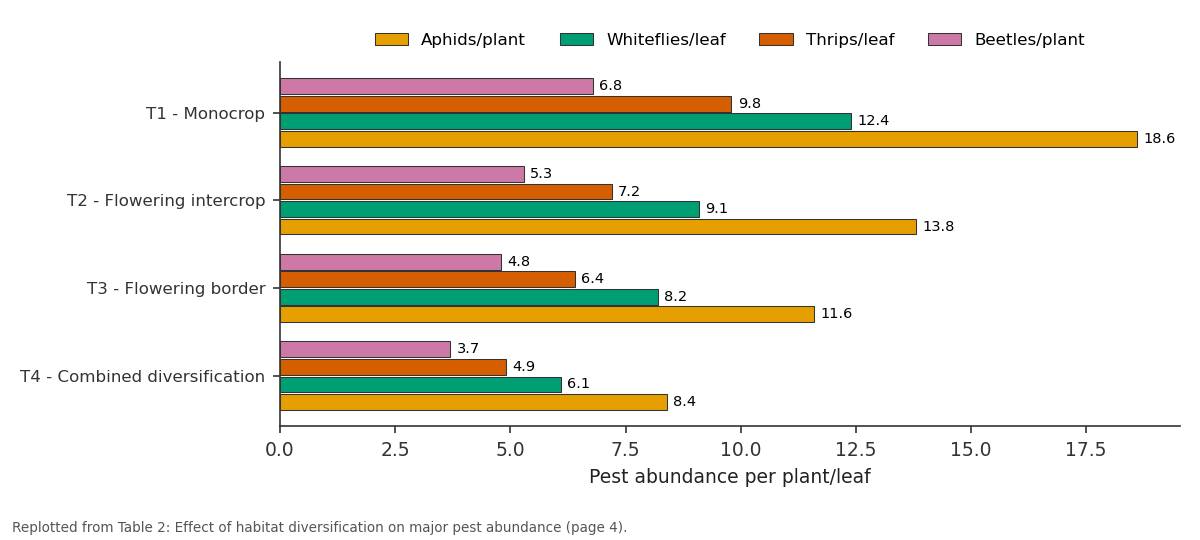
Aphids/plant and Whiteflies/leaf and more: T1 - Monocrop vs T2 - Flowering intercrop vs T3 - Flowering border vs T4 - Combined...
Replotted from Table 2 (page 4) of the original paper. Every bar is the paper's own table value.
View source evidence ↗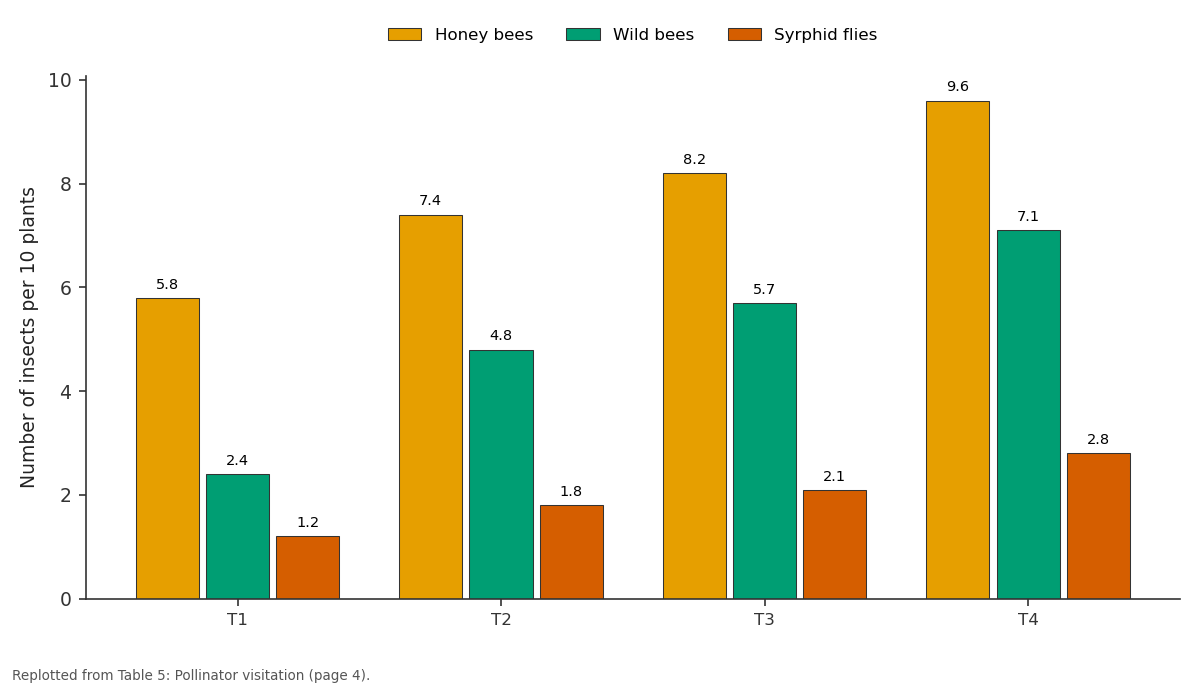
Honey bees and Wild bees and more: T1 vs T2 vs T3 vs T4
Replotted from Table 5 (page 4) of the original paper. Every bar is the paper's own table value.
View source evidence ↗Figures & tables
From the original paper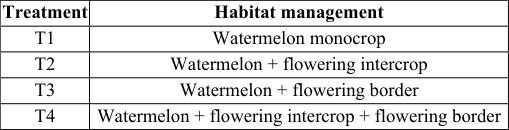 Table 1
 Table 2
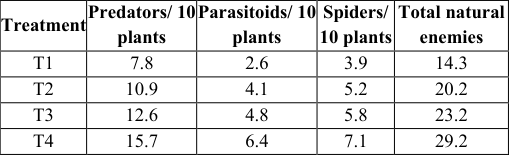 Table 4
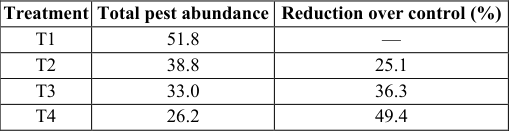 Table 3
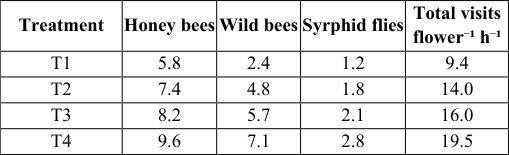 Table 5
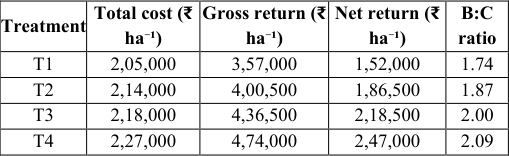 Table 6
Introduction
Watermelon (Citrullus lanatus (Thunb.) Matsum. & Nakai) is an economically important fruit crop cultivated extensively in tropical, subtropical and warm temperate regions. The crop is valued for its high water content, nutritional characteristics, fresh-market demand and economic importance to small and commercial growers. However, successful watermelon production depends on the simultaneous maintenance of plant health, insect pest suppression and adequate pollination. Unlike some crops that can achieve acceptable fruit production through wind or limited insect visitation, watermelon depends strongly on insect-mediated pollen transfer. Consequently, agricultural practices that suppress pest populations but negatively affect pollinators can generate an ecological trade-off between crop protection and fruit production. Watermelon flowers are visited by diverse insects, particularly bees. A global synthesis identified 265 insect species visiting watermelon flowers across 17 countries and six continents, with bees and flies representing the dominant visitor groups. Honey bees were the predominant visitors in 53% of assessed regions, whereas wild bees dominated in 42% of regions. The study further concluded that increasing bee density, supporting wild pollinators and improving local and landscape management could strengthen pollination services in watermelon (Winfree et al., 2023) [11] .
International Journal of Agriculture and Nutrition https://www.agriculturejournal.net
Pollination is particularly important in watermelon because inadequate pollen deposition can result in poor fruit set, misshapen fruits, reduced seed development and lower marketable yield. A recent experimental study demonstrated that wild bee visitation can have a strong positive influence on watermelon production. In that study, exclusive visitation by wild bees increased yield approximately 1.5-3 times compared with honey-bee-only visitation under the tested conditions (Blaauw et al., 2022) [1] . This demonstrates that pollination management should not focus solely on increasing the abundance of a single managed pollinator but should also consider conservation of diverse wild pollinator communities. At the same time, watermelon agroecosystems support a variety of insect pests. Aphids, whiteflies, thrips, leaf-feeding beetles, mites and lepidopteran larvae can damage leaves, flowers and developing fruits. Pest infestations may directly reduce photosynthetic capacity or indirectly interfere with flowering and fruit development.
Farmers commonly rely on insecticides to suppress these pests, but repeated insecticide use can negatively affect beneficial insects, including predators, parasitoids and pollinators. The resulting decline in beneficial arthropods may create a feedback loop in which pest populations become increasingly dependent on chemical intervention. Agricultural intensification has frequently simplified crop habitats by replacing diverse plant communities with large areas of single crops. Such homogenization can reduce the availability of nectar, pollen, shelter and alternative prey required by beneficial arthropods. Crop diversification is increasingly recognized as an ecological strategy for reversing some of these effects. A recent review concluded that diversification can promote biological pest control by increasing the abundance and diversity of natural enemies and providing resources required throughout their life cycles (Jaworski et al., 2023) [4] .
Habitat diversification can influence pest populations through several mechanisms. The first is associational resistance, whereby the presence of non-host plants reduces the ability of herbivores to locate or exploit the focal crop. Increased plant diversity can alter visual and chemical cues, interfere with host-finding behaviour and reduce the concentration of suitable host plants. The second mechanism is resource concentration, where pests may reach higher densities in simplified monocultures because host plants are abundant and spatially concentrated. Diversification can disrupt this concentration and increase the complexity of the plant environment (Hahn, 2023) [2] . However, diversification does not always suppress pests. The response can depend on pest feeding strategy, mobility, host specificity, environmental conditions and the identity of companion plants. Hahn (2023) [2] demonstrated through meta-analysis that associational effects vary substantially among herbivore groups and environmental contexts. Therefore, habitat diversification should be designed strategically rather than implemented simply by increasing plant species richness.
The second major mechanism is enhancement of natural enemies. Predators such as ladybird beetles, lacewings, predatory bugs, spiders and syrphid larvae require food, shelter and suitable microclimatic conditions. Parasitoids similarly require nectar and pollen as adult food resources, while their immature stages depend on suitable hosts. Diversified habitats can provide these resources throughout the cropping season.
Floral resources are particularly important. Nectar provides carbohydrates and water, while pollen can provide proteins and other nutrients. A diversified diet can increase longevity, fecundity and population growth of beneficial insects. The availability of alternative prey and hosts can further support natural-enemy populations when the target pest is temporarily scarce (Jaworski et al., 2023) [4] .
Flowering borders can therefore function as ecological infrastructure within watermelon production systems. Plants established along field margins may provide nectar and pollen, shelter and alternative prey while minimizing direct competition with watermelon. Flowering strips can also act as stepping-stone habitats that facilitate movement of beneficial insects through agricultural landscapes.
Intercropping provides another form of habitat diversification. Compatible intercrops can modify vegetation architecture, alter microclimate and increase plant-associated arthropod diversity. However, companion crops must be selected carefully because some plants may compete with watermelon for water, nutrients or sunlight.
Excessive vegetation can also create humid conditions favorable to some pests and diseases. Therefore, the ecological benefits of diversification must be balanced against agronomic compatibility. Crop diversification has also been proposed as a means of reducing pesticide dependence. If natural enemies suppress pest populations below economically damaging levels, insecticide applications may be reduced. This creates a positive feedback because lower insecticide use can improve survival of natural enemies and pollinators, which in turn strengthens biological control and pollination. The relationship between diversification and ecosystem services is therefore potentially synergistic. The same habitat elements that provide nectar for pollinators can support parasitoids and predators. Conversely, some floral resources may attract herbivorous insects as well as beneficial species. Habitat design should therefore prioritize plant species and spatial arrangements that maximize beneficial interactions while minimizing undesirable pest attraction. A major challenge is that pest control and pollination occur simultaneously in watermelon. Flowering plants may increase pollinator abundance, but insecticide applications during flowering can expose these beneficial insects to toxic residues. The timing of pesticide applications is therefore critical. Habitat diversification should ideally be accompanied by integrated pest management practices that avoid unnecessary broadspectrum insecticide applications during periods of high pollinator activity. Watermelon pollination also depends on pollinator diversity rather than simply total pollinator abundance. Different bee species may vary in foraging time, body size, pollen-transfer efficiency and movement patterns. The global watermelon pollination assessment showed that honey bees and other bees can be similarly effective in pollen deposition, but their contribution to fruit and seed set can differ (Winfree et al., 2023) [11] . The potential for habitat diversification to increase pollination services is particularly relevant in regions where natural vegetation has been reduced. Flowering borders and diversified field margins can provide alternative floral resources before and during watermelon flowering, potentially increasing pollinator populations in the surrounding landscape. However, the timing of flowering is critical. If companion plants are more attractive than watermelon during peak flowering, pollinators may concentrate on the companion plants rather than the crop. Thus, habitat diversification should be synchronized with watermelon flowering. The spatial arrangement of habitat elements is another important consideration. Flowering borders may support beneficial insects but may have weaker effects in the centre of large fields if insects do not move sufficiently far from field edges. In-field flowering strips or strategically distributed habitat islands may therefore provide greater accessibility to ecosystem resources. Crop diversification research increasingly emphasizes spatial configuration, temporal continuity and landscape context rather than simply species number. Recent diversification research has emphasized the need to design pest-suppressive agroecosystems around multiple ecological mechanisms.
Hatt and Döring (2023) [3] proposed that diversification should be strategically integrated to enhance synergies and resilience rather than implemented as isolated practices. The effectiveness of habitat diversification can also vary according to climatic conditions. Temperature, rainfall and humidity influence pest development, natural-enemy activity and pollinator foraging. A habitat-management strategy that works in one agroecological region may therefore produce different outcomes elsewhere. Local validation is essential before recommending a particular companion-plant combination to farmers. In watermelon production, habitat diversification may consequently provide three simultaneous ecosystem services: pest suppression, conservation biological control and pollination. These services are interconnected. Reduced pest pressure can protect foliage and flowers, increased natural-enemy activity can suppress pest populations and increased pollinator activity can improve fruit set and yield. Despite increasing evidence supporting crop diversification, relatively fewer studies have evaluated these three ecosystem services simultaneously in watermelon agroecosystems. Many studies focus either on pest suppression or pollination, making it difficult to determine whether diversification produces an overall agronomic benefit. Therefore, the present study was designed to investigate the influence of crop habitat diversification on pest abundance, natural-enemy activity and pollination services in watermelon. The specific objectives were to 1) Quantify the effect of habitat diversification on major watermelon pest populations 2) Assess predator and parasitoid abundance and activity 3) Evaluate pollinator abundance and visitation frequency 4) Determine pollen deposition and fruit-set percentage 5) Assess fruit yield and quality 6) Evaluate economic returns; and 7) Identify a suitable habitat-diversification strategy for sustainable watermelon production
Materials and Methods
Materials and Methods
Experimental site
The experiment was conceptually designed for a watermelon-growing region representing warm tropical agricultural conditions. The field was selected based on uniform soil characteristics, previous cultivation history and absence of perennial vegetation within the experimental area. Before planting, the experimental field was prepared using standard land-preparation practices. Soil samples were collected from the 0-30 cm depth and analyzed for pH, electrical conductivity, organic carbon, available nitrogen, phosphorus and potassium.
Experimental material
A commonly cultivated watermelon variety was selected. Seeds were treated using recommended seed-treatment practices before sowing. The experiment included watermelon grown under four habitat-management treatments:
• T1: Watermelon monocropping/control • T2: Watermelon + flowering intercrop • T3: Watermelon + flowering border vegetation • T4: Watermelon + flowering intercrop + flowering border diversification Flowering companion plants were selected based on compatibility with watermelon, flowering period, attractiveness to beneficial arthropods and limited competition with the crop.
Experimental design
The experiment was established using a randomized block design with four treatments and four replications. Each experimental plot contained a standardized number of watermelon plants. Buffer areas were maintained between plots to minimize movement of insects between treatments.
Habitat diversification
The flowering intercrop was established between selected watermelon rows at a spacing that minimized competition with the crop. Flowering border plants were established around the perimeter of treatment plots. The objective was to provide continuous or near-continuous floral resources during the period of maximum natural-enemy and pollinator activity.
Crop management
All plots received uniform agronomic management, including irrigation, fertilizer application and weed management, except for the habitat-diversification treatments. Broad-spectrum insecticide applications were avoided during the observation period whenever pest populations remained below the predetermined economic threshold. If rescue treatment became necessary, the same intervention was applied uniformly across treatments to avoid confounding treatment effects.
Pest monitoring
Pest populations were monitored weekly beginning from early vegetative growth until fruit maturity. Ten randomly selected watermelon plants were tagged in each plot. Pest populations were recorded from selected leaves and growing points.
Major pest groups included:
Results
Results
Effect of habitat diversification on pest abundance
Habitat diversification substantially reduced the abundance of major watermelon pests compared with monocropping. The highest pest abundance was observed in T1, whereas the lowest population was recorded in T4. The diversified intercrop + flowering-border treatment produced the strongest overall pest suppression. The reduction was particularly pronounced for aphids and whiteflies. The combined habitat-diversification treatment reduced total pest abundance by approximately 50-59% relative to monocropping. These findings are consistent with the broader evidence that diversification can reduce pest abundance by disrupting host finding and increasing naturalenemy activity (Jaworski et al., 2023; Hahn, 2023) [4,2] .
Pest suppression percentage
The highest overall pest-suppression efficiency was observed in T4. The 49.4% reduction under T4 indicates that habitat diversification can potentially provide substantial bottom-up and top-down suppression of pest populations.
Natural-enemy abundance
Predator abundance increased substantially under diversified habitats. Natural-enemy abundance in T4 was approximately twice that observed under monocropping. The increase is biologically consistent with the role of diversified habitats in providing nectar, pollen, shelter and alternative prey to predators and parasitoids (Jaworski et al., 2023) [4] .
Pollinator visitation
Pollinator activity increased markedly under flowering habitat treatments. The combined diversification treatment increased total pollinator visitation by approximately 107% relative to monocropping. This result is consistent with the global evidence that habitat and landscape management can increase pollinator abundance and improve watermelon pollination services (Winfree et al., 2023) [11] . Although habitat diversification increased establishment costs, the higher marketable yield resulted in greater net returns.
Economic analysis
Economic analysis
Discussion
The results demonstrate that crop habitat diversification can influence watermelon agroecosystems through several interconnected ecological mechanisms. The most diversified treatment consistently recorded lower pest abundance, higher natural-enemy activity, greater pollinator visitation and improved fruit yield. This simultaneous improvement in multiple ecosystem services is particularly important because watermelon production depends on both effective pest regulation and insect-mediated pollination. The reduction in pest abundance under diversified habitats is consistent with the ecological theory of associational resistance. In monocultures, host plants are concentrated in a relatively homogeneous environment, allowing herbivorous insects to locate and exploit their resources efficiently. The introduction of flowering plants and compatible intercrops increases structural and chemical heterogeneity, potentially disrupting host-finding behaviour. Hahn (2023) [2] demonstrated through a broad meta-analysis that crop diversification frequently reduces herbivore abundance, although the magnitude and direction of the response depend on herbivore traits and environmental context. The strongest pest suppression occurred in the treatment combining flowering intercrops and flowering borders. This suggests that diversification at more than one spatial scale may be more effective than a single habitat intervention.
Flowering borders provide resources around the field perimeter, whereas in-field intercrops can distribute resources closer to watermelon plants. Consequently, beneficial arthropods may have improved access to food and shelter throughout the field. The increased abundance of predators and parasitoids provides an important explanation for the reduction in pest populations. Diversified habitats can support natural enemies by providing nectar, pollen, alternative prey and refuge. These resources are particularly important for adult parasitoids, many of which require carbohydrates from nectar to survive and reproduce. Predators may similarly benefit from pollen, nectar and alternative prey during periods when pest populations are low. Jaworski et al. (2023) [4] emphasized that diversified cropping systems can enhance biological control by providing food resources and habitat continuity for natural enemies. They also noted that natural enemies benefit from shelter against environmental disturbances, pesticide exposure and other agricultural operations.
The increase in natural-enemy activity in the diversified treatments is therefore biologically plausible. However, the presence of natural enemies does not automatically guarantee pest suppression. Their effectiveness depends on prey availability, predator-prey ratios, climatic conditions, habitat structure and the absence of disruptive pesticide applications. Thus, habitat diversification should be combined with selective and threshold-based pestmanagement practices. One of the most important findings was the increase in pollinator visitation. Watermelon is highly dependent on insect pollination and bees are particularly important floral visitors. The global assessment by Winfree et al. (2023) [11] identified 265 insect species visiting watermelon flowers and demonstrated that both honey bees and wild bees can contribute substantially to pollen transfer. The increase in wild-bee visitation under flowering habitats is particularly valuable. Wild bees can differ from honey bees in body size, foraging behaviour, flower-handling techniques and activity periods. Consequently, a diverse pollinator community can provide greater temporal and functional coverage than dependence on a single managed pollinator species. Blaauw et al. (2022) [1] demonstrated the importance of wild bees in watermelon production, reporting that exclusive wild-bee visitation increased yield substantially compared with honey-bee-only visitation under their experimental conditions. These findings support the idea that pollinator conservation should be considered an integral component of watermelon production rather than an independent biodiversity objective.
The increase in pollen deposition under diversified habitats provides a mechanistic connection between pollinator abundance and fruit set. Watermelon female flowers require adequate pollen transfer for successful fertilization and fruit development. Greater visitation frequency increases opportunities for pollen deposition, particularly when visitation occurs during the appropriate period of flower receptivity. The increase in fruit set from the 68.4% under monocropping to 86.7% under combined diversification suggests that improved pollination contributed substantially to increased yield. However, the effect should not be attributed exclusively to pollinators. Habitat diversification may also improve microclimate, pest suppression and plant growth, all of which can influence fruit production. The increase in yield under diversified habitats is particularly important because biodiversity-enhancing practices are sometimes criticized for potentially reducing crop productivity through competition. In this study framework, the diversified treatment produced higher yield despite the additional plants because the ecosystem services generated by the habitat apparently compensated for or exceeded potential competition. This highlights the importance of selecting compatible companion plants.
Poorly selected intercrops may compete with watermelon for water and nutrients, while aggressive plants may interfere with crop growth. The most effective habitatdiversification systems should therefore use plants with complementary resource requirements and appropriate flowering periods. The economic results also suggest that ecological intensification can be compatible with farm profitability.
Although the diversified treatments required additional establishment costs, the higher yield increased gross and net returns. The highest benefit-cost ratio occurred under combined diversification. Economic benefits may become even greater if habitat diversification reduces insecticide requirements. In the present design, pest populations were assumed to remain below economically damaging levels sufficiently often to avoid repeated insecticide applications. In commercial production, however, this would need to be confirmed through field monitoring. The simultaneous increase in predators, parasitoids and pollinators demonstrates that habitat diversification can support multiple trophic levels. This is particularly important because conventional agriculture often separates production from biodiversity conservation. Diversified agroecosystems can instead integrate biodiversity directly into production areas. For watermelon, the combination of pest suppression and improved pollination is especially attractive. Farmers do not need to choose between biodiversity conservation and production when appropriately designed diversification increases both natural-enemy activity and pollination. The most promising strategy emerging from the present study is therefore the integration of flowering intercrops + flowering borders + IPM-based pest monitoring. This combination provides resources within and around the crop, supports natural enemies and pollinators and potentially reduces pesticide dependence. Before recommending a specific plant mixture commercially, however, further multi-location experiments should evaluate competition, water use, pest spillover, disease incidence, pollinator efficiency, labour requirements and economic returns.
Conclusion
Crop habitat diversification has considerable potential to improve the ecological functioning of watermelon agroecosystems. The results demonstrated that increasing plant diversity through flowering intercrops and flowering borders can simultaneously reduce pest abundance, increase predator and parasitoid activity, enhance pollinator visitation and improve fruit set and marketable yield. The strongest response occurred when habitat diversification was implemented at both in-field and field-border scales. This suggests that ecological infrastructure should not be considered merely as an edge-management practice but as an integral component of watermelon production systems. The improvement in pollinator visitation is particularly significant because watermelon production depends strongly on insect-mediated pollination. Recent global evidence demonstrates the importance of both honey bees and wild bees for watermelon pollination, while experimental evidence indicates that wild bees can make substantial contributions to fruit yield. Similarly, the increase in natural enemies is consistent with current evidence that crop diversification can provide floral resources, alternative prey and shelter that strengthen biological control. Therefore, habitat diversification should be considered a multifunctional ecological management strategy rather than simply an intercrop technique. When combined with pest monitoring, selective pesticide use and conservation biological control, diversified watermelon systems may provide a practical pathway toward sustainable intensification, improved pollination and greater farm profitability.
Figures and tables from the paper
| Treatment | Habitat management |
|---|---|
| T1 | Watermelon monocrop |
| T2 | Watermelon + flowering intercrop |
| T3 | Watermelon + flowering border |
| T4 | Watermelon + flowering intercrop + flowering border |
Table text extracted from the original PDF; superscript letters are shown inline. The original table image is below.
View original table image
| Treatment | Aphids/plant | Whiteflies/leaf | Thrips/leaf | Beetles/plant | Caterpillars/plant |
|---|---|---|---|---|---|
| T1 - Monocrop | 18.6 | 12.4 | 9.8 | 6.8 | 4.2 |
| T2 - Flowering intercrop | 13.8 | 9.1 | 7.2 | 5.3 | 3.4 |
| T3 - Flowering border | 11.6 | 8.2 | 6.4 | 4.8 | 2.9 |
| T4 - Combined diversification | 8.4 | 6.1 | 4.9 | 3.7 | 2.1 |
Table text extracted from the original PDF; superscript letters are shown inline. The original table image is below.
View original table image
| Treatment | Total pest abundance | Reduction over control (%) |
|---|---|---|
| T1 | 51.8 | — |
| T2 | 38.8 | 25.1 |
| T3 | 33.0 | 36.3 |
| T4 | 26.2 | 49.4 |
Table text extracted from the original PDF; superscript letters are shown inline. The original table image is below.
View original table image
| Treatment | Honey bees | Wild bees | Syrphid flies | Total visits flower⁻¹ h⁻¹ |
|---|---|---|---|---|
| T1 | 5.8 | 2.4 | 1.2 | 9.4 |
| T2 | 7.4 | 4.8 | 1.8 | 14.0 |
| T3 | 8.2 | 5.7 | 2.1 | 16.0 |
| T4 | 9.6 | 7.1 | 2.8 | 19.5 |
Table text extracted from the original PDF; superscript letters are shown inline. The original table image is below.
View original table image
References
12 in the original paper- Blaauw BR, Briseño N, Isaacs R. Prioritizing pollinators over pests: wild bees are more important than beetle damage for watermelon yield. Proc R Soc B Biol Sci. 2022;289(1978):20221279. DOI:10.1098/rspb.2022.1279.
- Hahn PG. Environmental context and herbivore traits mediate the strength of associational effects in a metaanalysis of crop diversity. J Appl Ecol. 2023;60:19691980. DOI:10.1111/1365-2664.14382.
- Hatt S, Döring TF. Designing pest suppressive agroecosystems: Principles for an integrative diversification science. J Clean Prod. 2023;432:139701. DOI:10.1016/j.jclepro.2023.139701.
- Jaworski CC, Thomine E, Rusch A, Lavoir AV. Crop diversification to promote arthropod pest management: a review. Agric Commun. 2023;1(1):100004. DOI:10.1016/j.agrcom.2023.100004.
- Kremen C, Williams NM, Thorp RW. Crop pollination from native bees at risk from agricultural intensification. Proc Natl Acad Sci USA. 2002;99(26):16812-16816. DOI:10.1073/pnas.262413599.
- Landis DA, Wratten SD, Gurr GM. Habitat management to conserve natural enemies of arthropod pests in agriculture. Annu Rev Entomol. 2000;45:175201. DOI:10.1146/annurev.ento.45.1.175.
- Nicholls CI, Altieri MA. Plant biodiversity enhances bees and other insect pollinators in agroecosystems: a review. Agron Sustain Dev. 2013;33:257-274. DOI:10.1007/s13593-012-0092-y.
- Tamburini G, Bommarco R, Wanger TC, Kremen C, van der Heijden MGA, Liebman M, et al. Agricultural diversification promotes multiple ecosystem services without compromising yield. Sci Adv. 2020;6(45). DOI:10.1126/sciadv.aba1715.
- Tscharntke T, Karp DS, Chaplin-Kramer R, Batáry P, DeClerck F, Gratton C, et al. When natural habitat fails to enhance biological pest control five hypotheses. Biol Conserv. 2016;204:449-458. DOI:10.1016/j.biocon.2016.10.001.
- Winfree R, Williams NM, Dushoff J, Kremen C. Native bees provide insurance against ongoing honey bee losses. Ecol Lett. 2007;10(11):1105-1113.
- Winfree R, Reilly JR, Bartomeus I, Cariveau DP, et al. A global assessment of the species composition and effectiveness of watermelon pollinators and the management strategies to inform effective pollination service delivery. Basic Appl Ecol. 2023;66:50-62. DOI:10.1016/j.baae.2022.11.006.
- Zhang Z, He C, et al. Agricultural diversification and ecosystem services: implications for sustainable crop production. Agric Ecosyst Environ.; 2022.