
Research article · 2026 · Full text
International Journal of Agriculture and NutritionA comparative review of tribal populations, livelihood systems, and traditional food practices among selected Tribal Communities of Wayanad, Kerala
Volume 8(8) · Pages 39–44 · DOI: 10.33545/26646064.2026.v8.i8a.734 ↗
Research areasFood, Nutrition, and Cultural PracticesIndigenous Health and EducationEthnobotanical and Medicinal Plants Studies
Abstract
Author-writtenWayanad, Kerala’s tribal communities make up a variety of social, ecological, and cultural systems, and their eating customs and means of subsistence rely on regional resources. However, tribal tribes cannot be regarded as homogeneous because their food systems are determined by differences in land use, livelihood, reliance on forests, socioeconomic circumstances, and market participation. The Paniya, Mullu Kuruma and kattunayakar tribes will be the main focus of this review’s comparative analysis of a few Wayanad tribal groupings. Traditional eating patterns in these communities have changes as a result of urbanization, education, diversity of economic options, market integration, farming practice modifications and forest access restrictions. The inhabitants' diets have also been greatly impacted by the seasonal availability of forest and agricultural items. Their culture includes knowledge of traditional foods, such as how to recognize and eat locally produced goods, but changes in lifestyle make it difficult for this knowledge to spread. The study emphasizes how crucial it is to record the community’s traditional food information, including seasonality, methods for obtaining and processing, and dietary shifts.
Summary
Source-checkedPlain-language reading of the full paper, prepared with AI and checked against the text. Each point links to the authors' own words.
Why it matters
- Tribal communities in Wayanad, Kerala, possess diverse social and cultural systems with food and livelihood practices deeply tied to local regional resources. View evidence ↗
- Traditional diets in these communities are shifting due to factors such as urbanization, education, market integration, and restricted access to forests. View evidence ↗
- There is a critical need to document traditional food knowledge, including how foods are processed and obtained, to preserve this information amidst dietary shifts. View evidence ↗
The question
- The review aims to investigate the socioeconomic status, livelihood patterns, and food systems of selected tribal groups in Wayanad. View evidence ↗
- The study uses comparative methods to understand how differences in land access, forest reliance, and market participation affect the eating habits of different tribes. View evidence ↗
What they did
- The review focuses its comparative analysis on three specific tribal communities: the Paniya, Mullu Kuruma, and Kattunayakar. View evidence ↗
- The research is structured as a comparative review of the selected tribes within the Wayanad region of Kerala. View evidence ↗
What they found
- Among the studied groups, the Mullu Kurumas have the highest socioeconomic status due to their education and established farming practices. View evidence ↗
- The Paniya community faces unstable income and seasonal food insecurity because of their heavy reliance on wage labor. View evidence ↗
- The Kattunayakar community traditionally relies on forest-based activities such as hunting, gathering, and honey harvesting for their subsistence. View evidence ↗
- The Kattunayakar diet is characterized by high diversity due to their practice of hunting and gathering wild foods. View evidence ↗
- Paniya families have less dietary diversity than other tribes, relying primarily on rice due to financial constraints and limited land. View evidence ↗
- Food sources differ by tribe: Paniya rely on purchased and public distribution foods; Mullu Kuruma use cultivated crops and gardens; and Kattunayakar rely on forest foods and purchased items. View evidence ↗
- Market integration and the shift toward purchased foods have more significantly affected the Mullu Kuruma and Paniya tribes than the Kattunayakar. View evidence ↗
What it means
- The authors conclude that the three tribes have distinct subsistence and consumption patterns shaped by their specific ecology, socioeconomic status, and culture. View evidence ↗
- The authors state that future research should focus on the systematic documentation and preservation of traditional dietary knowledge across different tribes. View evidence ↗
Visual summary
1 visualsIllustrations explain the paper; they do not show study data.
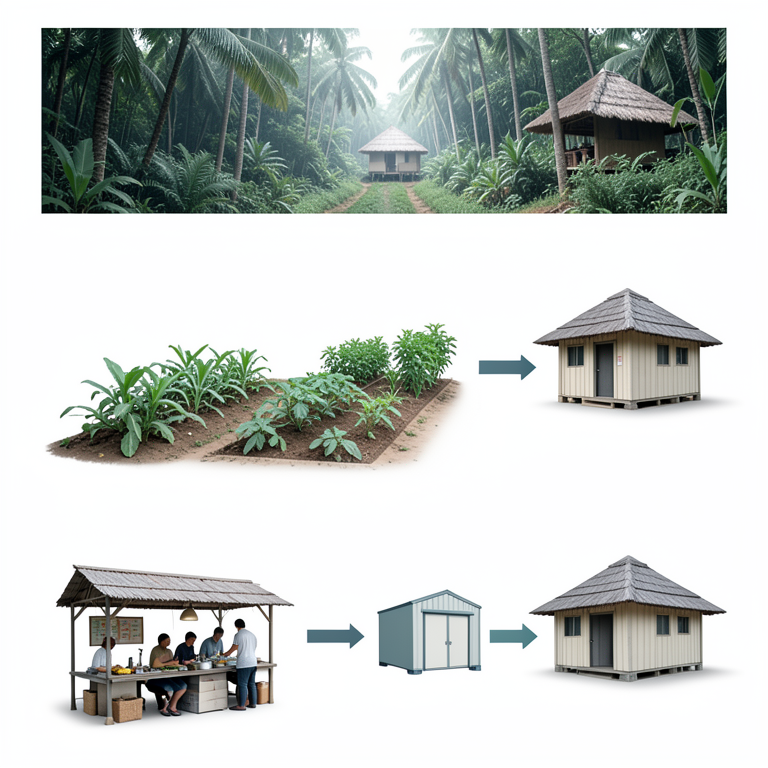
Tribal Food Source Comparison
AI-generated conceptual illustration (Tribal communities in Wayanad, Kerala). It explains the idea and does not show study data.
View source evidence ↗Figures & tables
From the original paper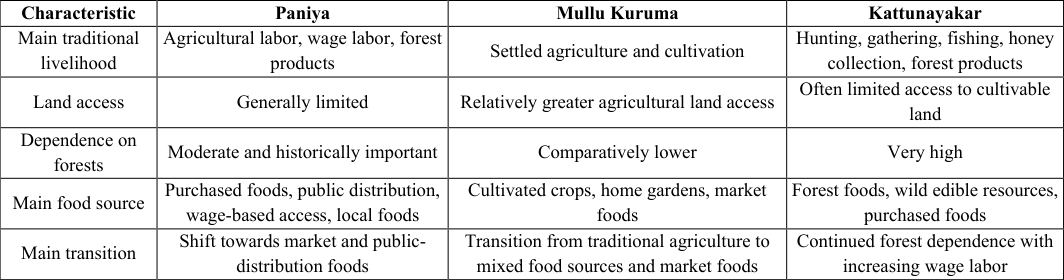 Table 1
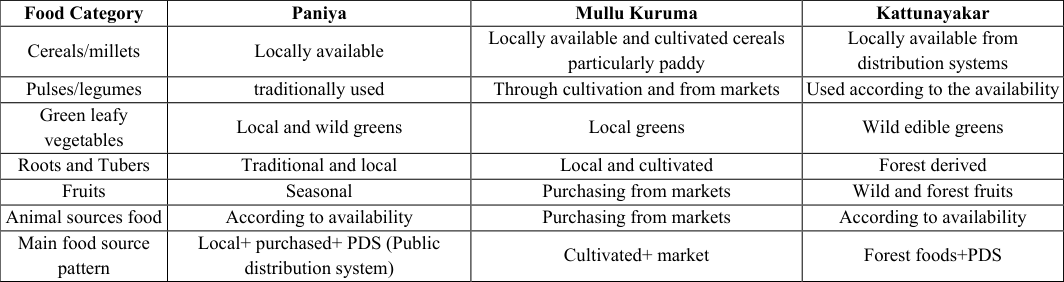 Table 2
Introduction
One of the essential elements of India's rich cultural diversity is its tribal communities. The indigenous people's relationships with the forest, crops, rivers, and other natural resources have long has an impact on their way of life. Their way of life, occupation, eating habits, economic and political marginalization, landlessness, and a lack of basic utilities despite making up a small portion of the world's population (Kapoor et al., 2024) [1] . Indigenous and tribal communities, on the other hand, possess special expertise on biodiversity, ecology. Farming, food conservation, medicinal plants, the preservation of natural resources. India I home to any of the world's tribes. Tribes are recognized as scheduled tribes under the Indian constitution. There are 705 scheduled tribes in India, accounting for roughly 8.6% of the country's total population, according to the 2011 census (Bisai et al., 2022) [7] . They live in India's forests, hills, plateaus, desert, coastal regions, and many other biologically diverse regions. The language, customs, social structure, economy, settlements, and food systems of the Indian tribal communities differ greatly. Gonds, Bhils, Santhals, Oraons, Mundas, Nagas, Mizos, Todas, Chencus, and numerous more significant tribal groups are among them. Local cereals, millets, pulses, roots and tubers, greens, forestbased meals make up these tribes' traditional diet. Industrialization, forestry, land alienation, commercial farming, and land tenure regimes have all altered these people's traditional livelihood strategies (Meshram et al., 2012) [2] .
Tribal communities of Kerala
The mountainous and wood regions of Wayanad, Idukki, Palakkad, Kasargod, pathanamthitta, and Malappuram is home to a variety of Kerala tribes. There are 36 recognized tribes in Kerala. Among them are the tribes of Paniya, Kurichiya, Adiya, Kattunayakar, Kuruma, Muthuvan, Urali and Kadar (Swaran et al., 2023) [3] . Every Kerala tribe has created its own mean of livelihood according to the conditions of its surroundings. Some of them have historically worked as farmers, but others have made their living through plantations, hunting, fishing, gathering, raising animals and receiving wages. Land ownership, income food availability, settlement and eating habits have all changes as a result of diverse employment.
Wayanad: Geographical and tribal profile
Wayanad is situated in the northeastern region of Kerala, a state known for its biodiversity and a portion of the western ghats. Hills, Valleys, forests, rivers, plantations, paddy fields, and other agricultural areas make up this district. It shares borders with the districts of Kozhikode, Kannur and Malappuram (Kattakayam, 1993) [4] . The Wayanad region's topography has had a significant impact on the social and economic makeup of the local tribes. Food, jobs, electricity, medicinal plants and many other resources have been obtained from forests and agricultural fields. One of the most numerous tribes in the state of Kerala is found in Wayanad. The main tribes are Paniya, Mullu Kurumas and Kattunayakar (GOK, 2024) [32] . The socioeconomic status of the Wayanad tribes has not been comparable. Thie level of education, job, housing, access to public utilize, reliance on forests, availability of food, and participation in the market economy all differ. Some studies have shown that there are disparities in education, socioeconomic status, livelihood security and facility access between tribes and non tribes (Sabu et al., 2023) [6] .
Profile of selected tribal communities Paniya community
With a sizable population centered in Wayanad, the Paniya are regarded as one of Kerala's largest tribal communities. The Malayalam term pani, which implies labor or work, is related to the name Paniya. This tribe has historically been associated with the agricultural labor system and has been impacted by the feudal relationships of labor bondage and land (Biju, 2025) [8] . The Paniya tribe's socioeconomic standing has somewhat improved after the labor somewhat improved after the labor bondage system was abolished. However, many Paniya families still depend on wage labor in a variety of industries, including construction, plantations and agriculture. Due to their reliance on wage labor, households have issues with unstable income and seasonal availability to food and other resources (Narayan et al., 2011) [9] . Compared to certain other tribes in Kerala the Paniya tribe has had less access to literacy and education. Such a result has been caused by poverty, marginalized, lack of educational opportunities, and geographic limitations. Additionally, the Paniya people have little access to land (Santhosh, 2008) [23] . The Paniyas traditional eating habits were based on locally grown crops like cereals, millets, legumes, root and tuber crops, green and wild forest sources. The seasonal availability of forest foods has affected food availability to some extent, but the shift in livelihood activities, limited access to forest foods and reliance on market foods and government policies have affected their eating habits (Azeez and Prusty, 2011) [11] .
Mullu Kurumas community
The mullukuruams are one of the most significant tribes in the Wayanad district and are generally recognized for their involvement in agricultural activities. The tribe has historically engaged in a variety of farming activities, including the production pf paddy, legumes, vegetables and fruits crops (Kumbrottil et al., 2024) [18] . The Mullu Kurumas is frequently seen as having a better economic situation than the Paniya and kattunayakar tribes. Ownership of agricultural land a long history of farming, and comparatively higher educational levels have all contributed to the stabilization of livelihood (Sathyanarayanan and Nirmal, 2012-2013) [24] . They maintained many of their traditional eating customs, although their dietary preferences have changes as a result of urbanization, education, job, diversification and market involvement, The younger generation may be abandoning traditional farming and agricultural methods (Silja, 2008; Pradeepa and Devi, 2019) [26,22] .
Kattunayakar community
One of the closely associated with the forest environment is the kattunayakar. The world's meaning frequently describes as a combination of the words "leader" (Nayakr) and "forest" (Kattu). Hunting, gathering, fishing, harvesting honey, and gathering non-timber forest products were the traditional means of subsistence for the kattunayakar people (Antony, 2025) [10] . These tribes have relied on forest products for food, medicine, fuel and other household necessities. Identification, gathering, processing and seasonal availability of wild fruits, roots, tubers, mushrooms, edible leaves, honey, medicines, fish and small animals are all part of the group's indigenous knowledge. There settlements are often located in relatively remote Ares. Aa s result, access to schools, healthcare institutions, transport, markets, and ither public facilities may be limited (Drisya and Remmiya, 2025) [25] .
Comparative socio-economic characteristics
The Wayanad tribes have been shown to differ in terms of socio-economic status, educational attainment, occupation, food insecurity and nutrition. Land ownership, their relationship with mainstream society, and their prior experiences are some of the reasons behind this. Out of all the tribes covered here, the Mullu Kurumas have the highest socioeconomic standing. This is a result of their consistent farming methods and high level of education which have led to economic advancement. They own both agricultural land and a secure financial situation (Sathyanarayanan and Nirmal, 2012-2013) [24] .
This constants with the Paniya tribe's dismal socioeconomic circumstances. The tribes' poverty and starvation have increased as a result of wage and bonded labor. The Paniyas are little bit vulnerable tribes, when compared to Mullu Kurumas according to nutritional research conducted by (Seema and Aravind, 2015) [25] . The kattunayakar reliance on the forest and their methods of foraging are what make them distinct. Despite having highly sophisticated ecological knowledge, their lack of access to forest regions and other sources of money is the cause of their financial woes. Due to their geographic position, they have limited access to health and education services (Misra, 2012) [19] . According to a comparative study by Bijoy and Raman (2003) [13] , a variety of characteristics including education, vocational diversity, land ownership, income and access to welfare programmes have a significant impact on the socioeconomic status of tribes. [3] Dietary diversity among tribal populations A varied diet is to be on of the factors that determine appropriate nutrition. The Wayanad indigenous population's dietary diversity varies based on their lifestyle and the food sources they have access to (Thomas and Augustine, 2019) [28] . A study conducted by Babu and Joseph (2015) [12] revelated that Mullukurma;s diet is often defined by a variety of foods due to established agricultural traditions and food production. Cereals, legumes, fruits, vegetables, roots and occasionally animal based dietary items are all included. Hunting for wild food stuffs is responsible for the kattunayakar diet's high diversity. Important micronutrients are added to basic meals by wild fruits, tubers, mushrooms, green vegetables, honey. Despite restrictions on the usage of forests and environmental circumstances, most kattunayakar families are able to obtain their customary meals (Devi and Nair, 2017) [14] . On the other hand, financial limitations and limited land availability are the primary factors preventing Paniya families from diversifying their diets. Fruits, vegetables, and animal items are comparatively uncommon in their diet, with rice serving as the primary staple. Socioeconomic considerations have had a significant impact on the diversity of diets in Paniya families (George and Shaji, 2021) [16] .
Food availability among Paniya, Mullukuruma and Kattunayakar tribes
One of the numerous elements influencing the tribe's nutritional state is the availability of food. A number of factors, including as land ownership, crop productivity, forest availability, income, seasonability and government food distribution programs, influence whether or not the members of the tribal home have access to food. The Paniya may be more susceptible to food insecurity due to their lack of access to land and reliance on wages for a living. Food availability in homes is influenced by seasonality, the availability of food jobs, and involvement in government aid programs. The public distribution program must be successful in order to guaranty that the Paniya have access to food (Nisha and Shabeer, 2026) [21] . The village of Mullu Kurumas has more arable land. This accomplished by growing paddy and planting year-round food-producing, fruits, vegetables and other incomes of the families. Furthermore, the homestead gardens, produce more food. Katunayakar family's access to food is greatly influenced by the forest environment. Traditionally, tubers, fruits, mushrooms are obtained from the forest. However, due to changes in the ecosystem and restricted access to forest resources, using traditional meals has become challenging (Stan and Yogendra, 2024) [27] . [3]
Seasonality of foods
In tribal societies, seasonality is a major factor in determine the availability of traditional meals. Seasonal and ecological factor dictate whether agricultural items, leafy vegetables, fruits, roots and tubers and wild foods are present. While other tribal communities who engage in agricultural techniques are likely to have a higher share of produced food, tribal communities that depend on forests for their livelihood are likely to see significant changes in the availability of wild foods depending on seasonality. Thus, the kind and diversity of foods consumed by various tribes can be greatly influenced by seasonality. This is particularly crucial for the Paniya, Mullu Kurumas and kattunayakar tribes because their various livelihood systems and reliance on forest and agricultural products, among other things, might result in varying seasonal eating customs (Jadhav et al., 2015) [33] .
Food taboos and cultural influences
Food taboos, social conventions, religious traditions and cultural views all influence food customs Certain foods may not be consumed during pregnancy, childbirth, illness, celebrations, religious occasions, or other life events due to dietary taboos. Perception related to health, purity, spirituality, reproductive functions, or social identities are the basis for these bans. Ecological knowledge, familial customs, social connections ceremonial behaviour and perceptions of how food affects the body all play a role in the dietary choices made by tribe. Because a dish that is highly appreciated by one group may be forbidden by another, food taboos must be examined in the context of the community's culture (Kakati and Deka, 2022) [17] .
Traditional food knowledge and transmission
An essential component of tribal societies cultural history is their understanding of food. In the Paniya, Mullu Kuruma and Kattunayakar communities, people's long-standing interactions with their natural surrounding have led to the development of food knowledge that includes the identification, collecting, election, and preparation of foods that are readily available in their local communities. Understanding leaves, roots, tubers, fruits and other resources, their seasonal availability, and how to use them are all included in food knowledge. Through participation in culinary activities, such expertise has traditionally been passing down from generation to generation. However, social contacts, employed prospect, education, and living practices can all have an impact on low knowledge is passes along, particularly to younger generations (Nagarathinam et al., 2024) [34] .
Market integration and food acquisition
The manner by which indigenous families obtain their food supply has gradually been impacted by the greater integration with markets. Food was formerly obtained from farming, forest collecting, and other available resources, These days, government-backed food distribution and purchased food are more common ways for people to obtain food. Depending on factor including landownership, occupation, income, accessibility and reliance om forest resources this transformation had happened to varied degrees. It is mainly happened to Mullu Kurumas and Paniyas and less affected to the kattunayakar tribe (Rajasenan et al., 2019) [35] .
Future directions
The systematic documenting and reservation of traditional dietary knowledge from different tribes must be the focus of future research. A comparative study of different tribes could reveal parallels and differences in their food resources, food procurement strategies, food preparation methods and food-related cultural elements. Seasonal foods, edible wild foods, traditional processing techniques, and shifting dietary behaviors among young people should all be used to document and preserve traditional food knowledge (Ghosh et al., 2015) [36] .
Conclusion
This study makes it abundantly evident that the Paniya, Mullukurumas, and kattunayakar of Wayanad have distinctive means of subsistence and food consumption pattern that are influenced by the ecology of their surroundings, the availability of resources, their socioeconomic status and their culture. While these three groups share some characteristics of being reliant of locally produced food, they differ in terms of land ownership, sources of income, reliance on forests and forest products and patterns of food acquisition and consumption. The Paniya are known to be farmers and wage workers who own comparatively less land and are more reliant on food from the market and the government. The review also shows that customs surrounding eating are evolving. The acquisition, availability, and consumption of traditional foods are being impacted by changes in employment, education, market integration, farming techniques, forest access, and interactions with mainstream society. The persistence of these food systems also depends on seasonal availability and the generational transfer of traditional culinary skills. Tribal communities should therefore not be seen as a monolithic group, and foodrelated traits should be understood in light of each community's unique ecological, social, and cultural context.
In order to chronicle seasonal foods, traditional food knowledge, food preparation and procurement methods, and shifts in dietary habits, especially among younger generations, more comparative documentation is needed.
Figures and tables from the paper
References
36 in the original paper- Kapoor R, Sabharwal M, Ghosh-Jerath S. Exploring the traditional foodways for nutritional well-being amongst vulnerable communities: insights from Ho indigenous community of Jharkhand, India. J Curr Res Nutr Food Sci. 2024;12(2).
- Meshram II, Arlappa N, Balakrishna N, Rao KM, Laxmaiah A, Brahmam GNV. Prevalence of undernutrition, its determinant and seasonal variation among tribal preschool children of Odisha state, India. J Hum Ecol. 2012;38(2):145-154.
- Swaram V, Chandrika CS, Chubamenla J. From resilience to vulnerability: indigenous agri-food systems of Wayanad district; 2023. https://dokumen.pub/thepalgrave-handbook-of-socio-ecological-resilience-inthe-face-of-climate-change-contexts-from-adeveloping-country-1st-ed-2023-97898199220559789819922062-9819922054.html
- Kattakayam JJ. Social structure, tribal demographics, and inter-tribe variations in Wayanad, Kerala. J Indian Anthropol Soc. 1993;28(3):215-224.
- Government of Kerala. Health@Wayanad report: official demographic breakdown of tribal communities in Wayanad; 2021. https://health.kerala.gov.in/assets/backend/publications/ [email protected]
- Sabu KU, Soman B, Prashanth NS, Kutty VR, Ravindran TKS. Historical and contextual pathways of inequity in child nutritional status: a case study of Paniya and Kurichiya Adivasi communities in Wayanad District, Kerala. Research Square; 2023. https://doi.org/10.21203/rs.3.rs-2762365/v1
- Bisai S, Saha KB, Sharma RK, Muniyandi M, Singh N. An overview of tribal population in India. Tribal Health Bull. 2022;20(Special Issue):1-126.
- Biju PV. Tracing the economic trajectories of the Paniya tribe: historical dependency and contemporary challenges in Wayanad. Int J Innov Res Multidiscip Field. 2025;11(11):201-207.
- Narayanan MKR, Kumar AK, Sunil CN, Joseph J, Balakrishnan V. Wild edible plants used by the Kattunayakar, Paniya and Kuruma tribes of Wayanad district, Kerala, India. J Med Plants Res. 2011;5(15):3520-3520.
- Antony JS. Epistemological dimensions of Indigenous honey collection in the Kattunaicken community of South India. Conserv Biol. 2025;39(4).
- Azeez PA, Prusty BAK. Food security and dietary habits of indigenous communities in the Western Ghats: shifts from forest dependence to public distribution systems. J Hum Ecol. 2011;34(2):115-123.
- Babu S, Joseph A. Nutritional status and dietary intake patterns of tribal women in Wayanad district, Kerala. Int J Community Sci Nutr. 2015;6(2):104-115.
- Bijoy CR, Raman KR. Muthanga: the real story: a piece of land for a life. Econ Polit Wkly. 2003;38(11):10751082.
- Devi KS, Nair RV. Forest rights and nutritional precarity: the lived experience of the Kattunayakar of Western Ghats. Econ Polit Wkly. 2017;52(18):63-71.
- Drisya AP, Remmiya Rajan P. Socio-economic conditions and developmental challenges of the Kattunaykkan tribal women in Wayanad district, Kerala. EPRA Int J Multidiscip Res. 2025.
- George S, Shaji MP. Changing paradigms of land use and food security: a comparative study of Kuruma and Paniya tribal settlements in Kerala. J Tribal Stud Ethnohist. 2021;29(1):45-58.
- Kakati R, Deka P. Food taboos and traditional beliefs during pregnancy and lactation among tribal women of Assam, India. J Ethnic Foods. 2022;9(1):1-9.
- Kumbrottil Sundaran N, Radhakrishnan A, Ravindran D, Palackal Bonny B, Vijayan Nandini N. Climate change and farmer livelihoods in Wayanad, India: A livelihood vulnerability index assessment. Nat Hazards Earth Syst Sci Discuss. 2024:1-25.
- Misra PK. The Jenu Kurubas. Anthropological Survey of India; 2012. https://www.researchgate.net/profile/JayaSanyal/publication/260917403_Scenario_of_Parkinsons _Disease_in_India/links/00b49532a9c05df780000000/S cenario-of-Parkinsons-Disease-in-India.pdf
- Wayanad District Tribal Development Action Council. Community agro-biodiversity conservation awards 2023. 2023. https://wdtdac.in/community-agrobiodiversity-conservation-awards-2023/
- Nisha KK, Shabeer KP. Livelihood transformation and its impact on food security and maternal and child health: evidence from tribal communities in Attappady, Kerala. Int J Soc Sci Econ Res. 2026;11(4) 003.
- Pradeepa S, Devi AT. Nutritional assessment of tribal women in Kainatty, Wayanad: A cross-sectional study. J Family Med Prim Care. 2019;8(10):3230-3235.
- Santhosh K. Ethnohistory of the Paniyan tribe: mapping the historical transitions from bonded labour to wage labour. KIRTADS Res Bull. 2008:14-32.
- Sathyanarayanan CR, Chandra N. Traditional life, livelihood and plantations: A study among the Mullu Kurumba. J Anthropol Surv India. 2012-2013;61(2)- 62(1):595-615.
- Seema KK, Aravind KP. Nutritional status of Paniya tribal children in Wayanad district, Kerala. Indian J Community Health. 2015;27(2):230-236.
- Silja VP, Varma KS, Mohanan KV. Ethnomedicinal plant knowledge of the Mullu Kuruma tribe of Wayanad district, Kerala. Indian J Tradit Know. 2008;7(4):604-612.
- Stan TS, Anand Y. The bees, the bears, and the Kattunayakans. Down To Earth; 2024 May. https://young.downtoearth.org.in/stories/biodiversity/th e-bees-the-bears-and-the-kattunayakans-117851
- Thomas J, Augustine A. Agro-biodiversity in traditional tribal farms of Wayanad, Kerala: implications for household dietary diversity. J Hum Ecol. 2019;65(2):112-123.
- Drisya AP, Remmiya RP. Socio-economic conditions and developmental challenges of the Kattuanyakkan International Journal of Agriculture and Nutrition https://www.agriculturejournal.net tribal women in Wayanad district, Kerala. Int J Multidiscip Res. 2025;11(5).
- Karat B, Rawal V. Scheduled tribe households: a note on issues of livelihood. Rev Agrar Stud. 2014;4(1):135158.
- Mehta BS, Singh B. Employment and livelihoods among tribal in India. J Anthropol Surv India. 2021;70(2).
- Government of India, Ministry of Tribal Affairs. Report of the High-Level Committee on socioeconomic, health and educational status of tribal communities of India; 2014. http://www.tribal.nic.in/downloads/otherimportant-reports/XaxaCommitteeReportMayJune2014.pdf
- Jadhav R, Datar MN, Upadhye AS. Forest foods of Northern Western Ghats: mode of consumption, nutrition, availability. Asian Agri Hist. 2015;19(4):293316.
- Nagarathinam S, Kinkini DM, Paramanantham N, Prasanth RS, Ravuther Merra Ravuthar A. Food manifested communication of traditional knowledge among tribal women in Tamil Nadu. Indian J Tradit Know. 2024;23(4):391-397.
- Rajasenan D, De Venanzi A, Bhaskar R. Tribal populations in Kerala's development process: an impact evaluation of policies and schemes. Rev Venez Anal Coyuntura. 2019;25(2).
- Ghosh-Jerath S, Singh A, Kamboj P, Goldberg G, Magsumbol MS. Traditional knowledge and nutritive value of indigenous foods in the Oraon tribal community of Jharkhand: An exploratory crosssectional study. Ecol Food Nutr. 2015;54(5).