
Research article · 2026 · Full text
International Journal of Horticulture and Food ScienceFirst record of Hibiscus macverryi (Malvaceae: sect. Lilibiscus) in Indian gardens with notes on horticulture, ex-situ conservation and propagation
Volume 8(8) · Pages 27–31 · DOI: 10.33545/26631067.2026.v8.i8a.829 ↗
Research areasBotany and Plant Ecology StudiesPlant and Fungal Species DescriptionsFlowering Plant Growth and Cultivation
Abstract
Author-writtenHibiscus macverryi L.A.J. Thomson & Braglia (Malvaceae), commonly known as ‘Ruby Rose’, is a Critically Endangered species endemic to Fiji. The species belonging to the Hibiscus sect. Lilibiscus, is reported here for the first time from Indian gardens based on cultivated plants in West Bengal. This communication provides a detailed taxonomic account, notes on its breeding history and horticultural significance, and describes its ex-situ conservation at the Acharya Jagadish Chandra Bose Indian Botanic Garden (AJCBIBG), Howrah.
Summary
Source-checkedPlain-language reading of the full paper, prepared with AI and checked against the text. Each point links to the authors' own words.
Why it matters
- Hibiscus macverryi, also known as 'Ruby Rose', is a critically endangered plant species native only to Fiji. View evidence ↗
- The species is listed as Critically Endangered on the IUCN Red List because there are fewer than 250 mature individuals left in the wild. View evidence ↗
- The plant has significant horticultural and ornamental value due to its deep pink flowers and dark red eye. View evidence ↗
The question
- The study aims to document the first occurrence of Hibiscus macverryi in Indian gardens, specifically those in West Bengal. View evidence ↗
- The research also seeks to provide a taxonomic description and evaluate the effectiveness of wedge grafting for the plant's ex-situ conservation. View evidence ↗
What they did
- Plant materials and voucher specimens were collected from the Hooghly and South 24 Parganas districts of West Bengal. View evidence ↗
- Specimen identity was verified by comparing morphology with the original protologue and using digital images from the South Pacific Regional Herbarium in Fiji. View evidence ↗
- Scions of H. macverryi were collected as shoot tips 10-15 cm long and 0.3-0.4 cm in diameter, each with 3-4 leaves. View evidence ↗
- The grafting experiments were conducted at the AJCBIBG nursery from September 18 to October 15, 2025. View evidence ↗
What they found
- The observed H. macverryi shrubs grew up to 150 cm long with green spreading branches and internodes measuring 2.6-3.5 cm. View evidence ↗
- The flowers were velvety pink with a dark red eye and measured 11.5-12.0 cm in diameter. View evidence ↗
- Interspecific wedge grafting using H. rosa-sinensis as the rootstock achieved a 53% success rate after 20 days. View evidence ↗
- The results indicate good compatibility between H. macverryi and H. rosa-sinensis, as the grafts healed rapidly without visible symptoms of incompatibility. View evidence ↗
What it means
- The authors conclude that wedge grafting with H. rosa-sinensis is an effective method for propagating this species. View evidence ↗
- The authors recommend this propagation procedure as a practical way to ensure the rapid multiplication and long-term conservation of the critically endangered species. View evidence ↗
Visual summary
1 visualsIllustrations explain the paper; they do not show study data.
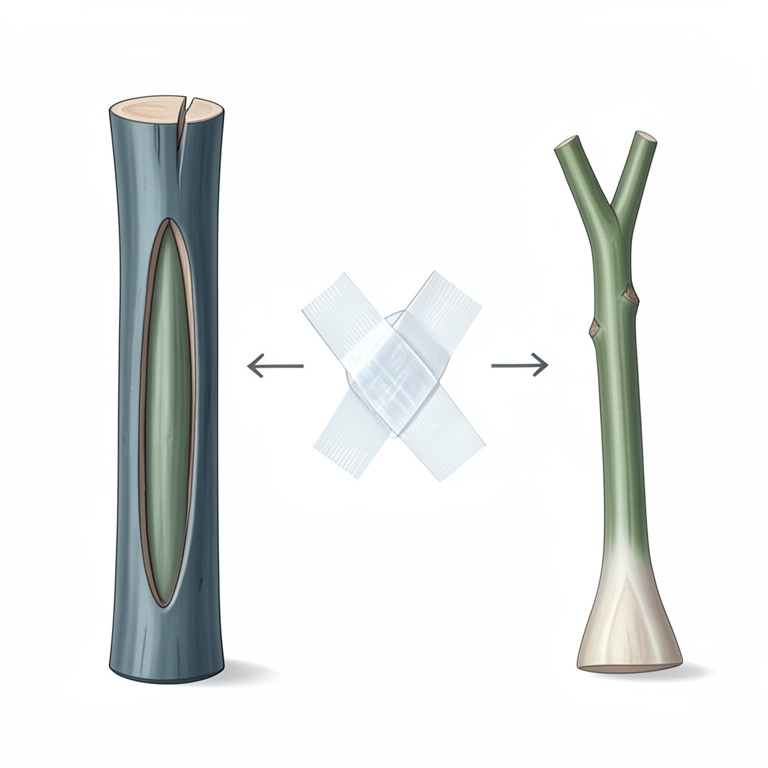
Interspecific Grafting Concept
AI-generated conceptual illustration (Hibiscus macverryi and Hibiscus rosa-sinensis stems). It explains the idea and does not show study data.
View source evidence ↗Figures & tables
From the original paper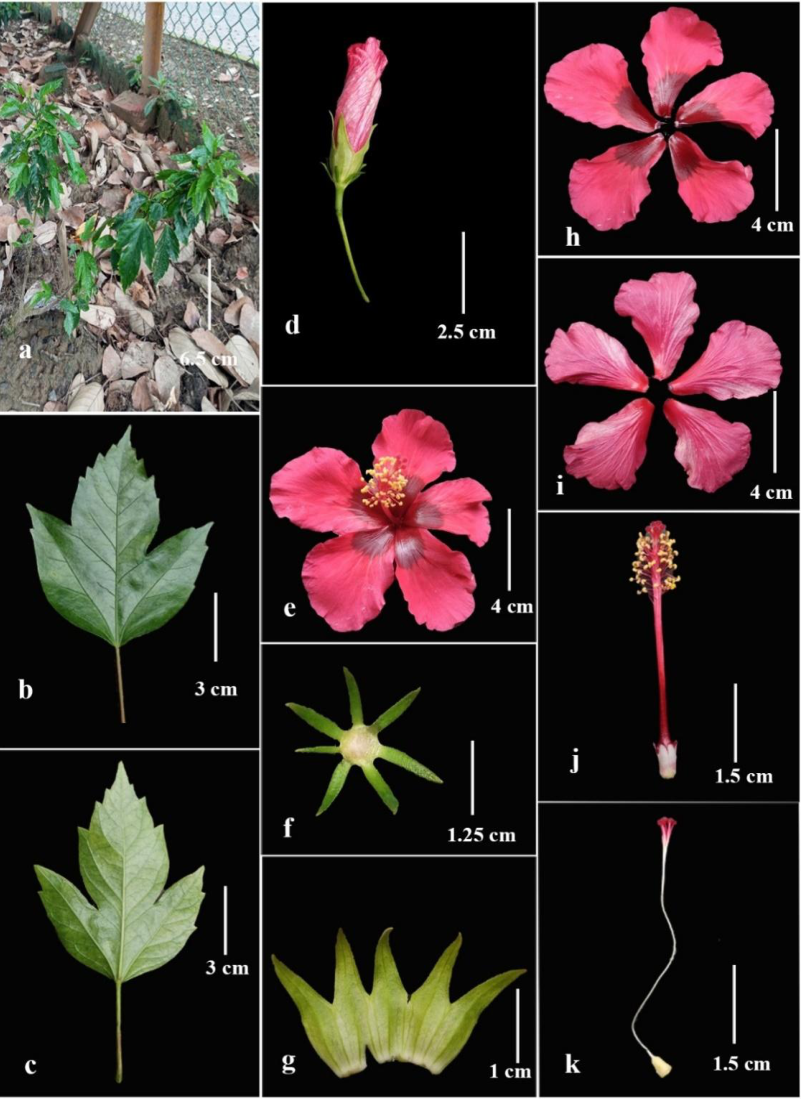 Figure 1
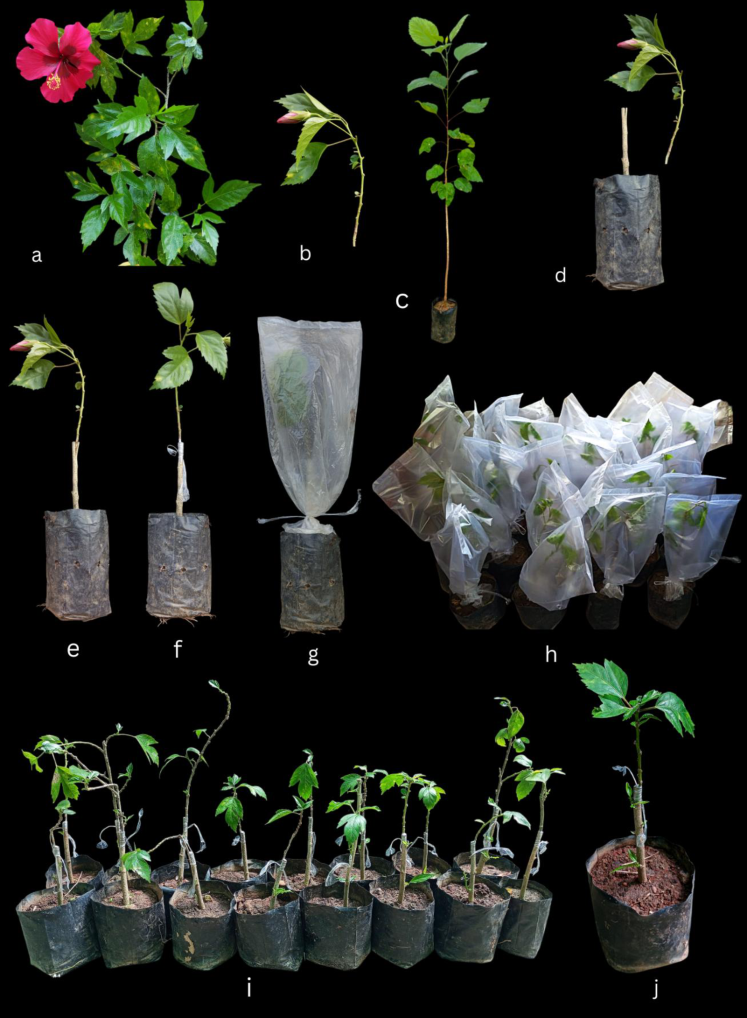 Figure 2
Introduction
The genus Hibiscus L. is a flowering plant genus belonging to the mallow family (Malvaceae: Malvoideae), comprising numerous species of herbs, shrubs, lianas, and trees native to warm temperate and tropical and subtropical regions of the world (POWO, 2025) [14] . The genus Hibiscus is represented by 437 species worldwide (Dalavi et al., 2025) [7] and is represented in India by 33 taxa belonging to 10 sections (Dalavi et al., 2025) [7] . Owing to their remarkable ornamental value, Hibiscus species have been extensively cultivated and hybridized, resulting in more than 24,000 registered cultivars globally (International Hibiscus Society, 2025) [10] , of which over 477 cultivars have been registered in India (Swamy et al., 2023;Chakraborty et al., 2023 a,b,c , 2024 a,b , 2026) [16,1,2,3,4,5,6] . During taxonomic investigations of the Hibiscus collection maintained at the Acharya Jagadish Chandra Bose Indian Botanic Garden (AJCBIBG), Botanical Survey of India, Howrah, the authors encountered few cultivated plants in West Bengal characterized by perennial bushy shrubs with heterophyllous leaves, deep pink flowers bearing a conspicuous dark red serrated eye, a prominent rosy-red staminal column with bright yellow anthers, and five velvety crimson stigmas. Detailed morphological examination and comparison with the protologue (Thomson and Braglia, 2019) [18] and relevant literature (Wilcox and Holt, 1913) [19] confirmed the identity of these plants as Hibiscus macverryi L.A.J. Thomson & Braglia. Hibiscus macverryi is a Critically Endangered species endemic to the Fijian islands of Taveuni and Vanua Levu. It belongs to Hibiscus sect. Lilibiscus, one of the smallest cultivated sections of the genus, represented in India by only three species namely, Hibiscus clayi O. Deg. & I.Deg., Hibiscus rosa-sinensis L., and Hibiscus schizopetalus (Dyer) Hook.f. (Dalavi et al., 2026) [8] . In its natural habitat, the species occurs in tropical moist forests at elevations of 50-300 m (Thomson and Braglia, 2019) [18] . Owing to its extremely restricted distribution, with fewer than 250 mature individuals remaining in the wild, it has been assessed as Critically Endangered (CR) on the IUCN Red List (Thomson and Linsky, 2020) [17] . The present study documents the first record of Hibiscus macverryi in Indian gardens, based on cultivated plants maintained in West Bengal. It provides a detailed taxonomic account, notes on its breeding history and horticultural significance, and describes its ex-situ conservation and propagation through wedge grafting at the Acharya Jagadish Chandra Bose Indian Botanic Garden. The study contributes valuable information for the conservation, cultivation, and sustainable utilization of this globally threatened ornamental species.
Materials and Methods
Materials and Methods
Survey and collection
As part of an ongoing breeding programme aimed at developing new Hibiscus cultivars at the Acharya Jagadish Chandra Bose Indian Botanic Garden (AJCBIBG), Botanical Survey of India, Howrah, West Bengal, extensive field surveys were conducted across India during 2022-2026 to collect endemic, and native Hibiscus species and their elite ornamental cultivars. During botanical explorations in West Bengal, germplasm and voucher specimens of Hibiscus macverryi were collected from Hooghly and South 24 Parganas districts. The collected germplasm was established in the 'Hibiscus Section' of AJCBIBG for further study, conservation, and breeding. Voucher specimens were processed and prepared herbarium as per the standard herbarium methodology (Jain and Rao, 1976) [11] and deposited in the Central National Herbarium (CAL), Botanical Survey of India, Howrah, West Bengal, India. The identity of the specimens was confirmed through detailed morphological comparison with the protologue (Thomson and Braglia, 2019) [18] and authenticated using digital images of type and reference specimens available at the South Pacific Regional Herbarium, Suva, Fiji (SUVA).
Propagation
Selection of plant material: Healthy 10-11month-old saplings of Hibiscus rosa-sinensis L. maintained in the AJCBIBG nursery were selected as rootstocks. Newly emerging soft to semi-hardwood shoot tips (2-3 months old) of Hibiscus macverryi L.A.J. Thomson & Braglia were collected from healthy mother plants maintained in the Hibiscus section and used as scions. Secateurs, grafting knives, razor blades, transparent polythene tape, and polythene caps were used during grafting. Propagation experiments were carried out in the AJCBIBG nursery between 18 September and 15 October 2025. Wedge grafting: Healthy shoot tips measuring 10 -15 cm in length and 0.3 -0.4 cm in diameter, each bearing 3 -4 leaves, were collected from selected mother plants of H. macverryi (Fig. 2a-b). Thirty vigorous H. rosa-sinensis rootstocks, measuring 40 -45 cm in height and 0.4 -0.7 cm in stem diameter (Fig. 2c), were selected for wedge grafting. The upper portion of each rootstock was removed, leaving 5 -8 cm of stem above ground level. The basal end of each scion was trimmed into a wedge ('V') shape using a sharp grafting knife and inserted into a corresponding slit made on the rootstock. The graft union was tightly secured with 1.5 -2.0 cm wide transparent polythene tape to prevent desiccation and ensure close cambial contact (Fig. 2d-f). Each graft was then covered with a transparent polythene cap (Fig. 2g-h) to maintain high humidity and minimize transpiration. The grafted plants were maintained under greenhouse conditions for 2 -3 weeks until successful graft union and sprouting were observed.
Ex situ conservation
Successfully established grafted plants were maintained in the AJCBIBG nursery for hardening and subsequent establishment. After acclimatization, healthy saplings were transferred to the Hibiscus section and the Endemic and Threatened Plants Section of AJCBIBG, where they are maintained as part of the ex situ conservation programme. The propagated plants also serve as valuable germplasm for future breeding, multiplication, and conservation of this Critically Endangered species. Shrubs, up to 150 cm long; branches spreading, green; internodal portion 2.6 -3.5 cm long. Leaves simple, 1 to 3lobed, petiolate; petiole 3.5 -3.8 × 0.2 -0.3 cm wide; blades broadly ovate, 8.3 -9.5 × 6.5 -7.5 cm, cordate at base, crenate along margin, acute at apex, dark green above, light green and pubescent beneath, palmately 5-nerved from the base; stipules linear to lanceolate, 0.6 -0.7 × 0.1 -0.2 cm. Inflorescence axillary, solitary; peduncle 3.5 -4 × 0.1 -0.2 cm; pedicel 0.5 -0.7 × 0.2 -0.3 cm; flower bud pinkish red, 4 -4.6 × 1.5 -2 cm. Flowers velvety pink with dark red eye zone, 11.5 -12.0 cm in diameter. Epicalyx 2.5 -2.7 cm in diameter, linear to lanceolate, 7-lobed; lobes 0.9 -1 × 0.4 -0.5 cm. Sepals c. 2 × 2.5 cm, united below the half, tube 1.3 -1.4 × 0.4 -0.5 cm, 5-lobed; lobes ovate-lanceolate, 0.9 -1 × 0.4 -0.5 cm, acute to acuminate at apex. Petals 6 -6.2 × 4 -4.2 cm, polypetalous, 5 -6, obovate, cuneate to unequal at base, entire to undulate along margin, rounded at apex, upper surface velvety pink with red eye, lower surface pale pink, veins prominently raised beneath. Staminal column pinkish red, 7 -7.4 × 0.2 -0.3 cm; naked zone 5 -5.3 cm long; anther zone 2 -2.5 × 1.0 -1.3 cm; anthers 0.1 -0.2 × 0.2 -0.3 cm, kidney shaped, yellowish in colour; filaments 0.3 -0.6 × c. 0.1 cm. Pistil 4.5 -5 cm long; ovary cylindrical, 1.0 -1.2 × 0.4 -0.5 cm; style 3.5 -3.6 cm long, 0.1 cm wide, linear; stigma red, 0.2 -0.8 × 0.3 -0.9 cm, 5lobed; lobes 0.2 -0.3 × 0.2 -0.3 cm, unequal, densely hairy. Capsules not seen. Flowering: November -February. as the female parent in 30 of these crosses, and has made a significant contribution to the development of modern tropical hibiscus cultivars (Wilcox and Holt, 1913) [19] . More recently, the species has been cultivated in horticulture under the name 'Ruby Rose' in the United Kingdom, Europe, Asia, Hawaii, and the mainland United States before being formally described as Hibiscus macverryi L.A.J. Thomson & Braglia (Thomson and Braglia, 2019) [18] . According to Thomson and Linsky (2020), H. macverryi has an extremely restricted distribution and is currently known from only four localities on the Fijian islands of Taveuni and Vanua Levu. The wild population comprises fewer than 250 mature individuals, with each subpopulation estimated to contain fewer than 50 individuals. The species is threatened by severe tropical cyclones, flash flooding, invasive weeds, and collection for hybridization with other Hibiscus species. It is also susceptible to root rot, dieback, leaf blight, leaf curl disease, and infestation by pests such as mealybugs and red spider mites. These factors continue to drive the decline of the wild population, resulting in its assessment as Critically Endangered [CR C2a(i)] on the IUCN Red List (Thomson and Linsky, 2020) [17] . The pathway through which H. macverryi was introduced into India remains unknown. The species has been maintained as an ornamental in gardens and private home gardens in West Bengal and is reported here for the first time from Indian gardens. Owing to its attractive deep pink flowers with a prominent dark eye, the species possesses considerable ornamental and horticultural value.
Results and discussion
Consequently, it has excellent potential for commercial nursery production, landscape planting, and future hibiscus breeding programs. Rootstock-scion compatibility is a critical factor influencing the success of grafting, as poor graft unions may reduce plant vigour, compromise quality, cause graft failure, or even result in premature death (Fallik and Ilic, 2014) [9] . Successful graft union depends largely on the compatibility between the rootstock and scion, which is generally associated with their taxonomic proximity (Silva et al., 2019) [15] . Although intraspecific grafting usually exhibits higher compatibility than interspecific grafting (Mudge et al., 2009) [13] , interspecific grafting can effectively exploit desirable traits from related species (Lee et al., 2010) [12] .
In the present study, interspecific wedge grafting was successfully carried out using H. macverryi as the scion and H. rosa-sinensis as the rootstock, resulting in a 53% graft success rate after 20 days (Fig. 2i-j). The successful graft union demonstrated good compatibility between the two species and facilitated rapid healing and establishment without any visible incompatibility symptoms. This technique enables efficient multiplication while conserving valuable propagules of H. macverryi, which would otherwise be required as rootstocks. Furthermore, the use of the widely cultivated H. rosa-sinensis as a rootstock may improve adaptability under diverse cultivation conditions. Following successful establishment, the grafted plants were introduced into the 'Hibiscus Section' and the 'Endemic and Threatened Plants Section' of the Acharya Jagadish Chandra Bose Indian Botanic Garden for long-term ex-situ conservation, multiplication, and utilization in future breeding programs.
Conclusion
This study reports the first occurrence of Hibiscus macverryi L.A.J. Thomson & Braglia in Indian gardens and documents its successful cultivation, ex situ conservation, and propagation at the Acharya Jagadish Chandra Bose Indian Botanic Garden, Botanical Survey of India, Howrah. Wedge grafting using Hibiscus rosa-sinensis L. as the rootstock proved to be an effective propagation technique, achieving a 53% graft success rate. The developed propagation procedure provides a practical approach for the rapid multiplication, long-term conservation, and sustainable utilization of this Critically Endangered ornamental species, thereby contributing to the conservation of global Hibiscus diversity.
Acknowledgement
AcknowledgementsThe authors are thankful to the Director, Botanical Survey of India (BSI), Kolkata for the facilities and encouragements and also grateful to the staff of AJC Bose Indian Botanic Garden, Howrah for support. We are also appreciative to Mr. Shubhdeep Majumdar, South 24 Parganas district for providing plant cuttings for our propagation.
Figures and tables from the paper
References
19 in the original paper- Chakraborty D, Swamy J, Singh D. Development and characterisation of new Hibiscus rosa-sinensis cultivar ('Janaki Ammal') from India. Int J Hortic Food Sci. 2023;5(1):77-80. DOI:10.33545/26631067.2023.v5.i1b.161.
- Chakraborty D, Swamy J, Singh D. Development and characterisation of a new Hibiscus rosa-sinensis L. cultivar 'Krishna's Radiance' from India. J Exp Agric Int. 2023;45(9):188-194. DOI:10.9734/jeai/2023/v45i92191.
- Chakraborty D, Swamy J, Singh D. Development of new Hibiscus rosa-sinensis L. cultivar 'Acharya Jagadish Chandra Bose' in West Bengal, India. J Exp Agric Int. 2023;45(12):155-159. DOI:10.9734/jeai/2023/v45i122273.
- Chakraborty D, Swamy J, Singh D. Classification of ornamental hibiscus based on flower pattern. In: Jayvardhan JVB, Jalander V, editors. Interdisciplinary research in life sciences: A path towards sustainability. Vol. 2. Advent Publishing; 2024. p. 262-273. DOI:10.5281/zenodo.14245576.
- Chakraborty D, Swamy J, Singh D. Nameeta: A newly developed Hibiscus rosa-sinensis L. cultivar from AJC Bose Indian Botanic Garden, West Bengal, India. J Exp Agric Int. 2024;46(11):649-654. DOI:10.9734/jeai/2024/v46i113086.
- Chakraborty D, Swamy J, Singh D. Development and characterisation of five Hibiscus rosa-sinensis cultivars 'the Bengal Series' from India. J Exp Agric Int. 2026;48(4):242-252. DOI:10.9734/jeai/2026/v48i44156.
- Dalavi JV, Kamble MY, Swamy J, Chakraborty D, Singh D. Occurrence of Hibiscus glanduliferus (Malvaceae) in India with notes on its nomenclature. Feddes Repertorium. 2025;136(3):169-174.
- Dalavi JV, Kamble MY, Bhagure P, Singh D. Taxonomic revision of Hibiscus sect. Lilibiscus (Malvaceae) in India with a new record of H. clayi for the flora of India. Feddes Repertorium. 2026;137. DOI:10.1002/fedr.70079.
- Fallik E, Ilic Z. Grafted vegetables -the influence of rootstock and scion on postharvest quality. Folia Hortic. 2014;26(2):79-90.
- International Hibiscus Society. The official ICRA nomenclature database of all registered Hibiscus hybrids; 2025. https://internationalhibiscussociety.org/searchive/index
- Jain SK, Rao RR. A handbook of field and herbarium methods. New Delhi: Today and Tomorrow's Printers and Publishers; 1976. p. 1-150.
- Lee JM, Kubota C, Tsao SJ, Bie Z, Echevarria PH, Morra L, et al. Current status of vegetable grafting: diffusion, grafting techniques, automation. Sci Hortic. 2010;127(2):93-105.
- Mudge K, Janick J, Scofield S, Goldschmidt EE. A history of grafting. Hortic Rev. 2009;35:437-493.
- Plants of the World Online. Royal Botanic Gardens, Kew; 2025. https://powo.science.kew.org/
- Silva EHC, Soares RS, Diniz GM, Franco CA, Marin MV, Candido WS, et al. Grafting as a management tool to control Meloidogyne incognita in okra: identifying rootstocks candidates. Sci Hortic. 2019;246:354-359.
- Swamy J, Chakraborty D, Singh D. Development and characterisation of new Hibiscus rosa-sinensis L. cultivar ('AA Mao') from India. Int J Agric Innov Res. 2023;11(6):135-139.
- Thomson L, Linsky J. Hibiscus macverryi. The IUCN Red List of Threatened Species 2020; 2020. https://dx.doi.org/10.2305/IUCN.UK.20202.RLTS.T16 8544210A168544277.en
- Thomson LAJ, Braglia L. A review of Fiji Hibiscus (Malvaceae-Malvoideae) species in section Lilibiscus. Pac Sci. 2019;73(1):79-121.
- Wilcox EV, Holt VS. Ornamental hibiscus in Hawaii. Honolulu: Paradise of the Pacific Press; 1913. No. 29. p. 7-60.