
Research article · 2024 · Full text
International Journal of Biology SciencesSustainable development of urban areas: Managing natural resources and their prevention for future generations and survival of vegetation's in Delhi NCR area
Volume 6(2) · Pages 332–337 · DOI: 10.33545/26649926.2024.v6.i2e.976 ↗
Research areasSustainable Development and Environmental ManagementEnvironmental Quality and PollutionUrban Planning and Landscape Design
Abstract
Author-writtenUrbanization is accelerating worldwide. By 2050, 68% of the global population will live in cities. In India, urban population is projected to reach 600 million by 2031. This rapid growth increases demand for water, land, air, energy, and biodiversity, while also generating pollution and waste. This paper examines sustainable development of urban areas with a focus on natural resource management and prevention strategies for inter-generational equity. Using literature review, case studies, and primary survey data from 400 residents in Delhi NCR, the study identifies key resource pressures, public perceptions, and feasible interventions. Findings show that 78% of respondents experience water shortage in summer, 84% report air quality as a major concern, and 71% support stricter enforcement of green laws. The paper concludes that integrated planning, circular economy practices, community participation, and long-term governance are essential to prevent resource depletion and secure sustainable cities for future generations.
Summary
Source-checkedPlain-language reading of the full paper, prepared with AI and checked against the text. Each point links to the authors' own words.
Why it matters
- Global urbanization is accelerating, with 68% of the world's population expected to live in cities by 2050 and India's urban population projected to hit 600 million by 2031. View evidence ↗
- The Delhi National Capital Region (NCR), housing over 32 million people, experiences severe pressure on its land, air, and groundwater resources. View evidence ↗
- Vegetation in the NCR is critical for survival as it manages monsoon flooding, recharges groundwater, traps particulate matter, and lowers peak summer temperatures by 2-4°C. View evidence ↗
The question
- The study seeks to answer how urban areas can continue to grow while simultaneously protecting their natural resource base. View evidence ↗
What they did
- The researchers conducted a primary survey using a structured questionnaire administered to 400 residents of the Delhi-NCR between January and March 2026. View evidence ↗
- The survey sample was stratified by income and age (18-60) and covered residents from Noida, Gurugram, East Delhi, and Central Delhi. View evidence ↗
What they found
- Survey results indicate that 84% of respondents view poor air quality as a problem, 78% experience summer water shortages, and 66% report a lack of nearby green space. View evidence ↗
- There is high public willingness to participate in conservation, with 81% willing to segregate waste, 73% willing to implement rainwater harvesting, and 68% willing to use public transport frequently. View evidence ↗
- A gap exists between citizen action and infrastructure, evidenced by the fact that while 81% of residents segregate waste, only 40% report that the municipality actually collects it as segregated. View evidence ↗
- Although 73% of respondents desire rainwater harvesting (RWH), only 35% have it installed due to constraints regarding space and cost. View evidence ↗
What it means
- The authors recommend that policymakers mandate resource budgets in city plans, scale circular waste and water systems, and implement real penalties for the destruction of urban commons. View evidence ↗
- Citizens are encouraged to adopt energy and water-saving habits at home and actively participate in local monitoring and governance. View evidence ↗
- The study is limited by its focus on the Delhi-NCR region and suggests expanding future research to include Tier-2 cities. View evidence ↗
Figures & tables
From the original paper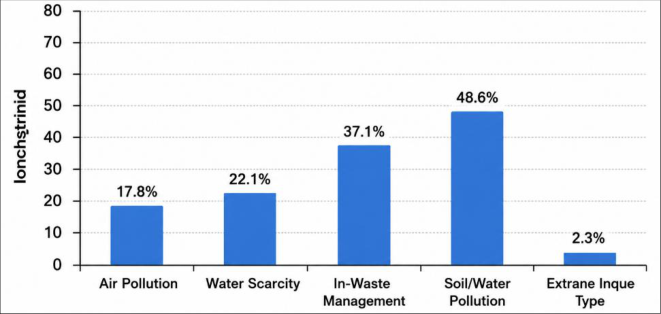 Figure 1
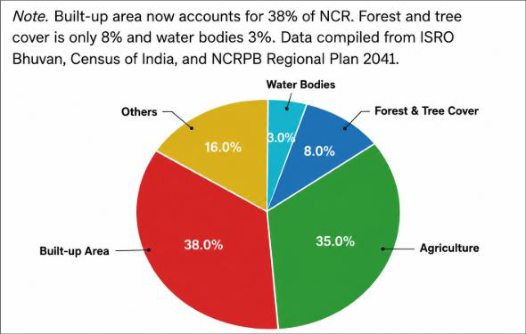 Figure 2
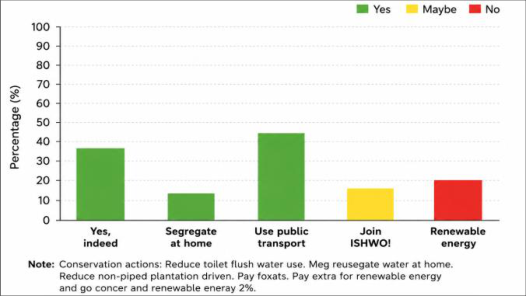 Figure 3
Introduction
Cities are centers of opportunity. They contribute over 80% of global GDP. But they are also the largest consumers of natural resources. The Brundtland Report (1987) defined sustainable development as meeting present needs without compromising future generations. For cities, this means balancing growth with ecological limits. India's urban story is unique. Between 2001 and 2011, India's urban population grew by 31%. Delhi, with over 32 million people in the NCR, faces extreme pressure on groundwater, air, and land. The Yamuna River is polluted, groundwater levels are falling 0.5 to 1 meter per year in parts of the city, and green cover is fragmented. The National Capital Region of Delhi represents one of the fastest urbanizing megaregions in the world. Spanning Delhi and parts of Haryana, Uttar Pradesh, and Rajasthan, NCR is home to over 46 million people as of 2026 and continues to grow at more than 2% annually. It is the political, economic, and cultural core of India, and also one of the most resource-stressed urban landscapes on the planet. The story of Delhi NCR over the last three decades is a story of rapid expansion: new townships in Gurugram, Noida, Ghaziabad, Faridabad, and Bahadurgarh; industrial corridors; highways; metro networks; and the conversion of agricultural land and green belts into built-up areas. This growth has delivered jobs, infrastructure, and upward mobility. But it has also placed enormous pressure on the region's finite natural resources. Delhi NCR sits on a semi-arid plain with low annual rainfall of 600-700 mm, heavily dependent on the Yamuna, Ganga canal system, and groundwater. The Central Ground Water Board classifies most districts of NCR as "over-exploited." Water tables in South Delhi, Gurugram, and Noida have fallen below 40 meters in many areas. Air quality frequently ranks among the worst globally during winter, driven by vehicular emissions, construction dust, industrial activity, and crop stubble burning in adjoining states. Land use change has been equally dramatic. Between 2000 and 2023, built-up area in NCR expanded by over 150%, while forest and tree cover remained stagnant at around 7-8% of Delhi and even less in surrounding districts. Vegetation in Delhi NCR is under particular threat, yet it is critical to the region's survival. The Ridge, often called Delhi's "green lungs," Yamuna floodplains, Aravalli extensions in Gurugram and Faridabad, and the network of parks, biodiversity parks, and avenue trees provide ecosystem services that the city cannot function without. They reduce ambient temperatures by 2-4°C during peak summer when NCR regularly crosses 45°C. They trap PM2.5 and PM10, recharge groundwater, and manage monsoon flooding in the Yamuna basin. They also support biodiversity, including leopards in the Aravalli, migratory birds in Okhla and Sultanpur, and native flora that is increasingly rare. However, encroachment, illegal mining in the Aravalli, diversion of forest land for infrastructure, and loss of trees to road widening have led to fragmentation. The urban heat island effect in central Delhi and Noida is now 5-7°C higher than surrounding rural areas, and heatrelated mortality is rising. The problem is not just depletion, it is the timing mismatch between urban demand and ecological capacity. Delhi draws water from Haryana and Uttar Pradesh through inter-state agreements, but those sources are themselves stressed. Electricity demand peaks at over 8,000 MW in summer, largely met by coal-based plants within and around NCR. Construction in NCR consumes an estimated 30-40 million tons of sand and aggregates annually, much of it from riverbeds. Waste generation exceeds 11,000 tons per day in Delhi alone, with landfill sites like Ghazipur and Bhalswa already overflowing. This linear model of take-use-dispose is not sustainable for a region projected to house 57 million people by 2031. Sustainable development offers the only viable path forward. As defined by the Brundtland Commission and adopted in SDG 11, sustainable cities must be inclusive, safe, resilient, and resource-efficient. For Delhi NCR, this translates into three urgent priorities: manage natural resources within ecological limits, prevent irreversible damage for future generations, and ensure the survival and expansion of vegetation. Resource management in NCR must shift from extraction to circularity. Water management needs demand-side measures: rainwater harvesting, reuse of treated wastewater for horticulture and industry, and revival of traditional baolis and johads in Haryana and Rajasthan parts of NCR. The Yamuna floodplains must be protected from encroachment and restored as wetlands rather than being treated as vacant land. Energy planning should prioritize rooftop solar, district cooling, and energy-efficient buildings to reduce peak load and emissions. Land use planning under the NCR Regional Plan 2041 emphasizes transit-oriented development and containment of sprawl, but implementation remains weak. Prevention is equally important. Prevention means enforcing the Aravalli notification to stop mining, maintaining green buffers between cities, and preventing groundwater overdraft through strict metering and pricing. It means integrating climate risk into all infrastructure projects, so that roads, drains, and housing do not worsen flooding or heat. For future generations, prevention also means accounting for inter generational equity. The decisions made today about how much groundwater we pump, how many trees we cut, and how we design our cities will determine whether Delhi NCR remains livable in 2050. Vegetation survival must move from an aesthetic afterthought to core infrastructure. Benedict and McMahon (2006) showed that connected networks of parks, wetlands, and trees reduce flooding and heat. They also argued that networks of natural areas provide essential services: flood control, cooling, and biodiversity habitat. • Governance and Equity: Agyeman et al. (2003) introduced "just sustainability," noting that resource policies must address both ecological limits and social justice also narrated that-environmental protection must also address poverty and access.
Land and Soil
Urban area in India grew from 3.1% to 3.5% of total land between 2010-2020.
Pressures: Sprawl into farmland, sealing of soil, construction debris. Impact: Reduced groundwater recharge, increased flooding, loss of biodiversity.
Air
Transport, industry, construction, and crop burning affect urban air. WHO (2021) lists 14 of 20 most polluted cities globally in India. Delhi's annual PM2.5 average is 5-6 times WHO limit. Impact: Respiratory illness, productivity loss, estimated 1.67 million deaths annually in India due to air pollution.
Energy
Cities consume 65% of India's electricity. 75% still from coal.
• Pressures: Peak demand, transmission loss, emissions.
• Impact: Climate change, air pollution, energy poverty in slums.
Biodiversity and Green Spaces
Delhi Ridge is the city's "green lung" but lost 1,200 hectares between 1994-2021. Urban wetlands are being encroached.
Impact: Loss of cooling, carbon sink, habitat, and recreation. • Longitudinal studies on inter-generational impact • Expand surveys to 10 Indian cities for comparative data If we protect water today, children will not fight for it tomorrow. If we keep air clean now, lungs of the next generation will be healthier. Sustainable urban development is ultimately about that choice. Sustainable urban development occurs when resource consumption stays within regenerative capacity, and when institutions ensure that savings today benefit future residents.
Figures and tables from the paper
References
36 in the original paper- Agyeman J. Introducing just sustainability. London: Zed Books; 2013.
- Benedict MA, McMahon ET. Green infrastructure. Washington (DC): Island Press; 2006.
- Central Ground Water Board. Ground water year book: Delhi. New Delhi: Ministry of Jal Shakti, Government of India; 2023.
- Centre for Science and Environment. State of India's environment report. New Delhi: Centre for Science and Environment; 2023.
- Delhi Development Authority. Master plan for Delhi 2041. New Delhi: Delhi Development Authority; 2021.
- Government of India. SDG India Index 2023-24. New Delhi: NITI Aayog; 2023.
- Kennedy C, et al. Greenhouse gas emissions from global cities. Environ Sci Technol. 2011;43(19):72977302.
- Rockström J, et al. Planetary boundaries. Nature. 2009;461:472-475.
- UN-Habitat. World cities report 2022. Nairobi: United Nations Human Settlements Programme; 2022.
- World Health Organization. Global air quality guidelines. Geneva: World Health Organization; 2021.
- World Bank. India's urbanization review. Washington (DC): World Bank; 2023.
- Central Ground Water Board. Ground water year book: Delhi 2022-23. New Delhi: Ministry of Jal Shakti, Government of India; 2023.
- Central Pollution Control Board. National air quality monitoring programme: annual report 2023-24. New Delhi: Ministry of Environment, Forest and Climate Change; 2024.
- Census of India. Delhi and NCR district census handbook. New Delhi: Registrar General and Census Commissioner of India; 2011.
- Delhi Development Authority. Master plan for Delhi 2041. New Delhi: Government of NCT of Delhi; 2021.
- Forest Survey of India. India state of forest report 2023. Dehradun: Ministry of Environment, Forest and Climate Change; 2023.
- Garg RD, Mishra S. Urban heat island and vegetation dynamics in Delhi NCR using remote sensing. J Urban Ecol. 2022;8(1):1-14. doi:10.1093/jue/juac008.
- Government of India. Smart Cities Mission: guidelines. New Delhi: Ministry of Housing and Urban Affairs; 2015.
- Gupta A, Singh RB. Groundwater depletion and management strategies in NCR region. Groundw Sustain Dev. 2021;14:100612. doi:10.1016/j.gsd.2021.100612.
- Indian Institute of Tropical Meteorology. System of air quality and weather forecasting and research (SAFAR) Delhi. Pune: Ministry of Earth Sciences; 2023.
- Jain M, Singh N. Land use land cover change in Delhi NCR: a geospatial analysis. Remote Sens Appl Soc Environ. 2020;18:100298. doi:10.1016/j.rsase.2020.100298.
- Kumar P, Sharma P. Urbanization and loss of wetlands in Delhi NCR. Wetl Ecol Manag. 2019;27(5):567-580.
- Ministry of Housing and Urban Affairs. NCR Regional Plan 2041. New Delhi: National Capital Region Planning Board; 2022.
- National Institute of Urban Affairs. State of urbanization in India: Delhi NCR report. New Delhi: NIUA; 2023.
- Prakash A, Kumar V. Air pollution and health impacts in Delhi NCR. Environ Sci Pollut Res. 2021;28(12):14567-14580.
- Rao S, Bhatia R. Biodiversity parks as urban conservation tools: case of Delhi. Urban For Urban Green. 2022;67:127423. doi:10.1016/j.ufug.2021.127423.
- Sharma D, Tiwari R. Waste management challenges in megacities: Delhi case study. J Environ Manage. 2023;326:116734.
- Singh J, Goyal R. Yamuna floodplain encroachment and ecological consequences. River Res Appl. 2020;36(8):1452-1463.
- The Energy and Resources Institute. Delhi climate change action plan 2023. New Delhi: TERI; 2022.
- Tiwari S, Srivastava A. Aravalli degradation and policy responses in Haryana and Rajasthan. Land Use Policy. 2021;109:105678.
- United Nations. Transforming our world: the 2030 agenda for sustainable development. New York: United Nations Department of Economic and Social Affairs; 2015.
- United Nations Human Settlements Programme. World cities report 2022: envisaging the future of cities. Nairobi: UN-Habitat; 2022.
- Verma P, Raghubanshi AS. Carbon sequestration potential of urban trees in Delhi. Urban Clim. 2023;48:101422.
- World Bank. India: urbanization and growth. Washington (DC): World Bank Group; 2021.
- World Health Organization. Air quality guidelines: global update 2021. New Delhi: WHO Regional Office for South-East Asia; 2023.
- Yadav S, Sharma N. Community participation in urban greening: evidence from Delhi. Cities. 2024;145:104712. doi:10.1016/j.cities.2023.104712.