
Research article · 2026 · Full text
International Journal of Agriculture and NutritionBridging the Nutritional Gap through High Value Fruits: An Economic and Dietary Feasibility Analysis of Minimum Dietary Diversity (MDD) in Rural area of Sitakunda-Mirsarai Upazila, Chattogram, Bangladesh
Volume 8(8) · Pages 20–24 · DOI: 10.33545/26646064.2026.v8.i8a.731 ↗
Research areasChild Nutrition and Water AccessAgricultural Innovations and PracticesFood Security and Socioeconomic Dynamics
Abstract
Author-writtenBackground & Objective: Minimum Dietary Diversity (MDD) is a globally recognized proxy for micronutrient adequacy and overall nutritional security. This study investigates the current dietary patterns of the rural population in Sitakunda and Mirsarai upazillas of Chattogram, Bangladesh, while evaluating the economic and agronomic feasibility of High Value Fruits (HVF) as a sustainable intervention to bridge identified nutritional gaps. Methodology: A comprehensive baseline survey was conducted involving 496 stakeholders, including micro-entrepreneurs, farmers and market actors. Data was collected on 10 standardized food groups to calculate overall MDD, alongside seasonal economic metrics for crop production and stakeholder constraints. Results: The dietary analysis revealed severe deficiencies in critical micronutrient dense food groups. While grain consumption was nearly universal (99.8%), 52.8% of the population lacked access to Vitamin-A rich fruits and vegetables and 53.6% failed to consume nuts and seeds. Conversely, agricultural data indicated a high capacity for HVF cultivation, with prominent cultivation of Mango (37.8%) and Papaya (12.3%). Economic evaluations across three distinct seasons (March 2021-March 2022) proved HVF cultivation to be consistently profitable, yielding gross profits up to 27.63 thousand BDT per season. However, expansion is heavily hindered by post-harvest management (89.8%) and financial (84.2%) constraints. Conclusion: Scaling up the cultivation of specific HVFs (e.g. Mango, Papaya, Dragon fruit) offers a highly viable dual solution: it directly mitigates the region's acute Vitamin A and micronutrient dietary deficiencies while simultaneously acting as a highly profitable economic engine for rural farmers.
Summary
Source-checkedPlain-language reading of the full paper, prepared with AI and checked against the text. Each point links to the authors' own words.
Why it matters
- Minimum Dietary Diversity (MDD) is used as a validated measure to determine if a population is receiving adequate micronutrients through their diet. View evidence ↗
- Rural populations in agrarian economies such as Bangladesh often have diets dominated by starchy staples, leading to significant deficiencies in essential minerals and vitamins. View evidence ↗
The question
- The study aims to assess the regional MDD, identify specific nutritional gaps, and determine if integrating High-Value Fruits is economically and agronomically feasible for improving nutritional security. View evidence ↗
What they did
- The research was conducted in the Sitakunda and Mirsarai upazillas of Chattogram, Bangladesh, using a systematic random sample of 496 respondents. View evidence ↗
- The study participants included 409 microenterprises (stratified by poverty level), 46 market actors, and 41 institutional or government officials. View evidence ↗
- Researchers used a 10-food-group framework to evaluate MDD and analyzed agricultural economic data from March 2021 to March 2022 to assess production viability. View evidence ↗
What they found
- Only 56% of the surveyed population met the minimum acceptable dietary diversity score, indicating a significant nutritional gap in the region. View evidence ↗
- The most severe deficiency was in Vitamin A, with 52.80% of the population reporting no consumption of Vitamin-A rich fruits and vegetables. View evidence ↗
- Over half of the population (53.6%) does not consume nuts and seeds, representing another major dietary deficit. View evidence ↗
- Mango is the most common fruit crop in the area, occupying 37.80% of cultivated land, followed by Guava (27.00%), Jackfruit (16.00%), and Papaya (12.30%). View evidence ↗
- Fruit cultivation is profitable throughout the year, with mean gross profits ranging from 20.71 thousand BDT in winter/spring to 27.63 thousand BDT in peak summer. View evidence ↗
- The primary barriers to expanding HVF cultivation are post-harvest management (89.80%), processing (89.10%), and financial constraints (84.20%). View evidence ↗
What it means
- The authors conclude that scaling up the cultivation of fruits like Mango, Papaya, and Dragon fruit can simultaneously solve micronutrient deficiencies and provide a profitable income source for farmers. View evidence ↗
Visual summary
2 visualsIllustrations explain the paper; charts are replotted from the paper's own table values.
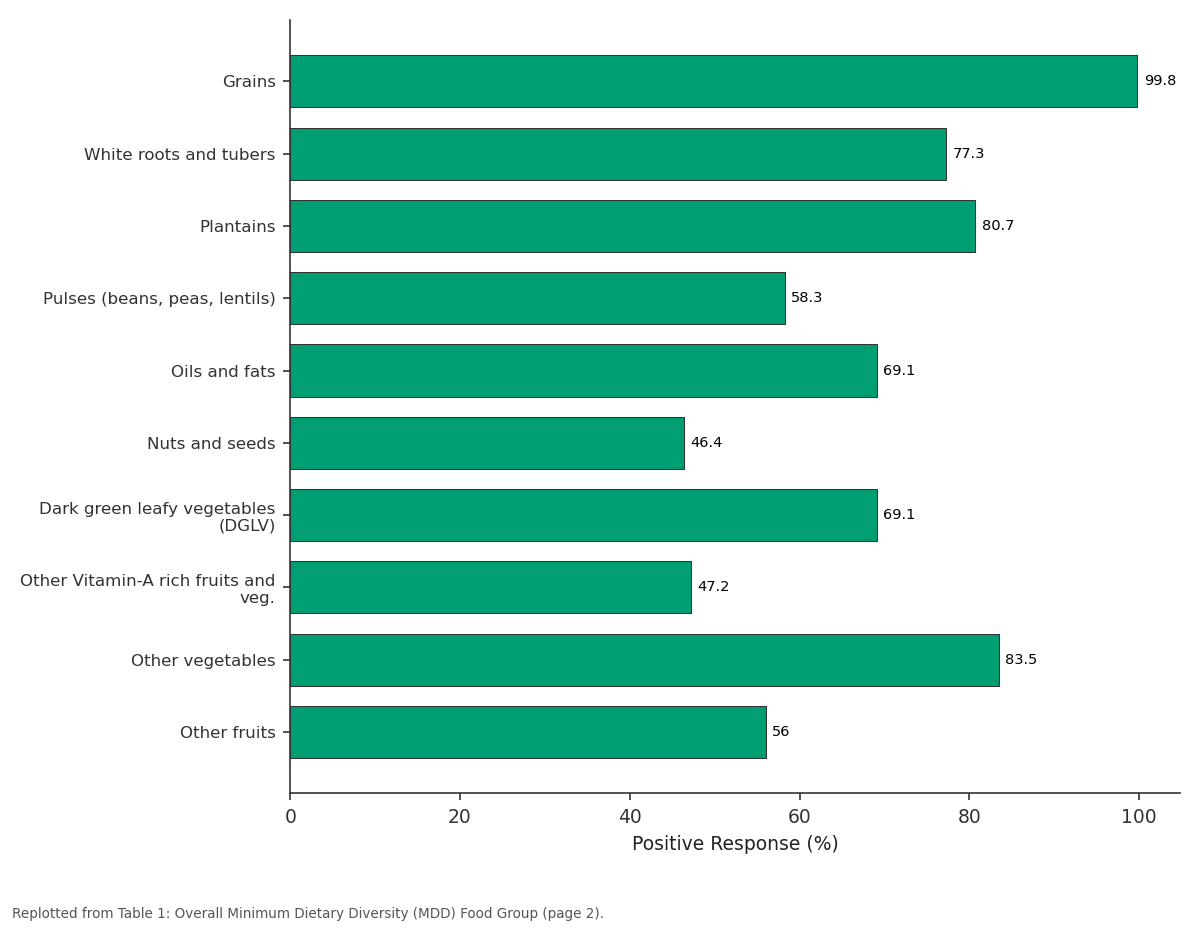
Positive Response (%): Grains vs White roots and tubers vs Plantains vs Pulses (beans, peas... vs Oils and fats
Replotted from Table 1 (page 2) of the original paper. Every bar is the paper's own table value.
View source evidence ↗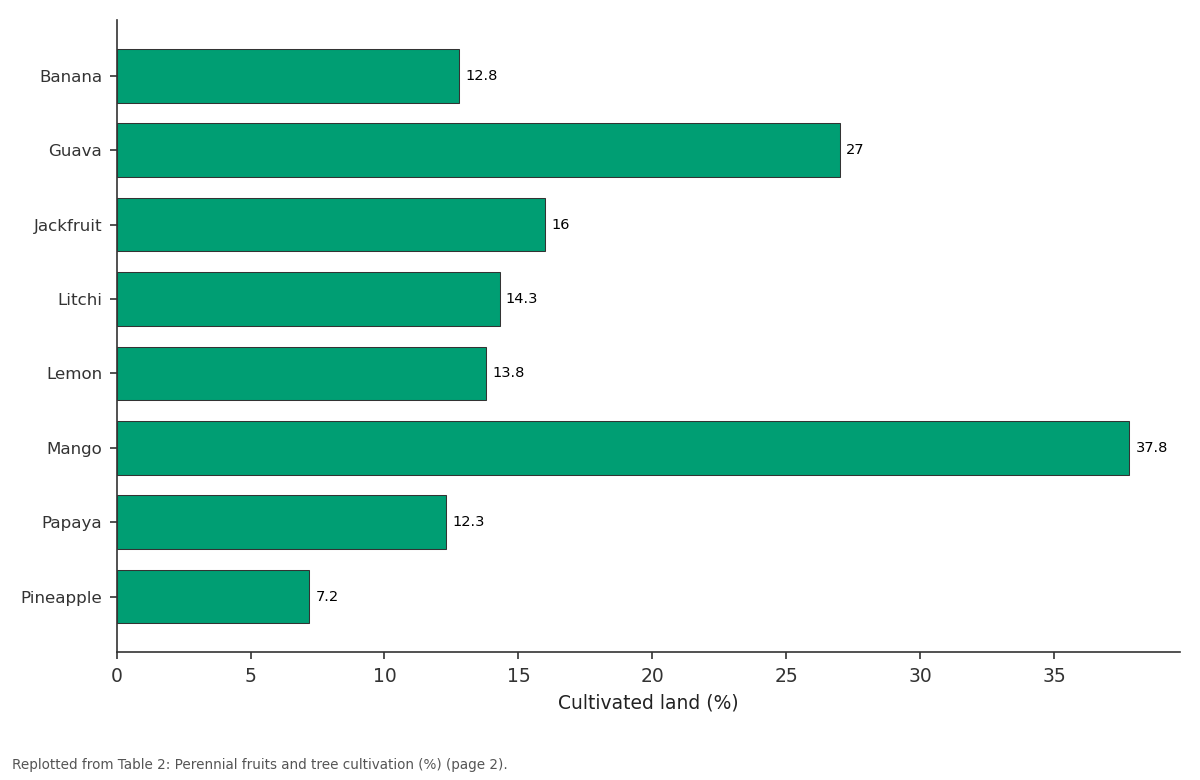
Cultivated land (%): Banana vs Guava vs Jackfruit vs Litchi vs Lemon
Replotted from Table 2 (page 2) of the original paper. Every bar is the paper's own table value.
View source evidence ↗Figures & tables
From the original paper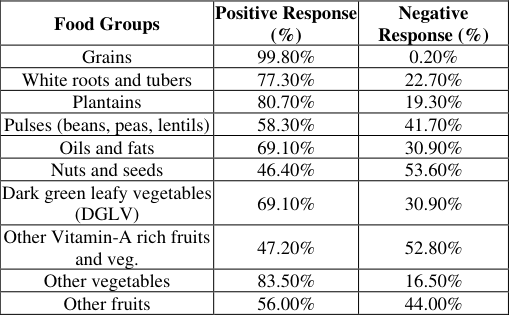 Table 1
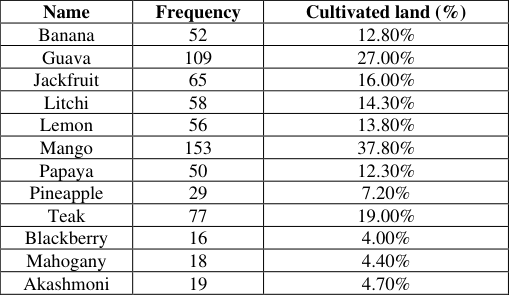 Table 2
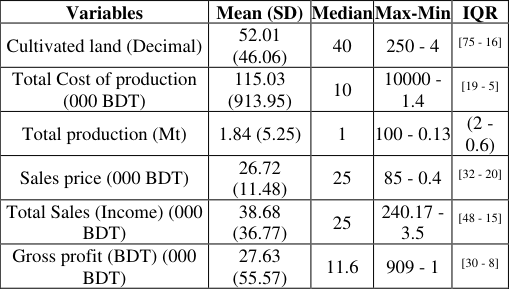 Table 3
 Table 4
 Table 5
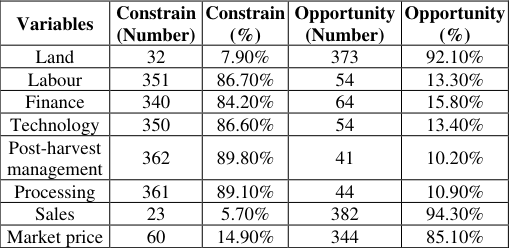 Table 6
Introduction
Global food security paradigms have increasingly shifted from mere caloric sufficiency to nutritional adequacy, emphasizing the importance of dietary quality in combating hidden hunger (Kennedy et al., 2011; Pingali, 2015) [8,9] . Minimum Dietary Diversity (MDD) serves as a critical, validated indicator of population level nutrient adequacy, reflecting the consumption of multiple distinct food groups required to meet daily micronutrient profiles (FAO, 2021) [2] . In developing agrarian economies like Bangladesh, rural populations frequently suffer from monotonic diets heavily skewed toward starchy staples, leaving substantial deficits in vitamins and essential minerals (Jones, 2017; Hirvonen et al., 2020) [7,5] . Addressing these micronutrient gaps requires sustainable, locally adaptable interventions. High-Value Fruits (HVF) such as dragon fruit, mango, papaya, cashew nuts and malta have emerged as a transformative agricultural sub-sector (Weinberger and Lumpkin, 2007) [7] . HVFs represent a dual leverage intervention: they are densely packed with deficient micronutrients (e.g. Vitamin A, Vitamin C, antioxidants) and command premium market [1,6,10] . The Sitakunda and Mirsarai upazillas of Chattogram, characterized by their unique topography and active microenterprise ecosystems, present a fertile ground for HVF expansion. However, a localized, data driven synthesis of how HVF cultivation directly aligns with regional dietary deficiencies remains underexplored. This paper assesses the overall MDD of the region, identifies specific nutritional deficits and evaluates the economic and agronomic feasibility of integrating HVFs as a sustainable mechanism for comprehensive nutritional security.
Methodology 2.1 Study Area and Sampling
The study was conducted in Sitakunda and Mirsarai upazillas under the Chattogram district of Bangladesh. A systematic random sampling process was employed to select an extensive cohort of 496 respondents. The sample comprised 409 microenterprises (stratified by poverty levels: 10% ultra-poor, 19% transitional poor and 71% enterprising poor), 46 market channel actors (wholesalers, retailers, processors) and 41 institutional researchers and government officials.
Data Collection
An extensive field investigation was executed between September 27 2022 to October 1, 2022. Primary data was gathered using structured, pre-tested questionnaires. Key informants and focus groups included ultra-poor, transitional poor and enterprising poor farmers. The survey evaluated the overall baseline of Minimum Dietary Diversity (MDD) based on a 10-food-group framework to represent the general dietary habits and nutritional security of the population. Simultaneously, longitudinal agricultural economic data (costs, yields, sales) from March 2021 to March 2022 was extracted to measure production viability.
Data Analysis
Collected field data were processed and analyzed using Microsoft Excel and IBM SPSS (Statistical Product and Service Solutions). Descriptive statistics, including means, standard deviations (SD) and frequencies, were computed to map both the dietary baseline and the economic parameters of HVF farming.
Results
Results
Overall Minimum Dietary Diversity (MDD) and Nutritional Gaps
To establish the regional nutritional baseline, the overall MDD was assessed based on the consumption patterns of 10 primary food groups over a standard recall period. The data reveals a heavy reliance on starchy staples alongside alarming deficits in micronutrient dense foods (Table 1).
| Food Groups | Positive Response (%) | Negative Response (%) |
|---|---|---|
| Grains | 99.80% | 0.20% |
| White roots and tubers | 77.30% | 22.70% |
| Plantains | 80.70% | 19.30% |
| Pulses (beans, peas, lentils) | 58.30% | 41.70% |
| Oils and fats | 69.10% | 30.90% |
| Nuts and seeds | 46.40% | 53.60% |
| Dark green leafy vegetables (DGLV) | 69.10% | 30.90% |
| Other Vitamin-A rich fruits and veg. | 47.20% | 52.80% |
| Other vegetables | 83.50% | 16.50% |
| Other fruits | 56.00% | 44.00% |
Table text extracted from the original PDF; superscript letters are shown inline. The original table image is below.
View original table image
According to the data, 53.6% of the population is not consuming nuts and seeds. Furthermore, the most critical micronutrient vulnerability lies in Vitamin A intake, where 52.80% of the surveyed population reported zero consumption of Vitamin-A rich fruits and vegetables. Overall, only 56% of the population achieves a minimum acceptable dietary diversity score, highlighting a substantial nutritional gap.
Current HVF Cultivation Scenario
The region exhibits a promising baseline for fruit and tree cultivation, which serves as a foundation for scaling up HVFs. The survey of perennial crops across the four unions indicates that traditional high value fruits are already established within the local agricultural framework (Table 2). As illustrated in Table 2, Mango is the most widely cultivated fruit crop, occupying 37.80% of cultivated land, followed by Guava (27.00%), Jackfruit (16.00%) and Papaya (12.30%).
| Name | Frequency | Cultivated land (%) |
|---|---|---|
| Banana | 52 | 12.80% |
| Guava | 109 | 27.00% |
| Jackfruit | 65 | 16.00% |
| Litchi | 58 | 14.30% |
| Lemon | 56 | 13.80% |
| Mango | 153 | 37.80% |
| Papaya | 50 | 12.30% |
| Pineapple | 29 | 7.20% |
| Teak | 77 | 19.00% |
| Blackberry | 16 | 4.00% |
| Mahogany | 18 | 4.40% |
| Akashmoni | 19 | 4.70% |
Table text extracted from the original PDF; superscript letters are shown inline. The original table image is below.
View original table image
Economic Viability of Cultivation
To determine the commercial feasibility of scaling HVF to meet the nutritional gaps, seasonal economic data was analyzed across three consecutive cycles from March 2021 to March 2022 (Table 3-5). The data unequivocally demonstrates that fruit cultivation maintains positive gross profit margins year round, ranging from a mean of 20.71 thousand BDT in the winter/spring season to 27.63 thousand BDT in the peak summer season.
Constraints and Opportunities in HVF Expansion
Despite the profitability, significant systemic barriers exist. We evaluated the constraints and opportunities associated with quality saplings, bio-pesticides, bio-fertilizers and farm technology.
Discussion 4.1 Bridging the Micro-Nutrient Gap through Target Crops
The MDD baseline paints a stark reality of the regional dietary pattern. While staple grain requirements are met, 52.8% of the population suffers from a lack of Vitamin Arich foods and 53.6% lack nuts and seeds. Prolonged Vitamin A deficiency is directly linked to weakened immunity and severe ocular morbidities in rural demographics (West, 2002; Stevens et al., 2015) [13,11] . High Value Fruits present an immediate, localized solution to this crisis. Local farmers are already predisposed to cultivating Mango (37.8%) and Papaya (12.3%). Both fruits are globally recognized as premier, bioavailable sources of beta-carotene (pro-vitamin A) and ascorbic acid (WHO, 2019) [14] . By actively transitioning these existing agricultural baselines into intensive HVF models and introducing ultra-high-value variants like Dragon Fruit, Avocado and Malta the region can domesticate its nutritional supply chain. Furthermore, promoting the cultivation of Cashew Nuts, a highly suitable HVF for the Chittagong Hill Tracts topography, directly addresses the severe 53.6% deficit in nut/seed consumption, supplying essential healthy fats and proteins.
Economic Viability as a Catalyst for Nutritional Security
Nutritional interventions in impoverished areas fail if they do not make economic sense for the producers (Gillespie et al., 2019) [3] . Seasonal data prove that fruit cultivation is inherently lucrative across the calendar year. Even in the lowest yield cycle (Nov 2021 to Mar 2022), farmers achieved a mean gross profit of 20.71 thousand BDT. This profitability is the economic engine that can drive nutritional security. As farmers generate higher incomes from HVF, household purchasing power increases, historically correlating with improved household dietary diversity scores (Headey and Alderman, 2019) [4] . Furthermore, the overwhelming perception of Sales (94.3%) and Market Price (85.1%) as high opportunity vectors indicates robust, unmet consumer demand.
Conclusion and Recommendations
The dietary architecture of Sitakunda and Mirsarai is heavily deficient in essential micronutrients, particularly Vitamin-A rich foods and nutrient-dense nuts/seeds. Expanding the cultivation of High Value Fruits (HVF) offers a scientifically and economically validated dual intervention.
Figures and tables from the paper
| Variables | Mean (SD) | Median | Max-Min | IQR |
|---|---|---|---|---|
| Cultivated land (Decimal) | 51.34 (41.92) | 40 | 300 - 5 | [60 - 25] |
| Total Cost of production (000 BDT) | 64.58 (595.85) | 8 | 8500 - 1 | [18 - 5] |
| Total production (Mt) | 1.67 (1.76) | 1.44 | 19 - 0.1 | (2.1 - 0.76) |
| Sales price (000 BDT) | 26.33 (13.35) | 23.68 | 80.5 - 0.5 | (34 - 15.5) |
| Total Sales (Income) (000 BDT) | 37.14 (27.12) | 33 | 161.19 - 0.95 | [47 - 18] |
| Gross profit (BDT) (000 BDT) | 23.65 (22.98) | 17.32 | 155.92 - 1 | [27 - 8] |
Table text extracted from the original PDF; superscript letters are shown inline. The original table image is below.
View original table image
| Variables | Mean (SD) | Median | Max-Min | IQR |
|---|---|---|---|---|
| Cultivated land (Decimal) | 47.99 (44.65) | 40 | 350 - 3 | [56 - 20] |
| Total Cost of production (000 BDT) | 10.97 (11.14) | 7 | 120 - 1 | [15 - 4] |
| Total production (Mt) | 1.62 (2.59) | 0.8 | 23 - 0.08 | (1.8 - 0.5) |
| Sales price (000 BDT) | 25.59 (11.97) | 22.63 | 78 - 0.6 | [30 - 19] |
| Total Sales (Income) (000 BDT) | 37.14 (27.12) | 33 | 161.19 - 0.95 | [47 - 18] |
| Gross profit (BDT) (000 BDT) | 20.71 (41.21) | 11.2 | 654.15 - 0.5 | [20 - 6] |
Table text extracted from the original PDF; superscript letters are shown inline. The original table image is below.
View original table image
References
14 in the original paper- Cummings RW. Agricultural diversification and smallholders in South Asia. New Delhi: Academic Foundation; 2007.
- Food and Agriculture Organization of the United Nations. Minimum dietary diversity for women: an updated guide to measurement from collection to action. Rome: FAO; 2021. doi:10.4060/cb3434en.
- Gillespie S, Harris J, Kadiyala S. The agriculturenutrition disconnect in India: what do we know? IFPRI Discussion Paper. Washington (DC): International Food Policy Research Institute; 2019. p. 1-45.
- Headey D, Alderman H. The relative caloric prices of healthy and unhealthy foods differ systematically across income levels and continents. Journal of Nutrition. 2019;149 [11] :2020-2033.
- Hirvonen K, Bai Y, Headey D, Masters WA. Affordability of the EAT-Lancet reference diet: a global analysis. Lancet Glob Health. 2020;8 [1] :59-66.
- Jones AD, Shrinivas A, Bezner Kerr R. Farm production diversity is associated with greater household dietary diversity in Malawi. Food Policy. 2014;46:1-12.
- Jones AD. Critical review of the emerging research evidence on agricultural biodiversity, diet diversity and nutritional status in low-and middle-income countries. Nutrition Reviews. 2017;75 [10] :769-782.
- Kennedy G, Ballard T, Dop MC. Guidelines for measuring household and individual dietary diversity. Rome: Food and Agriculture Organization of the United Nations; 2011.
- Pingali P. Agricultural policy and nutrition outcomes: getting beyond the preoccupation with calories. Food Security. 2015;7 [3] :583-591.
- Sibhatu KT, Krishna VV, Qaim M. Production diversity and dietary diversity in smallholder farm households. Proceedings of the National Academy of Sciences of the United States of America. 2015;112 [34] :1065710662.
- Stevens GA, Bennett JE, Hennocq Q, Lu Y, De-Regil LM, Rogers L, et al. Trends and mortality effects of vitamin A deficiency in children in 138 low-income and middle-income countries between 1991 and 2013: a International Journal of Agriculture and Nutrition https://www.agriculturejournal.net pooled analysis of population-based surveys. Lancet Glob Health. 2015;3 [9] :528-536.
- Weinberger K, Lumpkin TA. Diversification into horticulture and poverty reduction: a research agenda. World Development. 2007;35 [8] :1464-1480.
- West KP Jr. Extent of vitamin A deficiency among preschool children and women of reproductive age. Journal of Nutrition. 2002;132 [9] :2857S-2866S.
- World Health Organization. Increasing fruit and vegetable consumption to reduce the risk of noncommunicable diseases. Geneva: World Health Organization; 2019.