
Research article · 2026 · Full text
International Journal of Horticulture and Food ScienceBio-ecological management of lemon butterfly (Papilio demoleus lepidoptera: Papilionidae) in bael (Aegle marmelos): (Pooled data 2020-2024)
Volume 8(8) · Pages 15–18 · DOI: 10.33545/26631067.2026.v8.i8a.827 ↗
Research areasInsect Pest Control StrategiesEntomopathogenic Microorganisms in Pest ControlInsect-Plant Interactions and Control
Abstract
Author-writtenThe lemon butterfly (Papilio demoleus), a significant pest of bael (Aegle marmelos), causes extensive defoliation and yield losses in India's arid and semi-arid regions. Due to the environmental and health risks of chemical pesticides, this study evaluated eight bio-ecological treatments, including biopesticides and botanicals, for managing P. demoleus in bael orchards at Asalpur farm from 2020 to 2024. Using a randomized block design with three replications, treatments such as neem-based products, microbial agents (Bacillus thuringiensis, Metarhizium anisopliae, Beauveria bassiana, spinosad), and an untreated control were tested. Larval mortality was assessed at 1, 3, 7, and 15 days post-spray. Spinosad 45 SC (0.2 ml/L) achieved the highest mean mortality (77%), followed by Bacillus thuringiensis var. kurstaki (66.84%) and neem seed kernel extract (NSKE) 5% (52.59%). These treatments significantly outperformed others (p <0.05), while Beauveria bassiana, karanj seed extract, and Metarhizium anisopliae were less effective (38.29-41.25%). All treatments surpassed the untreated control (4.29% mortality). These findings highlight bio-ecological approaches, particularly spinosad and B. thuringiensis, as sustainable alternatives for P. demoleus management in bael cultivation.
Summary
Source-checkedPlain-language reading of the full paper, prepared with AI and checked against the text. Each point links to the authors' own words.
Why it matters
- Bael (Aegle marmelos) is an economically important fruit tree grown in the arid and semi-arid regions of India for its edible and medicinal properties. View evidence ↗
- The lemon butterfly (Papilio demoleus) is a major pest that can cause up to 100% defoliation in bael trees, particularly between August and February, resulting in significant yield losses. View evidence ↗
- Traditional chemical pesticides used for pest control are concerning due to their negative impacts on human health, the environment, and non-target organisms. View evidence ↗
The question
- The study aimed to evaluate how effective various biopesticides and botanical extracts are for managing the lemon butterfly in bael orchards over a five-year period. View evidence ↗
What they did
- Researchers tested eight treatments at Asalpur farm from 2020 to 2024, including an untreated control, botanical extracts (neem and karanj), and microbial agents (B. thuringiensis, M. anisopliae, B. bassiana, and spinosad). View evidence ↗
- The experiment used a Randomized Block Design with three replications, applying each treatment to two bael trees per replicate. View evidence ↗
- Larval mortality was measured as a percentage by inspecting 100 leaves per tree at 1, 3, 7, and 15 days after the foliar sprays were applied. View evidence ↗
What they found
- Spinosad 45 SC (0.2 ml/L) was the most effective treatment, achieving a mean mortality of 77% and peaking at 88.07% on the 3rd and 7th days. View evidence ↗
- Bacillus thuringiensis var. kurstaki (0.1%) had the second-highest mean mortality at 66.84%, reaching a peak of 94.16% mortality by day 7. View evidence ↗
- Neem seed kernel extract (NSKE) at 5% showed a mean mortality of 52.59%, with its highest efficacy of 76.04% occurring on day 3. View evidence ↗
- Neem oil (0.1%) and Metarhizium anisopliae (6 g/L) provided moderate control, with mean mortalities of 49% and 41.25% respectively. View evidence ↗
- Beauveria bassiana and karanj seed extract were the least effective treatments, with mean mortalities of 38.29% and 39.59% respectively. View evidence ↗
- The untreated control group showed negligible larval mortality, recorded at 4.29%. View evidence ↗
What it means
- The authors conclude that Spinosad 45 SC, B. thuringiensis var. kurstaki, and NSKE are sustainable and effective alternatives to chemical pesticides for managing the lemon butterfly. View evidence ↗
- The authors recommend that farmers integrate these biopesticides into Integrated Pest Management (IPM) frameworks and that policymakers support this transition through subsidies and extension services. View evidence ↗
- The study's results may have limited generalizability because the research was conducted at only one site, meaning climate and pest pressure variations were not fully accounted for. View evidence ↗
- The authors note that environmental factors affecting fungal biopesticides were not fully explored and suggest further research across different seasons and locations. View evidence ↗
Visual summary
1 visualsIllustrations explain the paper; they do not show study data.
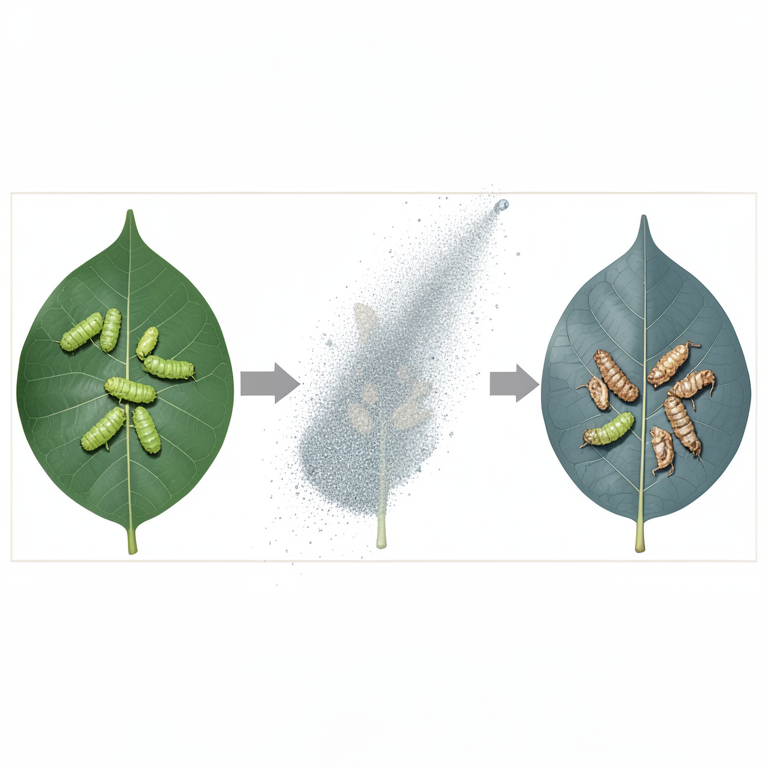
Comparison of Bio-Ecological Treatments
AI-generated conceptual illustration (Bael tree leaves (Aegle marmelos) and lemon butterfly larvae (Papilio demoleus)). It explains the idea and does not show study data.
View source evidence ↗Figures & tables
From the original paper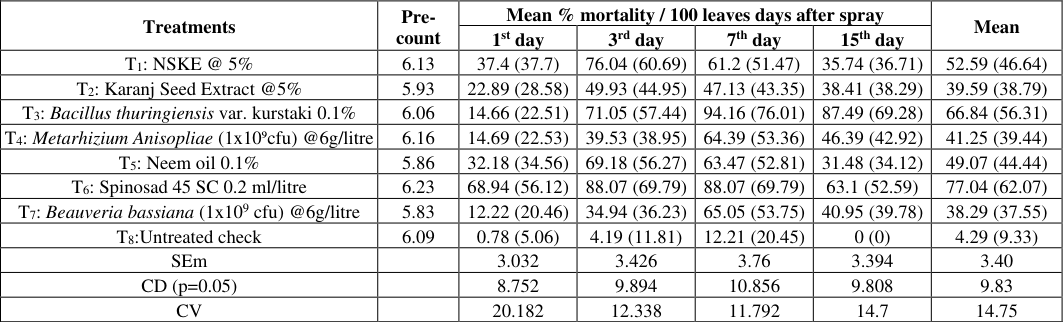 Table 1
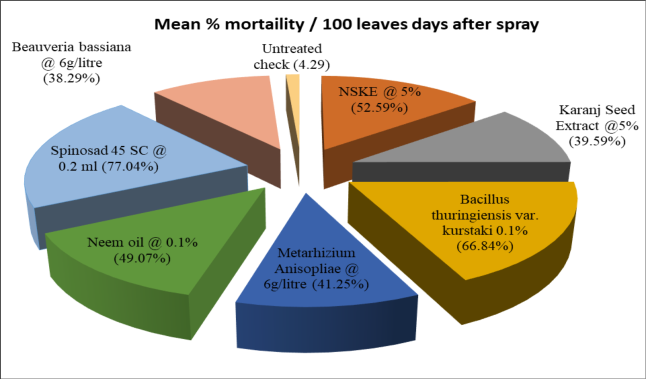 Figure 1
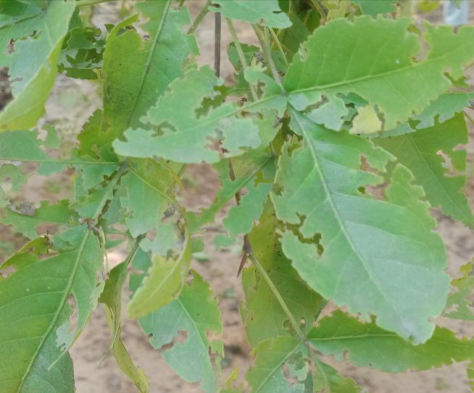 Figure 2
Introduction
Bael (Aegle marmelos Correa), a member of the Rutaceae family, is a valuable fruit tree cultivated in India's arid and semi-arid regions for its medicinal and edible fruits. Its economic importance has grown, but insect pests, particularly the lemon butterfly (Papilio demoleus Lepidoptera: Papilionidae), threaten productivity. The larvae of P. demoleus cause severe defoliation, especially from August to February, leading to significant yield losses (Singh, 1993) [11] . This pest primarily targets Rutaceae species, including bael, citrus, and Murraya koenigii, and can cause up to 100% defoliation in severe infestations (Thakare & Borle, 1969) [13] . With rising global demand for eco-friendly pest control, bio-ecological approaches are critical for sustainable agriculture in arid regions. Chemical pesticides have traditionally been used to control P. demoleus, but their adverse effects on non-target organisms, environmental pollution, and human health have raised concerns (Guerrero et al., 2004) [4] . Consequently, there is a pressing need for sustainable pest management strategies. Bio-ecological approaches, such as biopesticides (e.g., Bacillus thuringiensis, Metarhizium anisopliae, Beauveria bassiana) and botanical extracts (e.g., neem, karanj), offer ecofriendly alternatives due to their target-specificity and reduced environmental impact (Sadawaste et al., 2010) [8] . This study evaluated the efficacy of selected biopesticides and botanicals for managing P. demoleus in bael orchards at Asalpur farm over five years (2020-2024).
Materials and Methods
Materials and Methods
Study Site and Period
The experiment was conducted at Asalpur farm of SKN Agriculture University, Jobner Rajasthan, in an arid to semi-arid region with high P. demoleus infestation, particularly from August to February. Data were collected annually from 2020 to 2024.
Treatments
Eight treatments were evaluated: 1. Neem Seed Kernel Extract (NSKE) @ 5% 2. Karanj Seed Extract @ 5% 3. Bacillus thuringiensis var. kurstaki @ 0.1% 4. Metarhizium anisopliae (1x10⁹ CFU) @ 6 g/L 5. Neem oil @ 0.1% 6. Spinosad 45 SC @ 0.2 ml/L 7. Beauveria bassiana (1x10⁹ CFU) @ 6 g/L 8. Untreated control
Experimental Design
The trial followed a Randomized Block Design (RBD) with three replications. Each treatment was applied on two bael trees per replicate, ensuring adequate representation.
Application and Observation
Treatments were applied as foliar sprays using a knapsack sprayer (10 L capacity, 500 ml/tree). Pre-treatment larval counts were recorded by inspecting 100 leaves per tree across four cardinal directions (north, east, south, west). Post-treatment observations were made at 1, 3, 7, and 15 days after spraying. Larval mortality was calculated as a percentage.
Statistical Analysis
Data were subjected to analysis of variance (ANOVA) in RBD. Percentage mortality data were arcsine-transformed to normalize variance. Standard error of the mean (SEm), critical difference (CD) at p=0.05, and coefficient of variation (CV) were calculated to assess treatment efficacy and variability.
Results
Pre-treatment larval counts ranged from 5.83 to 6.23 larvae per 100 leaves, indicating uniform pest pressure across treatments (Table 1). Spinosad 45 SC (0.2 ml/L) exhibited the highest mean mortality (77%), with peak efficacy (88.07%) at 3 and 7 days post-spray. Bacillus thuringiensis var. kurstaki (0.1%) followed with a mean mortality of 66.84%, achieving 94.16% mortality at 7 days. NSKE (5%) recorded a mean mortality of 52.59%, with a maximum of 76.04% at 3 days. These treatments were significantly superior (p <0.05) to others. Neem oil (0.1%) and Metarhizium anisopliae (6 g/L) showed moderate efficacy, with mean mortalities of 49% and 41.25%, respectively. Beauveria bassiana (38.29%) and karanj seed extract (39.59%) were the least effective, statistically similar to M. anisopliae. The untreated control had negligible mortality (4.29%). Statistical parameters (SEm: 3.403, CD: 9.827, CV: 14.753) confirmed significant differences among treatments. Figure 1 illustrates the mean mortality across treatments.
| Treatments | Pre- count | Mean % mortality / 100 leaves days after spray | — | — | — | Mean |
|---|---|---|---|---|---|---|
| 1st day | 3rd day | 7th day | 15th day | |||
| T1: NSKE @ 5% | 6.13 | 37.4 (37.7) | 76.04 (60.69) | 61.2 (51.47) | 35.74 (36.71) | 52.59 (46.64) |
| T2: Karanj Seed Extract @5% | 5.93 | 22.89 (28.58) | 49.93 (44.95) | 47.13 (43.35) | 38.41 (38.29) | 39.59 (38.79) |
| T3: Bacillus thuringiensis var. kurstaki 0.1% | 6.06 | 14.66 (22.51) | 71.05 (57.44) | 94.16 (76.01) | 87.49 (69.28) | 66.84 (56.31) |
| T4: Metarhizium Anisopliae (1x10⁹cfu) @6g/litre | 6.16 | 14.69 (22.53) | 39.53 (38.95) | 64.39 (53.36) | 46.39 (42.92) | 41.25 (39.44) |
| T5: Neem oil 0.1% | 5.86 | 32.18 (34.56) | 69.18 (56.27) | 63.47 (52.81) | 31.48 (34.12) | 49.07 (44.44) |
| T6: Spinosad 45 SC 0.2 ml/litre | 6.23 | 68.94 (56.12) | 88.07 (69.79) | 88.07 (69.79) | 63.1 (52.59) | 77.04 (62.07) |
| T7: Beauveria bassiana (1x10⁹ cfu) @6g/litre | 5.83 | 12.22 (20.46) | 34.94 (36.23) | 65.05 (53.75) | 40.95 (39.78) | 38.29 (37.55) |
| T8:Untreated check | 6.09 | 0.78 (5.06) | 4.19 (11.81) | 12.21 (20.45) | 0 (0) | 4.29 (9.33) |
| SEm | 3.032 | 3.426 | 3.76 | 3.394 | 3.40 | |
| CD (p=0.05) | 8.752 | 9.894 | 10.856 | 9.808 | 9.83 | |
| CV | 20.182 | 12.338 | 11.792 | 14.7 | 14.75 |
Table text extracted from the original PDF; superscript letters are shown inline. The original table image is below.
View original table image
Discussion
Spinosad's superior performance (77% mean mortality) aligns with its mode of action as a bio-rational pesticide derived from Saccharopolyspora spinosa, which disrupts insect nervous systems (Haque et al., 2019) [5] . Its prolonged residual activity makes it highly effective against P. demoleus. Bacillus thuringiensis var. kurstaki (66.84% mortality) produces crystal toxins targeting lepidopteran larvae, with peak efficacy at 7 days, consistent with previous studies (Resham et al 1986) [7] , (Shivankar V J 1999) [9] , (Fawzi et al., 2007) [2] . NSKE (52.59% mortality), rich in azadirachtin, acts as a feeding deterrent and growth regulator, offering moderate but significant control (Sadawaste et al., 2010) [8] , (Hatim et al 2009) [6] , (Singh R. et al 1996) [10] , (Solunke et al 1991) [12] , (Gopali et al 2011) [3] . The lower efficacy of Beauveria bassiana and Metarhizium anisopliae may result from suboptimal environmental conditions (e.g., high temperatures or low humidity) that hinder fungal spore germination and infection (Chauke et al., 1999) [1] . Karanj seed extract's limited impact could be due to lower concentrations of active compounds compared to neem. Compared to chemical pesticides, these bioecological treatments offer reduced environmental risks, though their efficacy varies. The decline in mortality at 15 days suggests the need for repeated applications or integrated pest management (IPM) strategies combining multiple agents.
Limitations
This study was conducted at a single site, potentially limiting the generalizability of results due to variations in climate and pest pressure. The efficacy of fungal biopesticides may be influenced by environmental factors not fully explored here. Further research across multiple locations and seasons is needed to validate these findings.
Conclusion
Spinosad 45 SC (0.2 ml/L), Bacillus thuringiensis var. kurstaki (0.1%), and NSKE (5%) are effective bioecological tools for managing P. demoleus in bael orchards, offering sustainable alternatives to chemical pesticides. These treatments minimize environmental and health risks while achieving significant pest control. Farmers should adopt these biopesticides within IPM frameworks, supported by training on application techniques. Policymakers should promote bio-ecological approaches through subsidies and extension services to enhance sustainable bael cultivation.
Figures and tables from the paper
References
13 in the original paper- Chauke RP, Pasalwas AN, Dalal SR. Efficacy of various insecticides and plant products against the larvae of lemon butterfly (Papilio demoleus). In: HiTech Citrus Management: Proceedings of International Symposium on Citriculture. Nagpur: NRC for Citrus; 1999. p. 928-930.
- Fawzi AZ, Hilafy NA, Al-Okaily LN. Bacillus thuringiensis var. kurstaki as a biological control agent against lemon butterfly, Papilio demoleus. Journal of Kerala University. 2007;5(4):1-5.
- Gopali JB, Sharanabasappa, Suhasyelhetty YK, Kotikal, Athani SI. Seasonal abundance of citrus butterfly, Papilio demoleus L., and its parasitisation by natural enemies in north Karnataka on Kagzi lime. In: National Seminar on Recent Trends in Production Technology and Value Addition in Acid Lime; 2011 Aug 11-13; Bijapur, Karnataka. 2011. p. 113.
- Guerrero KA, Veloz D, Boyce SL, Farrell BD. First New World documentation of an Old World citrus pest, the lime swallowtail Papilio demoleus (Lepidoptera: Papilionidae), in the Dominican Republic (Hispaniola). American Entomologist. 2004;50(4):227-229.
- Haque R, Maleque MA, Rahman ML, Khan U, Bhuiyan L. Evaluation of new management approaches against lemon butterfly (Papilio demoleus) infesting Jara sweet orange in Sylhet, Bangladesh. Bangladesh Journal of Entomology. 2019;29(2):1-12.
- Hatim GM, Idriss RE, Abdella MZ, Sid Ahmed OAA. Effect of Nimbecidin 0.03% and Agerin® on the larvae of lemon butterfly (Papilio demodocus). Journal of Science and Technology. 2009;10(2):100-104.
- Resham BT, Fanindra PN, Butani DK. Insect pests of citrus in Nepal and their control. Pestology. 1986;10(4):24-27.
- Sadawaste AK, Giri GK, Jayawar NE. Biointensive management of citrus butterfly, Papilio demoleus. In: National Seminar on Citrus Biodiversity for Livelihood and Nutritional Security; 2010; Nagpur, Maharashtra. 2010. p. 393.
- Shivankar VJ. Recent trends in insect pest management of citrus. In: Hi-Tech Citrus Management: Proceedings of International Symposium on Citriculture; 1999 Nov 23-27; Nagpur: NRC for Citrus; 1999. p. 773-774.
- Singh R, Mahalakshmi R, Vijayachandran SN. The lemon butterfly: Potential pest of Aegle marmelos in nursery and its management with neem. Insect Environment. 1996;2(3):70.
- Singh SP. Species composition and diapause in citrus butterflies. Journal of Insect Science. 1993;6:48-52.
- Solunke BR, Deshpande SV. Studies on use of plant products for the control of lemon butterfly larvae. J Maharashtra Agric Univ. 1991;16(2):302-303.
- Thakare KR, Borle MN. Survey report of damage caused by lemon butterfly pest in Vidharbha region. Official communication. D.O. No. 782/69. 1969.