
Research article · 2026 · Full text
International Journal of Biology SciencesProduction performance of commercial brown layer under cage-free production system
Volume 8(8) · Pages 04–05 · DOI: 10.33545/26649926.2026.v8.i8a.971 ↗
Research areasAnimal Behavior and Welfare StudiesLivestock and Poultry ManagementAnimal Nutrition and Physiology
Abstract
Author-writtenCage-free systems for laying hens offers better animal welfare, higher-quality eggs, and premium market opportunities, it also poses economic, disease management, and consumer affordability challenges. In the present study, the production performance of birds under cage free system (in EC house) from start of first lay till 70 weeks of age is analysed and compared with standard production as per commercial standard. The overall HHEP till 70 weeks is around 292.35 numbers per hen irrespective of the mortality pattern. The prescribed standard for HHEP by 70 week is 298.5 eggs per hen till 70th week and 308 numbers by 72 weeks. The cumulative mortality percentage during the laying period was at 3.13% which is on par with the commercial standard. Considering the positive impact of cage free system on welfare of the birds and increasing awareness of consumers on products from caged birds, this system offer considerable advantages for the farmers.
Summary
Source-checkedPlain-language reading of the full paper, prepared with AI and checked against the text. Each point links to the authors' own words.
Why it matters
- In India, egg production is largely mechanized using battery cages because they reduce costs, save space, lower labor requirements, and improve disease management. View evidence ↗
- Cage-free systems are seen as providing better animal welfare and higher-quality eggs, though they present challenges regarding economics, disease control, and affordability. View evidence ↗
- There is a consumer perception that cage-free eggs are higher quality, and some research indicates they have higher Haugh units than caged eggs. View evidence ↗
The question
- The study aims to analyze the production performance of commercial brown layers in a cage-free system (EC house) from the first lay up to 70 weeks of age and compare it to commercial standards. View evidence ↗
What they did
- The study used a flock of 10,000 commercial brown shelled egg layers. View evidence ↗
- The birds were moved into the cage-free EC house at 17 weeks of age. View evidence ↗
- Egg production and mortality were recorded daily from the start of lay until the birds reached 70 weeks of age. View evidence ↗
- The researchers measured performance using Hen Housed Egg Production (HHEP) and Hen Day Egg Production (HDEP) formulas. View evidence ↗
What they found
- The flock reached sexual maturity at 19 weeks (133 days), which aligns with recommended commercial standards. View evidence ↗
- The overall Hen Housed Egg Production (HHEP) up to 70 weeks was approximately 292.35 eggs per hen. View evidence ↗
- By 20 weeks, the realized HDEP was 10.75%, which was higher than the standard HDEP of 8.75%. View evidence ↗
- Between 66 and 70 weeks, the realized HDEP was 76.18%, slightly lower than the standard HDEP of 77.40%. View evidence ↗
What it means
- The authors concluded that there are no significant differences between cage-free and caged systems regarding liveability and egg production. View evidence ↗
- The authors recommend the cage-free system for farmers due to its benefits for animal welfare and increasing consumer demand. View evidence ↗
Visual summary
2 visualsIllustrations explain the paper; charts are replotted from the paper's own table values.
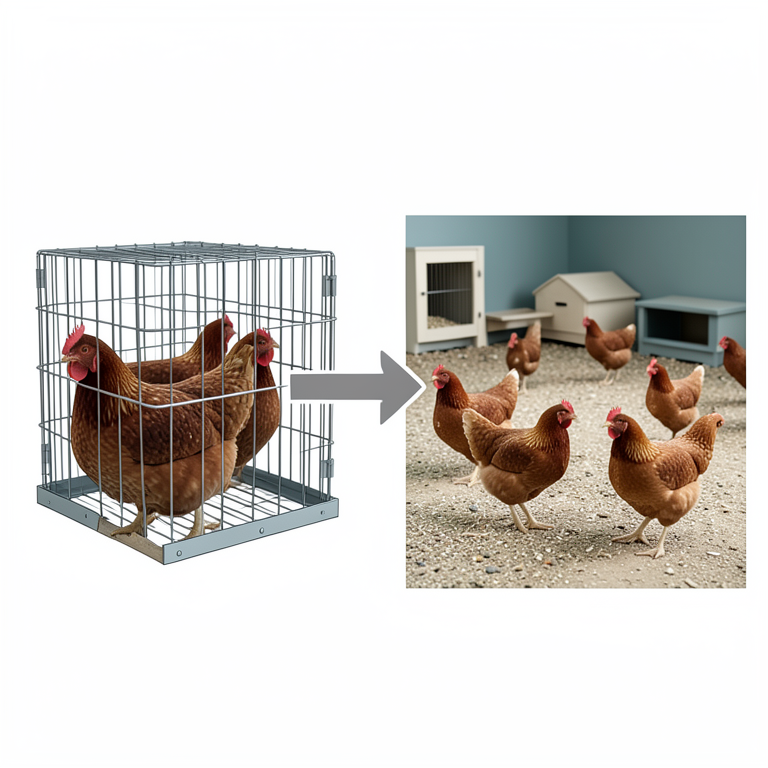
Comparison of Housing Systems
AI-generated conceptual illustration (commercial brown layer hens). It explains the idea and does not show study data.
View source evidence ↗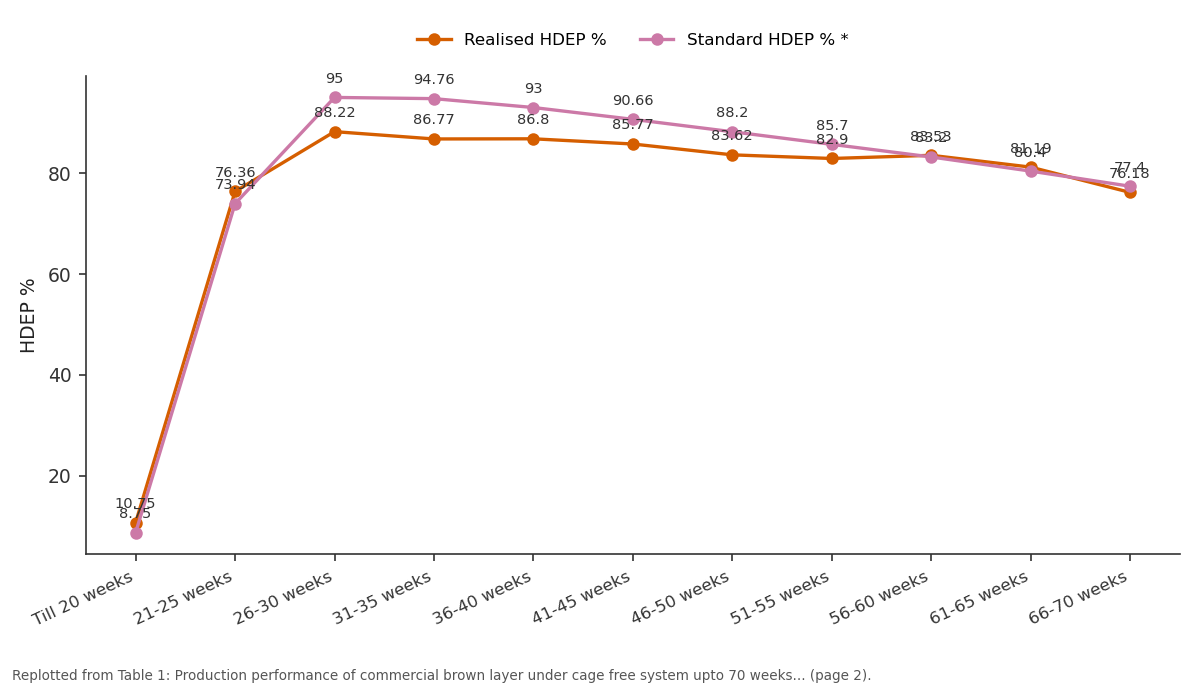
Realised HDEP % and Standard HDEP % *: Till 20 weeks vs 21-25 weeks vs 26-30 weeks vs 31-35 weeks vs 36-40 weeks
Replotted from Table 1 (page 2) of the original paper. Every bar is the paper's own table value.
View source evidence ↗Figures & tables
From the original paper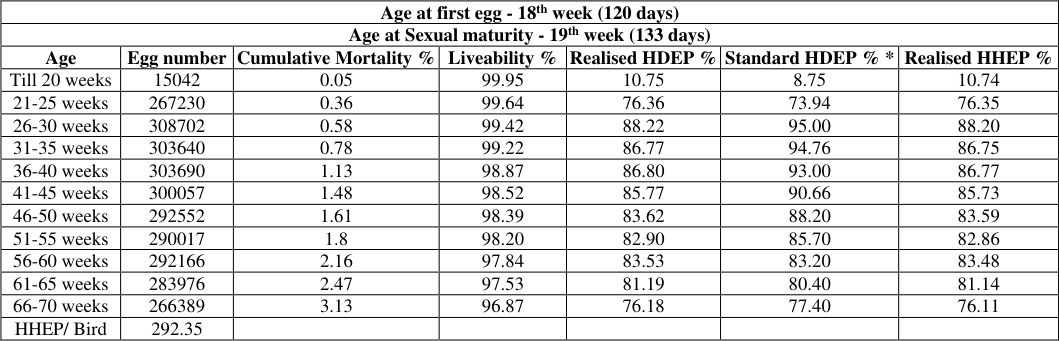 Table 1
Introduction
Egg production in India is highly mechanised wherein egg production is from layers reared under battery cages. Cage rearing of layers offers various advantages such as cost reduction, space reduction, low labour cost and better disease management etc., are the primary reason for mass production of eggs. The battery-type caging system where a massive number of chickens are piled up draws the consumers' reaction; therefore, facilities with furnished cages, deep litter, free-ranging areas, or cage-free rearing systems have become widespread in layer poultry farming (Blatchford 2018) [1] . Currently there has been a shift in the poultry industry from the use of battery cage production systems to the use of cage-free egg production systems globally. Cage-free systems for laying hens can be floor housing systems or aviary systems with multiple tiers. These systems offers better animal welfare, higherquality eggs, and premium market opportunities, it also poses economic, disease management, and consumer affordability challenges. Consumers tend to believe that eggs produced in cage-free systems are of better quality (Vits et al. 2005) [6] . Rodriguez-Hernandez et al., 2024 [4] , reported that the Haugh unit of the eggs of cage-free systems was higher than that of caged systems. In the present study, the production performance of birds under cage free system (in EC house) from start of first lay till 70 weeks of age is analysed and compared with standard production as per commercial standard.
Materials and Methods
The present data was recorded from a flock of 10000 commercial brown shelled egg layers. Day old chicks were procured from commercial supplier and were reared under standard managemental conditions. Standard feeding, lighting and vaccination protocols were adopted stringently without any deviation. Birds were shifted to cage free house (EC House) at 17 th week. Commercial layer feed was offered to the birds as per available standards. The egg production was recorded from start of lay on daily basis up to 70 weeks. Mortality numbers was recorded daily to arrive at overall mortality over the laying period. Hen housed egg production (HHEP) and hen day egg production (HDEP) was recorded using the following formula. HHEP = Average daily number of egg production per day or period /No.of hens housed initially X 100 and HDEP = Total no. of egg produced/Total no.of hens available on the day/periodX100. The recorded data was analysed to arrive at meaningful conclusions.
Results and Discussions
Age at sexual maturity (ASM) is considered an important economic trait in layer business. Age at Sexual maturity in layers is the age at 5% of the flock starts egg production. The present flock reached sexual maturity at 19 th week (133 days) which is on par with the recommended commercial standards (BV380 guide). In cage free systems, mortality percentage is considered an deterrent in comparision with traditional cage rearing where the birds are confined to cages better disease management practices can be easily adopted. In the present flock the cumulative mortality percentage during the laying period was at 3.13% which is much below the commercial standard (Table 1). The weekly production performance as indicated by the egg numbers and HDEP and HHEP are presented in table 1. The overall HHEP till 70 weeks is around 292.35 numbers per hen irrespective of the mortality pattern. The prescribed standard for HHEP by 70 week is 298.5 eggs per hen till 70 th week and 308 numbers by 72 weeks. There is no significant difference between the numbers achieved and prescribed. The reduced egg production in cage free systems maybe due to higher ME utilisation towards physical activities instead of egg production (Meng et al. 2015). Also, in uncaged housing systems, the likelihood of low energy feed materials found in the litter area played a role in reduced egg production (Philippe et al. 2020). Some researchers reported that egg production performance was higher in caged hens than in cage-free systems (Tumova and Ebeid 2003; Voslarova et al. 2006). On the contrary, vice versa was also accurate for free-range compared to caged systems (Yıldırım and Kaya 2017). HDEP and HHEP during the entire study period does no differ significantly indicating low mortality rates and better management practices.
| Age at first egg - 18th week (120 days) | — | — | — | — | — | — |
|---|---|---|---|---|---|---|
| Age at Sexual maturity - 19th week (133 days) | ||||||
| Age | Egg number | Cumulative Mortality % | Liveability % | Realised HDEP % | Standard HDEP % * | Realised HHEP % |
| Till 20 weeks | 15042 | 0.05 | 99.95 | 10.75 | 8.75 | 10.74 |
| 21-25 weeks | 267230 | 0.36 | 99.64 | 76.36 | 73.94 | 76.35 |
| 26-30 weeks | 308702 | 0.58 | 99.42 | 88.22 | 95.00 | 88.20 |
| 31-35 weeks | 303640 | 0.78 | 99.22 | 86.77 | 94.76 | 86.75 |
| 36-40 weeks | 303690 | 1.13 | 98.87 | 86.80 | 93.00 | 86.77 |
| 41-45 weeks | 300057 | 1.48 | 98.52 | 85.77 | 90.66 | 85.73 |
| 46-50 weeks | 292552 | 1.61 | 98.39 | 83.62 | 88.20 | 83.59 |
| 51-55 weeks | 290017 | 1.8 | 98.20 | 82.90 | 85.70 | 82.86 |
| 56-60 weeks | 292166 | 2.16 | 97.84 | 83.53 | 83.20 | 83.48 |
| 61-65 weeks | 283976 | 2.47 | 97.53 | 81.19 | 80.40 | 81.14 |
| 66-70 weeks | 266389 | 3.13 | 96.87 | 76.18 | 77.40 | 76.11 |
| HHEP/ Bird | 292.35 |
Table text extracted from the original PDF; superscript letters are shown inline. The original table image is below.
View original table image
Conclusions
No significant variations were noted between the standard productions in cages to that of Cage free systems in terms of egg production and liveability. Nevertheless, considering the positive impact of cage free system on welfare of the birds and increasing awareness of consumers on products from caged birds, this system offer considerable advantages for the farmers.
References
8 in the original paper- Blatchford RA. Backyard flock production. In: Advances in Poultry Welfare. 2018. p. 339-350. DOI:https://doi.org/10.1016/b978-0-08-1009154.00016-6
- Meng F, Chen D, Li X, Li J, Bao J. Effects of large or small furnished cages on performance, welfare and egg quality of laying hens. Animal Production Science. 2015;55(6):793-798.
- Philippe F, Mahmoudi Y, Cinq-Mars D, et al. Comparison of egg production, quality and composition in three production systems for laying hens. Livestock Science. 2020;232:103917.
- Rodriguez-Hernandez R, Rondon-Barragan IS, OviedoRondon EO. Egg quality, yolk fatty acid profiles from laying hens housed in conventional cage and cage-free production systems in the Andean tropics. Animals. 2024;14(1):168.
- Tumova E, Ebeid T. Effect of housing system on performance and egg quality characteristics in laying hens. Scientia Agriculturae Bohemica. 2003;34:73-80.
- Vits A, Weitzenburger D, Distl O. Comparison of different housing systems for laying hens in respect to economic, health and welfare parameters with special regard to organized cages (Literature Review). DTW Deutsche Tierarztliche Wochenschrift. 2005;112(9):332-342.
- Voslarova E, Hanzalek Z, Vecerek V, Strakova E, Suchy P. Comparison between laying hen performance in the cage system and the deep litter system on a diet free from animal protein. Acta Veterinaria Brno. 2006;75:219-225.
- Yıldırım H, Kaya Ş. Egg production and quality traits of layers kept in free range housing system. Greener Journal of Agricultural Sciences. 2017;7(2):60-64. DOI:https://doi.org/10.15580/gjas.2017.2.032217041