
Research article · 2026 · Full text
International Journal of Horticulture and Food ScienceAssessing the carbon sequestration potential of Cocus nucifera (coconut) in a hortipasture based agroforestry system
Volume 8(8) · Pages 11–14 · DOI: 10.33545/26631067.2026.v8.i8a.826 ↗
Research areasCoconut Research and ApplicationsAgroforestry and silvopastoral systemsForest ecology and management
Abstract
Author-writtenCocus nucifera (Coconut) is a major plantation crop with carbon-capturing potential along with the added benefit of intercropping. The present study was carried out to assess the carbon sequestration capacity of 22 years old Cocus nucifera based hortipasture. The average biomass yield accumulated in 22 years old Cocus nucifera trees ranges from 76.6 kg/tree to the maximum of 122.8 kg/tree. The carbon accumulation is 50 % of its biomass which ranges from 38.31 to the maximum of 61.4 kg/tree. At the present system of coconut farming with better management strategies and with suitable intercropping the coconut plantations can be effectively considered as a potential C sequestration source to mitigate the climate change problems.
Summary
Source-checkedPlain-language reading of the full paper, prepared with AI and checked against the text. Each point links to the authors' own words.
Why it matters
- Human activities like burning fossil fuels and deforestation have significantly increased greenhouse gas emissions. View evidence ↗
- Agroforestry systems in India cover 28.03 million hectares and act as important carbon sinks. View evidence ↗
- Coconut is a major plantation crop supporting 12 million people in India and has the potential to capture carbon when used with intercrops. View evidence ↗
The question
- The study aimed to evaluate the carbon sequestration capacity of 22-year-old coconut trees located in degraded wastelands within a hortipasture system. View evidence ↗
What they did
- The research used 22-year-old Local tall variety Cocus nucifera trees in an existing hortipasture system. View evidence ↗
- Researchers used a non-destructive method to calculate carbon sequestration, measuring individual tree height and girth at chest height. View evidence ↗
- Above Ground Biomass (AGB) was calculated by multiplying tree volume by a standard wood density of 0.6 kg/cm³. View evidence ↗
- Below Ground Biomass (BGB) was estimated using a root-shoot ratio of 0.26, and total carbon was calculated as 50% of the total biomass (AGB + BGB). View evidence ↗
What they found
- Biomass contribution was 86.95% from above ground components and 22.60% from below ground components. View evidence ↗
- The accumulated biomass yield for the 22-year-old trees ranged from a minimum of 76.6 kg/tree to a maximum of 122.8 kg/tree. View evidence ↗
- Carbon accumulation, representing 50% of biomass, ranged from 38.31 kg/tree to a maximum of 61.4 kg/tree. View evidence ↗
What it means
- The authors conclude that coconut plantations, when combined with suitable intercropping and better management, are effective carbon sequestration sources for mitigating climate change. View evidence ↗
- Planting coconut trees is recommended as a durable and cost-effective method to reduce atmospheric carbon dioxide. View evidence ↗
Visual summary
3 visualsIllustrations explain the paper; charts are replotted from the paper's own table values.
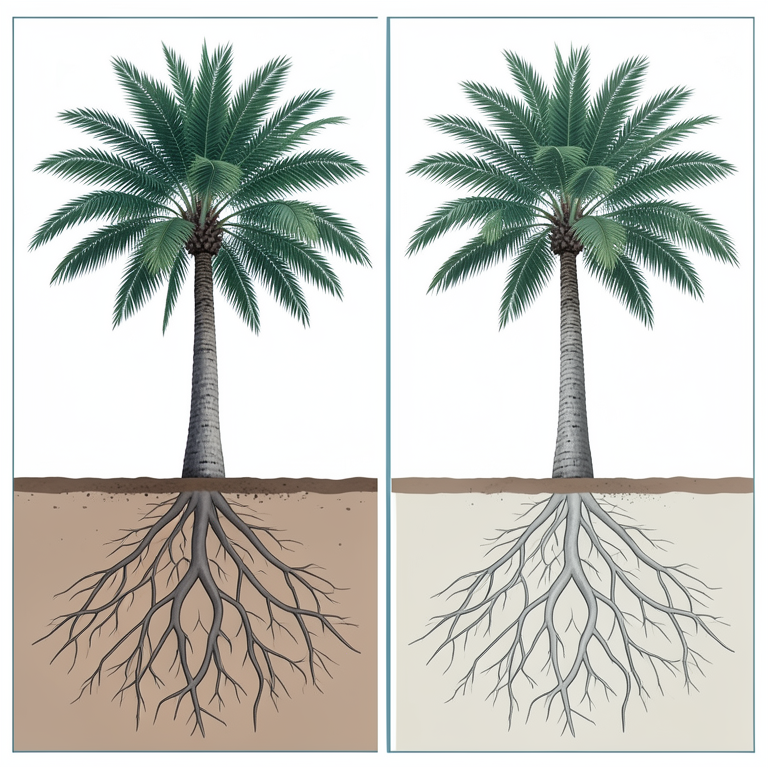
Biomass Distribution Model
AI-generated conceptual illustration (Cocos nucifera (coconut palm tree)). It explains the idea and does not show study data.
View source evidence ↗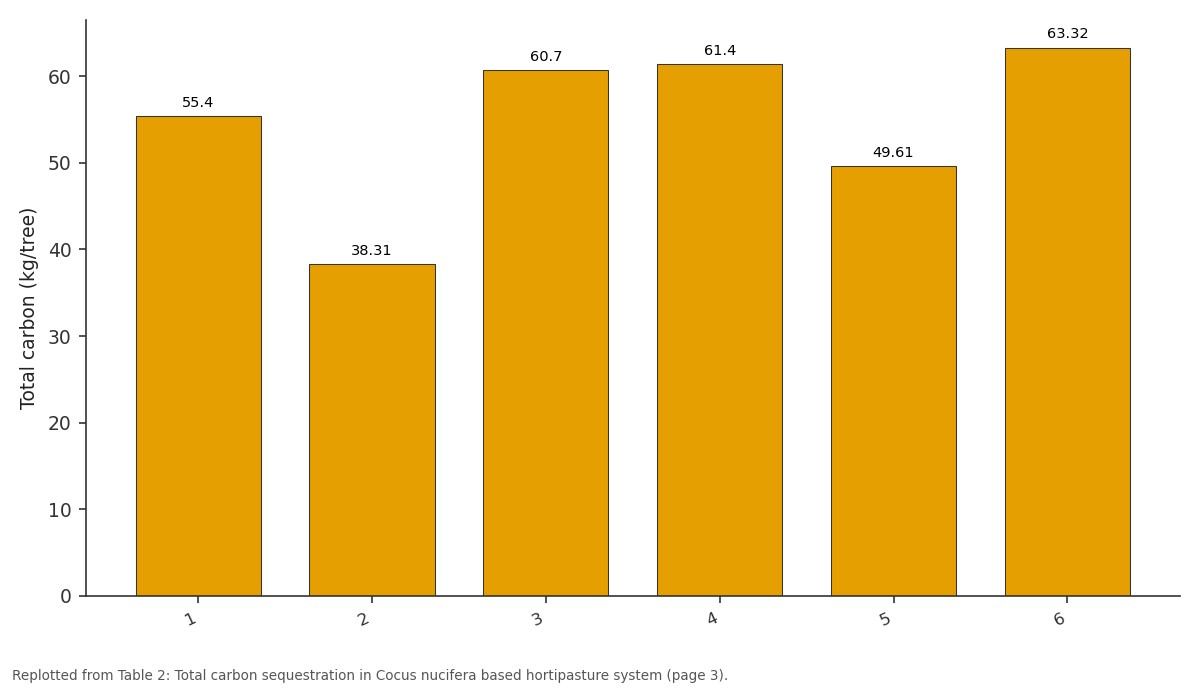
Total carbon (kg/tree): 1 vs 2 vs 3 vs 4 vs 5
Replotted from Table 2 (page 3) of the original paper. Every bar is the paper's own table value.
View source evidence ↗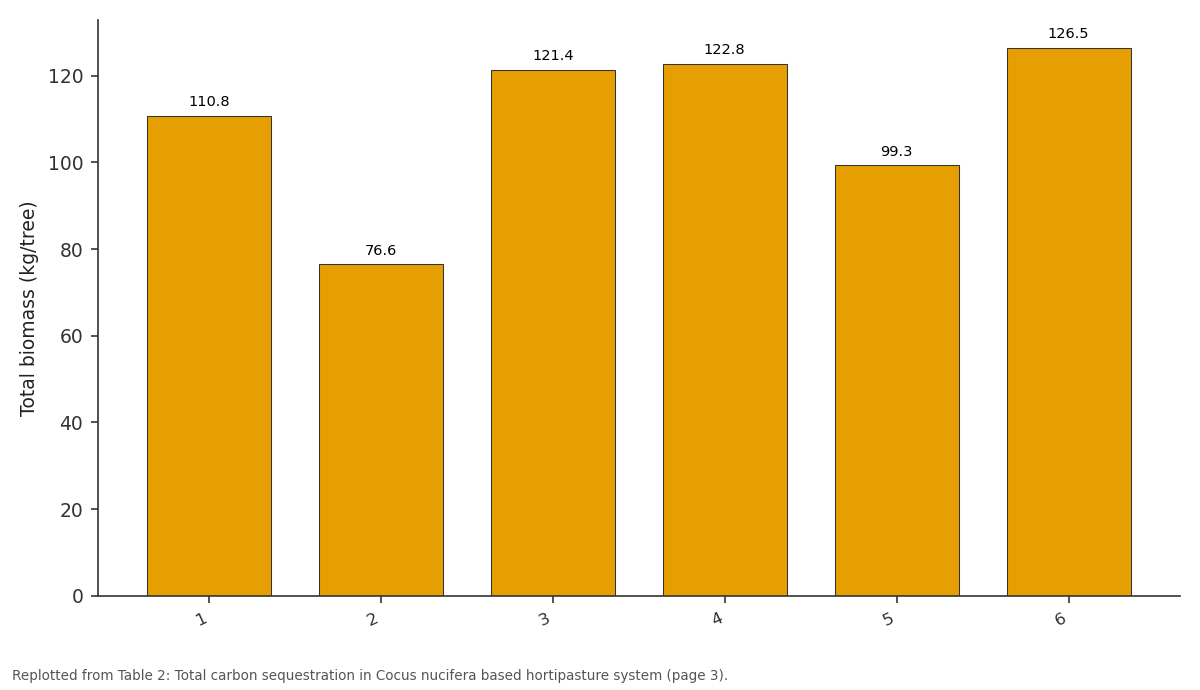
Total biomass (kg/tree): 1 vs 2 vs 3 vs 4 vs 5
Replotted from Table 2 (page 3) of the original paper. Every bar is the paper's own table value.
View source evidence ↗Figures & tables
From the original paper Table 1
 Table 2
Introduction
Human activities, such as burning fossil fuels (coal, oil and gas), cement production and other practices (crop residue burning, deforestation, and excessive fertilizer use) has significantly increased greenhouse gas emissions. Carbon dioxide, nitrous oxide, methane and other greenhouse gases have raised global temperature by 1°C since pre-industrial times, intensifying the greenhouse effect (Davis et.al., 2010) [6] . Carbon management is a global concern to lower the increasing amount of greenhouse gases in the atmosphere especially in forest ecosystem (Ashaq Ahmad Daret.al., 2026, Wani, 2019) [3,20] . One of the main goals of international policy is to restore forest cover and find low-cost carbon trapping methods (Shively et. al., 2004) [13] . In India, agroforestry system cover 28.03 M ha (Ahmad et.al., 2021) [1] , serving as significant carbon sinks. Different species and regions have different capacities for storing carbon in agroforestry (Meragiaw, 2017) [9] . Tree based intercropping system is one of the best options to sink carbon and nourish the people who depends on land for livelihood, by way of integrating food production with environmental services (Soto-Pinto et.al., 2010) [16] . We need to capture carbon through suitable crop substitutes for intensive cropping because intensive cropping system and agroforestry (Montagnini and Nair, 2004) [10] promote sustainable land use. Coconut is one of the main plantation crops dependent on 12 million people across the country that can be used to capture carbon with various intercrops. (Namitha et.al., 2025) [11] Carbon sequestration again depends on environmental, socio-economical and age of the trees. The carbon storage capacity would varies across species and geography also. Further the amount of carbon in any agroforestry system depends on the structural and functional units of different components with in the systems put into practice. In general hortipasture system has the potential to sequester over 70Mg/ha in the top 20 cm of the soil. There is also clear evidence to suggest that, the type of agroforestry system greatly influences the source or sink role of the trees.
Coconut are one such major plantation crop with carboncapturing potential along with the added benefit of intercropping. Coconut varieties differ in their ability for carbon sequestration. The carbon stock was significantly the highest in East Coast Tall (27.32 t ha -1 ) followed by hybrid WCT x GBGD (27.01 t ha -1 ). The lowest carbon stock were observed in coconut hybrid MYD x ECT (Ghavaleet. al., 2020) [7] . This is attributed to the highest plant girth and plant height among the different hybrids and varieties. Therefore, the present study was carried out to assess the carbon sequestration capacity of 22 years old coconut trees under degraded wastelands of hortipasture system.
Materials and Methods
The present study was carried out in the existing hortipasture system where in which 22 years old Cocus nucifera (Local tall variety) trees were maintained. To assess biomass and carbon allocation in the existing twenty two year old coconut in hortipasture system.Individual tree height and girth was measured at chest height. Carbon sequestration was calculated by non-destructive method For the experimental purpose, 22 years old Coconut trees need to be replaced to assess the system effect of hortipasture on the crop components preciously which are understoreyed.
Documentation of biomass and carbon allocation in cocus nucifera
Carbon sequestration takes place in plants when they photosynthesize CO 2 from the atmosphere into biomass, which means that it accumulates in "sinks" rather than being released into the Earth's atmosphere. They can also augment the soil with carbon by adding organic waste, especially dead and rotting root tissue, root exudates, etc. The amount of carbon stored was estimated in coconut trees equals 50 per cent of its dry biomass. Where as to assess the tree carbon sequestration in coconut, nondestructive method was followed.
Step 1 Calculating Above ground biomass (AGB) by the method suggested by Anusha Maitreya et.al.,(2023) [2] Above Ground Biomass (AGB) (kg/tree) = Volume X Wood density. Where standard average value of wood density is 0.6 kg/cm 3 was used to calculate AGB (Anusha Maitreya et.al., 2023) [2] . Volume of the tree is calculated by using the formula as follows V
. Where (V = volume, r 2 = Radius, h = height) in cm 3 Step 2 Calculating Below ground biomass (BGB) suggested by Ravindranath and Ostwald, (2008) [12] Below Ground Biomass (BGB) (kg/tree) = AGB (kg/tree) x 0.26. Further total biomass and total carbon is calculated by the following method. Root shoot ratio is 0.26 Total biomass = AGB+BGB Total carbon = Total biomass x 50% The data were subjected to analysis of variance as a factorial randomized block design using the General Linear Model procedure of SPSS and means were compared forstatistical significance by Duncan's multiple range tests (Snedecor and Cochran, 1994) [15] .
Result and discussion
The biomass and carbon distribution in Above Ground Biomass (AGB) of Cocus nucifera in the twenty two yearold hortipasture system was described in Table 1. Twenty two year-old Cocus nucifera had above ground biomass of 86.95 kg tree -1 and a tree volume was 144.9 kg m -3 . The mean diameter at breast height (DBH) of the twenty two year-old Cocus nucifera was 28.74 cm. From the above parameter, total biomass of the twenty two year-old Cocus nucifera was computed and presented in Table 2. The above ground components of coconut were contributed 86.95% and below ground components were contributed 22.60 % biomass to the total biomass. A total of 13.69 t C ha -1 was stored in the twenty two year-old Cocus nucifera. A total of 86.95% carbon was allocated in the above ground components whereas nearly 22.60 % carbon was allocated in the below ground components of the trees. The absence of data on biomass compartmentation and carbon allocation in various species has made it challenging to evaluate the potential for carbon storage. Only the aboveground biomass potentials of the majority of species utilized but the below-ground biomass pattern is also crucial to understanding the species capacity to store carbon. In addition to sequestering for about 14 tha -1 of carbon, the highly commercial Cocous nucifera tree yields a profit of about 2 lakh per hectare per annum. Since Cocus nucifera below-ground biomass is 22.60%, we should take the tree BGM into account and figure out how to increase carbon storage. Although the AGB by itself was the biggest carbon storage facility, the roots and litter of the tree species are crucial for sequestering carbon in the soil reservoir. AGM carbon must be locked up in post-harvest products for a longer time, depending on its intended use. Similar results were obtained by Singh and Lodhiyal (2009) [14] . Cocus nucifera cropping systems would mimic a forest, thus they play an important role in environment protection by way of fixing the carbon (Bhagya et.al., 2017) [4] . Thomas (2016) [18] suggested that planting certain crops, such as coconuts, can combat the effects of climate change along with carbon sequestration. Maheswarappa (2008) [8] reported that 98.2 t of carbon sequestration in well maintained coconut monoculture. Soil carbon storage is an indicator of the carbon sequestration potential of the soil. Since BGB contributes nearly 22 % of carbon sequestered, soil storage is very much considerate. In the rhizosphere soil of a multi-storeyed cropping system of coconut, organic compounds like amino acid, phenol and total sugar content were significantly higher when compared to mono crop (Bopaiah and Shetty, 1991) [5] . Sudha and George (2011) [17] reported that coconut + pineapple maintained the highest organic carbon content (1.30%) in soil, whereas maize intercropped in coconut maintained only 1.21 per cent soil organic carbon. This helps to choose a better crop combination for higher carbon stock in a coconut plantation.
| S.No | AGB (kg/tree) | Root shoot ratio | BGB (kg/tree) | Total biomass (kg/tree) | Total carbon (kg/tree) |
|---|---|---|---|---|---|
| 1 | 87.90 | 0.26 | 22.85 | 110.8 | 55.40 |
| 2 | 60.77 | 15.80 | 76.60 | 38.31 | |
| 3 | 96.38 | 25.06 | 121.4 | 60.70 | |
| 4 | 97.50 | 25.35 | 122.8 | 61.40 | |
| 5 | 78.78 | 20.48 | 99.30 | 49.61 | |
| 6 | 100.40 | 26.10 | 126.5 | 63.32 |
Table text extracted from the original PDF; superscript letters are shown inline. The original table image is below.
View original table image
| S.No | Height of the tree (m) | — | Diameter of the tree(cm) | Radius of the tree(cm) | Volume (kg/m3) | AGB (kg/tree) |
|---|---|---|---|---|---|---|
| 1 | 18 | 32.20 | 16.10 | 146.5 | 87.90 | |
| 2 | 20 | 25.42 | 12.71 | 101.3 | 60.77 | |
| 3 | 24 | 29.20 | 14.60 | 160.6 | 96.38 | |
| 4 | 23 | 30.00 | 15.00 | 162.5 | 97.50 | |
| 5 | 24 | 26.40 | 13.20 | 131.3 | 78.78 | |
| 6 | 25 | 29.24 | 14.62 | 167.3 | 100.4 | |
| Mean | 86.955 |
Table text extracted from the original PDF; superscript letters are shown inline. The original table image is below.
View original table image
Conclusion
Planting coconut trees is one of the cost effective and durable ways to overcome the current increase in atmospheric carbon dioxide. Due to its high Gross Primary Productivity (GPP) and Net Primary Productivity (NPP), the coconut tree directs majority of its photosynthetic output towards its leaves, fruits, peduncle and fine roots. The average biomass yield accumulated in different trees ranges from 76.6 kg/tree to the maximum of 122.8 kg/tree. The carbon accumulation is 50 % of its biomass which ranges from 38.31 to the maximum of 61.4 kg/tree. Apart from providing the biological yield, it fixes the carbon which helps to safeguard the environment by way of reducing the carbon di oxide gas emission. High carbon content soils are more fertile, leading to increased agricultural productivity and better water retention capacity. Carbon sequestration also play a crucial role in climate mitigation. Hence, at the present system of coconut farming with better management strategies and with suitable intercropping the coconut plantations can be effectively considered as a potential C sequestration source to mitigate the climate change problems.
References
20 in the original paper- Ahmad Md, Uddin M, Goparaju L, Talukdar NR, Rizvi J. Agroforestry environment, potentiality and risk in India: a remote sensing and GIS understanding. Environ Dev Sustain. 2021;23:15183-15203.
- Maitreya A, Maitreya A, Mankad A, Modi N. A review on carbon sequestration (non-destructive method) in urban ecosystem. Int Assoc Biol Comput Dig. 2023;2(1):245-250.
- Dar AA, Khopkar P, Ayesha A, Kanda NB, Rather MY, Gull A, et al. Soil organic carbon partitioning in Himalayan coniferous forests: influence of biotic and abiotic factors. Ecol Front. 2026;46(4):13971410.
- Bhagya HP, Maheswarappa HP, Surekha P, Bhat R. Carbon sequestration potential in coconut-based cropping systems. Indian J Hortic. 2017;74(1):1-5.
- Bopaiah BM, Shetty SH. Microbiology and fertility in coconut based mixed farming and coconut monocropping systems. Trop Agric. 1991;68(2):135-138.
- Davis G, Cobb J. Resource dependence theory: past and future. Res Sociol Organ. 2010;28:21-42.
- Ghavale SL, Shinde VV, Wankhede SM, Maheswarappa HP, Haldankar PM. Carbon sequestration and productivity potential of coconut (Cocos nucifera L.) hybrids and varieties under coastal ecosystem of Maharashtra. Curr J Appl Sci Technol. 2020;39(22):30-37.
- Maheswarappa HP. In-situ waste management in integrated nutrient management system under coconut (Cocos nucifera)-based high density multispecies cropping system in tropical soils of India. Indian J Agric Sci. 2008;78(11):924-928.
- Meragiaw M. Role of agroforestry and plantation on climate change mitigation and carbon sequestration in Ethiopia. J Tree Sci. 2017;36(1):115.
- Montagnini F, Nair PKR. Carbon sequestration: an underexploited environmental benefit of agroforestry systems. Agrofor Syst. 2004;61:281295.
- Namitha VV, Raj SKS, Prathapan K. Carbon sequestration potential in coconut based cropping system: a review. Agric Rev. 2025;46(1):143-146.
- Ravindranath NH, Ostwald M. Methods for estimating above-ground biomass. In: Carbon inventory methods: handbook for greenhouse gas inventory, carbon mitigation and roundwood production projects. Vol. 29. Springer; 2008. p. 113-147.
- Shively GE, Zelek CA, Midmore DJ, Nissen TM. Carbon sequestration in a tropical landscape: an economic model to measure its incremental cost. Agrofor Syst. 2004;60:189-197.
- Singh P, Lodhiyal LS. Biomass and carbon allocation in 8-year-old poplar (Populus deltoides) plantation in Tarai agroforestry systems of Central Himalaya, India. New York Sci J. 2009;2(6):49-53.
- Snedecor GW, Cochran WG. Statistical methods. 8th ed. Calcutta: Oxford and IBH Publishing Company; 1994.
- Soto-Pinto L, Anzueto L, Mendoza J, Ferrer GJ, Jong BD. Carbon sequestration through agroforestry in indigenous communities of Chiapas, Mexico. Agrofor Syst. 2010;78(1):39-51.
- Sudha B, George A. Tillage and residue management for organic carbon sequestration in coconut (Cocos nucifera) based cropping systems. Indian J Agron. 2011;56(3):223-227.
- Thomas GV. Coconut palm sequester carbon dioxide, says scientist. The Hindu. 2016 Jul 29.
- Thomas S. Productivity of coconut based multitier cropping system in relation to fertility status of the soil [MSc (Ag) thesis]. Hyderabad: Acharya NG Ranga Agricultural University; 2003. 127 p.
- Wani NR. Mitigation potential of carbon sequestration through forestry activities: an overview. J Am Sci. 2019;15(4):97-101.