
Research article · 2026 · Full text
International Journal of Agriculture and NutritionEffect of different food- forage based cropping system on Soil Properties and Nutrient uptake influenced by different food -forage based cropping system
Volume 8(7) · Pages 152–157 · DOI: 10.33545/26646064.2026.v8.i7b.727 ↗
Research areasAgronomic Practices and Intercropping SystemsAgricultural Science and FertilizationSoil Management and Crop Yield
Abstract
Author-writtenThe present study, entitled “Production Potential and Economic Viability of Food-Forage-Based Cropping Sequences under Irrigated Conditions of Jabalpur, Madhya Pradesh,” was conducted under the All India Coordinated Research Project on Forage Crops at Jawaharlal Nehru Krishi Vishwa Vidyalaya, Jabalpur, and Madhya Pradesh. Ten food-forage-based cropping sequences were evaluated in a randomized block design with three replications. The cropping sequence comprising maize (green cob) + ricebean-berseem-maize (fodder) + ricebean recorded the highest total nitrogen uptake of 642.1 q/ha. The maximum total phosphorus uptake of 103.4 q/ha was observed under maize (baby corn) + ricebean-oat-maize (fodder) + ricebean, whereas the minimum uptake was recorded under the hybrid Napier-based cropping sequence. The existing rice-berseem-moong cropping sequence registered a total phosphorus uptake of 61.2 q/ha. Potassium uptake was highest under maize (baby corn) + ricebean- oat-maize (baby corn) + ricebean, with a value of 757.0 q/ha, while the lowest uptake of 435.9 q/ha was recorded under hybrid Napier + ricebean-hybrid Napier + berseem-hybrid Napier + ricebean. Changes in soil properties after the completion of two cropping cycles indicated that the evaluated cropping sequences were generally effective in maintaining soil fertility. However, the continuous cultivation of hybrid Napier showed signs of soil organic carbon depletion after two rotational cycles. The improvement in soil fertility under the remaining cropping sequences could primarily be attributed to the inclusion of leguminous crops.
Summary
Source-checkedPlain-language reading of the full paper, prepared with AI and checked against the text. Each point links to the authors' own words.
Why it matters
- Forage-based cropping systems are considered potentially as profitable as, or more profitable than, traditional cropping systems in the studied region. View evidence ↗
- Cultivating forage crops can support the livelihoods of farmers by increasing the productivity of livestock. View evidence ↗
- Diversifying and intensifying food-forage production can improve farming profitability, meet household needs, and enhance soil health. View evidence ↗
The question
- The study aimed to evaluate the production potential and economic viability of various food-forage-based cropping sequences under irrigated conditions in Jabalpur, Madhya Pradesh. View evidence ↗
What they did
- The researchers evaluated ten different food-forage-based cropping sequences using a randomized block design with three replications. View evidence ↗
- The field experiments took place at the Adhartal Research Farm in Jabalpur, Madhya Pradesh, during the 2010-2011 and 2011-2012 periods. View evidence ↗
- The study used sandy clay loam soil with a pH of 7.60, 0.6% organic carbon, and an electrical conductivity of 0.49 dS/m. View evidence ↗
- Nutrient analysis was performed using the Nessler’s reagent colorimetric method for nitrogen, the ammonium vanadomolybdophosphoric acid yellow-colour method for phosphorus, and the flame photometer method for potassium. View evidence ↗
What they found
- The highest total nitrogen uptake was 642.10 q/ha/year, achieved by the sequence of maize (green cob) + ricebean-berseem-maize (fodder) + ricebean (T8). View evidence ↗
- The lowest total nitrogen uptake was 386.37 q/ha/year, recorded for the rice-berseem-moong sequence (T10). View evidence ↗
- The maximum total phosphorus uptake was 103.49 q/ha/year, observed in the maize (baby corn) + ricebean-oat-maize (fodder) + ricebean sequence (T5). View evidence ↗
- The lowest total phosphorus uptake was 57.95 q/ha/year, recorded for the hybrid Napier-based sequence (T1). View evidence ↗
- The highest total potassium uptake was 757.08 q/ha/year, recorded for the maize (baby corn) + ricebean-oat-maize (fodder) + ricebean sequence (T5). View evidence ↗
- The lowest total potassium uptake was 435.99 q/ha/year, recorded for the hybrid Napier-based sequence (T1). View evidence ↗
- Continuous cultivation of hybrid Napier led to signs of soil organic carbon depletion after two rotational cycles. View evidence ↗
- The maize (baby corn) + ricebean-berseem-maize (baby corn) + ricebean sequence resulted in 0.64% organic carbon and available N, P, and K levels of 250.3, 16.8, and 410.8 kg/ha. View evidence ↗
What it means
- The authors conclude that the improvement in soil fertility across most cropping sequences was primarily due to the inclusion of leguminous crops. View evidence ↗
- The authors state that all ten evaluated cropping sequences were capable of maintaining soil fertility without causing substantial deterioration over two cycles. View evidence ↗
Visual summary
2 visualsIllustrations explain the paper; charts are replotted from the paper's own table values.
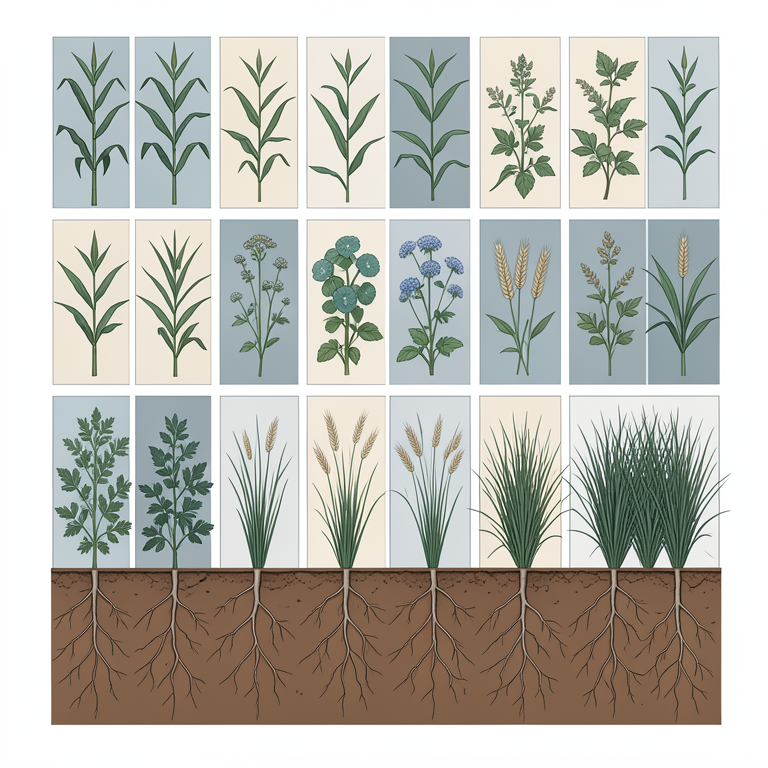
Experimental Layout Concept
AI-generated conceptual illustration (Agricultural field with maize, ricebean, berseem, oat, and hybrid Napier grass). It explains the idea and does not show study data.
View source evidence ↗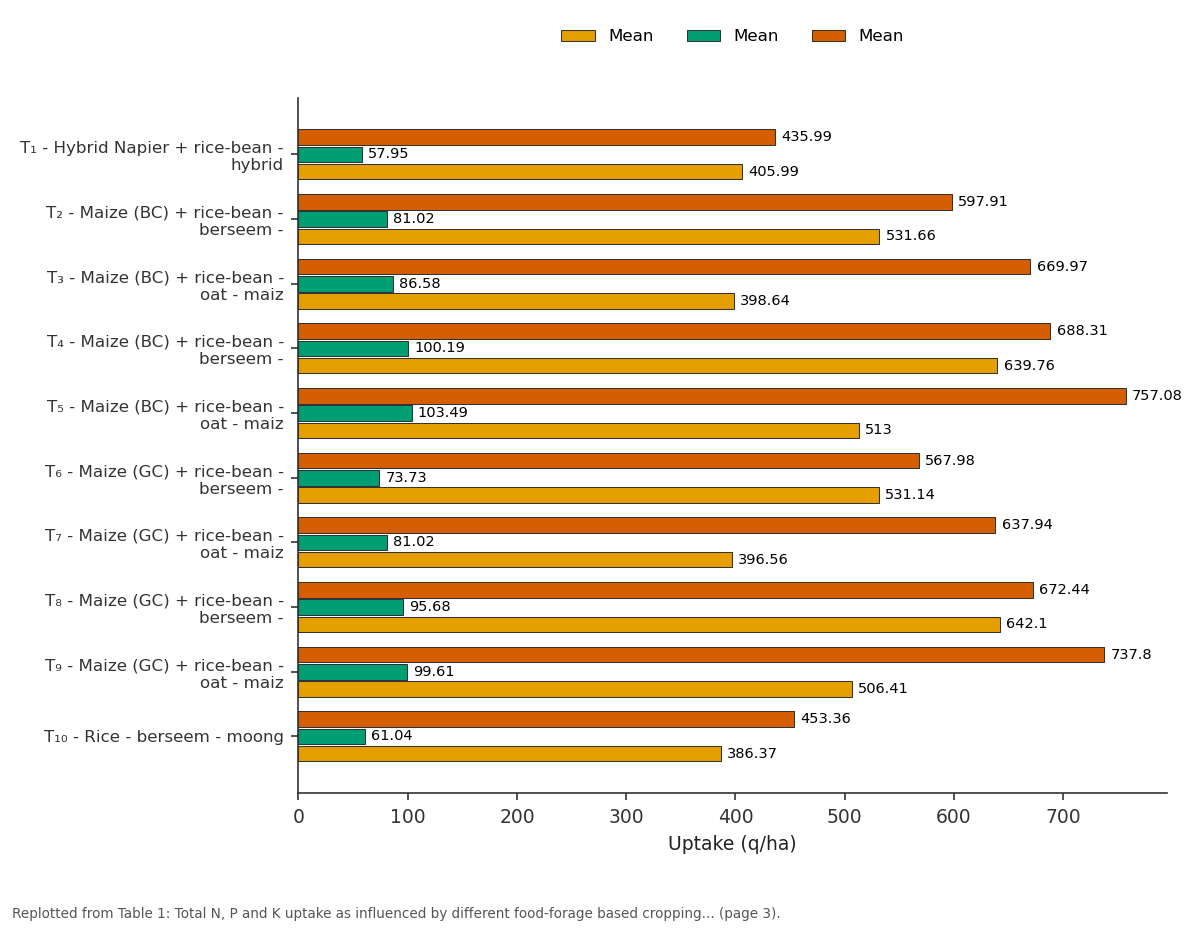
Mean and Mean and more: T₁ - Hybrid Napier +... vs T₂ - Maize (BC) +... vs T₃ - Maize (BC) +... vs T₄ - Maize (BC) +... vs T₅ - Maize (BC) +...
Replotted from Table 1 (page 3) of the original paper. Every bar is the paper's own table value.
View source evidence ↗Figures & tables
From the original paper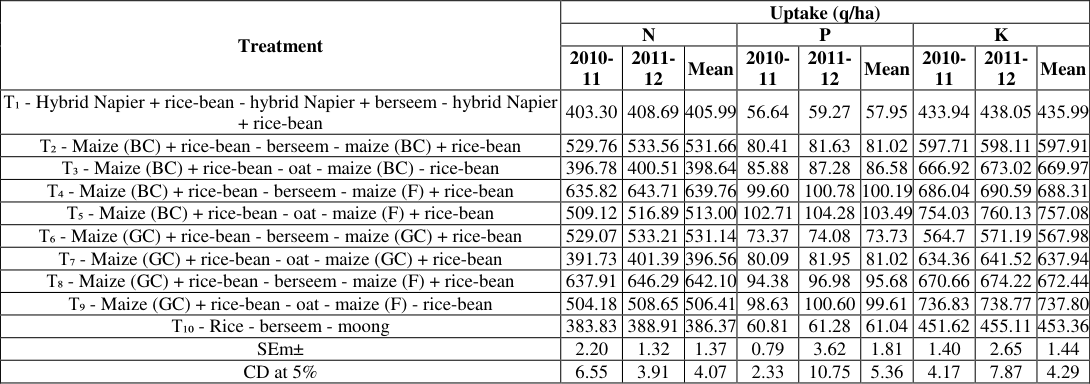 Table 1
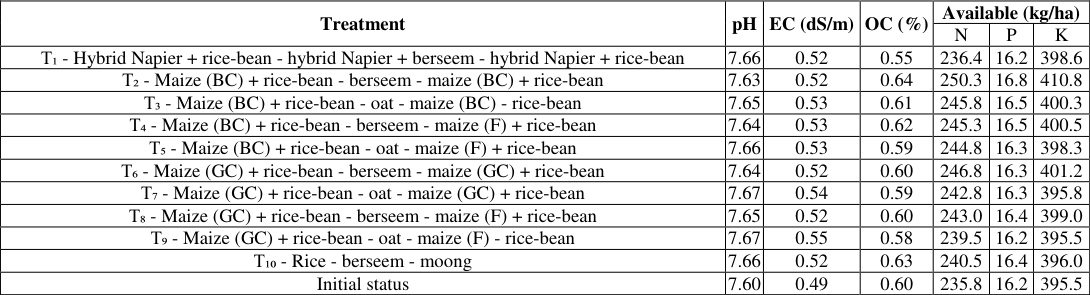 Table 2
Introduction
Forage-based cropping systems may be equally or even more profitable than the commonly followed cropping systems of the region. Forage crops have considerable potential in contingency planning because they can be grown as short-duration catch crops, intercrops, or alley crops under different resource-use conditions. Their cultivation can support farmers' livelihoods by improving livestock productivity. Considering the increasing demand for livestock products, production strategies should focus on promoting forage-based cropping systems. Forages may also be included as sole crops, mixed crops, or intercrops within existing cropping systems to reduce the gap between forage demand and supply in accordance with prevailing agro-economic and environmental conditions (Raghuvanshi et al. 2023b; Dubey et al. 2022b; Upadhyay et al. 2011) [1, 2, 3] . Food-forage-based production systems can support small and marginal farmers by enabling them to allocate a proportion of their agricultural land specifically to forage production within grain-based crop rotations. Forage crops should therefore be incorporated into existing food-based cropping systems through crop intensification in space, such as intercropping, in time, such as sequential cropping, or through a combination of both approaches. Such diversification and intensification can satisfy farmers' household requirements, improve their economic returns, enhance the profitability of farming, and contribute to better soil health.
Materials and Methods
Field experiments were conducted during 2010-2011 and 2011-2012 at the Adhartal Research Farm of Jawaharlal Nehru Krishi Vishwa Vidyalaya, Jabalpur, Madhya Pradesh. The investigation was undertaken under the All India Coordinated Research Project on Forage Crops.
The experiment was initiated during the kharif season of 2010-2011 and continued for two consecutive years at the same location without altering the treatment structure or experimental layout. An already established hybrid Napier crop was used under treatment T1. The experimental soil was sandy clay loam in texture and slightly alkaline in reaction, with a pH of 7.60. It contained a low level of organic carbon at 0.6% and had a normal electrical conductivity of 0.49 dS/m. The soil was low in available nitrogen at 235.8 kg/ha and medium in available phosphorus and potassium at 16.2 and 395.5 kg/ha, respectively. The experiment comprised ten food-forage cropping sequences, which were evaluated in a randomized block design with three replications. The treatment details were as follows: • T1: Hybrid Napier + ricebean-hybrid Napier + berseem-hybrid Napier + ricebean. An established hybrid Napier crop was used.
• T2: Maize (baby corn) + ricebean-berseem-maize (baby corn) + ricebean. • T3: Maize (baby corn) + ricebean-oat-maize (baby corn) + ricebean.
• T4: Maize (baby corn) + ricebean-berseem-maize (fodder) + ricebean.
• T5: Maize (baby corn) + ricebean-oat-maize (fodder) + ricebean.
• T6: Maize (green cob) + ricebean-berseem-maize (greenCob) + ricebean. • T7: Maize (green cob) + ricebean-oat-maize (green cob) + ricebean.
• T8: Maize (green cob) + ricebean-berseem-maize (fodder) + ricebean.
• T9: Maize (green cob) + ricebean-oat-maize (fodder) + ricebean.
• T10: Rice-berseem-moong. The crop varieties used in the experiment were JM-216 for baby corn, Priya Sweet Corn for green cob maize, African Tall for fodder maize, JRBJ-05-2 for ricebean, NB-1 for hybrid Napier, JB-1 for berseem, and JO-1 for oat. Recommended fertilizer doses were applied separately to each crop. The calculated quantities of fertilizers were supplied to the respective experimental plots according to the treatments. Nitrogen, phosphorus, and potassium were applied through urea, single superphosphate, and muriate of potash, respectively. In hybrid Napier, the complete doses of phosphorus and potassium were applied as basal fertilizers during the kharif season. Nitrogen was applied in five equal splits, with one split supplied after each cutting. In rice and maize grown during the kharif and summer seasons, the entire quantities of phosphorus and potassium and onethird of the nitrogen were applied at sowing. The remaining nitrogen was top-dressed in two equal splits at 25 and 45 days after sowing. Standing water and weeds were avoided in the crop plots during nitrogen top-dressing. In summer green gram, the entire quantities of nitrogen, phosphorus, and potassium were applied in rows approximately 2 cm below the seeds at the time of sowing. As berseem was sown through broadcasting, all fertilizers were also broadcast immediately before sowing and thoroughly incorporated into the soil. In oat, half of the nitrogen and the entire doses of phosphorus and potassium were applied as basal fertilizers. The remaining half of the nitrogen was applied immediately after the first green-forage cutting to encourage rapid crop regrowth. Seed and plant samples, excluding roots, were collected at the harvest of each crop component during both years. The collected samples were oven-dried until a constant weight was obtained and subsequently ground into a fine powder using a mortar and pestle. The nitrogen content of the samples was estimated using the Nessler's reagent colorimetric method described by Linder (1944). Phosphorus was determined through the ammonium vanadomolybdophosphoric acid yellow-colour method described by Jackson (1973) [4] , whereas potassium was analysed using the flame photometer method reported by Khanna et al. (1971). The nitrogen, phosphorus, and potassium contents of grain and straw samples were recorded separately for each treatment. Nutrient uptake was subsequently calculated using the corresponding grain and straw yields. Total nutrient uptake under each treatment was obtained by adding the nutrient uptake values of all component crops. The total uptake of nitrogen, phosphorus, and potassium by the complete cropping system was then calculated to compare the effects of the different treatments.
Results and Discussion
Results and Discussion
Effect of Cropping Sequences on Nutrient Uptake
The pooled data on total nitrogen, phosphorus, and potassium uptake under the different food-forage-based cropping sequences are presented in Table 1.
| Treatment | Uptake (q/ha) | — | — | — | — | — | — | — | — |
|---|---|---|---|---|---|---|---|---|---|
| N | P | K | |||||||
| 2010- 11 | 2011- 12 | Mean | 2010- 11 | 2011- 12 | Mean | 2010- 11 | 2011- 12 | Mean | |
| T₁ - Hybrid Napier + rice-bean - hybrid Napier + berseem - hybrid Napier + rice-bean | 403.30 | 408.69 | 405.99 | 56.64 | 59.27 | 57.95 | 433.94 | 438.05 | 435.99 |
| T₂ - Maize (BC) + rice-bean - berseem - maize (BC) + rice-bean | 529.76 | 533.56 | 531.66 | 80.41 | 81.63 | 81.02 | 597.71 | 598.11 | 597.91 |
| T₃ - Maize (BC) + rice-bean - oat - maize (BC) - rice-bean | 396.78 | 400.51 | 398.64 | 85.88 | 87.28 | 86.58 | 666.92 | 673.02 | 669.97 |
| T₄ - Maize (BC) + rice-bean - berseem - maize (F) + rice-bean | 635.82 | 643.71 | 639.76 | 99.60 | 100.78 | 100.19 | 686.04 | 690.59 | 688.31 |
| T₅ - Maize (BC) + rice-bean - oat - maize (F) + rice-bean | 509.12 | 516.89 | 513.00 | 102.71 | 104.28 | 103.49 | 754.03 | 760.13 | 757.08 |
| T₆ - Maize (GC) + rice-bean - berseem - maize (GC) + rice-bean | 529.07 | 533.21 | 531.14 | 73.37 | 74.08 | 73.73 | 564.7 | 571.19 | 567.98 |
| T₇ - Maize (GC) + rice-bean - oat - maize (GC) + rice-bean | 391.73 | 401.39 | 396.56 | 80.09 | 81.95 | 81.02 | 634.36 | 641.52 | 637.94 |
| T₈ - Maize (GC) + rice-bean - berseem - maize (F) + rice-bean | 637.91 | 646.29 | 642.10 | 94.38 | 96.98 | 95.68 | 670.66 | 674.22 | 672.44 |
| T₉ - Maize (GC) + rice-bean - oat - maize (F) - rice-bean | 504.18 | 508.65 | 506.41 | 98.63 | 100.60 | 99.61 | 736.83 | 738.77 | 737.80 |
| T₁₀ - Rice - berseem - moong | 383.83 | 388.91 | 386.37 | 60.81 | 61.28 | 61.04 | 451.62 | 455.11 | 453.36 |
| SEm± | 2.20 | 1.32 | 1.37 | 0.79 | 3.62 | 1.81 | 1.40 | 2.65 | 1.44 |
| CD at 5% | 6.55 | 3.91 | 4.07 | 2.33 | 10.75 | 5.36 | 4.17 | 7.87 | 4.29 |
Table text extracted from the original PDF; superscript letters are shown inline. The original table image is below.
View original table image
Total Nitrogen Uptake
The results demonstrated that total nitrogen uptake differed significantly among the evaluated cropping sequences. Treatment T10, consisting of rice-berseem-moong, recorded the lowest total nitrogen uptake of 386.37 q/ha/year. However, it remained statistically comparable with T1, hybrid Napier + ricebean-hybrid Napier + berseem-hybrid Napier + ricebean, which recorded 405.99 q/ha/year; T3, maize (baby corn) + ricebean-oat-maize (baby corn) + ricebean, which recorded 398.64 q/ha/year; and T7, maize (green cob) + ricebean-oatmaize (green cob) + ricebean, which recorded 396.56 q/ha/year. The highest nitrogen uptake of 642.10 q/ha/year was recorded under T8, maize (green cob) + ricebean-berseem-maize (fodder) + ricebean. It was closely followed by T4, maize (baby corn) + ricebean-berseem-maize (fodder) + ricebean, which recorded 639.76 q/ha/year. These findings are consistent with the observations reported by Tiwari et al. (2013) [5] , Tomar et al. (2023a) [6] , Bhalse et al. (2024) [7] , Chauhan et al. (2017) [8] , Dubey et al. (2022a) [2] , and Kumhar et al. (2025) [9] . No significant differences in nitrogen uptake were observed among T2, maize (baby corn) + ricebean-berseem-maize (baby corn) + ricebean; T5, maize (baby corn) + ricebean-oat-maize (fodder) + ricebean; and T9, maize (green cob) + ricebean-oatmaize (fodder) + ricebean. These treatments recorded nitrogen uptake values of 531.66, 513.00, and 506.41 q/ha/year, respectively. Comparable findings have also been reported by Verma et al. (2016b) [10] , Verma et al. (2024) [11] , Yadav et al. (2023) [12] , and Yadav et al. (2024) [13] .
Total Phosphorus Uptake
With regard to total phosphorus uptake, T1, comprising hybrid Napier + ricebean-hybrid Napier + berseem-hybrid Napier + ricebean, recorded the lowest value of 57.95 q/ha/year. However, this treatment was statistically comparable with T10, rice-berseem-moong, which registered a phosphorus uptake of 61.04 q/ha/year. The highest phosphorus uptake of 103.49 q/ha/year was recorded under T5, maize (baby corn) + ricebeanoat-maize (fodder) + ricebean. This treatment was superior to all other treatments except T4, maize (baby corn) + ricebeanberseem-maize (fodder) + ricebean, which recorded a total phosphorus uptake of 100.78 q/ha/year. Similar results have been reported by Singh et al. (2013a) [14] , Singh et al. (2013b) [15] , Nirala et al. (2022) [16] , Tomar et al. (2023b) [17] , and Tiwari et al. (2011) [18] . The phosphorus uptake recorded under T2, maize (baby corn) + ricebean-berseem-maize (baby corn) + ricebean; T3, maize (baby corn) + ricebean-oat-maize (baby corn) + ricebean; and T7, maize (green cob) + ricebean-oatmaize (green cob) + ricebean, did not differ significantly. These treatments recorded total phosphorus uptake values of 81.02, 86.58, and 81.02 q/ha/year, respectively. A similar trend was observed between T8, maize (green cob) + ricebean-berseem-maize (fodder) + ricebean, and T9, maize (green cob) + ricebean-oat-maize (fodder) + ricebean, which recorded phosphorus uptake values of 95.68 and 99.61 q/ha/year, respectively. In contrast, T6, maize (green cob) + ricebean-berseem-maize (green cob) + ricebean, recorded a comparatively lower phosphorus uptake of 73.73 q/ha/year. These observations are supported by the findings of Patel et al. (2023) [19] , Sahu et al. (2023) [20] , Raghuwanshi et al. (2023) [21] , Shri et al. (2015) [22] , Shrivastava et al. (2014) [23] , and Verma et al. (2016a) [24] .
Total Potassium Uptake Potassium uptake was considerably higher than nitrogen and phosphorus uptake under all the evaluated cropping sequences. The lowest total potassium uptake of 435.99 q/ha/year was recorded under T1, hybrid Napier + ricebean-hybrid Napier + berseem-hybrid Napier + ricebean. It was followed by T10, rice-berseem-moong, which recorded 453.36 q/ha/year. The highest potassium uptake of 757.08 q/ha/year was recorded under T5, maize (baby corn) + ricebean-oat-maize (fodder) + ricebean. Similar findings were reported by Tiwari et al. (2013) [5] , Singh et al. (2013) [15,14] , Bhalse et al. (2023) [1] , Bhayal et al. (2022) [25] , Jha et al. (2022) [26] , Jha et al. (2020) [27] , and Tiwari et al. (2011b) [18,28] . Treatment T5 recorded significantly greater potassium uptake than all the other treatments except T9, maize (green cob) + ricebean-oat-maize (fodder) + ricebean, which registered 737.80 q/ha/year. Treatments T3, maize (baby corn) + ricebean-oat-maize (baby corn) + ricebean; T4, maize (baby corn) + ricebean-berseemmaize (fodder) + ricebean; T7, maize (green cob) + ricebeanoat-maize (green cob) + ricebean; and T8, maize (green cob) + ricebean-berseem-maize (fodder) + ricebean, recorded comparatively similar potassium uptake values of 669.97, 688.31, 637.94, and 672.44 q/ha/year, respectively. Treatments T2, maize (baby corn) + ricebean-berseem-maize (baby corn) + ricebean, and T6, maize (green cob) + ricebeanberseem-maize (green cob) + ricebean, recorded total potassium uptake values of 597.91 and 567.98 q/ha/year, respectively. Both treatments performed better than the existing riceberseem-moong cropping sequence. Comparable results have been documented by Kumbhare et al. (2023b) [29] , Pahade et al. (2023) [30] , and Sairam et al. (2023) [31] . [32,33,34,35,18,6] . The improvement in soil fertility may be attributed to the inclusion of leguminous crops in all the evaluated cropping sequences. Similar findings were reported by Jha et al. (2011) [36] , Jha et al. (2023) [1] , Kumar et al. (2023) [37] , and Kumbhare et al. (2023a) [38] . The available phosphorus content increased marginally compared with the initial soil status under all cropping sequences. Only slight changes were observed in the available potassium content. In food-forage-based cropping sequences that included berseem, soil fertility parameters showed a modest improvement over their initial levels.
Figures and tables from the paper
| Treatment | pH | EC (dS/m) | OC (%) | Available (kg/ha) | — | — |
|---|---|---|---|---|---|---|
| N | P | K | ||||
| T₁ - Hybrid Napier + rice-bean - hybrid Napier + berseem - hybrid Napier + rice-bean | 7.66 | 0.52 | 0.55 | 236.4 | 16.2 | 398.6 |
| T₂ - Maize (BC) + rice-bean - berseem - maize (BC) + rice-bean | 7.63 | 0.52 | 0.64 | 250.3 | 16.8 | 410.8 |
| T₃ - Maize (BC) + rice-bean - oat - maize (BC) - rice-bean | 7.65 | 0.53 | 0.61 | 245.8 | 16.5 | 400.3 |
| T₄ - Maize (BC) + rice-bean - berseem - maize (F) + rice-bean | 7.64 | 0.53 | 0.62 | 245.3 | 16.5 | 400.5 |
| T₅ - Maize (BC) + rice-bean - oat - maize (F) + rice-bean | 7.66 | 0.53 | 0.59 | 244.8 | 16.3 | 398.3 |
| T₆ - Maize (GC) + rice-bean - berseem - maize (GC) + rice-bean | 7.64 | 0.52 | 0.60 | 246.8 | 16.3 | 401.2 |
| T₇ - Maize (GC) + rice-bean - oat - maize (GC) + rice-bean | 7.67 | 0.54 | 0.59 | 242.8 | 16.3 | 395.8 |
| T₈ - Maize (GC) + rice-bean - berseem - maize (F) + rice-bean | 7.65 | 0.52 | 0.60 | 243.0 | 16.4 | 399.0 |
| T₉ - Maize (GC) + rice-bean - oat - maize (F) - rice-bean | 7.67 | 0.55 | 0.58 | 239.5 | 16.2 | 395.5 |
| T₁₀ - Rice - berseem - moong | 7.66 | 0.52 | 0.63 | 240.5 | 16.4 | 396.0 |
| Initial status | 7.60 | 0.49 | 0.60 | 235.8 | 16.2 | 395.5 |
Table text extracted from the original PDF; superscript letters are shown inline. The original table image is below.
View original table image
References
64 in the original paper- Bhalse Lakhan, Jha AK, Verma Badal, Raghuvanshi S, Porwal Muskan, Sahu MP. Efficacy of pyroxasulfone and its combination against weeds in wheat (Triticum aestivum). Indian Journal of Agronomy. 2023;68(4):443446.
- Dubey Jitendra Kumar, Kushwaha HS, Jha Amit Kumar. Growth and biomass productivity of maize as influenced by maize cultivars and maize based cropping system. The Pharma Innovation Journal. 2022;11(7):749-751.
- Jha AK, Kewat ML, Upadhyay VB, Vishwakarma SK. Effect of tillage and sowing management on productivity, economics and energetics of rice-wheat cropping system for Kamore Plataue and Satpura hill zone of Madhya Pradesh. Indian Journal of Agronomy. 2011;56(1):35-50.
- Jackson RD. Diurnal Changes in Soil Water Content During Drying. SSSA Special Publications Field Soil Water Regime. 1973:3755.https://doi.org/10.2136/sssaspecpub5.c3
- Tiwari RK, Jha A, Tripathi SK, Khan IM, Rao SK. Rice based cropping system and climate change. JNKVV Res Journal. 2013;47(1):239-247.
- Tomar DS, Jha AK, Porwal M, Verma B, Tirkey S, Khare Y, et al. Efficacy of Halauxifen-methyl+ Florasulam against Complex Weeds in Wheat under Kymore Plateau and Satpura Hill Zone of Madhya Pradesh, India. International Journal of Plant & Soil Science. 2023;35(15):161-171.
- Bhalse L, Jha AK, Verma B, Dubey A, Surendra. Efficacy of Pyroxasulfone against Weeds and their Impact on Yield and Economic Analysis of Wheat. International Journal of Economic Plants. 2024;11(4):405411.https://doi.org/10.23910/2/2024.5639b
- Chauhan A, Jha G, Chourasiya A, Jha A, Joshi J. Effect of tillage and weed management practices and growth productivity and energy analysis of late sown chickpea. International Journal of Agriculture Sciences. 2017;9(5):3779-3781.
- Kumhar GL, Dadheech A, Sharma H, Dubay RB. Heterosis Analysis in Single cross Maize (Zea mays L.) Hybrids. Ecology, Environment and Conservation. 2025;31(April Suppl. Issue):149153.https://doi.org/10.53550/eec.2025.v31i03s.026
- Verma B, Jha AK, Ramakrishnan RS, Singh N, Dubey R, Patel R, et al. Assessment of foliar-applied stress regulators to sustain the growth and yield of wheat varieties under various irrigation levels. Plant Science Today. 2024.
- Yadav PS, Kewat ML, Jha AK, Hemalatha K, Verma B. Effect of sowing management and herbicides on the weed dynamics of berseem (Trifolium alexandrinum). The Pharma Innovation Journal. 2023;12(2):2845-2848.
- Yadav PS, Jha AK, Kewat ML, Sahu MP, Verma B. Effect of sowing management and herbicides application on weeds and yield of berseem (Trifolium alexandrinum). Indian Journal of Agronomy. 2024;69(1):71-77.
- Singh H, Jha G, Rawat A, Babu S, Jha AK. Low seed rate at surface sowing enhance resilience of physiological parameters and economics of wheat Indian Journal of Agricultural Sciences. 2013;83(8):881-4.
- Singh H, Jha G, Babu S, Jha AK. Effect of seed rate and sowing depth on growth, yield attributes and yield of irrigated wheat (Triticum aestivaum) in Madhya Pradesh. Indian Journal of Agronomy. 2013;58(2):57-59.
- Nirala T, Jha AK, Verma B, Yadav PS, Anjna M, Bhalse L. Bio efficacy of pinoxaden on weed flora and yield of wheat (Triticum aestivum L.). Biological Forum -An International Journal. 2022;14(4):558-561.
- Tomar DS, Jha AK, Verma B, Meshram RK, Porwal M, Chouhan M, et al. Comparative Efficacy of Different Herbicidal Combinations on Weed Growth and Yield Attributes of Wheat. International Journal of Environment and Climate Change. 2023;13(8):889-898.
- Tiwari RK, Dwived BS, Deshmukh G, Pandey AK, Jha A. Effect of weed control treatments on growth of little seed cannary grass and productivity of wheat. Indian Journal of Weed Science. 2011;43(3 & 4):239-240.
- Patel R, Jha AK, Badal V, Rahul K, Richa S. Bioefficacy of pinoxaden as post-emergence herbicide against weeds in wheat crop. Pollution research. 2023;42(1):115-117.
- Sahu V, Kewat ML, Verma B, Singh R, Jha AK, Sahu MP, et al. Effect of carfentrazone-ethyl on weed flora, growth and productivity in wheat. The Pharma Innovation Journal. 2023;12(3):3621-3624.
- Raghuwanshi M, Jha AK, Verma B, Sahu MP, Dubey A. Assessing the effect of weed management practices on weed flora, growth and yield of fodder maize (Zea mays L.). International Journal of Plant & Soil Science. 2023;35(11):112-120.
- Jha AK, Shri S, Shrivstava A. Influence of physiological parameters and yield by different maize based cropping system. The Bioscan. 2015;10(1):203-205.
- Shrivastava A, Jha AK, Jha G. Productivity and nutrient uptake influenced by different food -forage based cropping system. Ann. Agric. Res. New Series. 2014;35(3):286-91.
- Bhayal Lalita, Kewat ML, Aakash, Bhayal Divya, Jha AK, Badkul Anamika Jain. Influence of different sowing dates and nutrient management on yield attributes and yield of wheat (Triticum sestivum L.). International Journal of Plant & Soil Science. 2022;34(22):362-367.
- Jha AK, Pandey S, Pandey D, Meshram RK. Effect of fertilizer management with growth regulator on growth and yield of wheat. The Pharma Innovation Journal. 2022;11(2):2999-3000.
- Jha AK, Pandey S, Shukla RS. Effect of Seed Rate and Dibbling on Growth, Yield Attributes and Yield of Different Varieties of Wheat (Triticum aestivum) in Madhya Pradesh, India. Int.J.Curr.Microbiol.App.Sci. 2020;9(6):707-711.
- Tiwari RK, Khan IM, Singh N, Jha A. Chemical weed control in wheat through on form demonstration in Rewa district of Madhya Pradesh. Indian Journal of Weed Science. 2011;43(3&4):215-216.
- Kumbhare R, Jha AK, Anjana G, Patel R, Tekam Y. Combination of Fertilizer and Growth Regulators Impact on Nutrient Balance in Wheat Crop (Triticum aestivum L.). International Journal of Plant & Soil Science. 2023;35(22):823-832.
- Pahade S, Jha AK, Verma B, Meshram RK, Toppo O, Shrivastava A. Efficacy of sulfentrazone 39.6% and pendimethalin as a pre emergence application against weed spectrum of soybean (Glycine max L. Merrill). International Journal of Plant & Soil Science. 2023;35(12):51-58.
- Sairam G, Jha AK, Verma B, Porwal M, Sahu MP, Meshram RK. Effect of pre and post-emergence herbicides on weed flora of maize. International Journal of Plant & Soil Science. 2023;35(11):68-76.
- Jha AK, Shrivastava Arti, Mehta AK, Billaiya SK, Raghuvanshi NS. Effect of Different Concentration of Seaweed Saps on Quality, Green Fodder and Seed Yields of Berseem (Trifolium alexandrium). International Journal of Bio-resource and Stress Management. 2016;27(5):10081011.
- Jha AK, Sharma RS, Vishwakarma SK. Development of resource conservation techniques for tillage and sowing management in rice-wheat cropping system under irrigated production system of Kymore Plateau and Satpura hill zone of Madhya Pradesh. JNKVV Research Journal. 2007;41(1):26-31.
- Malviya P, Jha AK, Upadhyay VB. Effect of different proportions of vermicompost and fertilizers on growth and yield of scented rice and soil properties. Annals of Agricultural Research New Series. 2012;33(4):228-234.
- Kumhar BL, Agrwal KK, Jha AK, Rai HK, Kumar V, Choudhary M, et al. Productivity and economical viability of grassbased cropping systems. Range Management and Agroforestry. 2022;43(1):167-171.
- Gangwar Suchi, Naik KR, Jha Amit, Bajpai A. Soil properties as influenced by organic nutrient management practices under rice based cropping systems. Res. on Crops. 2011;17(1):8-12.
- Kumar B, Shaloo, Bisht H, Meena MC, Dey A, Dass A, Paramesh V, Babu S, Upadhyay PK, Prajapati VK, Chandanshive A, Suna T, Yadav SK, Saini AK, Dwivedi N, Brahmanand PS, Jha AK. Nitrogen management sensor optimization, yield, economics, and nitrogen use efficiency of different wheat cultivars under varying nitrogen levels. Front. Sustain. Food Syst. 2023;7:1228221.https://doi.org/10.3389/fsufs.2023.12282 21 38. Kumbhare R, Jha AK, Patel R, Jaiswal A, Gupta V, Kumar P, et al. Optimum dose of fertilizer with growth regulators for higher yield of wheat (Triticum aestivum L.). The Pharma Innovation Journal. 2023;12(11):1117-1123.
- Agrawal KK, Bhadauria UPS, Jha A, Jain S. Crop weather relationship studies on chickpea for improving crop adaptation to climate change. Indian J. Trop. Agri. 2010;28:239-242.
- Chand S, Kumar S, Roy AK, Vijay D, Choudhary BB, Indu, Kumar P, Agrawal RK, Yadav VK, Kaushal P, Yadava DK, Kumar RV, Singh AK, Ahmed S, Malaviya DR, Singhal RK, Prasad B, Kapoor R, Jha AK, Panchta R. Analyzing trends and future projections in fodder oats (Avena sativa L.) for quality seed production in India. Frontier Plant Science. 2025;16:1525422.https://doi.org/10.3389/fpls.2025.15254 22
- Dixit AK, Kumar S, Rai AK, Palsaniya DR. Productivity and profitability of fodder sorghum + cowpea + chickpea cropping system as influenced by organic manure, phosphorus and sulphur application in central India. Range Management & Agroforestry. 2014;35:66-72.
- Dubey Jitendra Kumar, Kushwaha HS, Jha Amit Kumar. Yield and economics of maize under maize-based cropping system in Kymore Plateau of Madhya Pradesh. Ann. Agric. Res. New Series. 2022;43(4):409-412.
- Dwivedi BS, Pandey AK, Tiwari RK, Jha AK, Khamparia NK. Performance of Integrated Nutrient Management on Yield and N uptake of Direct Seeded Rice. Progressive Agriculture an International Journal. 2012;12(2):381-385.
- Gajbhiye Mrinali, Agrawal KK, Jha AK, Kumar Narendra. Correlation Studies of Growth and Yield Attributes with Grain Yield of Scented. 2024.
- Rice as Influenced by Nano Urea in Combination with Inorganic Fertilizer and Organic Manure. International Journal of Environment and Climate Change. 2024;14(3):703-708.
- Hossain MT, Hossain MA, Sattar MA. Influence of phosphorus, zinc and molybdenum on nutrient and PODAP contents of grass pea (Lathyrus sativus L.) seed. Journal of the Bangladesh Agricultural University. 2005;3(1):65-69.
- Jha AK, Shrivastva A, Raghuvansi NS, Kantwa SR. Effect of weed control practices on fodder and seed productivity of Berseem in Kymore plateau and Satpura hill zone of Madhya Pradesh. Range Management and Agroforestry. 2014;35(1):61-65.
- Jha AK, Shrivastava A, Raghuvanshi NS. Effect of different phosphorus levels on growth, fodder yield and economics of various cowpea. 2014.
- Jha AK, Shrivastava A, Nayak S. Integrated Nutrient Management in Forage Based Cropping System (Jowar + Cowpea -Berseem). Int. J. Pure App. Bioscience. 2018;6(5):1206-1211.
- Jha AK, Yadav PS, Shrivastava A, Upadhyay AK, Sekhawat LS, Verma B, et al. Effect of nutrient management practices on productivity of perennial grasses under high moisture condition. AMA, Agricultural Mechanization in Asia, Africa and Latin America. 2023;54(3):12283-12288.
- Jha AK, Shrivastava A, Raghuvanshi NS. Effect of different phosphorus levels on growth, fodder yield and economics of various cowpea genotypes under Kymore plateau and Satpura hills zone of Madhya Pradesh. Inter. J. Agric. Sci. 2014;10:409-411.
- Kumhar BL, Agrawal KK, Jha AK, Rai HK. Variability of soil infiltration rate in different grass based cropping system in Kymore Plateau Satpura Hills region. Forage Res. 2021;47(3):325-328.
- Pongde SM, Ghodpade RM. Impact of phosphorus and zinc application and their interactions on yield and uptake of nutrients by maize in vertisols. International Journal of Forestry & Crop Improvement. 2014;5(1):16-21.
- Raghuwanshi M, Jha AK, Verma B, Yadav PS, Shrivastava A. Weed dynamics of fodder maize as influenced by different herbicides. International Journal of Environment and Climate Change. 2023;13(7):245-251.
- Rashid M, Iqbal M. Response of sorghum (Sorghum bicolor L.) fodder to phosphorus fertilizer on torripsamment soil. Journal of Animal and Plant Sciences. 2011;21(2):220-225.
- Rashid M, Iqbal M. Effect of phosphorus fertilizer on the yield and quality of maize (Zea mays L.) fodder on clay loam soil. The Journal of Animal & Plant Sciences. 2012;22(1):199-203.
- Sharma SK, Jat NL. Effect of phosphorus and sulphur on growth and yield of cowpea (Vigna unguiculata (L) Walp). Annals of Agricultural Research New Series. 2003;24(1):215-216.
- Shekara BG, Lohithaswa HC, Govindappa M, Pavan R. Response of fodder cowpea genotypes to varied levels of phosphorus. Forage Research Journal. 2010;36(2):91-93.
- Shekara BG, Sowmyalatha BS, Baratkumar C. Effect of phosphorus levels on forage yield of fodder cowpea. Journal of Horticulture Letters. 2012;2(1):325.
- Shri Sonam, Jha AK, Shrivastava A. Evaluation of different intercropping system for maximum productivityand economics in maize. Ann. Agric. Res. New Series. 2014;35(2):201-205.
- Singh A, Baoule AL, Ahmed HG, Dikko AU, Aliyu U, Sokoto MB, et al. Influence of phosphorus on the performance of cowpea (Vigna unguiculata (L) Walp.) varieties in the Sudan savanna of Nigeria. Agricultural Sciences. 2011;2(03):313.
- Singh DD, Sharma A. Response of black gram to phosphorus fertilization and rhizobium inoculation in the hill soils of Assam Annals of Agricultural Research. 2001;22(1):151-153.
- Singh SP, Singh B. Effect of phosphorus on germination growth, yield and nutrient composition of french bean irrigated with sodic water. Annals of Plant and Soil Research. 2003;5(1):78-80.
- Tanwar SPS, Sharma GL, Charar MS. Effect of phosphorus and biofertilizers on growth and productivity of black gram. Annals of Agricultural Research New Series. 2002;23(3):491-492.
- Upadhyay VB, Jain V, Vishwakarma SK, Kumhar AK. Production potential, soil health, water productivity and economics of rice (Oryza sativa) -based cropping systems under different nutrient sources. Indian Journal of Agronomy. 2011;56(4):311-316.
- Vashihatha RP, Dwivedi DK. Effect of nitrogen and phosphorus on "MP chari" sorghum. Indian Journal of Agronomy. 1997;42(1):112-115.
- International Journal of Agriculture, Environment and Biotechnology. 2016;9(4):593-597.