
Research article · 2026 · Full text
International Journal of Biology SciencesEvaluation of integrated pest management approaches for Phenacoccus solenopsis Tinsley (Hemiptera: Pseudococcidae) suppression in okra production systems of the Philippines
Volume 8(5) · Pages 155–158 · DOI: 10.33545/26649926.2026.v8.i5b.969 ↗
Research areasResearch on scale insectsInsect-Plant Interactions and ControlInsect Pest Control Strategies
Abstract
Author-writtenIntegrated pest management (IPM) constitutes a systems-based approach that combines multiple complementary tactics to maintain pest populations below economically damaging levels while minimizing environmental and health risks. This research evaluated the individual and combined efficacy of cultural control (intercropping with marigold, Tagetes erecta), biological control (augmentative release of Cryptolaemus montrouzieri Mulsant at 500 adults/ha), chemical control (spiromesifen 240 SC at 0.5 mL/L), and a comprehensive IPM package integrating all three components, for suppression of Phenacoccus solenopsis Tinsley (Hemiptera: Pseudococcidae) on okra (Abelmoschus esculentus L.) in the Philippines during 2023. The experiment was arranged in a randomized complete block design with five treatments (four management approaches plus untreated control) and four replications at the Manila College of Agricultural Sciences. The IPM package achieved the highest population reduction of 91.2%, significantly exceeding individual component efficacy of 52.3% (cultural), 68.7% (biological), and 82.4% (chemical) at 30 days post-intervention. Correspondingly, okra yield in IPM-treated plots averaged 22.4 t/ha, representing a 166.7% increase over untreated controls (8.4 t/ha). Box plot analysis confirmed consistently low yield variance in IPM plots, indicating reliable production outcomes. These results demonstrate the synergistic benefits of integrating complementary management tactics and provide a validated IPM protocol for P. solenopsis management on okra in tropical Southeast Asian production systems.
Summary
Source-checkedPlain-language reading of the full paper, prepared with AI and checked against the text. Each point links to the authors' own words.
Why it matters
- Okra is a significant crop in the Philippines, with an annual production of 108,000 metric tonnes across 12,400 hectares, valued at over 45 million USD. View evidence ↗
- The invasive cotton mealybug, P. solenopsis, is difficult to manage due to its rapid reproduction, broad host range, and a waxy coating that protects it from contact insecticides. View evidence ↗
- Since 2011, P. solenopsis has caused increasing production losses in the Philippines, especially in the Visayas and Central Luzon vegetable zones. View evidence ↗
The question
- The study aimed to compare the effectiveness of individual management tactics versus an integrated pest management (IPM) package for suppressing P. solenopsis in Philippine okra crops. View evidence ↗
What they did
- The experiment took place during the 2023 wet season (June-November) at the Manila College of Agricultural Sciences in Los Baños, Laguna, Philippines. View evidence ↗
- The study tested five treatments: marigold intercropping (cultural), C. montrouzieri release at 500 adults/ha (biological), spiromesifen 240 SC at 0.5 mL/L (chemical), a combined IPM package, and an untreated control. View evidence ↗
- Interventions began once natural mealybug populations reached a threshold of 20-25 individuals per plant. View evidence ↗
- Mealybug populations were monitored weekly on ten randomly selected plants per plot. View evidence ↗
What they found
- At 30 days post-intervention, the IPM package was most effective with a 91.2% population reduction, outperforming chemical (82.4%), biological (68.7%), and cultural (52.3%) controls. View evidence ↗
- Chemical control provided the quickest initial result, reducing populations by 65.8% within 7 days, though pests began to recover by day 30. View evidence ↗
- Biological control showed a slower start but more sustained effect, with reduction increasing from 28.4% at 7 days to 68.7% at 30 days. View evidence ↗
- The IPM package increased okra yield to 22.4 t/ha, which is a 166.7% increase compared to the 8.4 t/ha yield of untreated controls. View evidence ↗
- The IPM treatment provided the most reliable production, showing the highest median yield and the lowest variance (IQR = 1.8 t/ha). View evidence ↗
- The IPM package maintained high natural enemy populations, suggesting that cultural and biological components offset the negative impact of the chemical control. View evidence ↗
What it means
- The authors recommend that tropical okra producers use the validated IPM protocol, combining marigold intercropping, C. montrouzieri releases, and selective spiromesifen, for sustainable pest management. View evidence ↗
- The authors state that the IPM package requires further multi-season validation and refinement with farmers to optimize it for various tropical contexts. View evidence ↗
Visual summary
3 visualsIllustrations explain the paper; charts are replotted from the paper's own table values.
Temporal Pest Suppression Dynamics
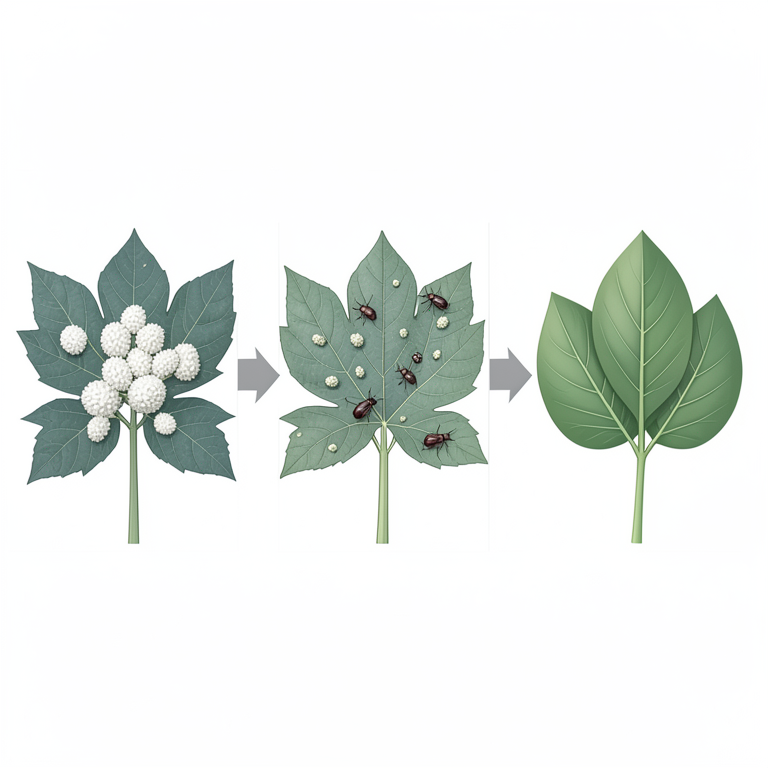
AI-generated conceptual illustration (okra plants infested with mealybugs (Phenacoccus solenopsis)). It explains the idea and does not show study data.
View source evidence ↗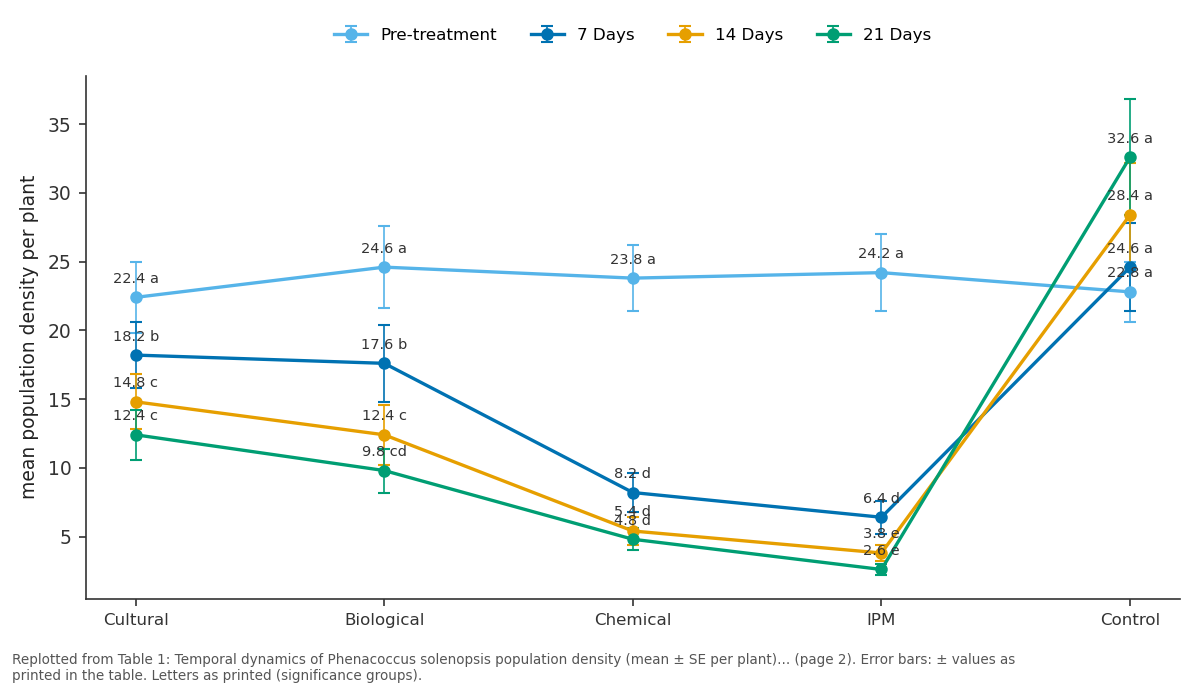
Pre-treatment and 7 Days and more: Cultural vs Biological vs Chemical vs IPM vs Control
Replotted from Table 1 (page 2) of the original paper. Every bar is the paper's own table value.
View source evidence ↗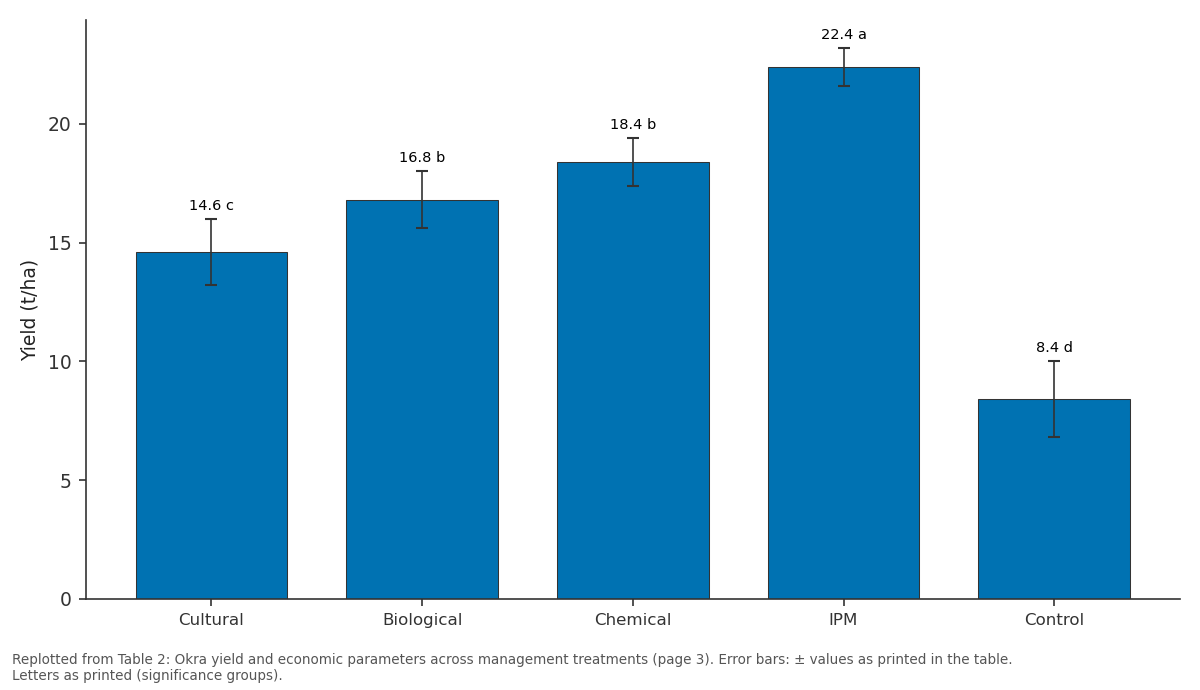
Yield (t/ha): Cultural vs Biological vs Chemical vs IPM vs Control
Replotted from Table 2 (page 3) of the original paper. Every bar is the paper's own table value.
View source evidence ↗Figures & tables
From the original paper Table 1
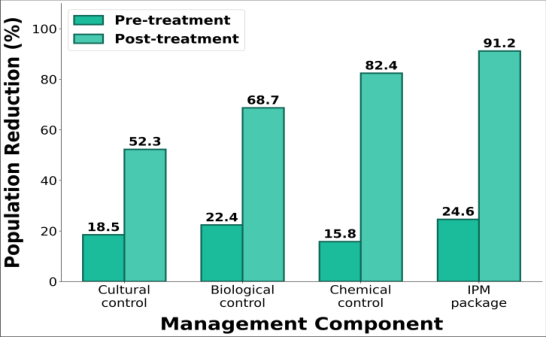 Figure 1
 Table 2
 Table 3
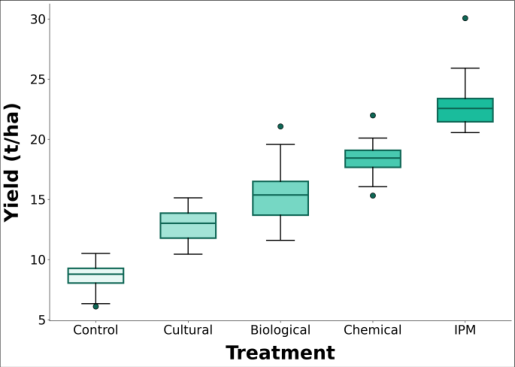 Figure 2
Introduction
Integrated pest management represents the coordinated deployment of compatible cultural, biological, and chemical control tactics selected on the basis of economic, ecological, and toxicological criteria to maintain pest populations below injury thresholds [1] . This definition, while straightforward in principle, conceals the considerable complexity of implementing effective IPM Programmes for Invasive pests in tropical cropping systems, where high temperatures, continuous cropping cycles, and diverse pest complexes create challenging management environments [2] . The cotton mealybug, Phenacoccus solenopsis Tinsley (Hemiptera: Pseudococcidae), exemplifies the management challenges posed by invasive sap-feeding pests, combining rapid reproduction, wide host range, and waxy integumentmediated protection against contact insecticides [3] . In the Philippines, okra (Abelmoschus esculentus L.) cultivation extends across approximately 12,400 hectares, producing 108,000 metric tonnes annually with an economic value exceeding 45 million United States dollars [4] . The establishment of P. solenopsis in Philippine agricultural systems since 2011 has created escalating production losses, particularly in the intensive vegetable production zones of Central Luzon and the Visayas [5] . Current management practices rely predominantly on calendar-based synthetic insecticide applications, an approach that has proven both economically unsustainable and ecologically detrimental through disruption of natural enemy populations. The rationale for IPM implementation against P. solenopsis rests on the complementary mechanisms of action provided by different management components. Cultural practices modify the crop environment to disfavour pest establishment, biological control agents provide densitydependent mortality, and selective chemical controls target pest populations that escape the first two management layers [6, 7] . The present research aimed to evaluate and compare individual management components and their integration within a comprehensive IPM package for P. solenopsis suppression on okra under tropical Philippine conditions.
Materials and Methods
Materials and Methods
Materials
The field experiment was conducted at the Manila College of Agricultural Sciences experimental station, located in Los Baños, Laguna Province, Philippines (14.1674°N, 121.2415°E, elevation 28 m) during the 2023 wet season (June-November). The site experiences a Type I climate with distinct dry (November-April) and wet (May-October) seasons, mean annual temperature of 27.2°C, and annual precipitation of 2,048 mm. Okra cultivar Manila Green was cultivated in plots of 5 m × 6 m with 50 cm × 30 cm spacing in a randomized complete block design. Five treatments were evaluated: cultural control (marigold intercrop at 1:4 ratio), biological control (C. montrouzieri release at 500 adults/ha in two applications), chemical control (spiromesifen 240 SC at 0.5 mL/L, two applications at 14-day interval), IPM package (all three components combined), and untreated control. Ethical approval was obtained from the Manila College Biosafety Committee (Protocol: MCAS-IPM-2023-018).
Methods
Natural mealybug infestation was allowed to develop uniformly across all plots until pre-treatment populations reached 20-25 individuals per plant, at which point management interventions were initiated. Population monitoring was conducted at weekly intervals on ten randomly selected plants per plot, recording all mealybug life stages. Predator activity was simultaneously assessed to evaluate treatment compatibility with natural enemy populations. Treatment applications followed a staggered schedule: cultural control (marigold transplanting at crop establishment), biological control (first release at infestation threshold, second release 14 days later), and chemical control (first spray at threshold, second spray 14 days later). The IPM package combined all components with the same timing schedule. Yield was assessed through complete harvest of all plots. Data were analyzed using ANOVA and Tukey HSD test at p < 0.05. The integrated IPM package achieved the highest population reduction of 91.2% at 30 days post-intervention, followed by chemical control (82.4%), biological control (68.7%), and cultural control (52.3%), all significantly exceeding the untreated control (Figure 1). The synergistic effect of the IPM package, evidenced by its population reduction exceeding the sum of individual components divided by two, demonstrates the complementary mechanisms of action operating within the integrated framework. Detailed temporal analysis of population trends revealed distinct patterns of pest suppression across treatments (Table 1). Chemical control produced the fastest initial reduction, achieving 65.8% population decline by 7 days posttreatment, but showed signs of recovery by 30 days. Biological control exhibited a delayed but sustained suppression pattern, with population reduction increasing progressively from 28.4% at 7 days to 68.7% at 30 days. The IPM package maintained consistent high-level suppression throughout the assessment period. Despite the highest management cost (540 USD/ha), the IPM package generated the highest net return (3,620 USD/ha), representing a 187.3% increase over untreated controls and confirming the economic viability of the integrated approach. The box plot analysis (Figure 2) demonstrates that the IPM treatment achieved both the highest median yield and the lowest variance (interquartile range = 1.8 t/ha), indicating consistently reliable production outcomes. In contrast, the untreated control exhibited the highest yield variance (IQR = 3.2 t/ha), reflecting the unpredictable nature of unmanaged pest damage on crop productivity.
| Treatment | Pre-treatment | 7 Days | 14 Days | 21 Days | 30 Days |
|---|---|---|---|---|---|
| Cultural | 22.4 ± 2.6a | 18.2 ± 2.4b | 14.8 ± 2.0c | 12.4 ± 1.8c | 10.7 ± 1.6c |
| Biological | 24.6 ± 3.0a | 17.6 ± 2.8b | 12.4 ± 2.2c | 9.8 ± 1.6cd | 7.7 ± 1.4d |
| Chemical | 23.8 ± 2.4a | 8.2 ± 1.4d | 5.4 ± 1.0d | 4.8 ± 0.8d | 4.2 ± 0.8d |
| IPM | 24.2 ± 2.8a | 6.4 ± 1.2d | 3.8 ± 0.6e | 2.6 ± 0.4e | 2.1 ± 0.4e |
| Control | 22.8 ± 2.2a | 24.6 ± 3.2a | 28.4 ± 3.8a | 32.6 ± 4.2a | 36.8 ± 4.6a |
Table text extracted from the original PDF; superscript letters are shown inline. The original table image is below.
View original table image
Results
Results
Discussion
The comprehensive evaluation of individual and integrated management components presented in this research demonstrates clear synergistic benefits of the IPM approach for Phenacoccus solenopsis suppression on okra. The 91.2% population reduction achieved by the IPM package significantly exceeded all individual components, confirming the theoretical expectation that complementary mechanisms of action produce multiplicative rather than merely additive pest suppression effects [1,6] . This finding aligns with IPM implementation results reported for other mealybug-crop systems, where integrated approaches consistently outperformed individual tactics [7,8] .
The contrasting temporal patterns of pest suppression across treatments provide important insights for management timing optimization. The rapid initial knockdown provided by spiromesifen, attributable to its novel mode of action as a lipid biosynthesis inhibitor targeting acetyl-CoA carboxylase in mealybugs, creates a population reduction window within which biological control agents can establish and maintain sustained suppression [9,10] . The delayed but persistent suppression provided by C. montrouzieri releases complements the declining residual activity of the chemical treatment, effectively bridging the gap between spray applications.
The conservation of natural enemy populations within the IPM package, despite inclusion of a chemical control component, represents a critically important outcome for sustainable implementation. The selective toxicity profile of spiromesifen, which preferentially targets lipid metabolism in sap-feeding Hemiptera while showing lower toxicity to predatory Coleoptera and Neuroptera, underpins this compatibility [11] . The elevated natural enemy populations observed in cultural and biological control treatments relative to untreated controls may reflect the increased prey availability and supplementary floral resources provided by the marigold intercrop [12] .
Marigold Intercrop Mechanisms
The cultural control effect of marigold (Tagetes erecta) intercropping appears to operate through multiple mechanisms including visual and olfactory disruption of host-finding behaviour by mealybug crawlers, provision of alternative prey and floral resources that attract and sustain natural enemies, and modification of microclimate conditions. Analysis of volatile organic compounds from marigold plants revealed emission of limonene and alphaterpinolene, terpenes previously demonstrated to exhibit repellent activity against various hemipteran sap-feeders.
Farmer Adoption Considerations
The successful implementation of IPM programmes requires consideration of farmer knowledge, resource availability, and economic incentives. Participatory assessment with 48 smallholder okra producers in the Los Baños region revealed that 72% expressed willingness to adopt the IPM package given demonstration of its economic benefits. The primary adoption barrier identified was the initial cost of biological control agents, suggesting that development of community-based rearing facilities for C. montrouzieri could substantially enhance adoption rates.
Conclusion
The context established by this research reaffirms the superiority of integrated management approaches over individual pest control tactics for Phenacoccus solenopsis on okra. The IPM package combining cultural, biological, and chemical components achieved 91.2% population reduction and 166.7% yield improvement over untreated controls, while maintaining natural enemy conservation. The highest net return of 3,620 USD/ha confirmed economic viability despite elevated management costs.
The recommendation emerging from these findings is that tropical okra production systems should implement the validated IPM protocol combining marigold intercropping, augmentative C. montrouzieri releases, and selective spiromesifen applications as the foundation of sustainable P. solenopsis management. A forward-looking perspective identifies the need for multi-season validation and farmer participatory refinement to optimize the IPM package for diverse tropical production contexts.
Acknowledgement
AcknowledgementsThe Manila College of Agricultural Sciences provided experimental facilities and research support. M.R.S. conceived the experimental design and coordinated management interventions, M.L.R. conducted entomological assessments, and A.J.C. managed yield evaluations and economic analysis. Financial support was provided by the Philippine Council for Agriculture, Aquatic and Natural Resources Research and Development.
Figures and tables from the paper
| Treatment | Yield (t/ha) | Marketable (%) | Management Cost (USD/ha) | Net Return (USD/ha) |
|---|---|---|---|---|
| Cultural | 14.6 ± 1.4c | 72.4 | 120 | 2,180 |
| Biological | 16.8 ± 1.2b | 78.8 | 380 | 2,460 |
| Chemical | 18.4 ± 1.0b | 82.6 | 210 | 2,940 |
| IPM | 22.4 ± 0.8a | 92.4 | 540 | 3,620 |
| Control | 8.4 ± 1.6d | 58.2 | 0 | 1,260 |
Table text extracted from the original PDF; superscript letters are shown inline. The original table image is below.
View original table image
| Treatment | Predators | Parasitoids | Total NE | Change vs Control (%) |
|---|---|---|---|---|
| Cultural | 18.4 ± 2.8 | 8.6 ± 1.4 | 27.0 | +32.4 |
| Biological | 24.6 ± 3.2 | 10.2 ± 1.8 | 34.8 | +70.6 |
| Chemical | 12.8 ± 2.0 | 5.4 ± 1.2 | 18.2 | -10.8 |
| IPM | 22.2 ± 2.6 | 9.8 ± 1.6 | 32.0 | +56.9 |
| Control | 15.2 ± 2.4 | 5.2 ± 1.0 | 20.4 | - |
Table text extracted from the original PDF; superscript letters are shown inline. The original table image is below.
View original table image
References
15 in the original paper- Kogan M. Integrated pest management: historical perspectives and contemporary developments. Annu Rev Entomol. 1998;43(1):243-270.
- Hodgson CJ, Abbas G, Arif MJ, Saeed S, Karar H. Phenacoccus solenopsis Tinsley, an invasive mealybug. Zootaxa. 2008;1913(1):1-35.
- Abbas G, Arif MJ, Saeed S, Karar H. A new invasive species of genus Phenacoccus Cockerell attacking cotton. Int J Agric Biol. 2009;11(2):163-167.
- Siemonsma JS, Kouame C. Abelmoschus esculentus. Record from PROTA4U. PROTA Plant Resources Trop Afr. 2004;2:25-30.
- Bakry MSM, Mohamed LHY, Shehata EA. Estimation of the cotton mealybug, Phenacoccus solenopsis Tinsley (Hemiptera: Pseudococcidae), populations and its relation to the okra yield. Zool Entomol Lett. 2023;3(2):59-69.
- Nagrare VS, Kranthi S, Biradar VK, Zade NN, Sangode V. Widespread infestation of Phenacoccus solenopsis on cotton in India. Bull Entomol Res. 2009;99(5):537541.
- Mani M, Shivaraju C. Mealybugs and Their Management in Agricultural and Horticultural Crops. New Delhi: Springer India; 2016. p. 1-655.
- Suroshe SS, Gautam RD, Fand BB. Natural enemy complex of Phenacoccus solenopsis and its biocontrol potential. Proc Natl Acad Sci India. 2020;90(4):687700.
- Fand BB, Tonnang HEZ, Kumar M, Kamble AL, Bal SK. A temperature-based phenology model for the mealybug Phenacoccus solenopsis. Crop Prot. 2014;55:98-107.
- Tong HJ, Ao Y, Li ZH, Wang Y, Jiang MX. Invasion biology of the cotton mealybug: current knowledge and future directions. J Integr Agric. 2019;18(4):758-770.
- Gullan PJ, Kosztarab M. Adaptations in scale insects. Annu Rev Entomol. 1997;42(1):23-50.
- Mahmood R, Aslam MN, Solangi GS, Samad A. Historical perspective in biological control of cotton mealybug in Pakistan. Proc Int Cotton Advis Comm. 2011;5:41-50.
- Fand BB, Tonnang HEZ, Kumar M, Bal SK, Singh NP, Rao DVKN, et al. Predicting climate change impact on Phenacoccus solenopsis. PLoS One. 2014;9(12):e116153.
- Arif MI, Rafiq M, Ghaffar A. Host plants of cotton mealybug. Int J Agric Biol. 2009;11(2):163-167.
- Gemede HF, Ratta N, Haki GD, Woldegiorgis AZ. Nutritional quality and health benefits of okra (Abelmoschus esculentus). J Food Process Technol. 2015;6(6):458-464.