
Research article · 2026 · Full text
International Journal of Biology SciencesExtended distribution of Rauvolfia tetraphylla (Apocynaceae) from Chhattisgarh to central India
Volume 8(8) · Pages 01–03 · DOI: 10.33545/26649926.2026.v8.i8a.968 ↗
Research areasBotany and Plant Ecology StudiesPlant and Fungal Species DescriptionsMediterranean and Iberian flora and fauna
Abstract
Author-writtenKoni village is situated in the Bilaspur Tehsil of the Bilaspur district, Chhattisgarh, India. It lies between 21.977978° N to 82.229080 E. It is located approximately 5 km from the tehsil headquarters in Bilaspur (C.G.). Extensive field studies were carried out from locations across June 2025 to April 2026. In this study, another species of Rauvolfia Plum. ex L. (Rauvolfia tetraphylla L.) that is shrubby in its natural environment was found in the extended distribution of this region of Chhattisgarh, Central India. The short description, based on the study of fresh specimens, includes their locality, phenology, and color photoplates of the plants, along with their distribution.
Summary
Source-checkedPlain-language reading of the full paper, prepared with AI and checked against the text. Each point links to the authors' own words.
Why it matters
- Rauvolfia is a diverse pantropical genus of approximately 78 species found in tropical and subtropical regions and is utilized for medicinal purposes. View evidence ↗
- While about four Rauvolfia species are found in India, only one species has been previously recorded in the central Indian state. View evidence ↗
- Existing inventories for Chhattisgarh and Central India are inconsistent and incomplete, necessitating more intensive field surveys and taxonomic revisions. View evidence ↗
The question
- The study aimed to document the presence and distribution of Rauvolfia tetraphylla L. in the Chhattisgarh region of Central India. View evidence ↗
What they did
- Field studies were conducted in Koni village, located in the Bilaspur district of Chhattisgarh, India (21.977978° N to 82.229080 E). View evidence ↗
- The field surveys were carried out over a period from June 2025 to April 2026. View evidence ↗
- Researchers collected specimens for herbarium mounting, took microphotographs with a Canon 700D camera, and identified the plants using primary floras, monographs, and taxonomic accounts. View evidence ↗
What they found
- Specimens collected from Koni, Bilaspur, were identified as Rauvolfia tetraphylla L. View evidence ↗
- This finding represents the first record of Rauvolfia tetraphylla L. in Chhattisgarh, significantly expanding the known distribution of the species in Central India. View evidence ↗
- The flowers are small (0.2 x 0.2 cm), white or cream-colored, and arranged in auxiliary umbellate cymes, featuring a 0.4 cm corolla tube and 5 stamens. View evidence ↗
- The fruit is an ovoid, glabrous drupe measuring 0.5-0.7 cm in diameter, which turns dark purple to black upon maturity and contains two rugose seeds. View evidence ↗
- R. tetraphylla is distinguished from R. serpentina by its smaller, creamy white ciliated flowers (0.4 x 0.4 cm) compared to the larger, purplish white non-ciliated flowers (2.5 x 1.5 cm) of R. serpentina. View evidence ↗
- The fruit of R. tetraphylla is unilobed and measures 0.8 x 0.6 cm, whereas R. serpentina has bilobed fruits measuring 1.1-1.4 x 0.5-1 cm. View evidence ↗
What it means
- The authors conclude that this record closes a biogeographical gap and suggests that other undiscovered varieties of the genus may exist in Central India. View evidence ↗
- The authors recommend immediate conservation actions, such as habitat protection and community awareness programs, to prevent the extinction of local taxa in the Bilaspur District. View evidence ↗
Figures & tables
From the original paper Table 1
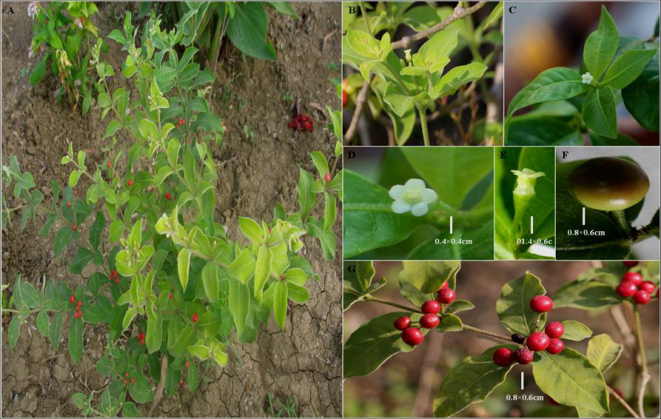 Plate 1
Introduction
Rauvolfia Plum. ex L. is a shrubby, lactiferous genus with flowers that belongs to the Apocynaceae family. It has an apically enlarged style that forms a stylar head and typically separate ovaries that are only connected by a common style or stylar head. Rauvolfia Plum. ex L., a large pantropical genus, comprises 78 accepted species (POWO, 2026) [8] with high morphological diversity, and the genus is extended to the native range in the tropics and subtropics. It is also used as a medicine.
Rauvolfia is represented by about four species in India (eflora of India, 2026) [2, 3], of which about one species occurs in the central Indian state (Verma et al., 1989; Mudgal et al., 1997; Shukla et al., 2025) [4, 9, 12]. Central India has comparatively fewer records: earlier accounts reported only one species (Verma et al., 1989; Mudgal et al., 2001) [4, 12]. Regional checklists and recent surveys for Chhattisgarh showed similar results. A recent list by Shukla et al., (2025) [9] reported a Rauvolfia species (Rauvolfia serpentina (L.) Benth. ex-Kurz) for the state, revealing inconsistencies among existing inventories and underscoring incomplete floristic knowledge for Central India and Chhattisgarh, thereby highlighting the urgent need for intensified field surveys and systematic taxonomic revision.
Materials And Methods
Study area and identification Koni village is situated in the Bilaspur Tehsil of the Bilaspur district, Chhattisgarh. It lies between 21.977978° N to 82.229080 E. It is located approximately 5 km from the tehsil headquarters in Bilaspur. During the extensive field surveys conducted from June 2025 to April 2026 in the Koni village and its adjoining area of the Bilaspur district, Chhattisgarh, India, an interesting plant species of the genus Rauvolfia Plum. ex L. (Apocynaceae) was collected.
Representative specimens were collected, processed, and mounted on herbarium sheets. Microphotographs were obtained using a digital DSLR camera (Canon 700D). Specimens were identified by comparison with diagnostic descriptions and keys in primary floras and monographs and by consulting regional treatments and recent taxonomic accounts. (Verma et al., 1989; Srivastava, 2004; Akare & Chaturvedi, 2018; Shukla et al., 2025) [1, 9, 10, 12]. The nomenclature followed is as per POWO (2026) [8].
The voucher specimen was deposited at the herbarium of the Department of Botany, Guru Ghasidas Vishwavidyalaya (A Central University), Bilaspur, Chhattisgarh, India. NAAS Rating (2026): 4.82 IJBS 2026; 8(8): 01-03 Ram Kumar Rajwade Department of Botany, Guru Ghasidas Vishwavidyalaya (A Central University), Bilaspur, Chhattisgarh, India Devendra Kumar Patel Department of Botany, Guru Ghasidas Vishwavidyalaya (A Central University), Bilaspur, Chhattisgarh, India Ram Kumar Rajwade Department of Botany, Guru Ghasidas Vishwavidyalaya (A Central University), Bilaspur, Chhattisgarh, India https://www.biologyjournal.net beneath, margin entire and ciliate; lateral veins 5-12 pairs; peduncle 1-4 cm long, ciliate. A flower, small, white or cream-colored, 0.2×0.2 cm across. Shortly peduncled, arranged in a few-flowered auxiliary umbellate cyme.
The calyx is lobed, short, rounded, ciliated, and 0.2 cm long. The corolla tube is dilated at the top, 0.4 cm long; the lobes are short, rounded, unexpanded, and ciliate. Stamens 5, included, 0.02 cm long. Ovary superior, carpel 2, collateral to each carpel.
Drupe: 0.5-0.7 cm in dia., dark purple to black at maturity, jointed to the top, ovoid, and glabrous. Seed two: ovoid, rugose (Plate 1). Flowering & fruiting: May-August. Specimen examined: India: Chhattisgarh: Bilaspur distr., Koni (22.1277730 N, 82.1384890 E; 277 m AMSL): 15.04.2026 (Flowering); Ram Kumar Rajwade & Devendra Kumar Patel [RKRp-002; Herb. of Dept. of Botany, Guru Ghasidas Vishwavidayalaya, Bilaspur, India].
Distribution: India: Andaman Is., Assam, Andhra Pradesh, Bihar, Chhattisgarh [study area], Delhi, Kerala, Karnataka, Orissa, Punjab, Tamil Nadu, Uttar Pradesh, and West Bengal. Native to: America (Central, Northern South), Bangladesh, Belize, Bolivia, Colombia, Costa Rica, China (South- Central, Southeast), Dominican Republic, Ecuador, El Salvador, Florida, French Guiana, Guatemala, Haiti, Hainan, Honduras, Jamaica, Leeward Islands, Mexico (Central, Gulf, Northeast, Northwest, Southeast, Southwest), Nicaragua, Panama, Peru, Nepal, Queensland, Taiwan, Trinidad, Tobago, Vietnam, Venezuela, West Indies, Windward Islands, (POWO, 2026) [8].
Results And Discussions
The newly obtained specimens from Koni, Bilaspur (C.G.), were recognized as Rauvolfia tetraphylla L. after being carefully compared to diagnostic descriptions and local treatments. The produced voucher information was cross- checked using internet nomenclature tools and established taxonomic references. This is the plant species first unknown addition from Chhattisgarh to Central India and a significant expansion of the taxon's distribution, enhancing Chhattisgarh's flora. In terms of biogeography, this record closes a distributional gap between previously identified populations and raises the possibility that Central India contains further, undiscovered variety.
In terms of taxonomy, the result emphasizes the necessity of ongoing field surveys in conjunction with close examination of morphology and nomenclature in order to determine regional species limits. Key to species of Rauvolfia Plum. ex L. in Chhattisgarh: 1a. Leaves lanceolate, acute; flower purplish white, large up to 2.5 cm; fruit Bilobed…………………………… Rauvolfia serpentina. 1b. Leaves are ovate or oblong and hairy; the flower is creamy white, minute up to 0.4cm; fruit is purple, unlobed.……....................
Rauvolfia tetraphylla. Taxonomic descriptions Rauvolfia tetraphylla L. First published in Sp. Pl.: 208 (1753).
Perennial Shrub, an erect, dichotomously branched, small, woody shrub approximately one metre high. Leaves, simple, 8-12×1.8-3.5 cm, 3-4 at the nodes, mostly 4 in each whorl of very unequal sizes; petiole 0.2-0.5 cm; elliptic, acute at the apex, cuneate at the base, pubescent above and glabrous Table 1: Distinguishing characters of Rauvolfia Plum. ex L., in Chhattisgarh, Central India S. No. Characters Rauvolfia tetraphylla L.
| S. No. | Characters | Rauvolfia tetraphylla L. | Rauvolfia serpentina L. |
|---|---|---|---|
| 1. | Stem | More than 2 metres | More than 1 meter |
| 2. | Leaves | Ovate-oblong, 3-4 in each node. | 15×3 cm, lanceolate, acute, alternate, 2-3 leaves in each node |
| 3. | Inflorescence | 1-1.5 cm, cyme | 7-15 cm, cyme |
| 4. | Flower | Creamy white, small, 0.4 × 0.4 cm, ciliated | Purplish white, large, 2.5×1.5 cm, non-ciliated |
| 5. | Fruit | Unilobed, greenish purple, turning black after ripening; 0.8 × 0.6 cm. | Bilobed, green, and black after ripening; 1.1-1.4 × 0.5-1 cm |
| 6. | Distribution | Bilaspur* | Bilaspur, Raipur, Rajnandgaon |
Table text extracted from the original PDF; superscript letters are shown inline. The original table image is below.
View original table image
Rauvolfia serpentina L. 1. Stem More than 2 metres More than 1 meter 2. Leaves Ovate-oblong, 3-4 in each node. 15×3 cm, lanceolate, acute, alternate, 2-3 leaves in each node 3. Inflorescence 1-1.5 cm, cyme 7-15 cm, cyme 4.
Flower Creamy white, small, 0.4 × 0.4 cm, ciliated Purplish white, large, 2.5×1.5 cm, non-ciliated 5. Fruit Unilobed, greenish purple, turning black after ripening; 0.8 × 0.6 cm. Bilobed, green, and black after ripening; 1.1-1.4 × 0.5-1 cm 6. Distribution Bilaspur* Bilaspur, Raipur, Rajnandgaon [Abbreviation: *- new distributed area] Plate 1: Rauvolfia tetraphylla L.
A- Habit; B, C - Inflorescence; D - Close view of flowers; E- Side view of Flowers; F, G - Immature and mature fruits https://www.biologyjournal.net
Conclusions
The main human-caused threats to the plant life include destruction of natural habitat, deforestation, uncontrolled human activities etc. Several local taxa in the Bilaspur District are in danger of going extinct due to these influences. Therefore, immediate conservation action is necessary, including community-based awareness and stewardship programs, restoration strategies, protection of important habitat patches, and focused population monitoring. Along with these activities, all possible efforts should be made to protect and multiply the valuable plant species for future generations.
Acknowledgements
We sincerely thank the authorities of Guru Ghasidas Vishwavidyalaya (A Central University), Bilaspur, Chhattisgarh, India,
Figures and tables from the paper
References
14 in the original paper- Akare SM, Chaturvedi A. A floral biology of wild snake root (Rauvolfia tetraphylla L.). Journal of Emerging Technologies and Innovative Research. 2018;5(11):409-416. 2. eFlora of India. Rauvolfia serpentina. eFlora of India - Database of Plants of Indian Subcontinent. 2026. Available from: https://efloraofindia.com/efi/rauvolfia- serpentina/ 3. eFlora of India. Rauvolfia tetraphylla. eFlora of India - Database of Plants of Indian Subcontinent. 2026. Available from: https://efloraofindia.com/efi/rauvolfia- tetraphylla/
- Mudgal V, Khanna KK, Hajra PK. Flora of Madhya Pradesh. Vol.
- Kolkata: Botanical Survey of India; 1997.
- Kumar A, Rao PSN. Flora of the Indravati Tiger Reserve. Kolkata: Botanical Survey of India; 2003.
- Panigrahi G, Murti SK. Flora of Bilaspur District, Madhya Pradesh. Vol.
- Kolkata: Botanical Survey of India; 1989.
- Panigrahi G, Murti SK. Flora of Bilaspur, Madhya Pradesh. Vol.
- Kolkata: Botanical Survey of India; 1999.
- Plants of the World Online (POWO). Facilitated by the Royal Botanic Gardens, Kew. 2026. Available from: https://powo.science.kew.org/
- Shukla AN, Tiwari AP, Garg A, Mao AA. Flora of Chhattisgarh. Vol.
- Kolkata: Botanical Survey of India; 2025.
- Srivastava SN. Rauvolfia tetraphylla Linn. from Azamgarh, Uttar Pradesh. Geophytology. 2004;34(1- 2):125-126.
- Pandey AK, Naik ML, Mishra RP. Biodiversity of Chhattisgarh: A checklist. 1st ed. Raipur: Chhattisgarh State Biodiversity Board, Aranya Bhawan; 2023. p. 78- 79.
- Verma DM, Pant PC, Hanfi MI. Flora of Raipur, Durg, and Rajnandgaon. Kolkata: Botanical Survey of India; 1989.